Cyber Security for Adolescents : Online Safety Tips for Teens and Parents
Cyber security for Adolescents : Learn how cyber security protects adolescents from online risks like cyberbullying, phishing, and digital addiction with expert-reviewed parental guidance.
Reviewed by Bibhu Ranjan Mund, MPH (Public Health Expert) with experience in maternal, infant, child, and adolescent health programs. Content is based on evidence-informed guidelines aligned with organizations such as the World Health Organization, UNICEF, Centers for Disease Control and Prevention, and National Institutes of Health.
Medical Disclaimer: This content is for informational and educational purposes only and is not intended as medical advice, diagnosis, or treatment. Always seek the advice of a qualified healthcare professional regarding any medical condition or concerns.
Introduction to Cyber Security for Adolescents
In the modern day of internet, your adolescent is just one click a way for both the opportunity and danger.
As per the report published by UNICEF (2023), about 1 in 3 adolescents are experiencing cyber-bullying globally and also 80% of teenagers are using the social media actively everyday. Even safe scrolling by them sometimes expose their privacy risks, scams and many mental health challenges.
Now due to the increasing internet activity & risks, cyber security for adolescents shouldn’t be overlooked.
Every individual who may a parent, caregiver, educators should understand the online risks, digital behavior including the prevention strategies so as to stay away from long-term harm. Aim of parents shouldn’t to restrict the uses, but to aware them about the boundaries and few good digital habits.
In this article, you will find-out the :
- The hidden online risks most teens don’t recognize
- Real health and behavioral impacts of excessive internet use
- Practical, science-backed cyber safety tips for adolescents and parents
Because if you protect your child today, it will reflect the safety in future.
Excessive use of digital platforms can impact both safety and mental health, learn more in our detailed guide on social media addiction in adolescents and its effects.
What I Observe During Adolescent Health Programs in Odisha?
During my adolescent health awareness session at different schools and communities of Odisha, I have met with parents who think that online risk only affects other children not their.
But, after discussion starts they start to share the issues of their children about excess gaming, social media use, online friendships and late night screen time etc.
Even after sharing the personal photos, locations or passwords by the teens, they don’t know the privacy risks and they admit this.
Such types of interactions remind me that now cyber safety is not a technology issue and become a family health and well-being concern.
Global Statistics on Adolescent Internet Use
| Indicator | Global Estimate | Source |
|---|---|---|
| Adolescents using the internet worldwide | ~71% of youth aged 15–24 use the internet | ITU |
| Children exposed to cyberbullying globally | Around 1 in 3 adolescents | UNICEF |
| Daily screen time among teenagers | Average 3–7 hours per day | APA |
| Teenagers using social media platforms | Over 80% globally | UNICEF |
Source : UNICEF Children in a Digital World 2023, International Telecommunication Union (ITU) Youth Internet Use Report 2022 and American Psychological Association Digital Media Advisory 2023
What These Statistics Informs?
Such statistics don’t suggest that the internet use is harmful.
They show that now-a-days many digital platforms become a major part of every adolescent life.
The biggest challenge is not a drop the internet use, but how safely it can be used by adolescent matters.
Public health experts focus on digital literacy awareness programs to prevent such issues.
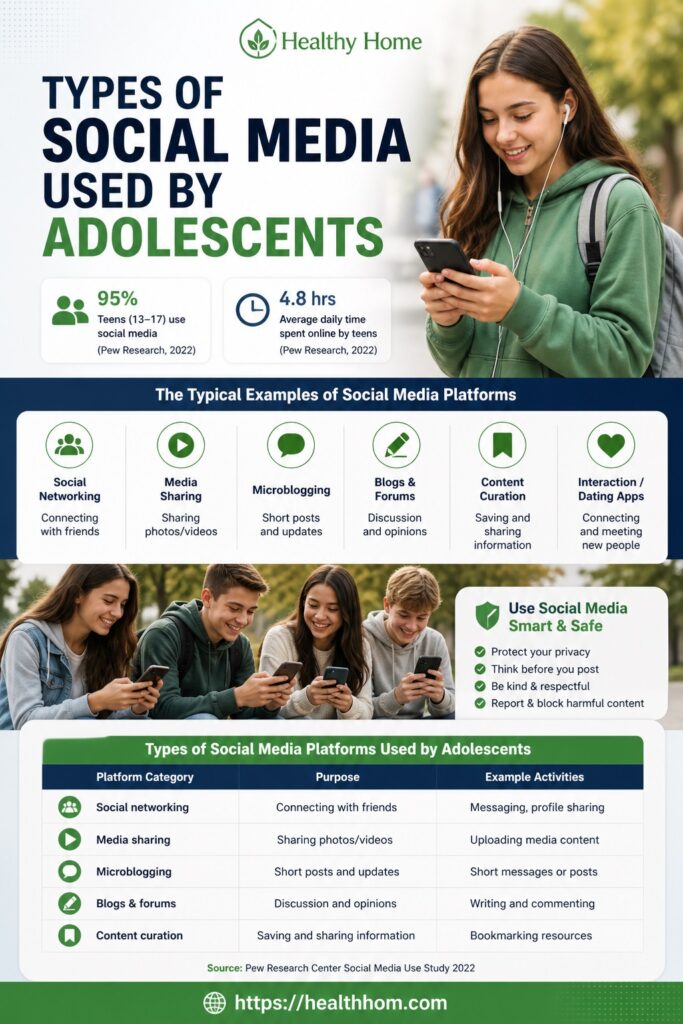
What are social media platforms?
Social media platforms refer to the online or mobile applications that enable users to create, share and engage with the content in web-based applications. These are the platforms through which communication, networking, information sharing and entertainment take place among various age groups.
Types of Social Media Used by Adolescents:
The typical examples of social media platforms are:
- Social networking sites
- Media sharing platforms
- Microblogging platforms
- Blogs and discussion forums
- Social bookmarking websites and content curation websites.
- Interaction based or dating applications.
The teens communicate with their friends, visit their interests and make new acquaintances through social media and access to internet. Although short term usage can bring enjoyment and learning, its excessive usage can bring about time mismanagement and exposure to harmful or age inappropriate material. To be safe on the Internet, responsible content creation and consumption are necessary.
Internet Use During Adolescence: Key Priorities
The use of internet and social media among adolescents has grown a lot particularly during and after the pandemic. Digital platforms are beneficial, but the possible risks are both safety and psychological health of adolescents and their long-term growth.
The focus must be on moderate and meaningful internet use whereby the youths are instructed to use the technology in learning, creativity, and positive communication but not blindly consuming it.
Balanced digital habits are essential for emotional stability, read more in our guide on mental well-being in adolescents and stress management.
A Parent’s Experience That Many Families May Relate To:
During a community awareness program in Odisha, one father shared that his only 14 year son is always playing online games with unverified friends.
First, the parents thought that it is harmless and son is just entertaining.
But, subsequently he became more irritated when the parents stop his online play, he slept late night and gradually limited the outdoor activities.
Now, the parents tried the screen free meal time with entire family and also go for weekend sports activity.
After a few months of such activities, he improved in his sleep, mood changes with family interaction.
Situation may be different for individuals, but this example show that how a positive support from family influence the digital habits.
Benefits of Internet Use for Teenagers
Proper use of internet has a number of advantages that include:
- Enhancing communication and building relationships.
- Increasing social and emotional knowledge.
- Availability to educational, informational, and creative information.
- Formal and informal learning opportunities.
- Management and artistic expression.
- The contact with other points of view and identities.
- Just having fun and rest when in moderation.
These benefits can be maximised once internet access is controlled, intentional and age based.
Along with digital balance, maintaining a healthy lifestyle is crucial, check our guide on healthy food choices for families to support overall development.
Comparison Table: Benefits vs Risks of Internet Use
| Aspect | Potential Benefits | Potential Risks |
|---|---|---|
| Communication | Connect with peers globally | Cyberbullying |
| Learning | Access to educational content | Exposure to misinformation |
| Creativity | Digital content creation | Online harassment |
| Entertainment | Games and videos | Excessive screen time |
Source: UNICEF Online Safety Framework 2021
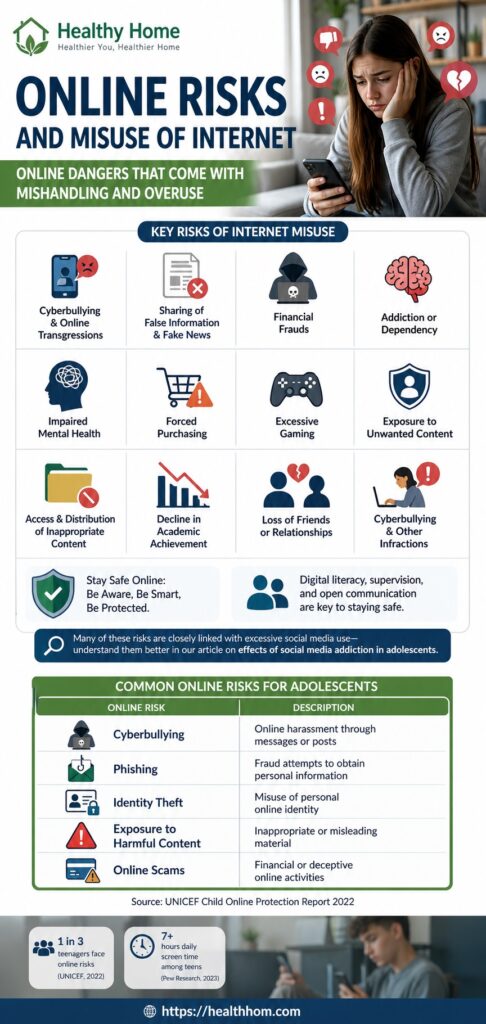
Online Risks and Misuse of Internet :
Online Dangers that come with Mishandling and Overuse of the Internet.
- Any kind of Cyber-bullying & other online transgressions
- Sharing of false information
- Advertisement in deceptive mode and other Fake news received throuh internet
- May have financial frauds
- Full addiction or dependency with internet
- May be impaired mental health issues
- Forced purchasing
- More time utilization in excessive gaming
- Maximum exposure to unwanted content in internet
- Easy access and distribution of unnecessary and in-appropriate contents frequently
- Overall declination in academic achievement of user
- Loss of friends or relationships
- Cyber-bullying and other infractions on the internet
Such risks make the need to be digitally literate, supervised, and communicate freely the key to the safety of adolescents.
Many of these risks are closely linked with excessive social media use, understand them better in our article on effects of social media addiction in adolescents.
Mental, Physical and Social Health Effects
The overuse of internet may lead to stress, anxiety, mood swings, low self-esteem and social withdrawal which are detrimental to the mental health of the adolescents. The persistent viewing of unrealistic online content could augment discontent and emotional distress.
Physical impacts could be decreased physical movements, improper body posture, eye pain, headaches, insomnia, and unhealthy weight gain. In the social aspect, the adolescents can grow alienated to the real life relations, lose interest in school life, and gain less confidence in face to face interaction.
Possible Effects of Excessive Internet Use
| Area | Possible Effects |
|---|---|
| Mental well-being | Stress, mood fluctuations |
| Physical health | Eye strain, posture issues |
| Social relationships | Reduced face-to-face interaction |
| Academic performance | Difficulty focusing on studies |
Source: American Psychological Association Social Media Advisory 2023
Protective qualities on using the internet:
There are some protective elements that make adolescents use the internet safely, and they are:
- Good hobbies and interests in the real life
- Good family relationships and emotional self-care.
- Cyber or Social Media Literacy
- Close relationship with family & friends in surroundings
- Always keeping healthy relationships with other people
- Good self-esteem
All these make them less vulnerable to online risks and responsible in their use of digital technology.
Techniques like mindfulness and self-regulation can improve digital discipline, explore practical strategies in our mindfulness guide for children and adolescents.
Protective Factors for Safe Internet Use
| Protective Factor | How It Helps |
|---|---|
| Digital literacy | Helps identify online risks |
| Family communication | Encourages safe internet habits |
| Positive peer groups | Reduces risky online behavior |
| Balanced screen time | Maintains healthy routines |
Source: WHO Adolescent Digital Health Guidance 2022
Risk Factors for Unsafe Internet Use
Physical and nutritional health also influence behavior and decision-making, read more about this in our article on anaemia and its impact on adolescent health.
The risk factors that contribute to unsafe internet use are:
Individual considerations
- Low risk perception;
- Developmental alterations;
- Low self-esteem
- Not understanding the consequences of risky behavior and preventive behavior
- Being out of school
- Having experienced physical abuse as a youngster
- Psychological intervention, self emotions with other societal problems
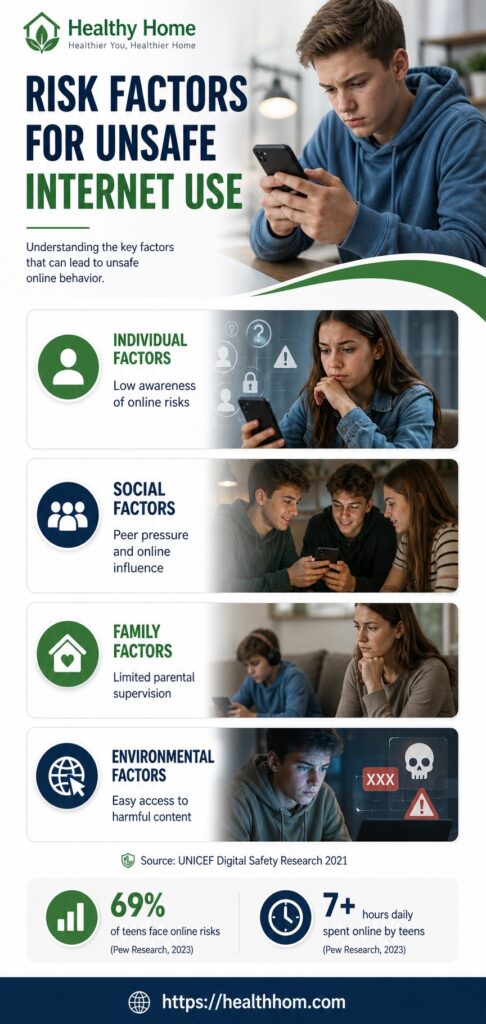
Social factors
- Negative peer pressure
- View of harmful internet materials.
- Isolation in society or troubled environments.
- forced relocation,
- dangerous migration,
- mobility for environmental and socioeconomic causes;
- media exposure (modeling)
Factors related to family
- Lacking of direct supervision & required support from family members
- Guidance in abnormal behavior
- Misuse of Substance in the family
- Un-employment
Teenagers could either be the victims or the offenders of:
- Cyber-bullying
- cyber-stalking,
- trolls,
- doxing,
- hacking,
- phishing;
- establishing and disseminating rumors;
- fabricating a persona for a variety of reasons;
- grooming;
- unwanted attention;
- blackmailing;
- financial frauds
These risks highlight why guided internet use and regular communication with adolescents is essential for their safety and mental well-being.
Issues regarding its over use:
- Uncontrolled media consumption, continuous gaming & chattering i.e. compulsion
- Continuing to use even when not intending to i.e. loss of control in overuse
- Fear of losing or not having a cell phone or sleeping with one in bed makes you feel uneasy if you aren’t permitted to use media.
- May have FOMO (fear of missing out) when not online also
Cyber Security Challenges in many Indian Families:
In many Indian houses, single smartphones can be used by all family members during childhood period and become personal asset during adolescent time.
Due to easy access to internet and smartphone use, it has a better learning opportunities. But, many parents are now feeling uncertain about the privacy settings, online scams, social media risks.
So that the topic of cyber safety matters only if a problem occurs. Discussion about online behavior is a must among adolescents along-with few restrictions by parents.
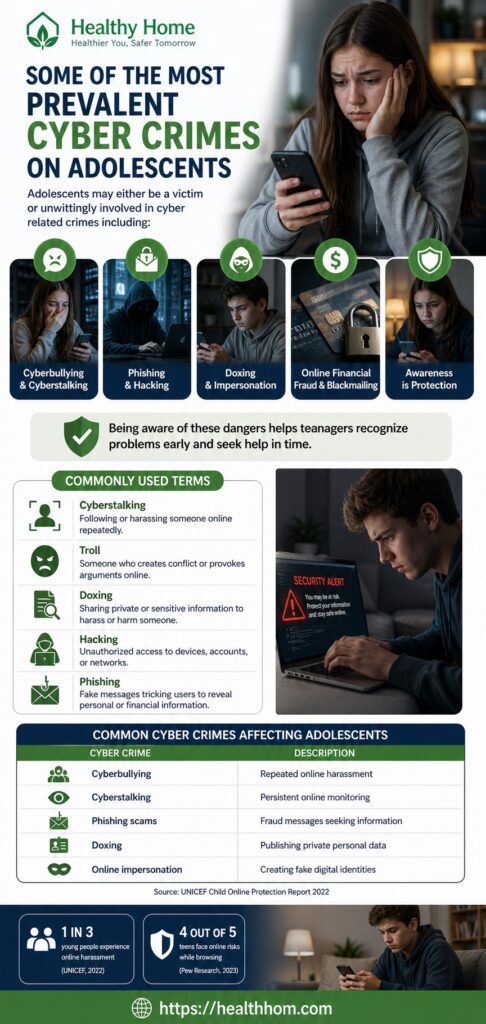
Some of the most prevalent Cyber Crimes on Adolescents
Adolescents may either be a victim or unwittingly involved in cyber related crimes including:
- Cyberbullying and cyberstalking.
- Phishing and hacking
- Doxing and impersonation
- Online financial fraud and blackmailing.
Being aware of these dangers makes teenagers understand that something is wrong and they can find assistance in time.
Some related terms which are frequently being used:
Cyber-stalking is the following of someone, a group or an organization over the Internet or other technological means while being harassed.
The word ”troll” is used in reference to a person who intentionally tries to create discord or animosity or arguments within an online social group.
The practice of doxing, which is itself a form of cyber-bullying, is when individuals use private or sensitive data, statements or documents to harass, expose, financially injure, or otherwise exploit the targeted individual.
Everyone seems to have an idea of what hacking is, where hacking is more than just hacking a computer, cellphone, tablet or even a whole network.
Phishing is a social engineering attack that the perpetrators use to obtain the credit card information and access credentials of users. An attacker impersonating a trusted organization causes the victim to open an email, instant message or text message.
When an Online Comment Causes Real Pain?
Many adults think that online comments are forgotten by teens quickly.
But in reality, they don’t forget easily and take it differently.
Negative comment, public humiliation may affect the self esteem of teens for weeks or even months.
A teenager may laugh to seeing the comment, other may silently feel anxiety, loneliness or fear.
So, cyberbullying not to be taken as “just online issue”. The emotional affects sometime feels real for many adolescents.
This is why cyberbullying should never be dismissed as “just online drama.” For many adolescents, the emotional effects are very real.
Common Cyber Crimes Affecting Adolescents
| Cyber Crime | Description |
|---|---|
| Cyberbullying | Repeated online harassment |
| Cyberstalking | Persistent online monitoring |
| Phishing scams | Fraud messages seeking information |
| Doxing | Publishing private personal data |
| Online impersonation | Creating fake digital identities |
Source: UNICEF Child Online Protection Report 2022
Warning Signs and Issues Related to Internet Overuse
Indications of misuse of internet include:
- The inability to control screen time.
- Social media or compulsive gaming.
- Fear of being out of touch with things.
- Fear of missing out (FOMO)
- Downward academic activity.
- Agitation.
Timely intervention is made possible through early recognition.
Warning Signs of Internet Overuse
| Sign | Description |
|---|---|
| Loss of time control | Spending excessive hours online |
| Academic decline | Reduced focus on studies |
| Mood changes | Irritability or anxiety when offline |
| Social withdrawal | Reduced offline interactions |
Source: APA Digital Media Health Advisory 2023
A Typical Warning Sign Parents Often Miss:
Sometimes internet overuse not begin with more screen hours. It may begin with changes like:
- Less interest in family conversations
- Reduced outdoor activity
- Frequent mood swings
- Staying awake late at night
- Constant checking of notifications
Many parents may observe these changes only after academic performance or sleep quality starts declining.
So, early identifying the problem may prevent the problems later on.
A Better Conversation Than “Give Me Your Phone”:
Many adolescents become more defensive when parents immediately question about their online activities.
Instead of asking:
“What are you doing on your phone all day?”
Try to ask:
“Have you seen anything online recently that made you uncomfortable?”
or
“Has anyone online ever asked you for personal information?”
So, a very simple and non-judgmental conversations may encourage the teenagers to share their concerns more openly.
Controlling the Internet Usage and Providing Internet Safety
In order to control the use of the internet, teenagers are supposed to think over their activities online, keep logs of time, and analyze the influence of the content on their moods and objectives. Caregivers and parents are encouraged to encourage routine, offline and discussion.
Some of the major safety practices are:
- Use of unknown online contacts should be avoided.
- Not disclosing personal or sensitive information in the open.
- Enhancing passwords with a powerful password and constantly changing it.
- Keeping the level of privacy high.
- Prompt reporting and appropriate action to suspicious or abusive behavior.
Discourage them against responding to the individual or individuals who are bullying him/her online:
- Block and report the individual or people involved;
- Take screenshots and photos and document them;
- The method involves talking about it while implementing time controls and safeguarding your digital safety
- Talk about, Encourage, and Make a Suggestion Provide some advice.
- Be mindful;
- Rights, rules, regulations and obligations may be taught to the adolescent.
- High privacy settings on different social media may be done and to keep their profiles hidden always.
Practical Cyber Safety Tips for Adolescents
| Safety Practice | Example |
|---|---|
| Strong passwords | Use unique passwords |
| Privacy settings | Keep profiles private |
| Avoid sharing personal data | Do not share location or phone number |
| Report harmful behavior | Inform parents or authorities |
| Limit screen time | Follow daily usage limits |
Source: UNICEF Online Safety Toolkit 2022
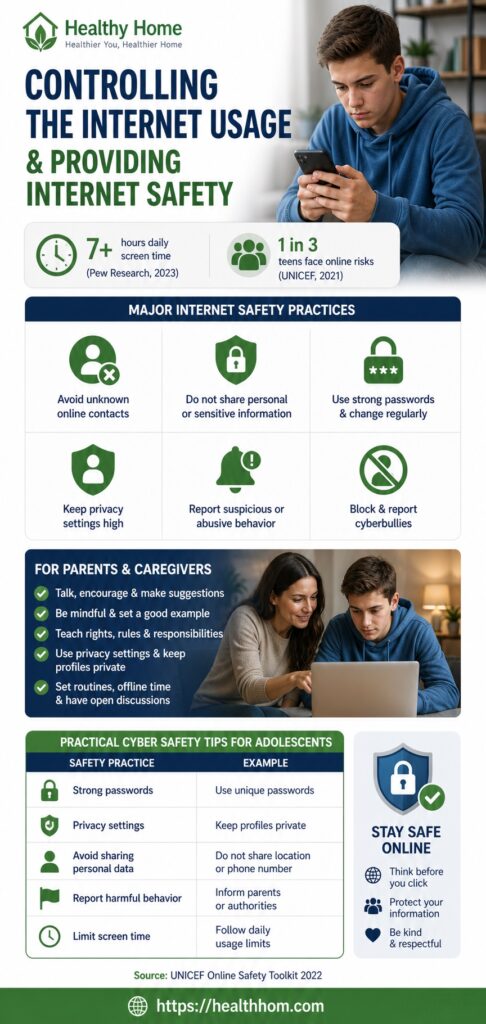
The Healthy Home 5-Minute Digital Safety Check-list:
Every week you may ask:
- Did anyone contact you online whom you don’t know?
- Did you share any personal information this week?
- Did any online content make you uncomfortable?
- Have you experienced cyberbullying?
- Are you balancing screen time with offline activities?
Cyber Safety Rules Used In Our Home:
Some families may find it helpful to establish some basic digital rules:
- No devices during meals.
- No sharing passwords with friends.
- Parents should know the major platforms being used.
- Avoid accepting friend requests from strangers.
- Discuss suspicious messages immediately.
- Keep phones outside the bedroom during sleep.
The exact rules may differ between families.
What Can You Do in Action?
- Create awareness of cyber safety at schools and communities.
- Cooperate with teachers, parental figures and the government.
- Promote cyber incidents reporting.
- Make available counseling services and support services.
- Create a healthy and positive online space.
Top 10 Cyber Safety Rules for Teens:
- Never share OTP
- Never share location publicly
- Use two-factor authentication
- Verify friend requests
- Avoid unknown links
- Report bullying immediately
- Use strong passwords
- Keep devices updated
- Avoid public WiFi for sensitive activities
- Talk to parents when uncomfortable
My Observation as a Public Health Professional:
From my years of experience in working under adolescent health programs in Odisha, I have observed that internet related issues are now common in adolescents as informed by many parents and teachers.
In past decades, focused discussion in a family was nutrition, hygiene and physical health.
Today, screen addiction, cyberbullying, online game, social media activities are major topics discussed in many Indian families.
This changes shows that the digital wellbeing is a major and essential part of adolescent health.
My Opinion:
As per my point of view, the mistake many families are making to focus on screen time used by their teens.
But in reality, the quality of internet is more important than quantity. According to APA and UNICEF, the educational and supervised internet use by adolescent is associated with a better outcomes than passive or any harmful online time spending.
If one teenager is viewing one hour learning session online under the guidance of parents and another is seeing the harmful content online for the same one hour, then the first one is a quality one.
So, healthy habits must focus both safety along-with quality purpose.
Key Message :
The internet should be used to shape the future of adolescents by providing proper guidance not denying it all.
As per the research published by the American Psychological Association (2023), it highlights that due to unsafe and excessive digital uses is directly linked with poor sleep, increased anxiety, reduced social interaction among teens. So that it clearly denotes that the cyber security not belongs to any technical issue, but it leads to overall health and development of teens.
But, the important thing is prevention is possible for this when they are supported with the followings:
- Digital awareness
- Healthy screen habits
- Open communication with parents
- Strong privacy and safety practices
Whether you may be a parent, caregiver, teacher, guardian, you role is to guide, educate and empower them, not to control the use.
The following video explains safe internet and social media practices for adolescents in a simple and practical manner. https://www.youtube.com/embed/oCQNhQmqOu0?si=Z4Of8h-u4pwaw3rE
A Simple Family Cyber Safety Plan:
| Daily | Weekly |
|---|---|
| No phones during meals | Review privacy settings |
| Discuss online experiences | Family digital check-in |
| Limit late-night screen use | Screen-free family activity |
| Keep devices updated | Review friend requests |
FAQs:
Q1. What is the significance of cyber security to adolescents?
Q2. What are typical dangers of teenagers on the Internet?
Q3. What can be done to ensure that teenagers are safe on the Internet?
Q4. What is the role of parents towards cyber safety?
Q5. What are the health consequences of too much internet usage?
Q6. What do we expect teenagers do when cyberbullied?
7. How can schools enhance cyber security awareness?
Related Health Articles from Healthy Home
- Social Media Addiction in Adolescents: Causes, Effects & Prevention
https://healthhom.com/social-media-addiction/ - Mindfulness Techniques for ADHD Management in Children and Adolescents
https://healthhom.com/mindfulness-and-adhd/ - How to Minimize the Risk of Worm Infestation: Causes, Symptoms & Prevention
https://healthhom.com/how-to-minimize-the-risk-of-worm-infestation/ - Impact of Anaemia in Adolescents: Long-Term Health Risks of Malnutrition
https://healthhom.com/impact-of-anaemia-in-adolescents-long-term-risks-of-malnutrition/ - Nurturing Mental Well-being in Adolescents: Causes, Risks & Prevention (healthhom.com)
Trusted References and Research Sources:
- advocacy_toolkit.pdf (who.int)
- Adolescent safety and protection | UNICEF
- Current perspectives: the impact of cyberbullying on adolescent health – PMC (nih.gov)
- Online Safety for Children and Adolescents | UNICEF India
- Adolescent Deviance and Cyber-Deviance. A Systematic Literature Review – PMC (nih.gov)
- Health advisory on social media use in adolescence (apa.org)
- Cyberbullying Prevention and Intervention Efforts: Current Knowledge and Future Directions – PMC (nih.gov)