Early Childhood Development in India (0–6 Years): Growth, Milestones, Nutrition & WHO Guidelines
Did you know 90% of brain development happens before age 5? Learn early childhood development in India concept, key milestones, nutrition & warning signs in children.
Reviewed by Bibhu Ranjan Mund, MPH (Public Health Expert) with experience in maternal, infant, child, and adolescent health programs. Content is based on evidence-informed guidelines aligned with organizations such as the World Health Organization, UNICEF, Centers for Disease Control and Prevention, and National Institutes of Health.
Medical Disclaimer: This content is for informational and educational purposes only and is not intended as medical advice, diagnosis, or treatment. Always seek the advice of a qualified healthcare professional regarding any medical condition or concerns.
Early Childhood development in India: Every child requires early childhood age to develop their cognitive abilities and social bonds as well as their physical attributes.
Introduction:
90% of a child’s brain develops before the age of 5 years.
According to the World Health Organization (WHO, 2023), early childhood experiences strongly influence a child’s learning ability, emotional health, behavior, and future well-being.
A child’s developmental journey begins with small milestones like smiling, recognizing caregivers and responding to voices. But many parents sometimes ignore these milestones and growth of the child is not being monitored seriously.
In real life, developmental delays are sometimes first noticed through small everyday observations like a child is avoiding eye contact, not responding to their names, speaks later than other normal child in the family. In the Community Health Programs in India, these early interventions are managing by the Anganwadi Workers at ANMs at village level. Sometimes Rasthtriya Bal Swasthya Karyakram (RBSK) also providing therapy services through District Early Intervention Centres (DEIC).
In India context, many Govt. programs like Integrated Child Development Service (ICDS), Anganwadi Services, POSHAN Abhiyan are playing a key role in supporting the early childhood development including nutritional supplementation and learning. They are also properly caring the child giving the playing therapy, emotional bonding, friendly atmosphere along-with monitoring the healthy growth.
In rural and urban communities of India, Anganwadi Centres are the first learning and nutritional support system for children it may be villages or in urbans. Parents bring their children to AWCs for growth monitoring supplementary nutrition, pre-schooling activities and major health guidance and these are provided to them free of cost supported by Govt.
This article will provide the different aspects of Early Childhood Development in India, the milestones, nutritional needs, warning signs of delay and WHO recommendations that every parent and caregiver should focus during first 6 year of baby’s life.
A child’s development begins even before birth, read our detailed guide on pre pregnancy planning for women to understand how maternal health influences early brain development.
What is Early Childhood Development?
Early childhood development (ECD) denotes the physical, emotional, social, cognitive and language development of children from birth to 8 years of age. It provides the foundation for lifelong learning, behavior and health.
Early Childhood Development Statistics (India)
Early childhood development is a significant public health concern as per global and national reports. The statistics below show the magnitude of ECD programs and requirement.
| Indicator | India Estimate | Source/Program |
|---|---|---|
| Children under 6 years in India | ~158 million | Census / Government estimates |
| Brain development by age 5 | ~90% of adult brain size | WHO |
| Children with risk of developmental delay globally | ~250 million | WHO / UNICEF |
| Anganwadi centres in India | ~1.3 million | ICDS |
| Children receiving supplementary nutrition | ~100 million+ | POSHAN Abhiyaan |
Quick Summary:
- Early childhood is critical for brain growth and lifelong development.
- Nutrition, caregiving, play and stimulation support healthy growth.
- Tracking milestones helps to identify developmental delays early.
- Anganwadi, ICDS and POSHAN programs support child development in India.
Why Early Childhood Feels So Important to Parents:
For a new parent, the early years of a child sometimes filled with excitement, joy, confusion including continuous learning process. They observe the first cry, first smile, speaking, eating, walking etc. so curiously and these are the un-forgettable memories for them. But, also many parents notice that their child is not eating properly, unable to speak in time, not growing as compared to other children of same age and become worry. So, this early period of every child is not only important for physical growth, but also for emotional bonding, learning, social behavior.
What Is Early Childhood development (ECD)?
The actual development of a child not means the growth in height and weight. It includes the brain, emotions, communication skills, ability to interact with others and confidence of baby develops during the early age.
Early childhood development can be defined as the process of physical, cognitive, emotional, social and language development of children through birth up to approximately eight years of age. WHO and UNICEF state that the early years have a considerable impact on lifelong health and educational performance as well as productivity.
The significance of Early Childhood Development
Strong ECD ensures :
- Healthy early development may support better long-term health outcomes
- Improved school preparedness and school performance.
- Better emotional skills and social skills.
- Increased chances of avoiding developmental delays.
- An improved general health in life.
Early nutrition and care are essential for healthy development, explore our child health and development guide for a complete overview.
Pediatricians suggests that the children who receive the proper caregiving, story telling by parents or grand-parents, regular conversations including play-based interaction actually develops a better communication and social interaction in their later life in the school. So, a small and consistent daily activities like talking with children, reading bedtime stories may develop the language and emotional development of a child.
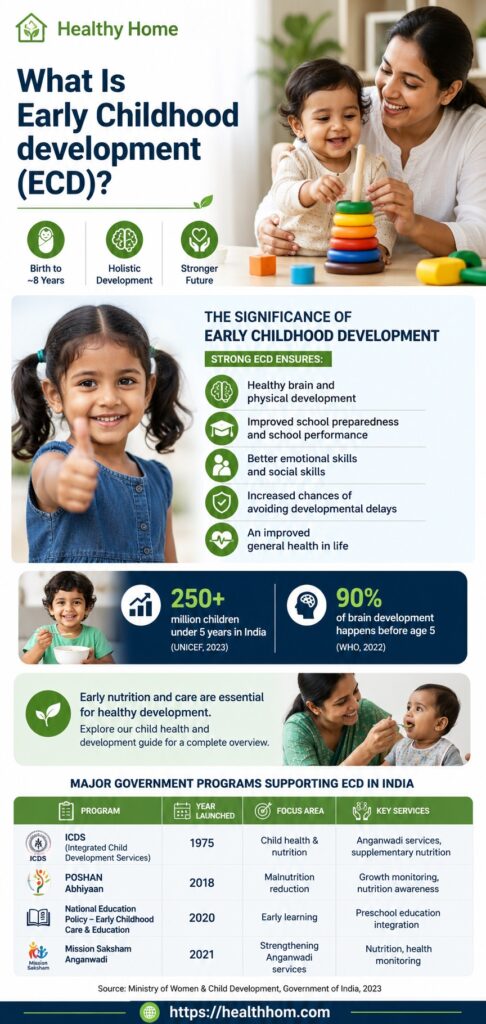
Major Government Programs Supporting ECD in India
| Program | Year Launched | Focus Area | Key Services |
|---|---|---|---|
| ICDS (Integrated Child Development Services) | 1975 | Child health & nutrition | Anganwadi services, supplementary nutrition |
| POSHAN Abhiyaan | 2018 | Malnutrition reduction | Growth monitoring, nutrition awareness |
| National Education Policy – Early Childhood Care & Education | 2020 | Early learning | Preschool education integration |
| Mission Saksham Anganwadi | 2021 | Strengthening Anganwadi services | Nutrition, health monitoring |
Source: Ministry of Women & Child Development, Government of India, 2023
Age-wise Development Areas
| Age Group | Main Development Focus |
|---|---|
| 0–12 months | Sensory development, bonding |
| 1–2 years | Motor skills and first words |
| 2–3 years | Language and social play |
| 3–5 years | Learning, curiosity and imagination |
Source: UNICEF Early Learning Report, 2019
Early childhood developmental Milestones
Key Development Domains in Early Childhood
| Development Domain | What It Includes | Examples |
|---|---|---|
| Physical Development | Growth of body and motor abilities | Crawling, walking |
| Cognitive Development | Thinking and learning skills | Memory, problem solving |
| Language Development | Communication abilities | Words, sentences |
| Social Development | Interaction with others | Playing with peers |
| Emotional Development | Managing feelings | Attachment, empathy |
Source: UNICEF Early Childhood Development Framework, 2019
Milestones are skills that majority of children attain at a specific age. Small variations are normal.
Development begins from birth, read our complete guide on baby’s first two years development to understand early milestones.
Why Parents Should Track Milestones Without Panic:
Parents can easily know the growth of their child by using the developmental milestone guide. But, every child develops at a slightly different pace like some may walk earlier other may speak earlier. So, small variation is a normal process. Parents should take help of professional advice if any child delays in steady progress, social interaction and overall development as compared to other children of same age.
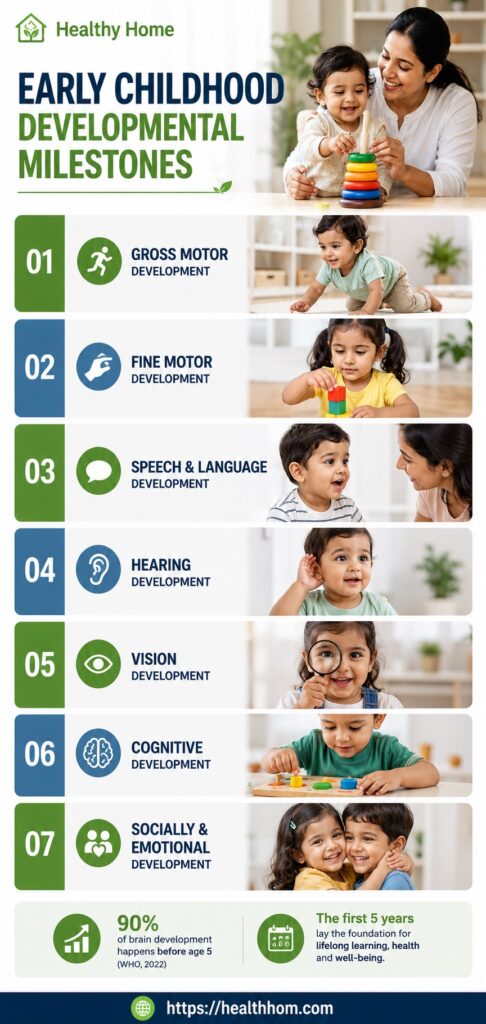
1. Gross Motor Development
| Age | Expected Milestones |
|---|---|
| 2 months | Social smile, some head control |
| 4 months | Holds head steadily |
| 9 months | Sits without support |
| 12 months | Crawls or stands with support |
| 15 months | Walks independently |
| 18 months | Walks well, pulls toys while walking |
| 24 months | Climbs up and down stairs with help |
| 3 years | Climbs stairs alternating feet |
In several parts of India, during the first time standing or walking independently by the children, the parents become so excited even try to capture these moments through recording of videos in their mobiles. Families also encourage children through clapping, smiling and playful interaction during these early milestones. So, the parents should supervise every movement of their child and not to force for early walking.
2. Fine Motor Development
| Age | Expected Milestones |
| 6 months | Grasps objects like a rattle |
| 9 months | Transfers objects between hands |
| 12 months | Pincer grasp (thumb and forefinger) |
| 15 months | Puts objects into containers |
| 18 months | Scribbles spontaneously |
| 24 months | Feeds self using spoon or hands |
Proper nutrition plays a key role in physical development, learn more in our guide on right food supplementation after 6 months
3. Speech and Language Development
| Age | Expected Milestones |
| 2 months | Coos and squeals |
| 4 months | Laughs and vocalizes |
| 6 months | Babbles sounds like “ba”, “pa”, “ma” |
| 9 months | Says simple words like mama, baba |
| 12 months | Says one meaningful word |
| 18 months | Uses 5–10 words |
| 24 months | Combines two words (e.g., “mama milk”) |
| 3 years | Speaks simple sentences |
Micronutrient deficiencies can affect brain development, read about risks in iron deficiency anemia in children
Children naturally learn by observing parents and caregivers around them. If the caregiver talk with the child, sing a song, read in-front of them, respond quickly, then the child will be able to develop the language and learning at proper time. In the bilingual Indian families, due to multiple languages spoken at home, the child may slightly affect the timing of speech milestones, but sometimes it also supports the long-term language flexibility.
4. Hearing Development
- 2 months: Sensitive to sounds
- 4 months: Reacts to the voice of the mother.
- 6 months: Turns head toward sounds.
- 9 months: Responds to own name
5. Vision Development
- 2 months: Makes eye contact
- 4 months: Chasing moving objects.
- 6 months: Head is turned towards visual stimuli.
- 9 months: Does not go through obstacles.
- 15 months: Putting of small objects into a container.
6. Cognitive Development
- 2 months: Social smile
- 6 months: Reaches for objects
- 9 months: Responds to name
- 12 months: Searching concealed objects.
- 15 months: Constants to interesting objects.
- 18 months: Recreates domestic actions.
- 24 months of age: Parallel play.
- 3 years: Starts playing fantasy.
7. Socially and Emotional Development
- 2 months: Social smile
- 6 months: Responds to caregivers.
- 9 months: Enjoys peek-a-boo
- 12 months: Makes the difference between known and unknown faces.
- 15 months: copying some gesture such as bye-bye or namaste.
- 24 months: Playing with other children parallel
Emotional Bonding in Indian Families:
In many rural Indian houses, in general the children grow-up along-with their parents, grand-parents, cousins and others also. Due to this close family environment, it supports the children for emotional attachment, social learning and language development naturally. Just a simple everyday tradition of storytelling by grand-parents, meals together, singing devotional songs, playing together may influence the communication skills in children a lot.
Red Flags for Developmental Delay
They are the general warning signs. Some are mentioned below:
- Delayed achievement of milestones such as walking or speaking etc.
- Lack of eye contact/social interaction.
- Problem with sound audition or listening.
- Lack of coordination/muscle problems.
- Persistent irritability, poor attention or lack of social interaction may sometimes require developmental assessment.
Early intervention and screening have great positive effects.
Some parents usually delay in visit to doctor only due to some traditional myth that “boys speak late” or “every child grow differently”. Minor variations may be normal, but if the child is having persistent delays in speech, social interaction, no hearing or movement shouldn’t be ignored. They must visit to nearest Early Intervention Centers where Therapists can help them for early therapy and early recovery.
Early detection is critical, explore our detailed guide on global developmental delay in children
Parental involvement in the development of children in early childhood
The role of parents in ECD is the most significant as they:
- Social protection and attentiveness.
- Making nutritious food balance.
- Promoting play based learning.
- Discussing, reading and singing to children.
- Providing a safe and stimulating homely atmosphere.
Positive parenting and early care practices start from infancy, read our guide on baby care in first two years.
Simple Daily Activities That Support Brain Development:
- Talking to children during cooking or feeding
- Reading picture books
- Singing rhymes
- Floor play without screens
- Outdoor play and sunlight exposure
- Naming colors, fruits, animals, and body parts
- Encouraging pretend play
So, the above activities not require any costly toys or coaching. Only the consistent and responsive caregiving matters a lot which are important than expensive educational products.
Nutrition in Early Brain Development
Healthy eating helps the brain to grow, improves the immune system and physical development. Those nutrients that are necessary include:
- Proteins
- Iron
- Iodine
- Zinc
- Omega-3 fatty acids
Supplementary nutrition in early childhood is offered through the government programs such as ICDS and Anganwadi services.
Healthy fats are also important, learn about deficiencies in omega-3 deficiency in mothers
Balanced nutrition is essential for brain growth, explore our guide on food supplementation and its importance.
Throughout India, so many locally available seasonal nutritious foods are easily available like fruits, ragi, groundnuts, green leafy vegetables along-with other foods such as khichidi, many types of dals, curd which are required to support the healthy child development. So it is clear that the home-made foods are healthier than processed and packaged food for children.
Key Nutrients Supporting Early Brain Development
| Nutrient | Role in Child Development | Common Food Sources |
|---|---|---|
| Protein | Growth and tissue development | Eggs, pulses, milk |
| Iron | Supports oxygen transport | Green leafy vegetables, legumes |
| Iodine | Supports thyroid and brain development | Iodized salt, dairy |
| Zinc | Supports immune function | Nuts, seeds, legumes |
| Omega-3 fatty acids | Brain structure support | Fish, walnuts, flaxseed |
Source: FAO & WHO Nutrition Guidelines, 2020
Iron plays a critical role in cognitive development, read more in iron deficiency anemia in children
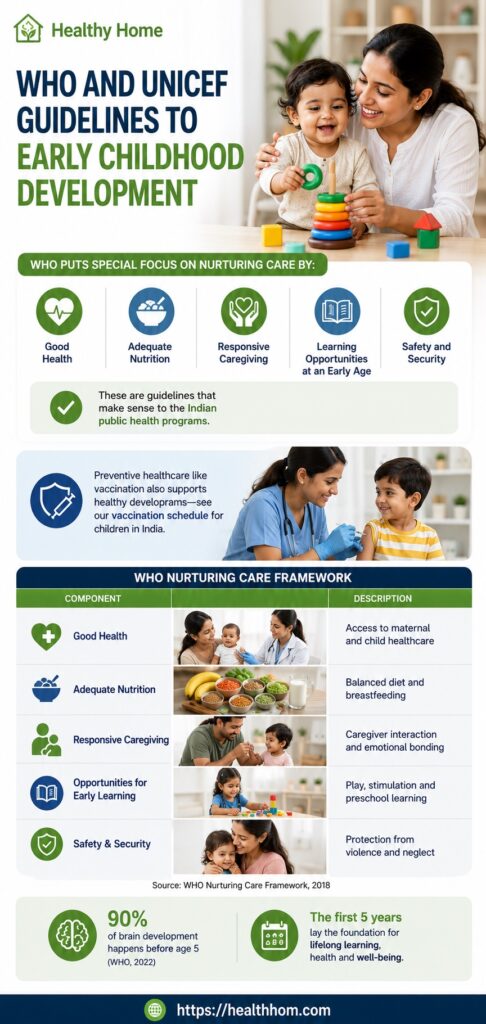
WHO and UNICEF Guidelines to Early Childhood Development
WHO puts special focus on nurturing care by:
- Good health
- Adequate nutrition
- Responsive caregiving
- Learning opportunities at an early age.
- Safety and security
These are guidelines that make sense to the Indian public health programs.
Preventive healthcare like vaccination also supports healthy development, see our vaccination schedule for children in India.
As per study by WHO in nurturing care chapter, it shows that the child development not only limited to medical treatment or nutrition. They also need the emotional support, proper communication, play therapy, affection in everyday life.
Common Parenting Mistakes That May Affect Early Development:
- Excessive screen exposure
- Force-feeding during meals
- Comparing children constantly
- Ignoring sleep routines
- Delaying developmental screening
- Limited outdoor play
- Lack of caregiver interaction
- Overuse of mobile phones around children
Most of the above habits are un-intentional only due to day-to-day increasing busy life schedule, stress even sometimes lack of awareness. Small positive daily habits can make a meaningful difference in a child’s overall development.
What Parents Commonly Worry About During Early Childhood:
Parents sometimes become concerned about:
- Late speech
- Poor eating habits
- Low weight gain
- Excessive mobile use
- Lack of concentration
- Hyperactivity
- Delayed walking
- Social withdrawal
Small variations may be a common, but parent should monitor the progress of child and discuss with Medical Practitioner or Pediatrician for any deviation.
Concluding Points:
The foundation of lifelong learning and emotional health begins during early childhood.
According to the reputed global organizations like WHO and UNICEF, they show that early support like proper nutrition, caregiving, learning, timely healthcare etc. during childhood may positively structure the life-long physical and mental health.
Perfect parenting means the habits of parents in supporting the children for safe environment, emotional strength, proper and balanced nutrition, early communication, regular medical check-ups. Parents and caregivers should observe the developmental milestones of their children and identify the early delay (if any) so as to manage it properly.
Everyday small step like talking & playing with children and nurturing them can build a healthier future of every child.
FAQs:
Q1. What does early childhood development mean?
Q2. What is the importance of early childhood development?
Q3. What are the key spheres of early childhood development?
Q4. What will nutrition do to early childhood development?
Q5. How do the parents contribute to ECD?
Q6. At what age do parents cause concern over developmental delay?
Related Health Articles from Healthy Home
- Early Childhood Development – Learn about key stages, milestones, and factors influencing a child’s growth in this guide on Early Childhood Development
- Global Developmental Delay – Understand causes, symptoms, diagnosis, and early intervention strategies for Global Developmental Delay in Children
- What Makes Humans Unique – Explore the biological, cognitive, and emotional traits that define humanity in Why a Human Child Is So Unique and What Makes Us Human
- Infancy to Toddler Development – A comprehensive overview of physical, emotional, and cognitive changes from birth to toddlerhood in Precious Infancy to Toddler Stage
- Food Supplementation for Growth & Nutrition – Learn how nutritional supplementation supports maternal and child health through Food Supplementation and Its Importance
Trusted References and Research Sources:Child Health and Development Guide: Growth Milestones, Immunity and Daily Care