1.6 Billion People Affected: Signs, Causes & Treatment of Iron Deficiency Anemia
1.6 billion people suffer from anemia. Discover warning signs, causes & effective treatment of iron deficiency anemia causes before it impacts your health.
Reviewed by Bibhu Ranjan Mund, MPH (Public Health Expert) with experience in maternal, infant, child, and adolescent health programs. Content is based on evidence-informed guidelines aligned with organizations such as the World Health Organization, UNICEF, Centers for Disease Control and Prevention, and National Institutes of Health.
Medical Disclaimer: This content is for informational and educational purposes only and is not intended as medical advice, diagnosis, or treatment. Always seek the advice of a qualified healthcare professional regarding any medical condition or concerns.
Affiliate Disclosure: This article contains affiliate links. If you purchase through these links, we may earn a small commission at no extra cost to you.
Introduction:
If you are feeling tired, weak or lack of concentration even after eating regularly, please don’t ignore it.
As per the research published by World Health Organization (2021), it shows that about 1.6 billion of people globally suffer from anemia having the iron deficiency is the most common issue. Also, in India more than 50% of women are affected and 65% of Adolescent Girls are affected (National Family Health Survey NFHS-5, 2019-21) which actually implies a serious public health issue.
Iron deficiency anemia causes fatigue and also impact the immunity, brain functioning, pregnancy outcomes. But the challenge is that most of the people are ignoring the early signs and treat when it becomes severe.
In this article, you will find-out the actual cause, different early signs, diagnosis methods and treatment options including the diet schedule & lifestyle changes required for its prevention.
Iron deficiency anemia is especially common in infants and young children during rapid growth phases. Learn how it affects early life in our detailed guide on Iron Deficiency Anemia in Children (6–24 Months)
Definition of Iron Deficiency Anemia?
It is a condition in which the body does not have enough healthy red blood cells or hemoglobin to carry adequate oxygen to meet the body’s normal physiological needs. It makes the hemoglobin thin, pale and diluted.
It can also be defined as the deficiency of red blood cells or hemoglobin in the blood.
Iron, folic acid, vitamin C, protein, and vitamin B12 create thick red hemoglobin.
Global and India Burden of Anemia
| Indicator | Estimated Prevalence |
|---|---|
| Global population affected by anemia | ~1.6 billion people |
| Women of reproductive age affected globally | ~29% |
| Pregnant women affected globally | ~36% |
| Women (15–49 yrs) affected in India | ~57% |
Source: WHO Global Anaemia Estimates, 2021; National Family Health Survey (NFHS-5), 2019–21
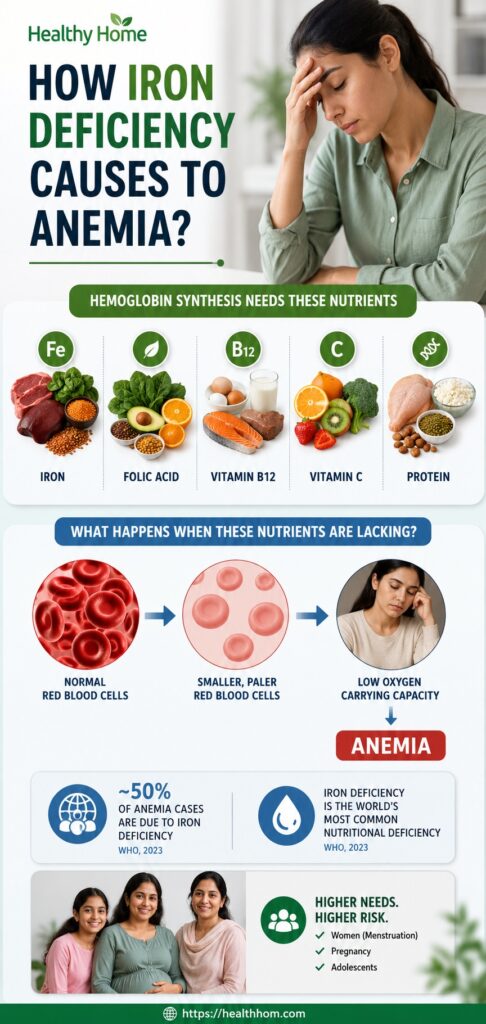
How Iron Deficiency causes to Anemia?
The process of hemoglobin synthesis also requires sufficient consumption and intake of essential nutrients such as:
- Iron
- Folic acid
- Vitamin B12
- Vitamin C
- Protein
Lack of these nutrients causes the formation of lower red blood cells which are pale and have a decreased oxygen carrying capacity hence anemia causes.
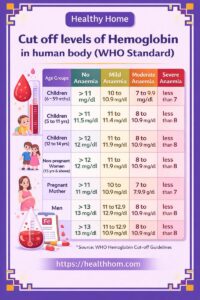
Cut off levels of Hemoglobin in human body (WHO Standard)
| Age Groups | No anaemia | Mild | Moderate | Severe |
| Children with age 6 to 59 mths | greater than 11 mg/dl | 10 to 10.9 mg/dl | 7 to 9.9 mg/dl | less than 7 mg/dl |
| Children with 5 to 11 yrs | greater than11.5 mg/dl | 11 to 11.4 mg/dl | 8 to 10.9 mg/dl | less than 8 mg/dl |
| Children with 12 to 14 yrs | greater than12 mg/dl | 11 to 11.9 mg/dl | 8 to 10.9 mg/dl | less than 8 mg/dl |
| Non pregnant women (15 yrs & above) | greater than12 mg/dl | 11 to 11.9 mg/dl | 8 to 10.9 mg/dl | less than 8 mg/dl |
| Pregnant Mother | greater than 11 mg/dl | 10 to 10.9 mg/dl | 7 to 9.9 mg/dl | less than 7 mg/dl |
| Men | greater than13 mg/dl | 11 to 12.9 mg/dl | 8 to 10.9 mg/dl | less than 8 mg/dl |
Iron Requirement by Age Group
| Population Group | Approximate Daily Iron Requirement |
|---|---|
| Infants (7–12 months) | 11 mg/day |
| Children (1–8 years) | 7–10 mg/day |
| Adolescents (9–18 years) | 8–15 mg/day |
| Adult Men | 8 mg/day |
| Women (19–50 years) | 18 mg/day |
| Pregnant Women | 27 mg/day |
Source: National Institutes of Health – Dietary Reference Intakes, 2020
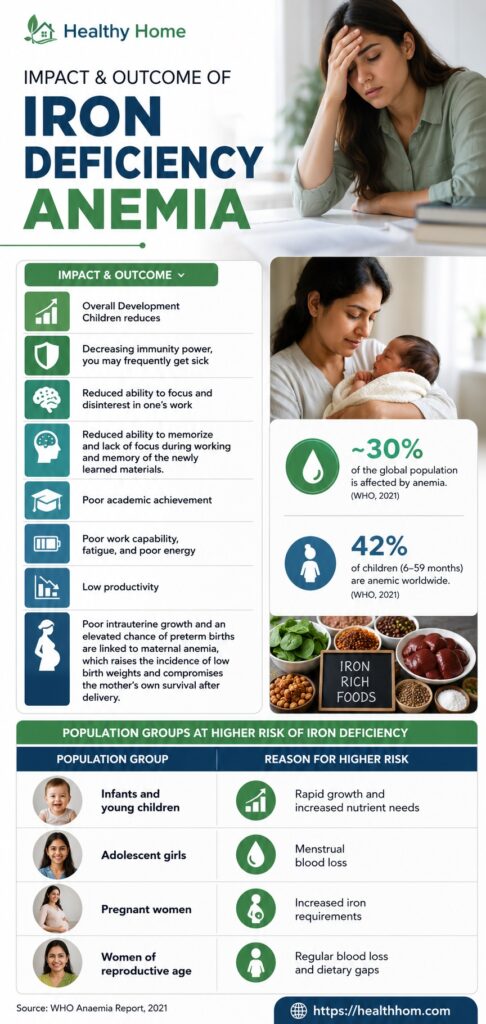
Impact & outcome:
- Overall Development Children reduces
- Due to decreasing immunity power, you may frequently get sick
- Reduced ability to focus and not interest in working
- Reduced ability to memorize and lack of focus during working and memory of the newly learned materials.
- Poor academic achievement
- Poor work capability, fatigue, and poor energy
- Low productivity
- Poor intrauterine growth and an elevated chance of preterm births are linked to maternal anemia, which raises the incidence of low birth weights and compromises the mother’s own survival after delivery.
Population Groups at Higher Risk of Iron Deficiency
| Population Group | Reason for Higher Risk |
|---|---|
| Infants and young children | Rapid growth and increased nutrient needs |
| Adolescent girls | Menstrual blood loss |
| Pregnant women | Increased iron requirements |
| Women of reproductive age | Regular blood loss and dietary gaps |
Source: WHO Anaemia Report, 2021
The first two years of life are critical for nutrition and immunity. Learn more in Precious Infancy to Toddler: A Baby’s First Two Years.
i. CHILDREN & ADOLESCENTS:
- Decreasing academic performance, Poor memory power, attention & focus, overall cognitive function etc.
- Immunity power decreases and infections arising frequently.
- Poor results for motor development
- Irregular menstruation Exhaustion/breathlessness
- Low stamina
- Child mortality
ii. Adults :
- Disabilities, weariness, and diminished muscle strength,
- Physical activity & work productivity also decreases
- An irregular heartbeat
- May be Cardiac arrest
- Irritability or mood swings
- Hospitalizations
- Increased chance of mortality
iii. Pregnant Women :
- Early birth
- Low birth weight
- Blood loss during delivery
- Bleeding after giving birth
- Deaths from pregnancy
- Perinatal care
- Neonatal care
- Low immunity for which depression and morbidity increases
iv. Lactating Women :
- The quality of life
- Fatigue
- Heart palpitations
- Risk of infection
- Depression & Stress increases
Early nutritional deficiencies can significantly affect growth and brain development. Read more in our guide on Early Childhood Development in India (0–6 Years).
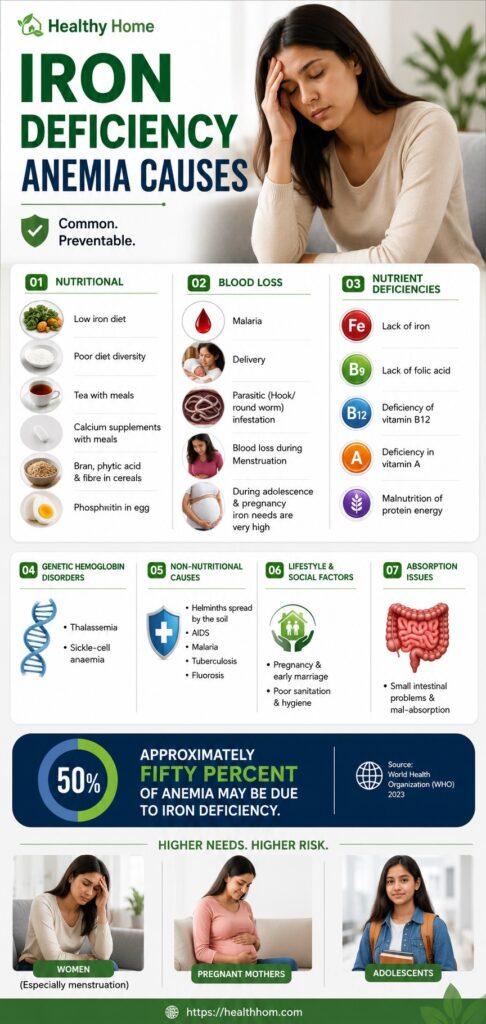
Iron Deficiency Anemia Causes
A) Nutritional: deficiency of these nutrients due to
- Low Dietary intake of iron
- Low bio-diversity
- Tea with meal
- Calcium phosphate supplement with meal
- Phytic acid and fibre in bran of cereals
- Phosphvitin in egg
B) Blood loss or destruction of blood cells due to :
- Malaria
- Delivery
- Parasitic (Hook/round worm) infestation
- Blood loss during
- Menstruation
- During adolescence & pregnancy iron needs are very high
Nutrition:
- Lack of iron
- Lack of folic acid
- Deficiency of vitamin B12
- Deficiency in vitamin A
- Malnutrition of protein energy
Genetic hemoglobin disorders :
- Thalassemia
- Sickle-cell anaemia
Non -Nutritional Causes :
- Helminths spread by the soil
- AIDS
- Malaria
- Tuberculosis
- Fluorosis
- Pregnancy and early marriage
- Small intestinal problems and mal-absorption
- Poor sanitation and hygiene
Approximately Fifty percent of Anemia may be due to Iron deficiency.
Poor complementary feeding practices can increase anemia risk in infants. Explore the right approach in Right Food Supplementation for Babies After 6 Months.
Common Causes of Iron Deficiency Anemia
| Category | Examples |
|---|---|
| Nutritional factors | Low dietary iron intake, poor dietary diversity |
| Blood loss | Menstruation, childbirth, injuries |
| Parasitic infections | Hookworm, roundworm |
| Chronic diseases | Tuberculosis, malaria |
| Absorption problems | Intestinal disorders |
Source: WHO Nutritional Anaemia Guidelines, 2017
Inter-generational Life Cycle of Anemia :
- Women with anemia who are pregnant
- Low hemoglobin and iron levels in a baby
- Anemia identified during early childhood but not treated.
- Teenage girl with the condition of menstrual blood loss and low iron levels and hemoglobin levels
- Because of low iron reserves, adolescents have to enter this reproductive life phase.
Maternal anemia directly impacts child health outcomes. Read more in Antenatal Iron Supplementation During Pregnancy
Different types of Nutritional Diversification:
- Green fruits and vegetables
- Fish, meat, liver, and eggs
- You can eat dried fruits, sesame, jaggery, sprouting pulses, ground nuts, jowar, bajra and wheat.
- Vitamin-c rich food in our diet increases the chance of more Iron absorption which are oranges, lemons, apples, pears & Indian gooseberries (Amla).
For pregnancy-specific nutrition, check our guide on Iron-Rich Foods During Pregnancy.
Dietary Diversification Examples
| Food Group | Examples |
|---|---|
| Green leafy vegetables | Spinach, amaranth |
| Cereals and millets | Jowar, bajra, wheat |
| Pulses and legumes | Lentils, chickpeas |
| Animal foods | Fish, eggs, meat |
| Fruits rich in vitamin C | Orange, guava, amla |
Source: FAO Nutrition Education Materials, 2019
Increased consumption of Iron Rich and Iron-Fortified food is necessary, as it is dietary diversification
- Long term approach
- Involvement of people in their eating habits
- Nutritional awareness & proper education to be provided to public & community.
- Reduce inhibitor and raise promoter concentrations to improve iron absorption
Iron Deficiency Anemia Diagnosis
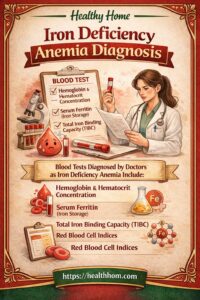
Blood tests Diagnosed by doctors as iron deficiency anemia include:
- Hemoglobin and hematocrit concentration.
- Serum ferritin (iron storage)
- Total Iron Binding Capacity (TIBC)
- Red blood cell indices
Diagnostic Tests for Iron Deficiency Anemia
| Test | Purpose |
|---|---|
| Hemoglobin test | Measures oxygen-carrying capacity of blood |
| Serum ferritin | Indicates iron storage levels |
| Total Iron Binding Capacity (TIBC) | Measures blood’s ability to bind iron |
| Red blood cell indices | Evaluates size and characteristics of RBCs |
Source: National Institutes of Health, 2021
Management and Treatment Options
Food-Based Approaches
- Consume more of foods that are rich in iron.
- Improve dietary diversity
- Use iron-fortified foods
Supplementation (Medical Advice Required)
- Tablets of iron and folic acid (IFA).
- IV iron sucrose in the severe cases.
Public Health Measures
- Regular deworming
- Malaria prevention
- Planning and birth spacing of families.
- Behavior change communication and nutrition counseling.
Public Health Programs Addressing Anemia in India
| Program | Year | Objective |
|---|---|---|
| National Nutritional Anaemia Prophylaxis Programme | 1970 | Prevention of anemia among mothers and children |
| Iron Plus Initiative | 2013 | Iron supplementation across age groups |
| Anemia Mukt Bharat | 2018 | Reduce anemia prevalence through multi-sectoral strategies |
| POSHAN Abhiyaan | 2018 | Improve nutrition and reduce malnutrition |
Source: Ministry of Health & Family Welfare, Government of India, 2022
Preventing anemia early in life is crucial. Learn child-specific prevention strategies in Iron Deficiency Anemia in Children (6–24 Months).
Iron supplements should only be taken after medical consultation, especially during pregnancy or chronic illness.
Suggestive Link for Iron Tab. from Amazon as mentioned below: https://amzn.to/4cGCUZ7
Iron-Fortified Foods You should add to Your Diet
Plant-Based Sources
- Green leafy vegetables
- Pulses and legumes
- Jowar, bajra, wheat
- Sesame seeds, groundnuts
- Jaggery and dried fruits
Animal-Based Sources
- Fish, meat, liver
- Eggs
Improve Iron Absorption
- Consume foods rich in vitamin c like oranges, lemons, amla, guava, apples and pears.
- Do not take tea or coffee just after meals.
Factors That Influence Iron Absorption
| Factor Type | Examples |
|---|---|
| Absorption Promoters | Vitamin C foods (citrus fruits, amla), fermented foods |
| Absorption Inhibitors | Tea, coffee, high phytate foods |
| Dietary Balance | Combination of plant and animal foods |
Source: WHO & FAO Nutrition Guidelines, 2020
Comparison Table: Iron Sources from Plant vs Animal Foods
| Type of Iron Source | Examples | General Absorption Characteristics |
|---|---|---|
| Plant-based (Non-heme iron) | Pulses, spinach, sesame seeds, jaggery | Absorption influenced by other foods |
| Animal-based (Heme iron) | Meat, fish, poultry, liver | Generally more readily absorbed |
Source: FAO Food and Nutrition Paper, 2020
Government programs also support early child health and nutrition. Learn how in Early Childhood Development in India (0–6 Years)
Can Iron deficiency anemia be prevented?
Yes. Prevention of same should include:
- An iron-enriched balanced diet.
- Enhancement of iron absorption by taking vitamin c.
- Conducting health check-ups often in pregnancy.
- Early nutrition according to the recommendations of medical professionals.
A small video from YouTube on this topic : https://www.youtube.com/embed/tG4b3eU1Nzc?si=RGQg6Ax7YEwS1bJP
Concluding Points:
Iron Deficiency Anemia Causes the different health conditions, but the important point is it can be prevented.
A balanced nutrition, early diagnosis, proper awareness and immediate medical are are the main weapon s for prevention and management. Daily small habits like including iron-rich foods, Vitamin-C foods for absorption, regular health check-up can make the difference.
Many Global Health Organizations like WHO suggests that if it is detected early, then it can be prevented the complications like fatigue, poor immunity and other issues.
But, the symptoms like tiredness always, dizziness, weakness etc. mustn’t be ignored and take suitable action for its management.
FAQs :
Q1: Iron-deficiency anaemia – meaning?
Q2: Why does iron deficiency commonly cause anemia?
* In-sufficient diet viz. iron-rich foods
* Blood losses due to heavy menstruation, different types of ulcers, many internal bleeding
* Increased requirement of iron during pregnancy period, growth spurts or any type of physical training
Q3: Signs and symptoms of iron deficiency anemia?
* Fatigue and weakness
* Pale or yellowish skin
* Shortness of breath
* Dizziness or lightheadedness
* Cold hands
* Feet Brittle nails
* Hair loss
Q4: Is there any category of people who are at risk due to iron deficiency anemia?
* Women with heavy menstrual periods
* Pregnant women Infants and young children
* Mineral deficient diets among people who strictly consume non-meat food as a vegetarian or a vegan person
* Having some chronic diseases or gastrointestinal conditions if any
Q5: How iron deficiency anemia can be diagnosed?
* Hemoglobin levels as well as Hematocrit and Ferritin measurements together with Total Iron-Binding Capacity evaluation.
* How much red blood cells does one have in the blood system of humans
* Iron storage protein which is to know the Ferritin levels
* TIBC i.e. Total Iron Binding Capacity
Q6: How iron deficiency anemia be treated?
* Iron for treating patients is either delivered through medicines or through an intravenous injection.
* Incorporating spinach along with red meat and lentils and fortified cereals as part of your balanced diet.
* Treatment involves dealing with both issues related to blood loss or poor nutrient absorption.
Q7: Can iron-deficiency anemia be prevented ?
* Making sure you eat iron-rich foods to avoid problems.
* Absorption of iron increases if we take vitamin-c rich foods.
* During pregnancy period, Monitoring iron levels & know the actual status
Related Health Articles from Healthy Home
- Antenatal Iron Supplementation During Pregnancy (healthhom.com)
- Iron Deficiency Anemia in Children (6–24 Months) (healthhom.com)
- Anemia in Adolescents: Symptoms, Causes, Treatment (healthhom.com)
- Iron rich foods during pregnancy – Healthy Home – Trusted Health Tips for Kids, Teens & Families (healthhom.com)
- Iron Supplementation – Best Benefits – Healthy Home – Trusted Health Tips for Kids, Teens & Families (healthhom.com)
Trusted References and Research Sources:High Protein Indian Diet Plan: 7-Day Family Meal Plan with Affordable Protein FoodsHealthy Nutrition Guide for Families : Balanced Diet, Gut Health and Weekly Meal PlanHealthy Living Guide for Families : Nutrition, Sleep and Daily Wellness Habits11 Iron Rich Foods During Pregnancy : Benefits and Healthy Meal IdeasWhat is a balanced daily meal plan? Nutrition Guide and 7-Day Diet Plan