7 Days Meal Plan on a Budget : Healthy Diet for Families
Discover a simple 7 days meal plan using affordable, local foods. Backed by nutrition science & designed for families.
Reviewed by Bibhu Ranjan Mund, MPH (Public Health Expert) with experience in maternal, infant, child, and adolescent health programs. Content is based on evidence-informed guidelines aligned with organizations such as the World Health Organization, UNICEF, Centers for Disease Control and Prevention, and National Institutes of Health.
Medical Disclaimer: This content is for informational and educational purposes only and is not intended as medical advice, diagnosis, or treatment. Always seek the advice of a qualified healthcare professional regarding any medical condition or concerns.
Introduction:
You may have experienced that many healthy food are expensive, but it is not correct always.
Most of the families are still struggling to know what to eat consistently.
As per the study report of Food and Agriculture Organization (2023), about 3.1 billion of people globally can’t able to afford a healthy diet which in-turn a challenge today.
But, the important thing is that:
Healthy diet doesn’t always says bout the more costly ingredients, complicated recipes or any imported food.
If you plan you meal correctly, the ongoing simple local foods every which you are eating can be able to provide a balanced nutrition having no extra cost with the same taste, easy to prepare and even cultural-friendly.
In this article, you will find-out the 7 days meal plan on a budget prepared for the families which help to save your money, reducce food waste and improve the health without neglecting the nutritional aspect.
To better understand how to structure nutritious meals, explore our guide on a balanced daily meal plan for all age groups.
Home-Cooked Local Diet vs Ultra-Processed Foods
| Aspect | Home-Cooked Local Foods | Ultra-Processed Foods |
|---|---|---|
| Cost | Usually lower when using local ingredients | Often higher long-term cost |
| Ingredients | Whole grains, vegetables, pulses | Refined ingredients |
| Preparation | Simple home cooking | Industrial processing |
| Cultural connection | Based on local food traditions | Less connection to local diets |
| Environmental impact | Often lower | Higher packaging waste |
Source: Harvard T.H. Chan School of Public Health – Nutrition Source (2022)
Global Nutrition & Food Accessibility Snapshot
| Indicator | Global Estimate | Source |
|---|---|---|
| People unable to afford a healthy diet | ~3.1 billion people | FAO – State of Food Security and Nutrition in the World, 2023 |
| Global prevalence of obesity among adults | ~13% of adults worldwide | WHO Global Health Observatory, 2022 |
| People experiencing moderate or severe food insecurity | ~29% of the world population | FAO/IFAD/UNICEF/WFP/WHO Report, 2023 |
| Households prioritizing low-cost staple foods | Common in low-income settings | World Bank Food Security Report, 2022 |
How This Budget Meal Plan Works (Simple & Practical)
Principles of Sustainable & Accessible Nutrition
| Principle | Example in Meal Plan |
|---|---|
| Local foods | Seasonal vegetables and grains |
| Plant-based meals | Lentils, beans, tofu |
| Low food waste | Reusing leftover vegetables |
| Simple cooking | Home-prepared meals |
| Seasonal eating | Fruits and vegetables from local markets |
Source: FAO Sustainable Diet Guidelines (2021)
You can further enhance your diet by adopting sustainable cooking practices that benefit both health and the environment.
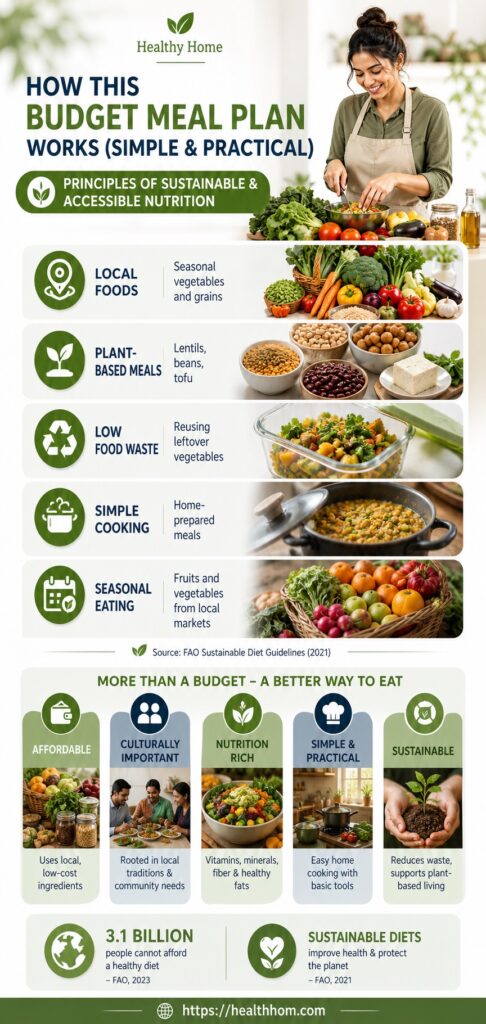
It’s not only limiting budget, but also it includes the following:
- Affordable: By utilizing different types of ingredients which are not so costly, easily locally available & also requires minimum processing.
- Cultural Importance: Based on different local & cultural practices, focusing on the needs of community, taking suggestion from religious & regional eating process, diet according to local tradition etc.
- Vitamins, minerals, fiber & healthy fats which also rich in nutrition.
- Simplicity: Meals which can be easily prepared in local kitchen & not required VIP kitchen tools. Also, the ingredients are easily available in local market.
- Sustainable: It reduces the percentage of any kind of food waste, increasing trend of plant-based meals including an encouragement to use the re-usable resources which are local produces.
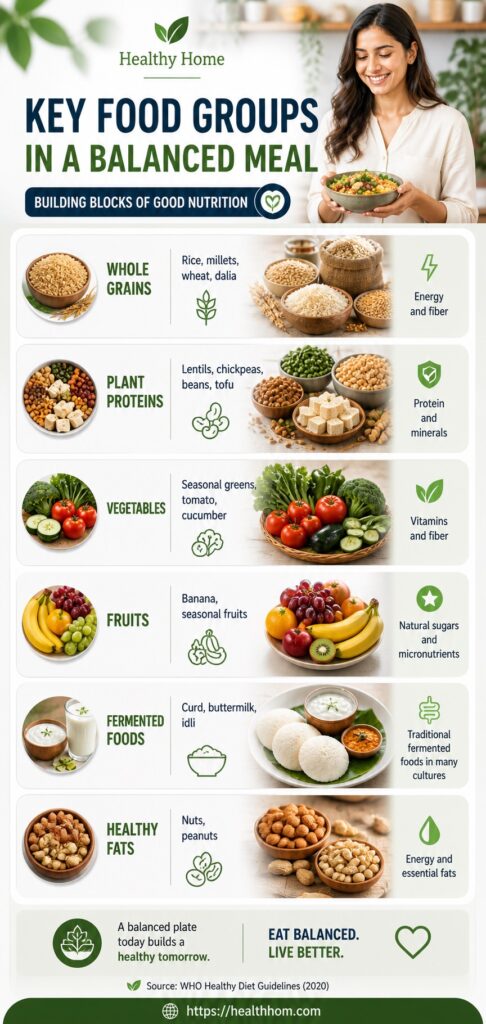
Key Food Groups in a Balanced Meal
| Food Group | Examples in This Meal Plan | Nutritional Role |
|---|---|---|
| Whole grains | Rice, millets, wheat, dalia | Energy and fiber |
| Plant proteins | Lentils, chickpeas, beans, tofu | Protein and minerals |
| Vegetables | Seasonal greens, tomato, cucumber | Vitamins and fiber |
| Fruits | Banana, seasonal fruits | Natural sugars and micronutrients |
| Fermented foods | Curd, buttermilk, idli | Traditional fermented foods in many cultures |
| Healthy fats | Nuts, peanuts | Energy and essential fats |
Source: WHO Healthy Diet Guidelines (2020)
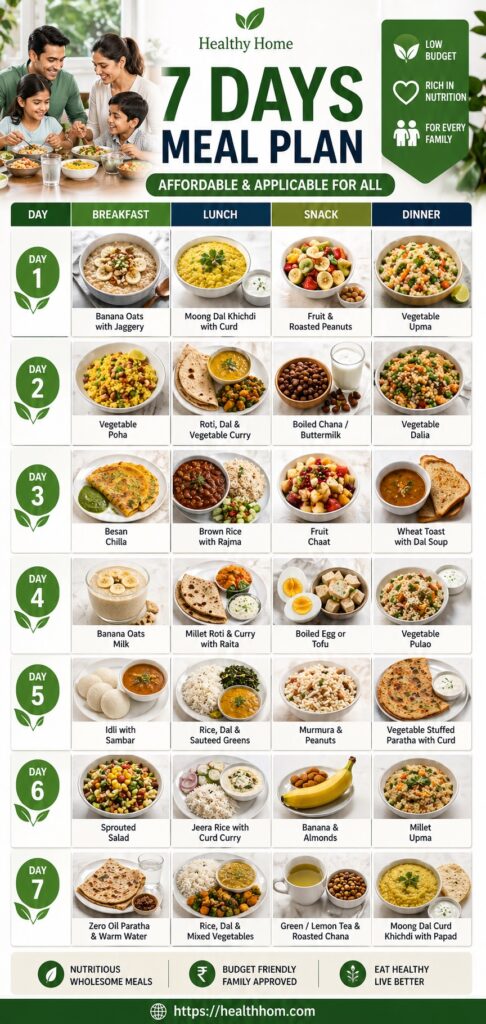
7 Days Meal Plan which are affordable & applicable for all
Every day of this meal plan is including the breakfast, lunch, snack and dinner. Such meals are having low budget including variety produces & rich in nutrition.
Overview of the 7-Day Meal Plan
| Day | Breakfast | Lunch | Snack | Dinner |
|---|---|---|---|---|
| Day 1 | Banana oats with jaggery | Moong dal khichdi with curd | Fruit & peanuts | Vegetable upma |
| Day 2 | Vegetable poha | Roti, dal & vegetable curry | Boiled chana / buttermilk | Vegetable dalia |
| Day 3 | Besan chilla | Brown rice with rajma | Fruit chaat | Wheat toast with dal soup |
| Day 4 | Banana oats milk | Millet roti & curry | Egg or tofu | Vegetable pulao |
| Day 5 | Idli with sambar | Rice with dal & greens | Murmura & peanuts | Vegetable stuffed paratha |
| Day 6 | Sprouted salad | Jeera rice with curd curry | Banana & almonds | Millet upma |
| Day 7 | Vegetable paratha | Rice with dal & vegetables | Green tea & roasted chana | Moong dal khichdi |
Day 1:
- Breakfast: Banana ripen which is mixed with jaggery & oats. This meal provides fiber and iron, nutrients that help support energy levels.
- Lunch time: Kichidi preferable made from Moong dal & curd. It is a one-pot meal of rice & lentils which are served with probiotic rich curd.
- Snack: Any types of locally available seasonal fruit with roasted peanuts with less oils.
- Dinner: Upama mixed in green vegetables & lemon juice to be added. It is semolina-based diet having full of veggies with different taste, colour & flavor.
Day 2:
- Breakfast: Poha (Raw rice prepared after roasting which are flat in nature) may be cooked with peas, mustard seeds with lemon juice.
- Lunch time: Roti made with wheat, Mixed curry prepared with different types of green vegetables and yellow dal.
- Snack: Black Chana (boiled) or may be a full glass of buttermilk.
- Dinner: Dalia with Vegetable which are also a type of broken wheat.
Day 3:
- Breakfast: Gram flour which is locally called as Besan in Indian language and chilla with chutney made from coriander leaf. It is rich in high protein & also free of gluten.
- Lunch time: First green salad and then brown cooked rice Brown along-with Rajma curry which are locally nutritious food.
- Snack: Salad made with different types of local fruits which is called as “Fruit Chaat” & sprinkled with some lemon juice & black salt for taste.
- Dinner: Whole wheat bread which are toasted for taste including Hot soup made preferably with Moong dal.
Day 4:
- Breakfast: Puree of Banana Ripen & oats with Milk. Milk may be focused on plant based as per availability.
- Lunch time: Roti made with different types of Millet-like Finger Millet (Ragi /Mandia), Pearl Millet (Bajra) etc. with Tomato & Potato curry and cucumber raita/salad.
- Snack: For non-veg people, Boiled egg with Coconut & water. If vegetarian tofu may be taken as snack.
- Dinner: Pulao with different green vegetables along-with curd.
Millets are nutrient-dense grains, explore their full millet nutrition benefits and uses.
Day 5:
- Breakfast: Fermented breakfast viz. Idli, Sambar, etc. It is the best idea for improving gut health.
- Lunch time: Cooked rice & different types of Dal (pulses) preferably Chana Dal along-with sauteed seasonal greens pulses.
- Snack: Murmura which is a type of raw rice puffed-in pot and little roasted peanuts with zero oil.
- Dinner: Paratha (made with wheat & other pulses) stuffed with green vegetables/ panner/mushroom etc. with curd.
Fermented foods like curd and idli play a key role, discover the best fermented foods for gut health and digestion.
Day 6 :
- Breakfast: Sprouted green salad with pulses, sweet corn with boiling and sprinkled with chaat masala & black salt
- Lunch time: cucumber and onion salad, jeera rice with curd curry (yogurt-based) fishes.
- Snack: Ripen Banana along-with some almonds pieces
- Dinner: Upama cooked with many different types of millets viz. Foxtail Millet with green vegetables.
Day 7:
- Breakfast: Zero oil Paratha (made with different readily available pulses at local level) with stuffed green vegetables with little pickle and a glass of warm water.
- Lunch time: Cooked white rice, dal with different locally available pulses with mixed vegetable curry.
- Snack: Green Tea / Lemon tea may be taken without oil roasted chana which is a kind of pulses
- Dinner: Yellow moong dal curd khichidi and without oil fried papad.
Different Nutritional Benefits
- Fiber rich contents: Grains preferably whole, different legumes & green vegetables which actually supports digestion and also helps to reduce bad cholesterol in the body and improves the lipid profile.
- Readily available Plant Proteins: Lentils, beans & and chick-peas which generally offers a qualitative source of different protein for human.
- Macronutrients balancing: Every meal plan ensures a balancing carbohydrate, proteins & healthy fats
- Rich in Micronutrient foods: Such types of diversified fruits, green vegetables included in the meal plan covers essential vitamins & minerals which are required for human. Including anti-inflammatory foods can help reduce chronic disease risk and support long-term wellness.
- Foods Fermented with: Curd, buttermilk and idli which is a kind of South Indian Food. These foods support the gut health.
Including fiber-rich foods also supports digestion, learn more about gut health improvement with these gut-friendly foods.
Common Plant Protein Foods
| Food | Example Dishes | Source |
|---|---|---|
| Lentils | Dal, khichdi | Indian traditional diets |
| Chickpeas | Chana curry, roasted chana | FAO Plant Protein Guide (2021) |
| Beans | Rajma curry | WHO Healthy Diet Guidelines (2020) |
| Soy products | Tofu | Harvard Nutrition Source (2022) |
| Peanuts | Roasted snacks | USDA Nutrition Database (2022) |
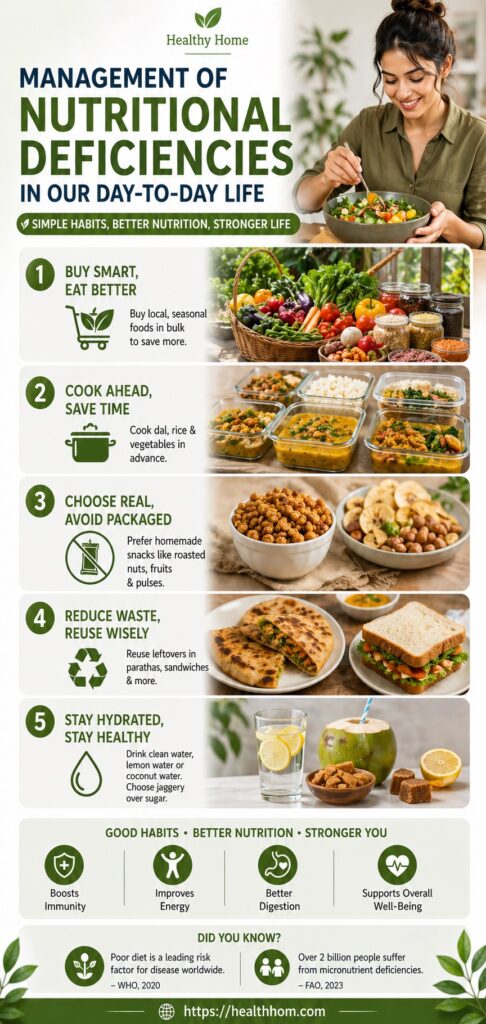
Management of nutritional deficiencies in our day-to-day life.
- Purchase the foods: Which are locally & seasonally available, easily accessible & seasonal produces in bulk to minimize cost.
- Cook at a time: You may cook different staple foods viz. dal/pulses, rice, & vegetable curries in advance.
- Minimizing utilization of Packaged Foods: We may prefer the home-made snacks which are made with zero oil roasting process like nuts or fruits or pulses instead of going to purchase the packed foods which are heavily made with oils.
- Recycling & Re-using: We may use our leftover vegetable curries in parathas made from wheat or may be sandwiches which is tasty and cost effective also.
- Hydration needed: Drink enough clean & safe water, lemon water or coconut water instead of many types of drinks prepared with sugar. We may prefer jaggery instead of sugar.
Diet not only impacts physical health but also influences food and mental well-being significantly.
Affordable Nutrient-Dense Foods
| Food | Why It Is Affordable | Common Nutritional Value |
|---|---|---|
| Lentils and pulses | Long shelf life | Plant protein and fiber |
| Seasonal vegetables | Locally produced | Vitamins and minerals |
| Whole grains | Staple foods in many regions | Energy and fiber |
| Eggs | Widely available | Protein and micronutrients |
| Peanuts | Low cost compared to other nuts | Healthy fats |
Source: FAO Affordable Nutrition Guidance (2021)
Proper sleep also supports metabolism, learn how to improve sleep and nutrition balance naturally.
Benefits of Weekly Meal Planning
| Benefit | Explanation |
|---|---|
| Cost control | Helps reduce food spending |
| Reduced food waste | Planned ingredient use |
| Balanced diet | Inclusion of different food groups |
| Time saving | Fewer daily food decisions |
| Family routine | Encourages shared meals |
Source: Mayo Clinic Healthy Meal Planning Guide (2022)
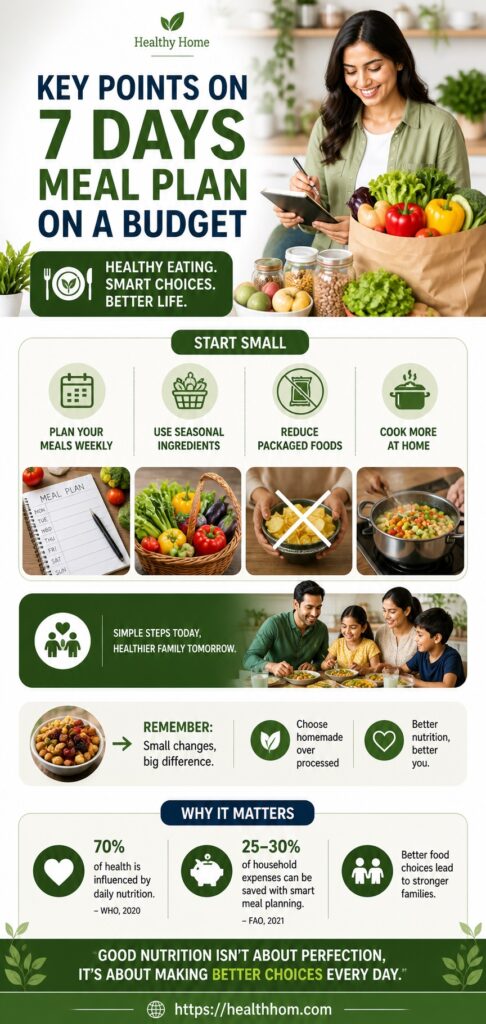
Key Points:
Now a days, giving importance to healthy eating doesn’t mean a luxury one, but it’s a necessary part for everyone to be healthy.
If you refer the above 7 day meal plan, within a limited cost, you can be able to prepare meals which are nutritious, tasty and natrue-friendly. Only the key point is to choose the right food with consistency.
Start with a small habit like:
- Plan your meals weekly
- Use seasonal ingredients
- Reduce packaged foods
- Cook more at home
Subsequently, these simple steps may improve your diet pattern and also be able to build overall health of your family with low cost budget.
One important is that, even one smaller change like replacing the processed snacks with homemade food may make a difference.
As the quality nutrition is not bout the perfection, but the better healthy choice everyday.
Along with nutrition, healthy lifestyle habits like outdoor activity enhance overall well-being.
Accessible nutrition is not just a food, but also it defines the health equity, dignity & opportunity to everybody for thriving. Hence, let start with promise that a good nutritious food is a right for all & not a luxury.
Want a printable version of this meal plan? Download the PDF and follow it daily.
FAQs:
Is this 7-day food plan affordable to poor families?
Is it possible to adhere to this meal plan by vegetarians?
Is this a balanced nutrition meal plan?
Will this meal plan be appropriate to children and adolescents?
Is this meal plan viable to diabetes people?
Related Health Articles from Healthy Home
- What is a balanced daily meal plan? – Healthy Home – Trusted Health Tips for Kids, Teens & Families (healthhom.com)
- 8 Best Fermented Food for Gut Health in Adolescents – Healthy Home – Trusted Health Tips for Kids, Teens & Families (healthhom.com)
- 10 Evergreen Gut Friendly Foods That Support Gut Health Naturally – Healthy Home – Trusted Health Tips for Kids, Teens & Families (healthhom.com)
- How food affects mental health and Emotional Well-Being – Healthy Home – Trusted Health Tips for Kids, Teens & Families (healthhom.com)
- What is millet ? Nutrition, Benefits, Uses & Side Effects (healthhom.com)
Trusted References and Research Sources: