Last Updated on June 13, 2026 by Bibhu Ranjan Mund, MPH
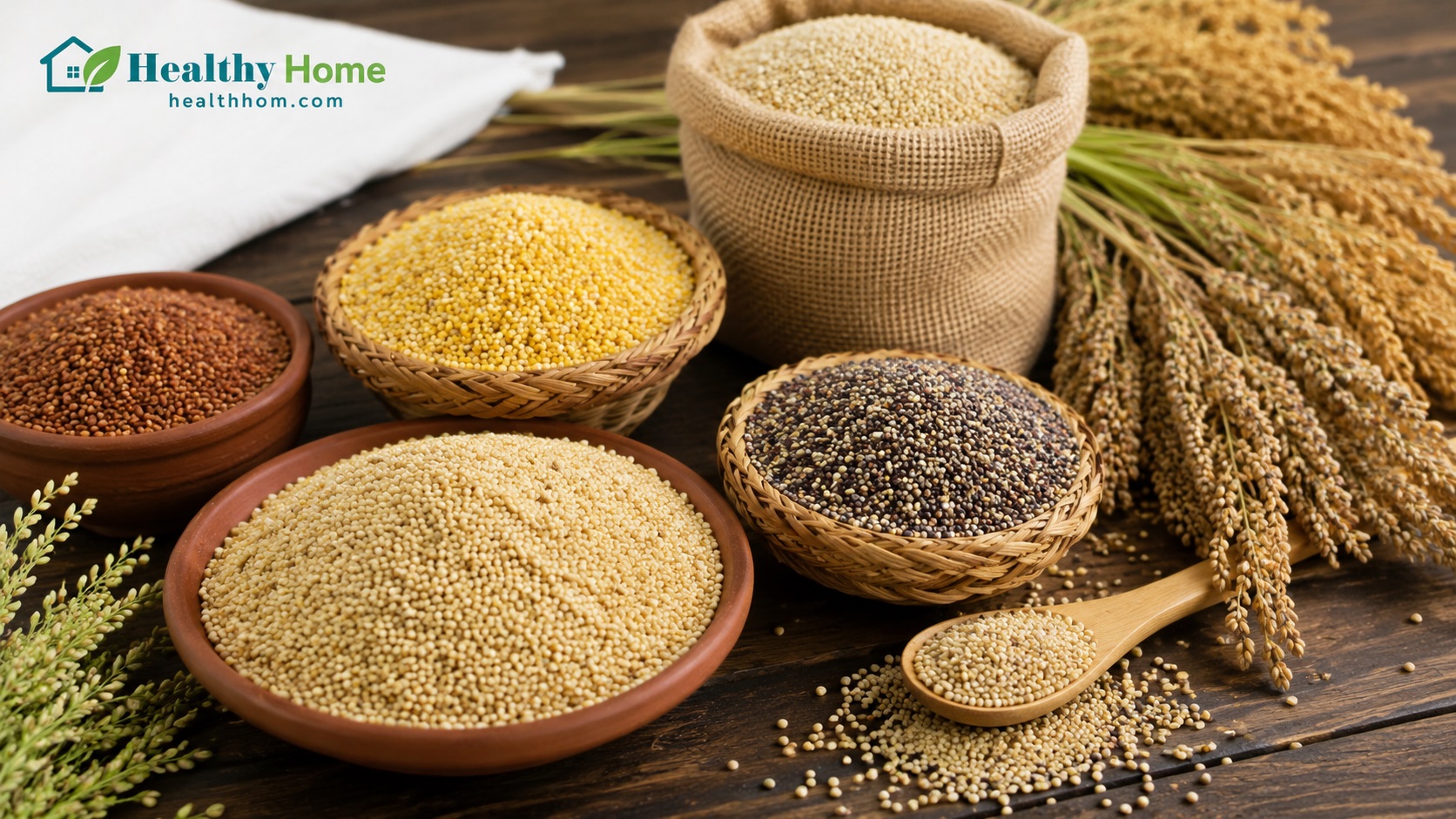
What is millet? Discover its nutrition, health benefits, types, uses & side effects. Learn why millets are a smart alternative to rice & wheat.
Reviewed by Bibhu Ranjan Mund, MPH (Public Health Expert) with experience in maternal, infant, child, and adolescent health programs. Content is based on evidence-informed guidelines aligned with organizations such as the World Health Organization, UNICEF, Centers for Disease Control and Prevention, and National Institutes of Health.
Medical Disclaimer: This content is for informational and educational purposes only and is not intended as medical advice, diagnosis, or treatment. Always seek the advice of a qualified healthcare professional regarding any medical condition or concerns.
Affiliate Disclosure: Some of the products recommended in this article may contain Amazon affiliate links. If you make a purchase through these links, we may receive a small commission. This supports our platform and helps us continue sharing reliable health information, without affecting your purchase price.
Introduction:
Now-a-day, millets are not only an “ancient grains” and a real comeback for the modern society.
Accordingly the publication of Food and Agriculture Organization (FAO, 2023), millets are now cultivated in more than 130 countries due it’s role in fighting against diabetes, heart diseases inlcuding climate change.
But, the important point may come to the mind that, do millets actually healthier than rice and wheat, or just new trend of food?
If you are interested in changing your healthy habits like controlling body weight & blood sugar, then millets may be an alternative option.
In this article, you will find-out what is millet, its reality, nutritional value, different types of millets, possible side effects and simple ways to include in your diet schedule.
Quick Facts
| Quick Fact | Insight |
|---|---|
| Millets are ancient grains | Cultivated for thousands of years |
| Climate-friendly crop | Requires less water |
| Naturally gluten-free | Suitable for gluten-free diets |
| Nutrient-rich grains | Provide fiber, minerals and protein |
Source: FAO Millets Overview 2023
Quick Summary:
- Millets are ancient, gluten-free grains rich in fiber and nutrients
- Grown in 130+ countries (FAO, 2023) and support food security
- Help with blood sugar control, heart health, and digestion
- Common types: Ragi, Bajra, Jowar, Foxtail
- Can be used in roti, dosa, porridge, and snacks
- Eco-friendly crop (low water, climate-resilient)
- Best consumed in moderation as part of a balanced diet
What is millet ?
Millet are a type of small seeds/grain of the Poaceae or grass family. From ancient time, the millet seeds have been cultivated and are extensively grown in Africa & Asia regions. It is also a type of cereal which is now becoming a trendy food & awareness about their nutritional value with many environmental benefits for human being.
Including millets in your routine diet can improve overall nutrition, learn how to plan a balanced daily meal plan for better health.
Global Importance of Millets
| Indicator | Global Insight | Source |
|---|---|---|
| Countries where millets are widely cultivated | Over 130 countries | FAO Global Millet Report 2023 |
| Major millet producing regions | Asia and Africa | FAO Global Millet Report 2023 |
| India’s share in global millet production | Around 40% | Government of India Millets Mission Report 2023 |
| Year declared International Year of Millets | 2023 | United Nations International Year of Millets 2023 |
Major gift to human as theses types of millet helps to keep good heart health and regulates blood sugar level. The millets are a good healthy alternative because of their fiber level, protein, vitamins, minerals and low glycemic index.
Foods like millets play an important role in non-communicable diseases prevention, including diabetes and heart disease.
Different sorts of Millets exist:
Millets Compared With Other Cereals
| Feature | Millets | Rice | Wheat |
|---|---|---|---|
| Fiber content | Generally higher | Lower | Moderate |
| Glycemic index | Usually lower | Higher | Moderate |
| Water requirement for cultivation | Low | High | Moderate |
| Climate resilience | High | Moderate | Moderate |
Source: ICRISAT Millet Research Review 2022
Choosing whole grains like millets supports healthy dietary habits and long-term wellness.
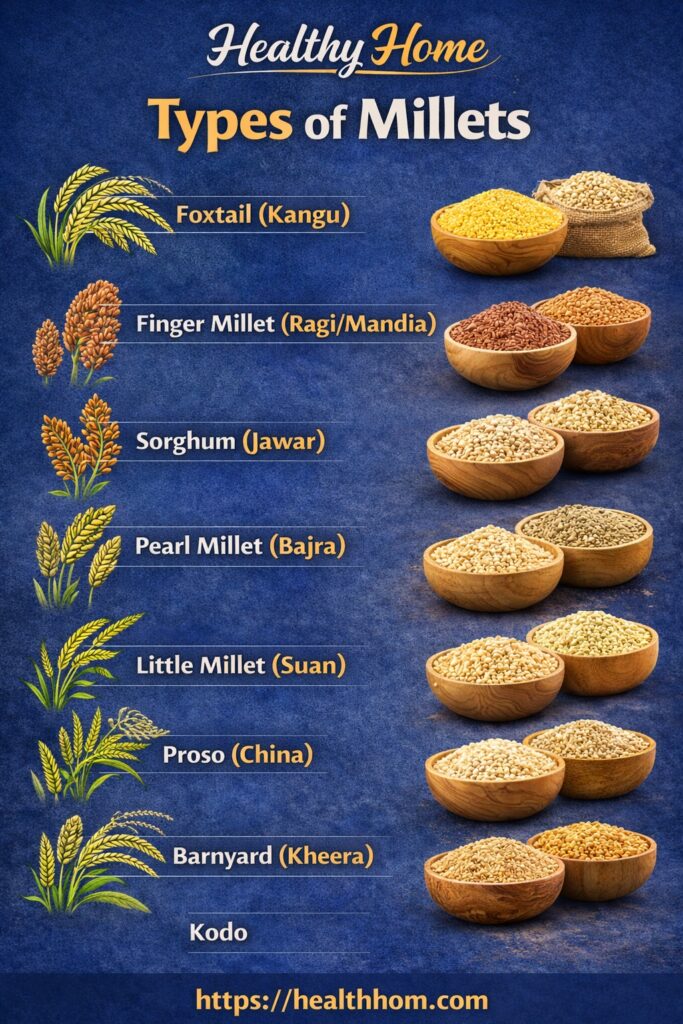
Types of Millets:
- Foxtail (Kangu) – May review Amazon
- Finger Millet (Ragi/Mandia)
- Sorghum(Jawar)
- Pearl Millet(Bajra)
- Little Millet (Suan) – May review Amazon
- Proso (China)
- Barnyard (Kheera) – May review Amazon
- Kodo
Millets are among the best healthy foods to eat daily for maintaining balanced nutrition.
Common Millet Varieties
| Millet Type | Scientific Name | Common Region of Use |
|---|---|---|
| Foxtail Millet | Setaria italica | Asia |
| Finger Millet | Eleusine coracana | India & Africa |
| Pearl Millet | Pennisetum glaucum | Africa & India |
| Sorghum | Sorghum bicolor | Global |
| Little Millet | Panicum sumatrense | South Asia |
| Barnyard Millet | Echinochloa frumentacea | Asia |
Source: FAO Millet Diversity Report 2022
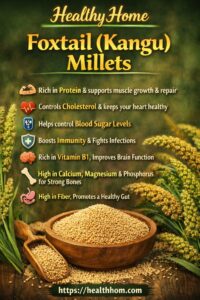
1. Foxtail (Kangu):
- It is Rich in Protein & also support for growth of muscles with repair.
- Controls the level of Cholesterol and thus keep good heart health.
- Helps control your blood sugar levels
- Builds up your body’s resistance & helps you battle infections.
- Rich in Vitamin B1, which improves cognition of our brain & mental ability.
- Contains calcium, magnesium, phosphorus which all help the body build strong bones
- It is high in fiber and so leads to a healthy gut
High-fiber foods like millets support digestion, discover more foods that improve gut health naturally.
2. Finger Millet (Ragi/Mandia)
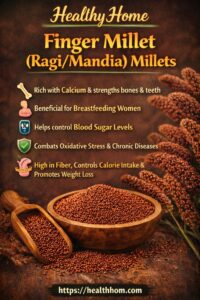
- It is Rich with Calcium and also give strengths to our bones & teeth
- Beneficial for the breastfeeding women.
- Controlling the level of Blood Sugar in body
- It is also helping to fight against oxidative stress & to reduce the risk of many chronic diseases
- Rich in high fiber keeps us full for longer time which reduces the un-required calorie intake & thus promoting a weight loss.
Nutrient-rich grains like ragi can help prevent deficiencies, read more about iron-rich foods for anaemia prevention.
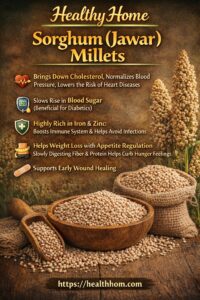
3. Sorghum(Jawar)
- The high fiber content of barley brings down cholesterol, normalizes blood pressure, and lowers the risk of heart diseases.
- People with diabetes will find sorghum beneficial as it slows the rise in blood sugar.
- It is highly rich in iron & zinc. It boosts the immune system of our body & helps to avoid many infections.
- Slowly digesting fiber & protein helps as hungry feelings which may ruin the day ahead, & helps in weight loss with appetite regulation.
- It may supports in early management of small wounds.
4. Pearl Millet(Bajra)
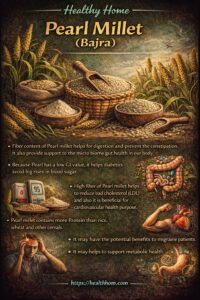
- Fiber content of Pearl millet helps for digestion and prevent the constipation. It also provide support to the micro biome gut health in our body
- Because Pearl has a low GI value, it helps diabetics avoid big rises in blood sugar.
- High fiber of Pearl millet helps to reduce bad cholesterol (LDL) and also it is beneficial for cardiovascular health purpose.
- Pearl millet contains more Protein than rice, wheat and other cereals.
- It may have the potential benefits to migraine patients.
- It may helps to support metabolic health
Low glycemic foods are essential, learn about the ideal diet for diabetes prevention and control.
5. Little Millet (Suan):
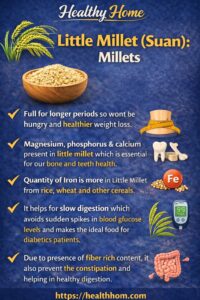
- Full for longer periods so wont be hungry and healthier weight loss
- Magnesium, phosphorus & calcium present in little millet which is essential for our bone and teeth health.
- Quantity of Iron is more in Little Millet from rice, wheat and other cereals.
- I helps for slow digestion which avoids sudden spikes in blood glucose levels and makes the ideal food for diabetics patients.
- Due to presence of fiber rich content, it also prevent the constipation and helping in healthy digestion.
6. Proso (China) :
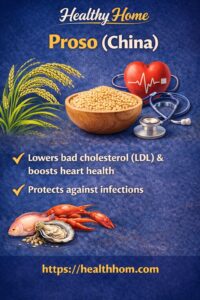
- It encourages to lower the bad cholesterol (LDL) and supports the cardiovascular well-being due to high fiber content.
- The more these vital minerals found in seafood, the more natural defense that you have against infections.
Nutritional Highlights of Different Millets
| Millet | Key Nutritional Highlight |
|---|---|
| Foxtail millet | High dietary fiber |
| Finger millet | High calcium content |
| Pearl millet | Good source of iron |
| Sorghum | Rich in antioxidants |
| Little millet | Good source of minerals |
| Barnyard millet | High fiber |
Source: ICMR Nutrition Review 2021
Nutrient-rich diets also support cognitive function, understand how nutrition affects brain health.
7. Barnyard (Kheera) :
- Rich in protein and fiber and helps to overall development of human
- It is also good to liver health
- More fiber content helps for smooth digestion & prevent the constipation.

8. Koto Millet:
- Kodo is rich with antioxidant property which helps to combat oxidative stress & inflammation in the body for which it lowers the risk of many chronic diseases.
- The fiber content of Kodo millet improves digestion & also helps to reduce bloating with constipation.
- It helps to prevent the pain during Menstruation of women
- It traditionally believed to strengthen the nervous system, but consult the Doctor.
Important: Millets are good provided that they are consumed as a part of the balanced and diversified diet. These are are not a replacement of medical care.

Nutritional Composition of Millets (Approximate per 100 g)
| Nutrient | Average Value | Source |
|---|---|---|
| Energy | 330–370 kcal | ICMR Nutrient Composition of Indian Foods 2021 |
| Protein | 7–11 g | ICMR Nutrient Composition of Indian Foods 2021 |
| Dietary fiber | 7–12 g | ICMR Nutrient Composition of Indian Foods 2021 |
| Iron | 3–8 mg | FAO Food Composition Table 2022 |
| Calcium | 10–350 mg | ICMR Nutrient Composition of Indian Foods 2021 |
Environmental Benefits of Millets :
- All types of millet needs fewer quantity of pesticides which enables sustainable agronomic practices in our environment.
- It can grow in very low nutrient soils & lowers utilization of chemical fertilizers in society.
- Millet is also an eco friendly alternative which promotes sustainability more likely
- Since cotton uses little water, it is a good crop for dry communities.
- Due to it short growing cycle, it helps the food security and early cultivation.
Choosing eco-friendly foods like millets contributes to a sustainable healthy lifestyle
Environmental Benefits
| Environmental Factor | Millet Advantage |
|---|---|
| Water requirement | Lower than many cereal crops |
| Climate resilience | Tolerant to drought |
| Soil adaptability | Can grow in poor soils |
| Growing period | Short crop cycle |
Source: FAO Climate-Resilient Crops Report 2022

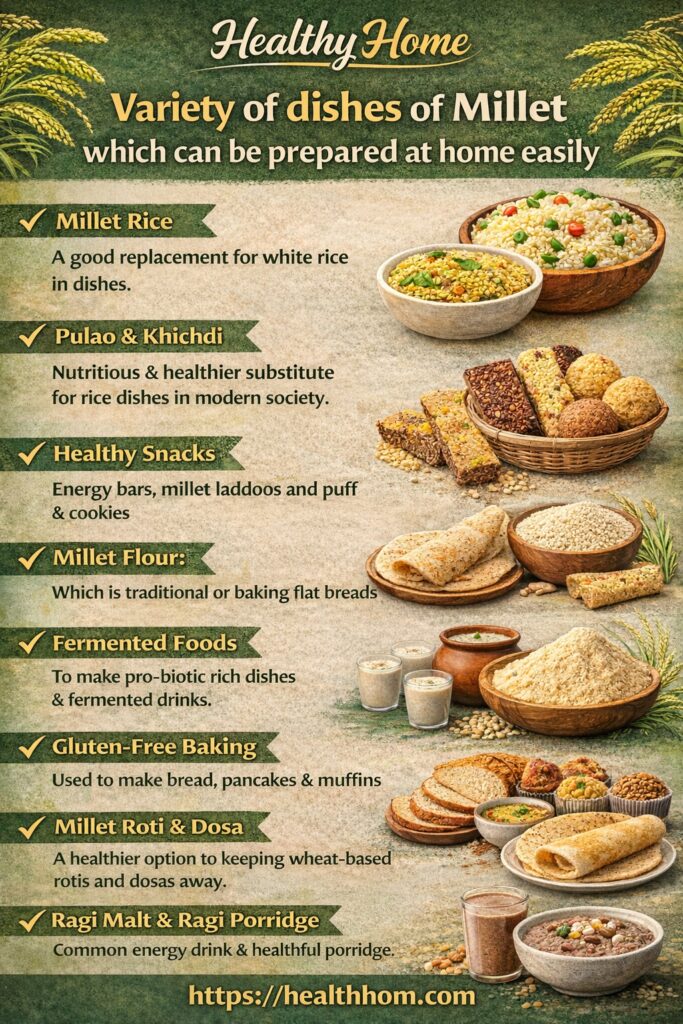
Variety of dishes of Millet which can be prepared at home easily:
- Millet Rice – A good replacement for white rice in dishes.
- Pulao & Khichdi – It is nutritious & healthier substitute for rice dishes in our modern society.
- You can enjoy energy bar varieties, millet laddoos and puff and cookies as healthy snacks.
- Millet Flour: Which is a traditional or baking flat breads
- Snacks prepared in Millet – Different kinds of ladoos, puffs & energy bars can be prepared..
- Fermented Foods – To make pro-biotic rich dishes & for traditional fermented drinks to take in our modern society.
- Baking with Gluten Free – It is used to make bread, pancakes & muffins.
- Millet Roti and Dosa – A healthier option to keeping wheat-based rotis and dosas away.
- Ragi Malt – A very common energy drink to enhance stamina and heat immunity.
- Ragi Porridge: A healthful choice for breakfast and particularly suitable for infants and aged people.
Try incorporating these grains into your meals with these healthy millet recipes for daily use.
Comparison Table: Millets vs Refined Grains
| Feature | Millets | Refined Grains |
|---|---|---|
| Fiber | Higher | Lower |
| Processing | Minimal | Highly processed |
| Nutrient retention | Higher | Reduced |
| Glycemic response | Generally slower | Often faster |
Source: WHO Healthy Diet Fact Sheet 2023
Common Culinary Uses of Millets
| Millet Dish | Description |
|---|---|
| Millet rice | Substitute for regular rice |
| Millet roti | Flatbread using millet flour |
| Millet porridge | Breakfast dish |
| Millet dosa | Fermented savory pancake |
| Millet snacks | Laddoos, puffs, cookies |
Source: National Institute of Nutrition (NIN) Recipes Guide 2022
Fermented millet dishes also provide probiotics, explore the benefits of fermented foods for gut health.
Read more What is a balanced daily meal plan?
Key message :
Millets have returned for the new generation which actually a very good step towards a better health & sustainable future.
As per the global data published from World Health Organization and FAO (2023), if you use the nutrient-rich millets as a part of balanced diet, it may support the heart health, improve the digestion and help to manage the blood sugar level.
But, every diet must be taken in moderation and like this Millets should be taken in moderation with a proper cooked or preparation. The actual benefit may be seen not in overnight but gradually by using consistently.
Now start with a simple step like just replace only one meal a day with any one millet and may notice the difference in long-term.
In this modern lifestyle including so many environmental challenges, millets shouldn’t be thought as just a food as it is a practical solution for both the individual health and earth.
For a broader understanding, explore our complete guide to healthy eating and nutrition.
FAQs:
Q1. What are millets?
Millets are low seeded grains which are of the Poaceae grass family prevalent in Asia and Africa. They are quite nutritious and also gluten free.
Q2. Are millets good for health?
Yes. The millets are source of fiber, protein, minerals and B-vitamins. They aid in digestion, cardiovascular health, maintenance of even energy levels and balanced nutrition.
Q3. Are the millets beneficial in the management of weight?
Fiber is abundant in millets and it makes you feel full of longer and might assist in maintaining a balanced diet coupled with healthy lifestyle.
Q4. Does millet is good for the skin and hair?
Millets are known to be rich in antioxidants, vitamins, and minerals that can promote well-being in general such as skin and hair condition.
Q5. Will rice or wheat be substituted with millets?
Yes, one can eat millets as an alternative to rice and wheat which may be used in most recipes.
Q6. Can we eat millets every day?
Yes, there can be a daily consumption of moderation millets as a balanced diet.
Q7. Are millets gluten-free?
Majority of the millets are naturally gluten-free, so they can be used by persons that have gluten intolerance. Nevertheless, medical dietary requirements should be attended to by a healthcare professional.
Q8. Are there any side effects?
Millets are generally safe. Over consumption has the risk of leading to gastrointestinal discomfort among other people. Individuals who have thyroid disease or other chronic diseases need to seek a doctor before changing their major diets.
Related Health Articles from Healthy Home
- Healthy & Easy Millet Recipes – Nutritious Meal Ideas
- Best Natural Foods to Heal Your Gut Naturally
- Anemia in Adolescents – Symptoms, Causes & Prevention
- How Food Affects Mental Health – Nutrition & Brain Health
- Iron-Rich Foods During Pregnancy – Nutrition Guide for Mothers
Trusted References and Research Sources:High Protein Indian Diet Plan: 7-Day Family Meal Plan with Affordable Protein FoodsHealthy Nutrition Guide for Families : Balanced Diet, Gut Health and Weekly Meal PlanHealthy Living Guide for Families : Nutrition, Sleep and Daily Wellness Habits11 Iron Rich Foods During Pregnancy : Benefits and Healthy Meal IdeasWhat is a balanced daily meal plan? Nutrition Guide and 7-Day Diet Plan
- Millet Consumption & Health Benefits – PubMed Central
- Nutritional & Health Benefits of Millets – Government of India
- Health Benefits of Millet – WebMD
- The Story of Millets – Government of India
- Foxtail Millet – Properties, Processing & Health Benefits (ResearchGate)
- Pearl Millet – Nutrition & Health Review (ResearchGate)
- What is Millet? Benefits & Nutrition – Healthline
- Millet Nutrition & Uses – WebMD


About the Author – “Bibhu Ranjan Mund”, Master in Public Health (MPH) from IIHMR University, Jaipur (Rajasthan) has more than 18 years of experience in Public Health activities in maternal health, child health, adolescent health, nutrition and community wellness programs under National Health Mission, Health & Family Welfare Department, Odisha. He is the founder of “Healthy Home” and translates the evidence based public health information into a practical source so that families may able to apply in everyday life. All the information are for educational purposes only and not replaces the professional medical advice. ORCID Researcher ID – 0009-0003-0158-4992. Connect LinkedIn – https://www.linkedin.com/in/bibhu-ranjan-mund-b72171358/