Choline Rich Foods for Kids: Benefits, Daily Needs and Meal Plan
Discover the best choline rich foods for kids to support memory, focus and healthy brain development. Includes daily requirements, meal plan and expert guidance.
Reviewed by Bibhu Ranjan Mund, MPH (Public Health Expert) with experience in maternal, infant, child, and adolescent health programs. Content is based on evidence-informed guidelines aligned with organizations such as the World Health Organization, UNICEF, Centers for Disease Control and Prevention, and National Institutes of Health.
Medical Disclaimer: This content is for informational and educational purposes only and is not intended as medical advice, diagnosis, or treatment. Always seek the advice of a qualified healthcare professional regarding any medical condition or concerns.
Introduction:
Almost every parent hopes their child should perform well in school including better focus, increase memory power and stay mentally active.
As per the present scenario of increasing internet facility, online classes, screen addictions along-with academic pressures, most of the children are struggling with consistent learning process, attention and memory. Maximum of these are linked with the nutrition which plays a key role behind the actual scene.
Out of all the essential nutrient, one overlooked is choline.
As per the National Institutes of Health (NIH)- 2023, choline is also essential for brain development, memory formation and functioning of neuro-transmitter, especially during the growing years of children. Studies shows that many children are not meeting the daily choline requirements at all.
In the real life, most of the parents are focusing on calcium, iron and other vitamins for their children, but overlooking the choline rich foods for kids which is the “silent brain nutrient” that actually helps to focus learning ability including cognitive performance.
You don’t need more expensive supplements or complicated diets for choline fulfillment.
This article will discuss some of the simple and practical ways for inclusion of choline-rich foods in everyday meals along-with a detailed 7-day meal plan having easy recipes and expert-backed insights which actually works better.
Proper nutrition plays a vital role in early growth, as explained in this child health and development guide for parents.
Choline plays an important role in brain development and neurotransmitter function, which are essential during childhood growth.”
— National Institutes of Health Office of Dietary Supplements, 2023
Choline & Kids: What Parents Should Know:
- Choline supports in the normal development of the brain and memory in growing children.
- Children aged between 4-8 years require approximately 250mg/day.
- Eggs are said to be one of the richest natural sources (147 mg per egg).
- Vegetables such as beans, tofu, peanuts, milk, broccoli and quinoa are also having choline.
- Daily needs can be fulfilled by a balanced meal plan on a weekly basis.
- Using of supplement should always be prior consultation with a pediatrician
- Some parents may observe improvements in dietary quality and daily routines when nutrient-rich foods are regularly taken.
- Choline is also associated with proper sleep, hydration and balanced diet.
Why Nutrition Experts Discuss Choline for Children
Choline has been studied for its functions on brain development especially at early childhood and adolescence stages. As per a research published by the National institutes of Health, Office of Dietary Supplements, choline plays a key role in:
- Cell membrane structure
- Production (acetylcholine) of neuro-transmitters.
- Brain signaling processes
Proper consumption during childhood facilitates normal development and neural development.
Following a healthy nutrition guide for families ensures children receive essential nutrients like choline for brain development.
A Common Concern Many Parents Share
During my community nutrition awareness at Rayagada (Odisha), a parent of 8 year old boy worry about his son. He was spending in school hour, tution classes, online learning time but can’t concentrate study at home.
At first, the family thought that it was due to more screen time. But, when it was found that the son was frequently skipping breakfast and protein-rich food were not added in daily meals.
After the discussion, the family started to add eggs, milk, roasted peanuts & beans regularly and subsequently the parents realized the child is more energetic and consistent with his studies.
Such types of experiences show that the brain health is influenced by many factors like quality sleep, physical activity, emotional well-being and balanced nutrition.
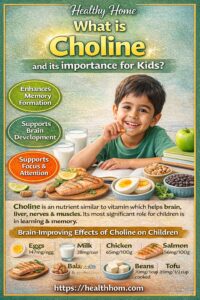
What is Choline and its importance for Kids?
Choline is a nutrient often grouped with B-vitamins because of its similar biological functions.
The Brain-improving effects of Choline on children.
1. Help to Enhance the Memory Formation
Choline is required to make acetylcholine which is the neuro-transmitter that supports memory, learning and attention.
2. Supports Brain Development
The Choline supports in creating the cell membrane structure and in accelerating the processing of the brain, particularly in children between 4-14 years.
3. May support Concentration and Duration of attention.
Adequate choline intake supports normal brain function, learning and memory.
4. Increases Mood and Mood Equilibrium.
When the brain is nourished, it can deal with stress, anxiety and exam pressure.
5. Guards the Brain against the tiresome.
Supports normal neuro-transmitter function, particularly among the children whose school days are lengthy or those who have been exposed to screens.
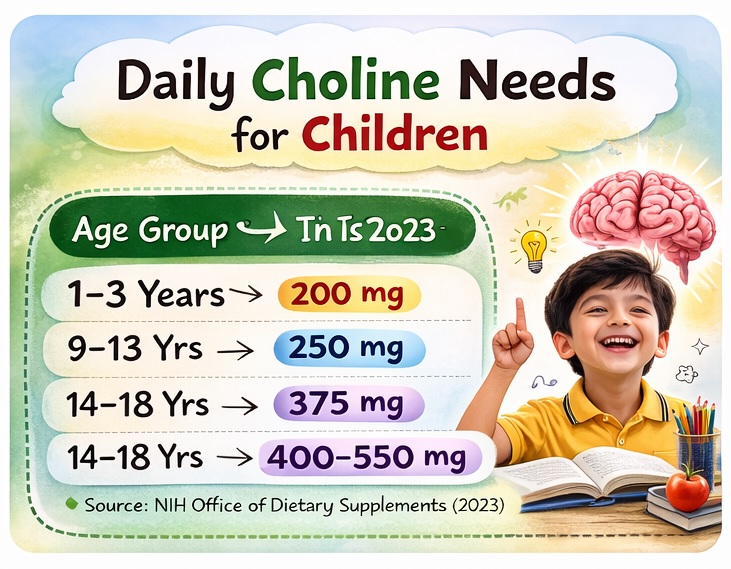
How much Choline do kids need?
Daily intake which is to be taken based on age group:
| Age Group | Recommended Intake | Why It Matters |
|---|---|---|
| 1–3 years | 200 mg/day | Early brain growth |
| 4–8 years | 250 mg/day | Memory & school readiness |
| 9–13 years | 375 mg/day | Learning & focus |
| 14–18 years | 400–550 mg/day | Cognitive maturity |
The majority of children nowadays are exposed to half or even a quarter of their daily needs. This impairment may affect memory, learning rate and concentration.
According to the National Institutes of Health (NIH), adequate intake of choline for children aged 4–8 years is 250 mg/day.
A well-structured balanced daily meal plan helps to ensure children meet their daily choline and overall nutrient requirements.
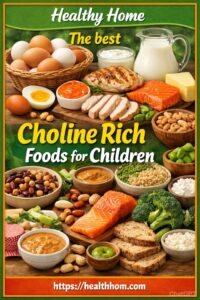
The best choline rich foods for chilren.
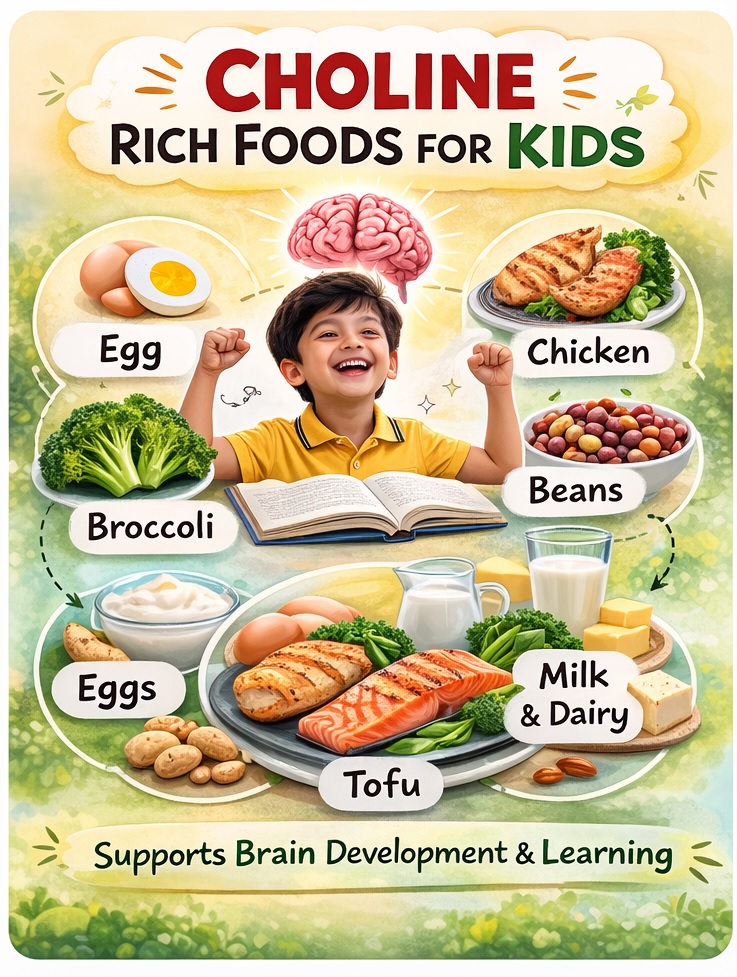
These are the strongest, child-friendly, foods having sources of Choline:
1. Eggs: Superfood to improve memory in children.
A single egg has 147 mg of chlorine, which is almost a half of the amount young children need on a daily basis.
The reason why eggs are the ideal brain food:
- High-quality protein
- Fats that are necessary in the brain.
- Fast & multifunctional
Best ways to serve eggs:
- Boiled
- Omelette with veggies
- Scrambled with spinach
- Egg sandwich
- Boiled egg & toasted French
3-5 eggs a week may lead to a significant increase in choline levels.
Parent Quick Tips : Add 1 egg + 1 handful peanuts daily = ~170 mg choline.
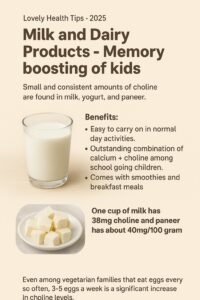
2. Milk and Dairy Products
Small and consistent amounts of choline are found in milk, yogurt and paneer.
Benefits:
- Easy to have in normal day activities.
- Outstanding combination of calcium & Choline among school going children.
- Comes with smoothies and breakfast meals.
One cup of milk has 38mg choline and paneer has about 40mg/100 gram.
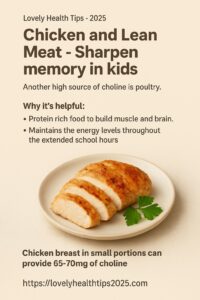
3. Chicken and Lean Meat
Another high source of Choline is poultry.
Why it’s helpful:
- Protein rich food to build muscle and brain.
- Maintains the energy levels throughout the extended school hours.
Chicken breast in small portions can provide 65-70mg of Choline.
4. Fish (Salmon and Cod in particular)
Fatty fish is also mixed with Choline and omega-3 DHA & other necessary nutrients in the functioning of the brain.
Benefits:
- Helps to maintain cognitive performance
- Supports the visual learning
- Contributes to brain cell membrane structure
A 100g salmon fillet has 56 mg of Choline
5. Beans and Legumes
Choline is abundant in kidney beans, black beans and chickpeas.
Why legumes help:
- Superior source of vegetarianism.
- Fibre helps in improving digestion.
- Regulates mood through balancing the blood sugar.
A single serving of cooked beans = 70-80mg Choline.
6. Brussels Cabbage and Cruciferous vegetables.
The vegetable broccoli, cauliflower and cabbage also have a surprising amount of Choline.
Benefits:
- High in Vitamin-K as well as to stimulate the brain.
- Helps the detox the body
- Soup, stir-fry in lunchboxes.
One cup of cooked broccoli = 63mg Choline.
7. Peanuts and Nut Butters
Peanuts are also healthy in fats, as well as Choline- ideal for school snack boxes.
Benefits:
- Boosts energy
- May improves concentration
- Packed with protein
Two Tablespoons peanut butter contains 20mg Choline.
8. Soy Products
Excellent vegan sources are tofu, soy milk and edamame.
Benefits:
- Suitable in case of children who are intolerant of dairy or eggs.
- High-protein alternative
- Easy to add to meals
Half cup tofu = 35 mg Choline.
9. Whole Grains
Moderate Choline is found in quinoa, brown rice and wheat.
Benefits:
- Gives sustained glucose for the activities of learning.
- Supports overall growth
- Not so much difficult to incorporate in Indian diets.
One cup quinoa = 43 mg of Choline.
Effects of Choline Deficiency in Children.
Parents sometimes overlook the early signs of inadequate nutrient intake, who think it is just a normal kid behavior. Here are some indicators:
- Brain and Mood Symptoms
- Forgetfulness
- Problem with lesson remembering
- Trouble with focus
- Slow learning
- Low motivation
- Mood swings
- Physical Symptoms
- Fatigue
- Muscle weakness
- Poor sleep
- Frequent irritability
In case you experience of 2-3 of these symptoms on a regular basis, the lack of Choline can be improved.
You can easily include choline-rich foods using these healthy lunch box ideas for kids for school meals.
Public Health Observation: What I Commonly See in Families
During child health and nutrition programs at Nabarangpur (Odisha), I have observed that many parents know about the nutrients like calcium, iron, vitamin D, but only few aware about Choline when preparing the meals.
In reality, the challenge is sometimes lack of variety food. Children may eat enough calories but miss important nutrients due to repetitive food pattern.
In my field experience, which families include eggs, legumes, dairy products and seasonal locally available vegetables, find easier to meet the multiple nutrition including choline.
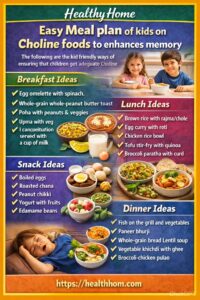
Easy Meal plan of kids on Choline foods to enhance memory
The following are the kid friendly ways of ensuring that children get adequate Choline per day:
- Breakfast Ideas
- Egg omelette with spinach
- Whole grain whole-peanut butter toast.
- Several items such as poha with peanuts and vegetables.
- Upma made of vegetables served with a cup of milk.
- Smoothie: banana & milk with yogurt
- Lunch Ideas
- Brown rice with rajma/chole
- Egg curry with roti
- Chicken rice bowl
- Tofu stir-fry with quinoa
- Broccoli paratha with curd
- Snack Ideas
- Boiled eggs
- Roasted chana
- Peanut chikki
- Yogurt with fruits
- Edamame beans
- Dinner Ideas
- Fish on the grill and vegetables.
- Paneer bhurji
- Whole-grain bread Lentil soup.
- Vegetable khichdi with ghee
- Broccoli-chicken pulao
Including anti-inflammatory foods to eat daily can further support brain health and reduce inflammation.
Easy Ways Indian Families Can Add More Choline Without Changing Their Entire Diet
Many Indian parents think that they need costly food supplements to improve the nutrition. But, small changes in Indian meals may be the difference like:
- Adding a boiled egg with breakfast.
- Mixing roasted peanuts into poha or upma.
- Including paneer in vegetable parathas.
- Using sprouts in evening snacks.
- Serving curd alongside lunch.
- Adding chickpeas to salads or pulao.
Above changes may fit into everyday family meals and sometimes easier for children to accept the new foods.
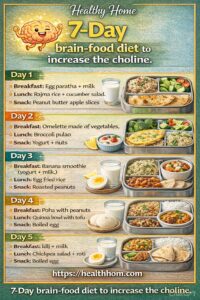
7-Day brain-food diet to increase the choline.
The following is a plan that can be followed by parents on a weekly basis.
- Day 1
- Breakfast: Egg paratha + milk
- Lunch: Rajma rice + cucumber salad.
- Snack: Peanut butter apple slices.
- Dinner: Paneer curry + rotis
- Day 2
- Breakfast: Omelette made of vegetables.
- Lunch: Broccoli pulao
- Snack: Yogurt + nuts
- Dinner: Chicken curry + roti
- Day 3
- Breakfast Banana smoothie (yogurt + milk).
- Lunch: Egg fried rice
- Snack: Roasted peanuts
- Dinner: Dal and vegetable stir-fry.
- Day 4
- Breakfast: Poha with peanuts
- Lunch: Quinoa bowl with tofu
- Snack: Boiled egg
- Dinner: Fish curry + rice
- Day 5
- Breakfast: Idli + milk
- Lunch: Chickpea salad + roti
- Snack: Peanut chikki
- Dinner Paneer paratha + yogurt.
- Day 6
- Breakfast: French toast+ boiled egg.
- Lunch: Brown rice + lentils
- Snack: Fruit yogurt
- Dinner: Chicken stir-fry
- Day 7
- Breakfast: Egg dosa
- Lunch: rice + Cauliflower curry.
- Snack: Smoothie bowl
- Dinner: Vegetable khichdi
Stress-reducing habits for children : 5 Minute Mindfulness Exercise for Kids & Teens
Improvements in child development following the use of Choline-rich foods.
Parents may notice:
- Academic/Cognitive & Improvements.
- Improved school lesson memory.
- Improved focus
- Lessening of irresponsible errors.
- Faster learning
- Behavioral Improvements
- Less irritability
- Better sleep
- Greater motivation
- More emotional stability
- Physical Benefits
- Better energy levels
- Reduced fatigue
Combining nutrition with practices like 5-minute mindfulness exercises for kids improves focus and emotional balance.
Parenting tips “how to increase the Choline intake”.
- At least 1 egg in a day if your family eats eggs.
- Include nuts and legumes in the snacks.
- One-two of the daily meals should contain one cruciferous vegetable (broccoli, cauliflower).
- Once or twice in a week, make a substitution of white rice with quinoa or brown rice.
- Keep peanut butter in your handbag as a snack at school.
- Cook tofu or paneer more often.
Encouraging mindful eating for kids helps children develop better focus, eating habits, and nutrient absorption.
Minor variations produce long term benefits on the brain.
Gut-friendly fermented foods : 7-Day Gut Health Plan for Families – Improve Digestion Naturally
Comparison Table of Food Vs Choline
| Food | Choline (mg) | Best For | Frequency |
|---|---|---|---|
| Egg | 147 mg | Memory | 4-5/week |
| Milk | 38 mg | Daily intake | Daily |
| Beans | 70 mg | Vegetarian | 3x/week |
A healthy gut also supports brain function, making this 7-day gut health plan for families a valuable addition.
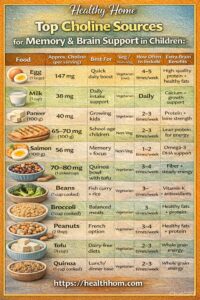
Top Choline Sources for Memory & Brain Support in Children:
| Food | Approx. Choline (per serving) | Best For | Veg / Non-Veg | How Often to Include | Extra Brain Benefits |
|---|---|---|---|---|---|
| Egg (1 large) | 147 mg | Quick daily boost | Vegetarian (ovo) | 4–5 times/week | High-quality protein + healthy fats |
| Milk (1 cup) | 38 mg | Daily intake support | Vegetarian | Daily | Calcium + growth support |
| Paneer (100 g) | 40 mg | Growing kids | Vegetarian | 2–3 times/week | Protein + bone strength |
| Chicken Breast (100 g) | 65–70 mg | School-age children | Non-Veg | 2–3 times/week | Lean protein for energy |
| Salmon (100 g) | 56 mg | Memory + focus | Non-Veg | 1–2 times/week | Omega-3 DHA support |
| Beans (1 cup cooked) | 70–80 mg | Vegetarian families | Vegetarian | 3–4 times/week | Fiber + steady energy |
| Broccoli (1 cup cooked) | 63 mg | Balanced meals | Vegetarian | 3 times/week | Vitamin K + antioxidants |
| Peanuts (2 tbsp) | 20 mg | Snack option | Vegetarian | 3–4 times/week | Healthy fats + protein |
| Tofu (½ cup) | 35 mg | Dairy-free diets | Vegetarian | 2–3 times/week | Plant protein |
| Quinoa (1 cup cooked) | 43 mg | Lunch/dinner base | Vegetarian | 2–3 times/week | Whole grain energy |
Egg vs Beans Comparison (Parent-Friendly)
Egg vs Beans: Which Is Better for Choline?
| Feature | Egg (1 Large) | Beans (1 Cup Cooked) |
|---|---|---|
| Choline Content | 147 mg | 70–80 mg |
| Protein | High-quality complete protein | Plant-based protein |
| Vegetarian Friendly | Ovo-vegetarian | Fully vegetarian |
| Budget Friendly | Moderate | Very affordable |
| Best For | Quick daily boost | Vegetarian families |
| Frequency | 4–5 times/week | 3–4 times/week |
As children grow, adding fermented foods for teen gut health supports digestion and cognitive performance.
Food Combination Table
| Combination | Approx. Choline |
|---|---|
| Egg + Milk | 185 mg |
| Egg + Peanut Butter | 167 mg |
| Beans + Broccoli | 140 mg |
Daily Choline Checklist
- Egg
- Dairy
- Legume
- Vegetable
- Whole grain
Key Takeaways:
- Some of the best natural sources are eggs, beans, milk and fish.
- Daily choline requirements are not met by many children.
- One can easily get required intake through a balanced diet without supplements
Expert Insight by Bibhu Ranjan Mund, MPH
One learning from my years of community health work is that parents sometimes think of a single food to improve memory.
Children’s cognitive development depends on many factors like balanced nutrition, adequate sleep, regular physical activity, emotional support at home and consistent learning habits together.
Choline rich foods are important and families can achieve the best results when healthy foods become part of everyday routines.
Concluding Points:
Constantly Growing, learning & adapting new things are the most important activity of every child’s brain and the food they eat plays a key role in such journey.
Importance of Choline is not widely discussed as compared to iron, calcium & other vitamins. Research from PubMed Central (2020) suggests that if child is consuming proper Choline rich foods is directly supports the cognitive function and neural development, especially during the Pre-School and School-going age.
In everyday life, only perfection is not the actual goal. In some day, you child may skip a meal or refuse to eat which is a normal behaviour of every child.
The truth is only consistency over time like :
- Adding one egg or a few peanuts
- Including beans or dairy regularly
- Making small and balanced changes in daily meals
These small and simple daily habits may lead to a noticeable improvements in energy level, learning ability, focus on study etc. within a few month.
So, start with small quantity and follow the 7-day plan. Silently observe what actually works better for your child.
As building of a smarter, healthier future doesn’t require so dramatical changes, it only begins with very simple but consistent nutrition choices made every day.
Early nutrition habits play a key role in the prevention of lifestyle diseases later in life.
FAQs:
1. Is Choline safe for children?
2. What will happen who doesn’t eat egg?
3. Does the Choline supplementation is useful?
4. Are toddlers also able to consume Choline rich foods?
5. What will be the time to the results after including choline rich foods for kids?
Related Health Articles from Healthy Home :
- Mindful Eating for Kids : 7 fun ways – Lovely Health Tips-2025
- 8 Best Fermented Food for Gut Health in Adolescents – Lovely Health Tips-2025
- 7 days habit to Reduce Anxiety Naturally – Lovely Health Tips-2025
- 14 best Anti Inflammatory Foods for daily eating – Lovely Health Tips-2025
- 7 days meal plan with accessible nutrition – Lovely Health Tips-2025
Trusted References and Research Sources
- Economic Times – Brain-Boosting Foods for Memory & Focus Source: https://economictimes.indiatimes.com/news/web-stories/9-brain-boosting-foods-to-improve-memory-focus-mental-clarity/slideshow/122779105.cms
- PubMed Central – Choline and Cognitive Function (Research Article) Source: https://pmc.ncbi.nlm.nih.gov/articles/PMC7009052/
- Healthline – Top Foods Rich in Choline Source: https://www.healthline.com/nutrition/foods-with-choline
- Healthline – 11 Best Brain Foods for Cognitive Health Source: https://www.healthline.com/nutrition/11-brain-foods