Microplastics in Food: Hidden Sources, Health Risks & 20 Easy Ways to Protect Your Family
Learn from where microplastics in food come from, their possible health effects and practical ways the Indian families can reduce daily exposure using evidence-based tips.
Reviewed by Bibhu Ranjan Mund, MPH (Public Health Expert) with more than 18 years of experience in maternal, infant, child, and adolescent health programs. Content is based on evidence-informed guidelines aligned with organizations such as the World Health Organization, UNICEF, Centers for Disease Control and Prevention, and National Institutes of Health.
Research Archive
Mund, B. R. (2026). Microplastics in Food: Hidden Sources, Potential Health Risks, and Evidence-Informed Strategies to Reduce Household Exposure (1.0). Healthy Home (healthhom.com). Zenodo :https://doi.org/10.5281/zenodo.21170580
Medical Disclaimer: This content is for informational and educational purposes only and is not intended as medical advice, diagnosis, or treatment. Always seek the advice of a qualified healthcare professional regarding any medical condition or concerns.
Quick Summary
If you are not able to take the time to read the complete article, you may read this key takeaways.
- Microplastics in food are tiny plastic particles found in food, drinking water, air and even in household dust.
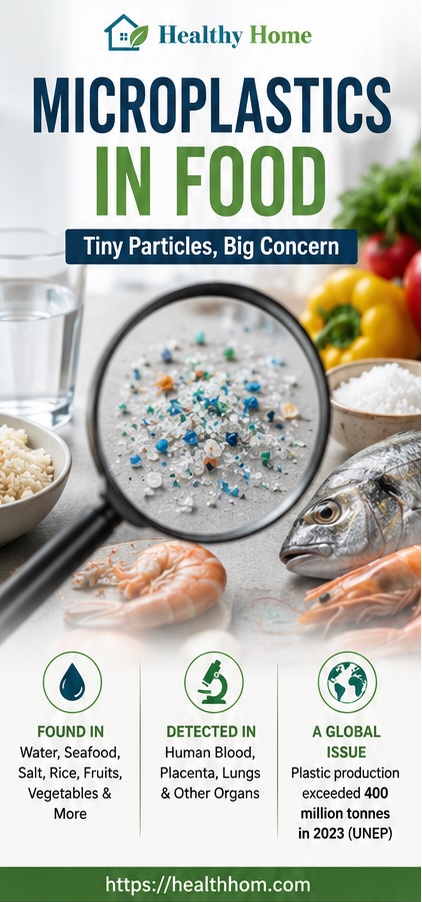
- Many scientists have detected them in bottled water, seafood, salt, fruits, vegetables, rice, honey, tea bags and also in packaged foods which are easily available in the market.
- Children may be more vulnerable because they eat, drink and breathe more relative to their body weight than adults.
- Simple daily habits you can follow like avoiding heating food in plastic containers, choosing reusable containers, eating fresh foods and following a balanced daily meal plan may help to reduce unnecessary exposure and may support long-term health.
- Our aim is not to eliminate completely from every source of plastic as this not possible in modern age, but we may reduce the un-necessary choices.
What is Microplastics in Food?
These are tiny plastic particles even smaller than 5 millimetres which enter our day-to-day meals through water, seafood, salt, packaging and environmental contamination. As research is under process, but to reduce the exposure by limiting plastic use with hot food, choosing reusable containers and eating fresh foods may help to protect a long-term health.
I Never Thought Plastic Could Be on My Dinner Plate
What if your food contained an ingredient that never appears on the nutrition label i.e. tiny plastic particles?
Last Sunday evening, we had dinner with my friends at Bhubaneswar (Odisha). One of my friends said “Are you aware that we eat about a credit card’s worth of plastic every week?”
All my friends became silent and another friend put down his spoon on the dining table. Some laughed and said “This is not true”.
As I am a public health professional, I knew that the above saying was not simple. The scientists are studying the exact quantity of plastic people are consuming. But one thing is clear that tiny plastic particles which are found in the air, our drinking water and also so many foods we eat on day to day basis.
This can feel worrying. Most of us think to avoid Three Whites like White Sugar, White Salt and White Maida and also some unhealthy fats and include anti-inflammatory foods in our everyday meals. We are also aware about the pesticides or food additives which are adding in vegetables and other processed foods. But very few of us realize that the such tiny plastic particles also entering our body through our everyday food and drinks.
There’s no need to panic after hearing this. Instead of, we have to take simple and practical steps to reduce such intake. This article explains what are the present studies and what are the easy day-to-day healthy habits to protect our families.
Healthy living is not about avoiding one single environmental risk. It is about to build a Healthy lifestyle habit for family which which can protect your body and your family’s overall health.
Global Statistics at a Glance
| Finding | Latest Data | Source | Publication Year |
| Global plastic production exceeded 400 million tonnes annually | More than 400 million tonnes annually | UNEP | 2023 |
| Microplastics have been detected in bottled water, tap water, seafood, fruits, vegetables, salt, and honey | 2019–2024 | WHO, EFSA | 2019–2024 |
| 2019–2024 | Multiple peer-reviewed studies | PubMed indexed research | PubMed indexed research |
This WHO technical report reviews evidence on microplastics in drinking water, potential health effects, and research priorities. World Health Organization (WHO): Microplastics in Drinking-water
Important note: If microplastics are detected in human body, it doesn’t mean that it will cause disease. Scientists are studying these findings for our long-term health.
Why Are Scientists So Concerned About Microplastics?
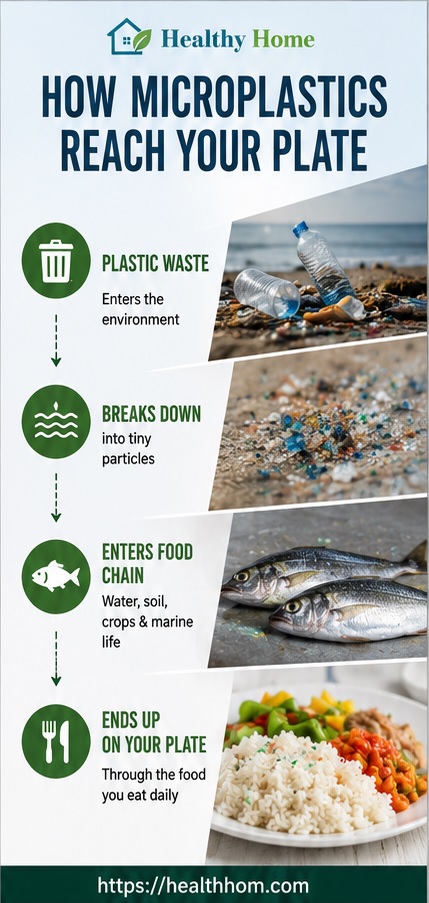
Think about after dropping a plastic bottle into a river. It doesn’t disappear. But the sunlight, heat waves and friction slowly break the plastic into smaller and smaller pieces even to small particles.
Then, these small particles become tiny and can’t be seen with the naked eye. These tiny particles are called as Microplastics. Plastics after thrown into any place, become microplastics and can travel everywhere like:
- Rivers
- Oceans
- Soil
- Crops
- Drinking water
- Air
- Fish
- Livestock
These microplastics can easily find its ways to enter into our meal plates. The food waste or papers can easily decompose within a short time, but plastics takes decades or even centuries for fragmenting into smaller particles.
What Are Microplastics?
Microplastics are the plastic particles smaller than 5 millimetres. Some are smaller than a rice grain and also some are invisible without a microscope. Scientists classify them into two major groups:
This report summarizes the available evidence on exposure to microplastics from food, water, and air and identifies important knowledge gaps. WHO Report on Dietary and Inhalation Exposure to Nano- and Microplastic Particles
1. Primary Microplastics
These are already manufactured in very small sizes such as:
- Industrial plastic pellets
- Synthetic textile fibres released during washing
- Certain industrial abrasives
During this decade, many countries have already put restriction for the use of plastic microbeads in cosmetics.
2. Secondary Microplastics
The larger plastic items are gradually breakdown like:
- Plastic bottles
- Food packaging
- Disposable cups
- Carry bags
- Fishing nets
- Plastic containers
These are the most common source found in the environment.
How Do Microplastics Enter Into Our Food?
Many people imagine that plastic only enters food through packaging.
In reality, the journey often begins much earlier.
1. Agricultural Soil
Plastic mulch, irrigation water, sewage sludge and environmental pollution can enter the tiny plastic particles into the farmland. Researchers are investigating whether crops absorb or retain these tiny particles from contaminated soil.
2. Oceans and Rivers
Fish, shellfish and other marine animals may swallow the microscopic plastic particles present in water. So, when humans consume few seafood like shellfish, then such microplastic exposure may increase.
3. Drinking Water
Scientists have detected microplastics in both bottled water and tap water in different parts of the world. But, the quantity may vary depending on location, water source, treatment methods and packaging etc.
4. Food Packaging
To protect the food from contamination, generally plastics are used for packaging it, but if hot foods are kept or repeated use may the plastic particles enter into the food.
So, this the reason that the public health experts recommend to avoid heat in plastic containers commonly. It can be heated if designed for that specific purpose only.
5. Household Dust
Indoor dust is also a source of microplastic. Like synthetic carpets, curtains, clothing and furniture can release microscopic plastic fibers which may reside on the kitchen surfaces and food.
Above source and route of microplastic is under study by researchers. However, it reminds us that not only through eating the microplastics enter in our body, but also from different environmental sources around us.
A Simple Example from an Indian Kitchen
One day I was observing my own kitchen last Friday morning. Tea is boiling on the gas stove. Also leftover curry from last night is being reheated. My son is getting ready for school. I am also hurried to go for office.
My wife packed the lunch box for me and son in the plastic container as this is lightweight and also convenient. All the above habits are normal in everyday life of millions of Indian homes.
But very small changes like to store hot food in stainless steel vessels instead of plastic boxes, carrying water in steel bottles, cool the food before packing in lunch boxes may reduce the contact between hot food and plastic.
Such types of changes don’t require any costly lifestyle habits, rather gradually it will improve the healthy long-life.
If you choose the nutritious homemade meals for school children, it can benefit both children’s health and the environment.
Public Health Perspective
From a public health point of view, microplastic may be a modern environmental challenge not an immediate personal emergency. Current evidence does not suggest that eating one meal from a plastic container will make someone ill.
So, the researches are thinking of a different question that “During past decades, what happens when billions of people experience low exposure for the use of plastics?”
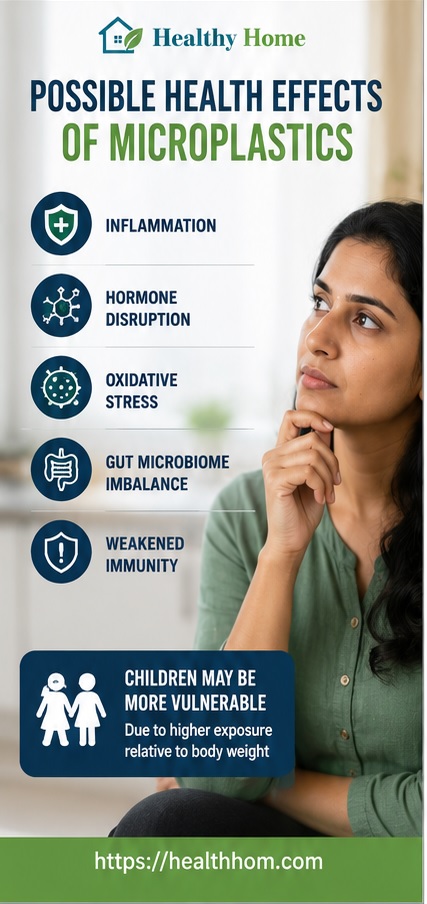
So, the scientists are studying the possible links with inflammation, reproductive health, metabolic disorders, cardiovascular issues and also immune function. As there is no strong evidence till date, we should avoid the too much exposure and go for a balanced approach.
Useful if you want readers to understand WHO’s public health position in simpler language. WHO calls for more research into microplastics and plastic pollution
Which Foods May Contain More Microplastics?
Scientists have detected microplastics in various types of foods. It depends upon the methods of processing, packaging etc. So, we have to understand which foods may contain higher volume.
1. Bottled Drinking Water
Most of people prefer the bottled water as they think it as cleaner and safer to use. But, several studies have identified the microplastic particles in the bottled water, which may come from:
- Plastic bottles
- Bottle caps
- Manufacturing processes
- Packaging materials
- Storage and transportation
It may vary between countries.
Practical Tip
If the local tap water is safe after proper filtration, then a reusable stainless steel bottle may reduce both plastic waste and repeated use from disposable bottles.
Safe drinking water is one of the foundations for a good health. Along-with choosing appropriate storage containers, following a proper daily hydration routine is also important.
2. Seafood
Seafood is said to be one of the dietary sources of microplastic exposure. Marine livings like fish and shellfish may swallow the tiny particles during feeding of organisms.
Shellfish such as mussels and oysters are more vulnerable as they sometimes eat whole including their digestive system.
Should You Stop Eating Fish?
No. Fish is an excellent source of:
- High quality protein
- Omega-3 fatty acids
- Vitamin D
- Iodine
- Selenium
The nutritional benefits of eating fish generally more important that risk of microplastics for most of the people. So, to choose seafood from trusted suppliers and to follow the national dietary guidelines is recommended by many researchers.
3. Table Salt
Scientists have identified microplastic particles in sea salt which are collected from different areas of globe. As in the sea water, so many plastic pollutions exist, during the production of salt the tiny microplastic particles may remain in the prepared salt.
The health experts already recommend to limit the salt intake as it may be a reason for high blood pressure, so presently the society has limited the use of sea salt which is a positive sign.
4. Rice
Rice is considered as a staple food in many Indian households. The recent studies have identified the quantity of microplastics in both the packaged and unpackaged rice. The experts believe that this may occur during:
- Farming
- Transportation
- Processing
- Plastic packaging
A Simple Household Practice
Many Indian families already in a habit to wash rice several times before cooking which is a good practice to remove dust and excess starch. Some preliminary studies suggest that washing rice may reduce certain surface contaminants, but still research is continuing to determine how much it affects microplastic exposure.
5. Fruits and Vegetables
Fresh fruits and vegetables are very much essential for good health. But, some studies have shown that tiny plastic particles may remain in fruits and vegetables as the plants are exposed to contaminated soil, irrigation water or also airborne dust.
Choosing colorful fruits like papaya can provide valuable vitamins, antioxidants and dietary fiber and may also support a healthy eating pattern.
Should Parents Be Concerned?
No. Parents shouldn’t be concerned about this, but to encourage the children to take fruits and vegetables everyday as balanced type. The vitamins, minerals, fiber, antioxidants are more important than to avoid due to environmental contatmination.
The good practice is to clean the fruits and vegetables in running water always before eating or cooking.
If nutritious eating habits started from childhood sometimes, it will continue till adulthood and play an important role in healthy growth and development.
6. Tea Bags
Most of the premium tea bags are not made from only paper. It also manufactured using some plastic containing materials to give a proper shape of tea bag. When we boil water and steep the tea bag, the microplastic particles may mix with tea.
Better Alternatives
In India, may families still use and enjoy:
- Loose leaf tea
- Stainless steel tea strainers
- Traditional tea preparation methods
Such available options can naturally help to reduce the enter of microplastic including the preserving its own flavor.
7. Packaged and Processed Foods
Modern food packaging system has improved and focused the food safety. But still due to repeated contact between food and plastic packaging, if under high temperature, it may leads to entering of small amounts of plastic.
So, in India the traditional use of fresh home-cooked meals and eating contribute to less plastic contact than the highly processed packaged foods.
Does Cooking Increase Microplastic Exposure?
Only cooking doesn’t create the microplastics. But, few wrong habits have increase the risk like:
- Microwaving food in old plastic containers
- Pouring boiling curry into thin plastic containers
- Using scratched plastic utensils repeatedly
- Storing hot oil in plastic bottles
Above wrong practices may be replaced with other alternatives such as:
- Stainless steel
- Glass
- Ceramic
- Food-grade silicone (if appropriate)
Are Children More Vulnerable?
Children are still in developing stage and not an adult. So, if we compared with adults, children generally :
- Eat more food relative to their body weight.
- Drink more water relative to their body size.
- Breathe faster.
- Have developing organs and immune systems.
Due to above differences, many environmental health experts think that children should be given more focus for safe use which may directly affect their long-term health. Still the scientists are conducting studies the real effect in child’s health due to microplastic exposure.
Along with balanced nutrition, adequate sleep, regular physical activity and emotional support all lead to a healthy childhood development.
What Do Scientists Think About the Health Effects?
This is the actual question, but the answer may be yes or no. Most of the evidence comes from:
- Laboratory experiments
- Animal studies
- Cell studies
- Environmental monitoring
- Emerging human research
Researchers are still working to understand the long-term effect for human health.
- Inflammation
- Oxidative Stress
- Hormonal Disruption
- Gut Microbiome
- Cardiovascular Health
Although research is still continuing, eating a fiber-rich diet has one of the most practical ways to support a healthy gut microbiome.
What Public Health Experts Recommend
Most of the public health organizations not recommend to avoid the nutritious foods only due to microplastics. Instead of they suggested to take practical steps like:
- Reducing plastic pollution.
- Improving waste management.
- Supporting safer food packaging.
- Encouraging more research.
- Promoting healthy dietary patterns rich in fresh foods.
A recent peer-reviewed review covering occurrence, sources, analytical methods, and potential health risks. PubMed: Microplastics in Drinking Water – Systematic Review (2024)
Author’s Public Health Perspective
During my working in 18 years of public health service, I have felt that the people become astonished when they hear about the various environmental risk factors. Like at first it was about air pollution, then the use of pesticides, an emerging issues of microplastics.
So, elimination of the microplastic exposure may be unrealistic, but a better approach of changing the practical lifestyle matters a lot.
We should be in a practice of replacing the old plastic box with a stainless steel, use the reusable water bottle, taking fresh home-cooked meals may be good choice of every Indian life.
Even small changes in everyday cooking and like traditional Indian food preparation, it can benefit more environmentally sustainable lifestyle.
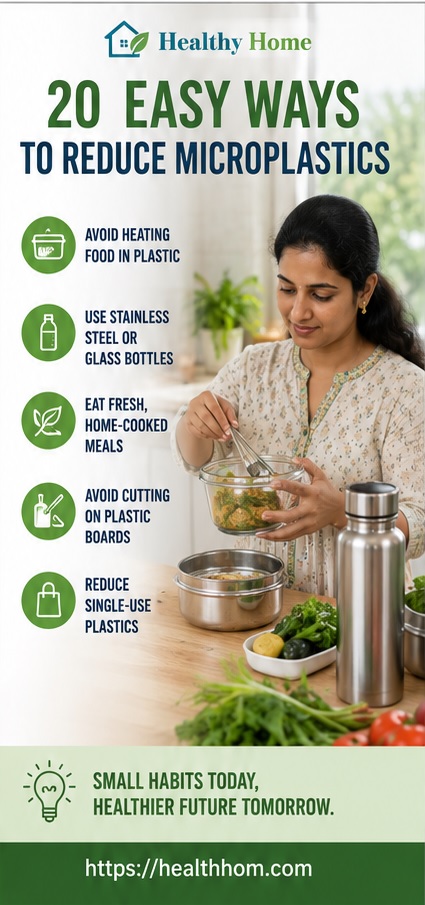
20 Practical Ways to Reduce Microplastics in Food
1. Avoid Heating Food in Plastic Containers
Heat may increase the risk of entering of the tiny plastic particles with few chemicals from some plastic containers into the food. So, to avoid this, you can transfer the leftover food before reheating it:
- Glass containers
- Stainless steel bowls
- Ceramic dishes
2. Choose Stainless Steel or Glass Water Bottles
Many Indian families are already using the steel bottles from decades.
Along-with the ability to reduce the plastic waste, it is also easy to clean and suitable to carry drinking water.
3. Replace Old, Scratched Plastic Containers
Plastic containers become damage if used long time.
So, if the plastic container is cracked, discolored or heavily scratched, please replace it as soon as possible.
4. Don’t Pour Boiling Food Directly Into Thin Plastic Boxes
If you want to store in a plastic container, you should allow the freshly cooked food to cool for a few minute and then store it.
Such type of small habit may also reduce the contact between the hot food and plastic.
5. Eat More Fresh Home-Cooked Meals
Many Indian families are in a habit in traditional home cooking methods which is a good habit.
The fresh prepared meals will not contact with multiple layers of plastic packaging.
Home cooking also is also a healthier food choices which can reduce the unnecessary food packaging and environmental waste.
6. Wash Fruits and Vegetables Thoroughly
The washing cannot remove all the contaminant, but it can help to remove the dust, soil and surface particles.
Use clean running water before cooking or eating.
7. Rinse Rice Before Cooking
Many Indian families used to wash rice two or three times before cooking it.
8. Prefer Loose Tea Leaves When Possible
If you are taking tea everyday, you may use loose tea leaves in a steel container which can reduce the contact with certain plastic containing tea bags.
9. Store Cooking Oil Properly
Edible oils can also be packed in glass container. Else, it should transfer to a stainless steel container after opening the sealed plastic package.
10. Reduce Single-Use Plastic Bottles
You should make a habit to carry your own reusable bottle instead of everyday use and through plastic bottles. I will also save the money.
11. Improve Indoor Ventilation
Microplastic fibers may settle in the day-to-day household dust.
So, regular cleaning, wet mopping and proper ventilation can help to reduce the dust.
12. Vacuum or Dust Regularly
Dust may contain some fibers from the indoor carpets, curtains and synthetic clothing etc..
So to keep you home clean is a gold standard for health benefits.
13. Choose Natural Fabrics Whenever Practical
Cotton, linen and some natural fibers may release fewer synthetic particles during use than some synthetic textiles.
So, during purchasing new clothes, you may go to buy these.
14. Avoid Cutting Food on Worn Plastic Chopping Boards
If you use the plastic chopping boards, the deep knife marks can release tiny plastic particles.
So, wooden or quality bamboo cutting boards may be used as alternative method.
15. Separate Very Hot Food From Plastic Wrap
Steaming food may not be covered with plastic wrap, instead it should allow to cool and and wrap.
16. Support Local Fresh Produce
When buying vegetable and fruits from local are market, it will use less packaging like processed foods.
17. Avoid Burning Plastic Waste
When plastic burns, it usually releases the harmful pollutants and micro-particles into the air.
So, proper waste disposal systems to maintain for environmental and human health.
18. Teach Children Good Habits Early
Children to aware about :
- Carry reusable bottles.
- Avoid unnecessary disposable plastics.
- Throw waste into bins.
- Respect the environment.
19. Follow Trusted Health Information
Different social media may spreads alarming claims for advertisement.
Hence, before making any major lifestyle changes, please check the information from recognized public health organizations or reliable sources.
20. Focus on Overall Healthy Living
Everyone to focus on nutritious food for a good health benefits which are rich in:
- Fruits
- Vegetables
- Whole grains
- Pulses
- Nuts
- Adequate water
Long-term wellness mostly depends on balanced nutrition along-with regular exercise, quality sleep, stress management and other healthy lifestyle practices.
A Practical Indian Household Example
I had seen one family of four members who were living in Jeypore (Odisha). They didn’t replace every plastic items in the kitchen, but changed a small innovation in each month like:
- Month 1: Switched to steel water bottles.
- Month 2: Replaced an old scratched lunch box.
- Month 3: Started carrying cloth shopping bags.
- Month 4: Began storing leftover dal in glass containers.
Above changes are not so costly. After a few month, the family reduced unnecessary plastic contact. Such habits are a real approach which can be followed by everyone.
What foods contain the highest levels of microplastics?
| Food | Exposure |
|---|---|
| Bottled water | High |
| Shellfish | High |
| Sea salt | Moderate |
| Tea bags | Moderate |
| Rice | Low–Moderate |
Frequently Asked Questions:
Can microplastics be completely avoided?
Is bottled water unsafe for microplastics?
Should I stop eating seafood or to limit it?
Does boiling water remove microplastics completely?
Should I throw all of my plastic containers?
Is glass safer than plastic to store the food?
Public Health Expert’s Note
Current research does not prove that microplastics can directly cause disease. You should reduce the unnecessary and avoidable exposure, which will be a great precaution especially for children and pregnant women as such groups may be vulnerable for environmental pollutions.
Key Takeaways
- Microplastics are found in many foods, drinking water and the environment.
- Scientists are continuing the study for long-term health effects.
- Recent evidence suggests to reduce the unnecessary exposure without any anxiety.
- Traditional Indian home-cooked meals, safe food storage and reusable containers are practical steps for families.
- Parents to educate their children for the better environmental habits.
A healthy lifestyle for children is more than only nutrition. Limiting excessive screen time, encouraging outdoor play and maintaining healthy sleep routines are equally important.
Evidence Summary
| What Science Knows | What Scientists Are Still Studying |
|---|---|
| Microplastics are present in food and water. | Long-term effects on human health. |
| They have been detected in human tissues. | Safe exposure limits. |
| Reducing plastic pollution benefits the environment. | Which particles pose the greatest health risk. |
Author Note:
During my more than 18 years in public health in Odisha, I have seen that the small lifestyle changes sometimes have the greatest long term impact. This article is having current scientific evidence with practical guidance which the families can easily folllow.
Concluding Points:
Generally we the Indian people think about the healthy eating and focus on nutrients, vitamins and even know about calories. But today’s topic is entire different which is an emerging point of discussion n the globe i.e. microplastic in food.
From the article it is understand that you should concern about drinking water, seafood and others that microplastic may enter into our body, but it shouldn’t lead to fear.
Presently researchers are working more on the long term exposure for human health, but some are under study. So, our healthy habit is an important step to get rid of this. Like choosing home cooked meals, avoid heating of food in plastic container, carrying reusable water bottle and reduce the single use plastics are the practical step for everyday life.
You may be a parents, caregiver or consumer, you can’t remove the source of microplastic from the environment, but better choice may be able to create a healthy environment.