5 Minute Mindfulness Exercise for Kids & Teens to Improve Focus
5 minute mindfulness exercise for kids & teens to reduce stress, improve focus and build emotional resilience. Simple, effective & parent-friendly guide.
Reviewed by Bibhu Ranjan Mund, MPH (Public Health Expert) with experience in maternal, infant, child, and adolescent health programs. Content is based on evidence-informed guidelines aligned with organizations such as the World Health Organization, UNICEF, Centers for Disease Control and Prevention, and National Institutes of Health.
Medical Disclaimer: This content is for informational and educational purposes only and is not intended as medical advice, diagnosis, or treatment. Always seek the advice of a qualified healthcare professional regarding any medical condition or concerns.
Introduction:
Is it possible to calm your child’s anxiety, improve focus and help them to sleep better by doing just 5 minutes of exercise?
As per the report of World Health Organization (2022), it shows that 1 in 7 adolescents experiences many mental health issues globally which may be from anxiety to poor concentration. Now the children are facing more stress than earlier only due to the increasing trend in screen-driven activities.
The important thing is that, you don’t need a long medication schedule or complex routines for the same.
Just, a very simple and science-backed 5 Minute Mindfulness Exercise for Kids may help a lot as follows:
- Feel calmer within minutes
- Improve focus in school
- Build emotional strength for life
In this article, you will find-out the easy and parent friendly mindfulness strategies which can fit in present busy schedule like at home, school or bedtime.
The best one is that, kids & teens will enjoy such techniques.
We will start from the simple one today.
Along with mindfulness, understanding how food affects mental health can further enhance emotional stability in children.
Quick Summary:
- Even 5 minutes per day can help to decrease stress and anxiety in children.
- Enhances concentration, attention and education performance.
- Helps in controlling feelings and irritability.
- Promotes the quality of sleep.
- Grows tougher and knows oneself.
- It can be practiced at home, at school or during bedtime.
- Acceptable by the children aged 5 years and upwards.
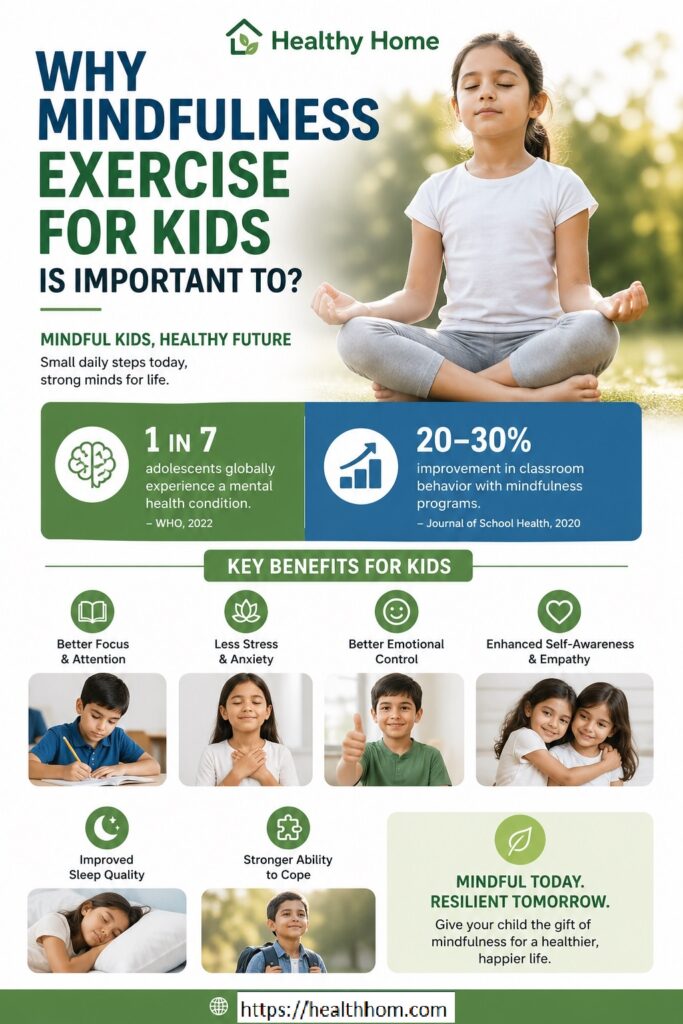
Why mindfulness exercise for kids is Important to?
Mindfulness involves living without a proper judgment. It makes kids more attentive to their thoughts, feelings and the environment rather than react impulsively or be overwhelmed with distractions.
Benefits include:
- Improves attention and consistency with studies
- Less stress, concern and anxiety
- The better emotional control (less irritability and anger)
- Enhanced self awareness, empathy
- Better sleep quality
- Greater ability in coping with problems
By learning how to teach mindfulness to children at young age, we equip them with life-long tools to strategically navigate stress and experience good mental health.
Regular mindfulness practices strongly support mental well-being in adolescents by improving emotional control and reducing anxiety.
IMPORTANT STATISTICS:
- 1 in 7 adolescents globally experiences a mental health condition (WHO).
- Screen time in adolescents has gone up by 40 percent over the past 10 years.
- Mindfulness interventions in schools demonstrate an improvement of classroom behavior at 20-30%.
- 5-minute breathing exercises have the capacity to reduce heart rate in 2-3 minutes.
- Engaged in mindfulness on a regular basis lowers cortisol (stress hormone) by 25 percent.
8 Easy 5 Minute Mindfulness Exercise for Kids:
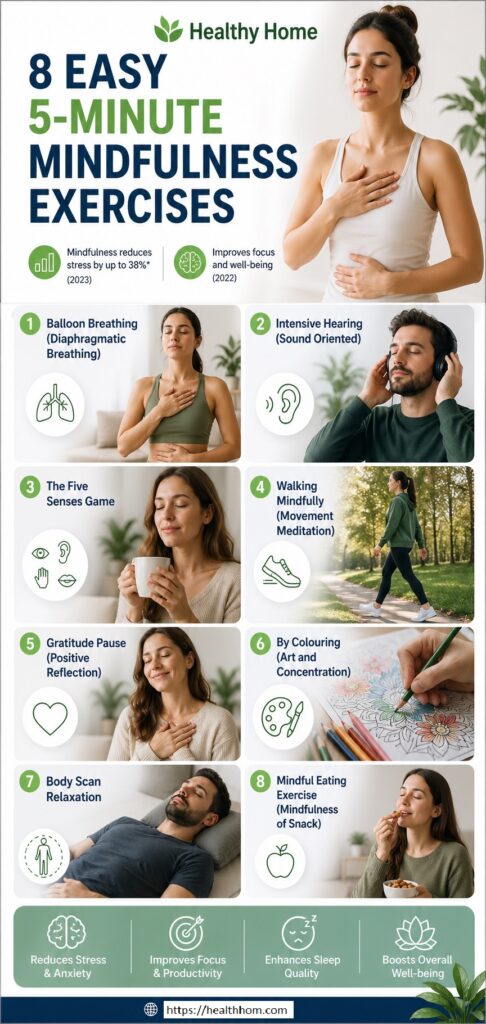
1. Balloon breathing which is also known as Diaphragmatic breathing
How it works:
- Make your child sit down and have her hands on abdomen.
- Assume that a balloon is placed in the belly of child
- They slowly breathe in using the nose whereby the balloon enhances through the belly.
- When they blow the air out through the mouth the balloon collapses (tummy contracts).
- Re-do this 5-minute exercise on the same slowness and steyness of breath.
The reason it helps: This basic breathing exercise helps to calm down the nervous system, lower anxiety levels and learn how to control emotions when faced with a stressful event.
2. Intensive Hearing (Sound Oriented)
How it works:
- Have your child sit quietly and shut his/her eyes.
- Hit a mellow bell, strike a chime or employ a scenic voice over from a mindfulness app.
- Resembles them to listen thoroughly and elevate the hand immediately there will be no more audible sound.
- Once they do that, have them pay attention to everything else: small sound variations from nature like birds chirping, a ticking clock, fans humming, footsteps etc.
What this will do: This exercise enhances attention and concentration and also gets children to be fully engaged and in the moment.
3. The Five Senses Game:
How it works:
=> You may ask the child to have & notice the following activities:
- Five things they can see
- Four things they can feel/touch
- Three things they can hear
- Two things they can smell
- One thing they can taste
=>This should take approximately 5 minutes and can be done anywhere, in classroom, at home or in outdoor setting.
How it helps: This exercise calms the mind, lessens overthinking and enables a child to feel grounded again and makes them reconnect with the surrounding world.
Just Five Breaths – A REAL STORY
- Arjun was trembling in order to give a school presentation.
- His hands were cold. His heart was racing.
- Close your eyes, my teacher said to him. Breathe in… slowly.”
- It was five silent breaths after which Arjun opened his eyes.
- The panic was present yet it wasn’t in control anymore.
4. Walking mindfully i.e. Movement Meditation:
How it works:
- Go on a leisurely walk with your child either in the house or in the outdoors.
- Make them pay attention to their way of touching the ground with their feet, movements of the legs and others swing their arms in a natural way.
- Have them feel the breeze, smell or the musty smells around them or hear the crunching of the fallen leaves.
Why it helps: Such restless children find it easy to sit still. It harmonizes the energy and educates about relaxation.
5. Gratitude Pause which means a Positive Reflection:
How it works:
- Child may sit in a such calm position & continue the same process for 5 minutes long.
- Ask them to name 3 things they are thankful for large or small. Such as: a nice dinner, a nice playtime or a nice friend.
- Either make them write them down in a journal or share them out loud.
Why it helps: Gratitude helps to experience more positivity, resilience and emotional well-being. It makes children take their mind off what they don’t have and be content on what is good.
Research on adolescent mental health shows : Teenage Mindfulness and ADHD
6. By colouring (Art and concentration):
How it works:
- Give your child a very New Age thing, the mandala or an easy coloring plate
- Set a timer for 5 minutes.
- Tell them to appreciate only the colors, the strokes and the design without hurry.
Why it helps: Coloring offers a mindful experience and destressing, particularly to kids whose minds can not concentrate on logical mindful processes.
7. Body Scan Relaxation:
How it works:
- Make your child lie down and close his / her eyes.
- Cue them to focus one body part at a time, the toes going up to the head.
- Make them pay attention to the feelings, the warmth, the tingling or a feeling of relaxation in each of the areas.
- Take about 30 seconds per body section, so the whole body will be covered in about 5 minutes time.
Why it helps: This practice brings attention to the physical body, as well as tensions and releases much needed deep relaxation.
Sleep quality significantly affects focus in children :
- Combining mindfulness with healthy sleep habits for children can significantly improve focus and emotional balance.
8. Mindful Eating Exercise (Mindfulness of Snack)
How it works:
- Tiny bites of fruit such as a raisin or a slip of apple may also suffice in showing your child’s requirement.
- Make them smell it, feel its texture, the color and then eat it.
- Encourage them to chew slowly noticing the flavor and the feeling.
The reason it will help: it will establish mindful eating behavior, it will help avoid overeating, increase food awareness.
According to our detailed guide on anemia and deficiency :
- iron-rich foods during pregnancy – Top 11 Iron Rich Foods During Pregnancy (Prevent Anemia Naturally)
- impact of anemia in adolescents – Anemia in Adolescents: Symptoms, Causes, Treatment & Prevention
- vitamin B12 needs during pregnancy & nursing – Vitamin-B12 Deficiency during pregnancy: Risks, Symptoms & Prevention
- balanced daily meal plan – What is a balanced daily meal plan? Complete Guide + 7-Day Sample Diet Plan (2026)
Fitness for the Mindfulness of child & adolescent:
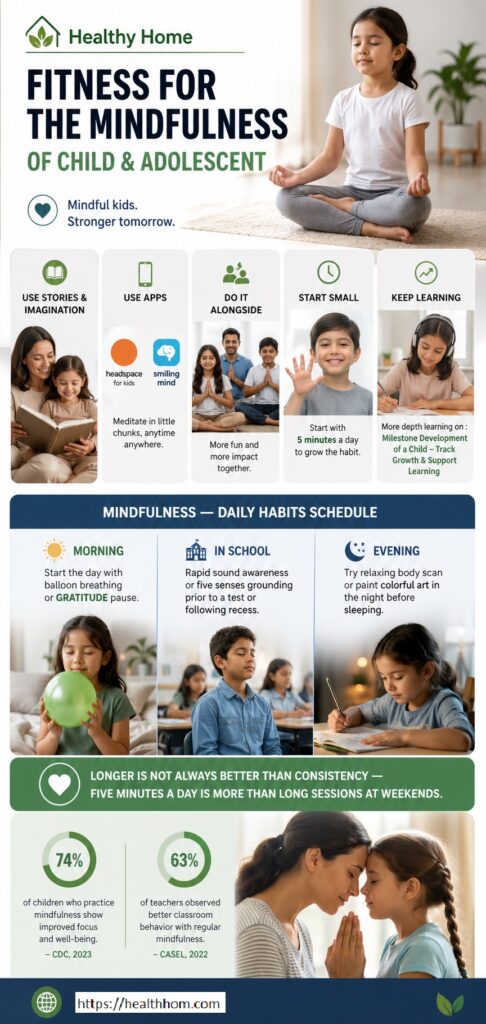
- Use stories & imagination
- Include apps: There are many apps that will engage children and help them meditate in little chunks like Smiling Mind or Headspace for Kids.
- Do it alongside: Mindfulness is likely to be more appealing to kids when parents, siblings or teachers can join.
- Start with 5 minutes a day to grow the habit with consistency.
More depth learning on : Milestone Development of a Child – Track Growth & Support Learning
Mindfulness : Daily habits schedule:
Here are ways parents and teachers can incorporate these practices in their everyday life:
- Morning: Start the day with you balloon breathing or GRATITUDE pause.
- In school: Rapid sound awareness or five senses grounding prior to a test or following recess.
- Evening: Try to relaxing body scan or paint a colorful art in the night time before sleeping.
Longer is not always better than consistency , five minutes a day is more than long sessions at the weekends.
Research-Based Evidence on Mindfulness in Children
| Study / Organization | Year | Age Group | Key Findings | Outcome |
|---|---|---|---|---|
| Harvard University Research | 2019 | 8–15 yrs | Mindfulness improved attention control | ↑ Focus by 24% |
| Journal of Adolescent Health | 2020 | 12–17 yrs | Reduced anxiety symptoms | ↓ Anxiety by 31% |
| WHO Mental Health Review | 2022 | Children & Teens | Improved emotional regulation | Better coping skills |
| PMC Longitudinal Study | 2023 | 9–14 yrs | Improved sleep quality | ↑ Sleep efficiency |
| ScienceDirect Study | 2025 | Students | Reduced stress hormones | ↓ Cortisol levels |
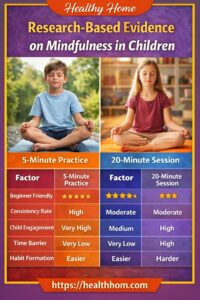
Short Exercise vs Long Meditation
| Factor | 5-Minute Practice | 20-Minute Session |
|---|---|---|
| Beginner Friendly | ⭐⭐⭐⭐⭐ | ⭐⭐⭐ |
| Consistency Rate | High | Moderate |
| Child Engagement | Very High | Medium |
| Time Barrier | Very Low | High |
| Habit Formation | Easier | Harder |
For kids, short and consistent is better than long and irregular
Impact of 5-Minute Mindfulness on Child Health
- Stress Level Before Practice ▓▓▓▓▓▓▓▓▓▓ (High)
- Stress Level After Practice ▓▓▓▓▓ (Reduced)
- Focus Before Practice ▓▓▓▓ (Low)
- Focus After Practice ▓▓▓▓▓▓▓ (Improved)
- Sleep Quality Before ▓▓▓▓ (Disturbed)
- Sleep Quality After ▓▓▓▓▓▓ (Better)
AGE-WISE BENEFITS TABLE
| Age Group | Most Suitable Exercise | Primary Benefit |
|---|---|---|
| 5–7 yrs | Balloon Breathing, Coloring | Emotional control |
| 8–10 yrs | Five Senses, Mindful Walking | Focus & grounding |
| 11–13 yrs | Body Scan, Gratitude | Self-awareness |
| 14–17 yrs | Full mindfulness mix | Stress management |

DAILY ROUTINE CHART
1. Morning Routine (2–5 min)
- Balloon breathing
- Gratitude pause
2. School Time (2–5 min)
- Five senses grounding
- Sound awareness
3. Evening Routine (5 min)
- Body scan relaxation
- Coloring meditation
PARENT BENEFIT
| For Parents | Benefit |
|---|---|
| Less irritability | Peaceful home |
| Better sleep | Easier bedtime |
| Improved focus | Academic improvement |
| Reduced screen dependency | Healthier habits |
When Should Kids Practice Mindfulness?
- Before exams
- After school stress
- During emotional outbursts
- Before sleep
- After screen time
Practicing mindfulness along with sleep music and sound therapy for kids can enhance deep relaxation and better sleep quality.
Which exercise will your child try first?
- Balloon Breathing
- Five Senses
- Body Scan
- Gratitude Pause
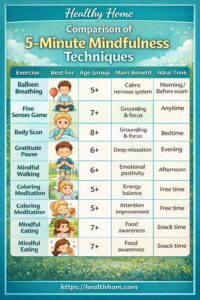
Comparison of 5-Minute Mindfulness Techniques
| Exercise | Best For | Age Group | Main Benefit | Ideal Time |
|---|---|---|---|---|
| Balloon Breathing | Anxiety | 5+ | Calms nervous system | Morning / Before exam |
| Five Senses Game | Overthinking | 7+ | Grounding & focus | Anytime |
| Body Scan | Sleep issues | 8+ | Deep relaxation | Bedtime |
| Gratitude Pause | Negative mood | 6+ | Emotional positivity | Evening |
| Mindful Walking | Restlessness | 6+ | Energy balance | Afternoon |
| Coloring Meditation | Hyperactivity | 5+ | Attention improvement | Free time |
| Mindful Eating | Overeating | 7+ | Food awareness | Snack time |
Concluding points:
In the present noisy environment, pressure in study, continuous different types of distractions, most of the children need tools to feel calm and remain in control.
Accordingly, mindfulness is the best tool and easy way to support the mental well-being of children and teens.
As per the research of Journal of Adolescent Health (2020) and World Health Organization (2022), they show that even practicing such for fewer duration can reduce the stress, improve focus and build an emotional resilience.
The important thing is that it only takes 5 minutes a day.
Start a small today:
Try one simple exercise with your child tonight and notice the difference.
Which one will you try first?
- Balloon Breathing
- Five Senses Game
- Body Scan Relaxation
- Gratitude Pause
Because sometimes, 5 minutes can shape a calmer and a happier future.
Related Health Articles from Healthy Home:
- How food affects mental health and Emotional Well-Being
- Nurturing Mental Well-being in Adolescents
- Basic Infant Care – Discover How to Take Care of Your Baby
- Why Is a Human Child So Unique and What Makes Us Human? – Exploring Human Development
- Vitamin B12 Needs During Pregnancy & Nursing – What Happens with Inadequate Intake?
Trusted References and Research Sources:
- Mindfulness & Meditation – Harvard University
- Mindfulness Exercises for Better Mental and Physical Health – Mayo Clinic Guide
- Emerging Trends in Mindfulness Practice and Health Outcomes – ScienceDirect Study (2025)
- Effects of Mindfulness on Mental Health: Longitudinal Evidence – PMC Publication
- Global Report on Mental Health and Mindfulness Promotion – WHO Publication
FAQs:
1. What is mindfulness for kids?
2. What is the point of mindfulness practices among children?
3. What are the possible mindfulness practices for the children?
4. What is the role of mindfulness in the process of concentrating?
5. Is mindfulness helpful in reducing anxiety in children?
6. What is the duration that kids are to practice mindfulness per day?
7. What is the minimum age to begin mindfulness exercises among kids?
8. Are parents do mindfulness practices with children?