Safe Cooking Tips for Pregnant Women : Healthy Indian Meal Plan
Learn safe cooking tips for pregnant women, foods to avoid, trimester-wise nutrition, and healthy Indian pregnancy meal plans for mother and baby health.
Reviewed by Bibhu Ranjan Mund, MPH (Public Health Expert) with experience in maternal, infant, child, and adolescent health programs. Content is based on evidence-informed guidelines aligned with organizations such as the World Health Organization, UNICEF, Centers for Disease Control and Prevention, and National Institutes of Health.
Medical Disclaimer: This content is for informational and educational purposes only and is not intended as medical advice, diagnosis, or treatment. Always seek the advice of a qualified healthcare professional regarding any medical condition or concerns.
Introduction:
As per the research published by World Health Organization (WHO, 2024), it shows that the poor maternal nutrition and unsafe food practices can increase the risk of anemia, low birth weight, many infections and also preterm birth globally. Only a simple mistake like reheating the food improperly or consuming the uncooked meals may affect the fetal development.
So, many of pregnancy complications are linked with nutrition which can be prevented with safer & proper cooking habits with a balanced meal pattern.
This article on Cooking Tips for Pregnant Women in Indian context will explains:
- Safe cooking tips during pregnancy
- Foods to eat and avoid
- Trimester-wise nutrition needs
- Healthy Indian meal plans for pregnant women
- Best cooking methods to preserve nutrients
Whether you are in your first trimester or nearing delivery, these evidence-based tips can help support a healthier pregnancy journey for both mother and baby.
Did you know?
Even mild food infections during pregnancy may increase the risk of premature birth and low birth weight, according to WHO maternal nutrition reports.
Quick Summary:
- Avoid raw eggs & unpasteurized milk
- Limit caffeine below 200 mg/day
- Include iron, calcium & folic acid daily
- Prefer steaming, boiling & pressure cooking
- Eat 3 balanced meals with healthy snacks
Importance of Safe Cooking During Pregnancy Period:
In pregnancy, the immune system is more sensitive and puts the mother at risk of food borne diseases like salmonella and listeriosis. The right cooking techniques and hygiene can be used to prevent infection that may lead to low birth weight and preterm births.
Additional Nutritional Requirements During Pregnancy
| Nutrient | Additional Requirement | Why Important |
|---|---|---|
| Calories | +350 kcal (2nd trimester) +450 kcal (3rd trimester) | Fetal growth |
| Protein | +23 g/day | Tissue & placenta development |
| Iron | 27 mg/day | Prevent anemia |
| Calcium | 1000–1200 mg/day | Bone development |
| Folic Acid | 400–600 mcg/day | Neural tube protection |
| Iodine | 220 mcg/day | Brain development |
Meeting daily nutrient requirements such as iron, calcium, and omega-3 is crucial, explore our complete guide on Omega-3 Intake During Pregnancy for brain and fetal development.
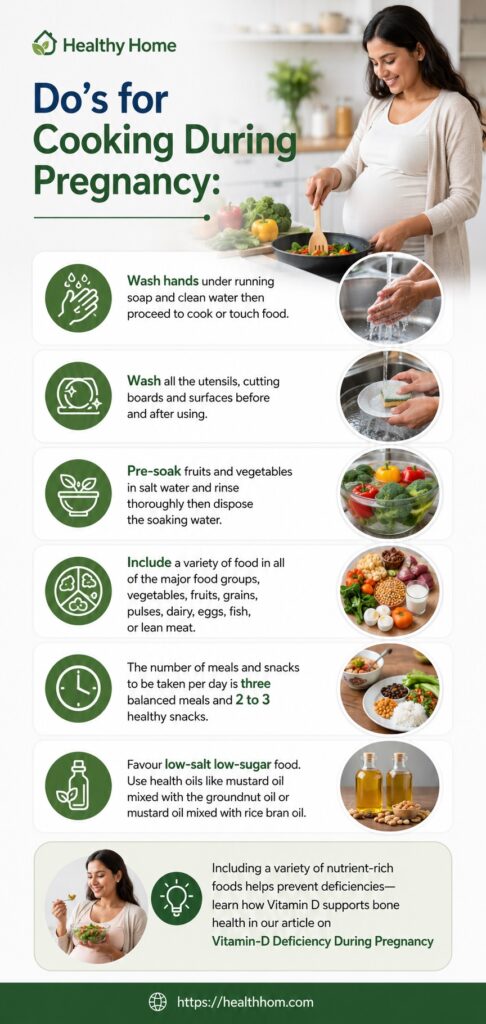
Do’s for Cooking During Pregnancy:
- Wash hands under running soap and clean water then proceed to cook or touch food.
- Wash all the utensils, cutting boards and surfaces before and after using.
- Pre-soak fruits and vegetables in salt water and rinse thoroughly then dispose the soaking water.
- Include a variety of food in all of the major food groups, vegetables, fruits, grains, pulses, dairy, eggs, fish, or lean meat.
- The number of meals and snacks to be taken per day is three balanced meals and 2 to 3 healthy snacks.
- Use low-salt low-sugar food.
- Use health oils like mustard oil mixed with the groundnut oil or mustard oil mixed with rice bran oil.
- Including a variety of nutrient-rich foods helps prevent deficiencies, learn how Vitamin D supports bone health in our article on Vitamin-D Deficiency During Pregnancy
Common Foodborne Risks in Pregnancy
| Infection | Source | Possible Risk |
|---|---|---|
| Salmonella | Raw eggs, undercooked poultry | Diarrhea, dehydration |
| Listeria | Unpasteurized milk, soft cheese | Miscarriage, preterm birth |
| Toxoplasma | Undercooked meat | Fetal infection |
| E. coli | Contaminated vegetables | Severe diarrhea |
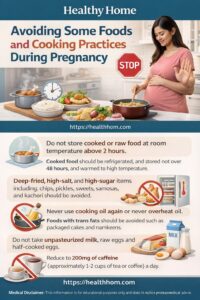
Avoiding Some Foods During Pregnancy:
- Do not store cooked or raw food at room temperature above 2 hours.
- Cooked food should be refrigerated, and stored not over 48 hours, and warmed to high temperature.
- Deep-fried, high-salt, and high-sugar items including; chips, pickles, sweets, samosas, and kachori should be avoided.
- Never use cooking oil again or never overheat oil.
- Foods with trans fats should be avoided such as packaged cakes and namkeens.
- Do not take unpasteurized milk, raw eggs, and half-cooked eggs.
- Reduce to 200mg of caffeine (approximately 1-2 cups of tea or coffee) a day.
Avoiding unhealthy processed foods is essential to maintain nutrient balance, explore healthy eating habits in our guide on Eco-Friendly Eating & Nutrition
Safe Caffeine Intake in Pregnancy
| Beverage | Approx. Caffeine |
|---|---|
| 1 cup tea | 40–50 mg |
| 1 cup coffee | 80–100 mg |
| Safe daily limit | ≤200 mg |
Safe vs Unsafe Cooking Practices
| Safe Practice | Avoid |
|---|---|
| Freshly cooked meals | Food kept >2 hrs at room temp |
| Steaming & pressure cooking | Deep frying |
| Fresh oil use | Reusing oil |
| Pasteurized milk | Raw milk |
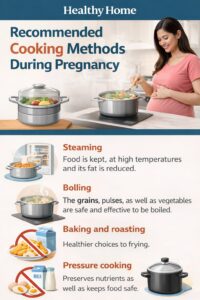
Recommended Cooking Methods During Pregnancy
- Steaming: Food is kept at high temperatures and its fat is reduced.
- Boiling: The grains, pulses as well as vegetables are safe and effective to be boiled.
- Baking and roasting: Healthier choices to frying.
- Pressure cooking: Preserves nutrients as well as keeps food safe.
Healthy cooking methods not only preserve nutrients but also support long-term wellness, check out our guide on Improve Lifespan Naturally.
Safe Cooking Temperatures
| Food | Safe Internal Temperature |
|---|---|
| Poultry | 74°C |
| Fish | 63°C |
| Eggs | Fully cooked (no runny yolk) |
| Leftovers | Reheat to steaming hot |
Trimester-Wise Nutrition Focus
| Trimester | Key Nutrient Focus | Example Foods |
|---|---|---|
| 1st | Folic acid, B6 | Leafy greens, lentils |
| 2nd | Protein, Iron | Dal, eggs, fish |
| 3rd | Calcium, DHA | Milk, ragi, fish |
Nutrient needs change across trimesters, learn why iron demand peaks in later stages in our guide on Antenatal Iron Supplementation
Sample Meal Plans for the Pregnant Woman in India
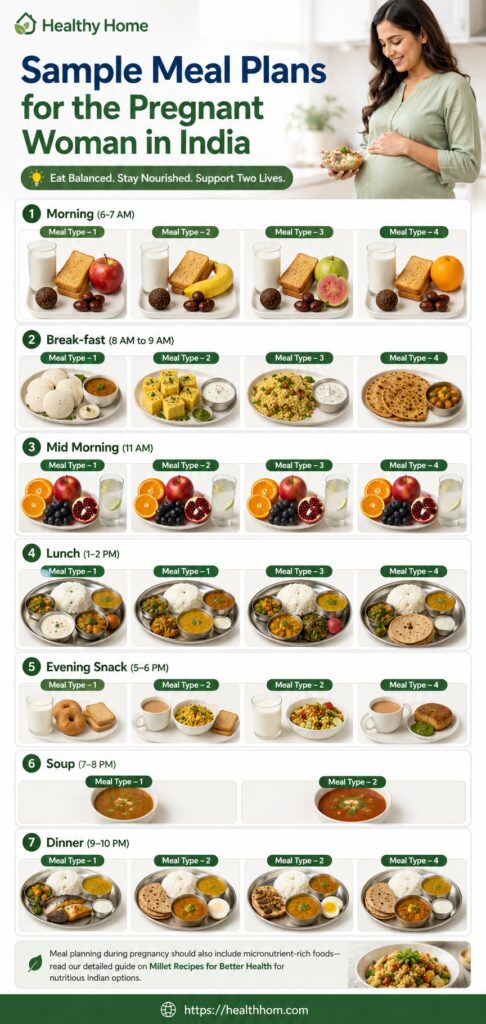
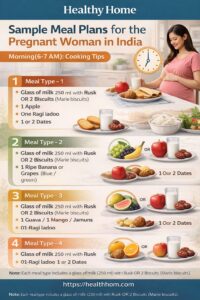
- Morning(6-7 AM):
- Meal Type – 1
- A glass of milk 250 ml with Rusk OR 2 Biscuits (Marie biscuits)
- 1 Apple
- One Ragi ladoo
- 1 or 2 Dates
- Meal Type – 2
- A glass of milk 250 ml with Rusk OR 2 Biscuits (Marie biscuits)
- 1 Ripe Banana or Grapes (Blue / green)
- 01 Ragi ladoo
- 1or 2 Dates
- Meal Type – 3
- A glass of milk 250 ml with Rusk OR 2 Biscuits (Marie biscuits)
- 1 Guava / 1 Mango / Jamuns
- 01-Ragi ladoo 1 or 2 Dates
- Meal Type – 4
- A glass of milk 250 ml with Rusk OR 2 Biscuits (Marie biscuits)
- 01-Apple or 1 Orange
- 1 Ragi ladoo
- 1 or 2 Dates
Meal planning during pregnancy should also include micronutrient-rich foods, read our detailed guide on Millet Recipes for Better Health for nutritious Indian options.
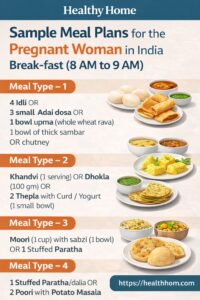
2. Break-fast (8 AM to 9 AM) :
- Meal Type – 1
- 4 Idli OR 3 small Adai dosa OR 1 bowl upma (whole wheat rava)
- 1 bowl of thick sambar OR chutney
- Meal Type – 2
- Khandvi (1 serving) OR Dhokla (100 gm) OR
- 2 Thepla with Curd / Yogurt (1 small bowl)
- Meal Type – 3
- Moori (1 cup) with sabzi (1 bowl) OR
- 1 Stuffed Paratha
- Meal Type – 4
- 1 Stuffed Paratha/dalia OR
- 2 Poori with Potato Masala
3. Mid Morning(11-AM):
- Meal Type – 1
- 1 Orange OR 1 Apple OR 1 Pomegranate (Anar) OR 1 cup black grapes with 1 Glass Tender Coconut Water OR lemon water
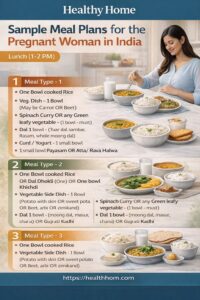
4. Lunch (1-2 PM) :
- Meal Type – 1
- One Bowl cooked Rice
- Veg. Dish – 1 Bowl (May be Carrot OR Beet)
- Spinach Curry OR any Green leafy vegetable – (1 bowl – must)
- Dal 1 bowl – (Tuar dal sambar, Rasam, whole moong dal)
- Curd / Yogurt – 1 small bowl
- 1 small bowl Payasam OR Atta/ Rava Halwa
- Meal Type – 2
- One Bowl cooked Rice OR Dal Dhokli (One) OR One bowl Khichdi
- Vegetable Side Dish – 1 Bowl (Potato with skin OR sweet potato OR Beet, arbi OR zimikand)
- Spinach Curry OR any Green leafy vegetable – (1 bowl – must)
- Dal 1 bowl – (moong dal, masur, chana) OR Gujrati Kadhi
- 1 Chikki
- Meal Type – 3
- One Bowl cooked Rice
- Vegetable Side Dish : 1 Bowl (Potato with skin OR sweet potato OR Beet, arbi OR zimikand)
- Spinach Curry OR any Green leafy vegetable or saag (1 bowl – must)
- Dal 1 bowl – (moong dal, masur, chana )
- Curd / Yogurt – 1 small bowl
- 1 Sandesh
- Meal Type – 4
- One Bowl cooked Rice OR 2 Fulkas/ bajra rotior Chapati
- Vegetable Side Dish : 1 Bowl (Potato with skin OR sweet potato OR Beet, arbi OR zimikand)
- Spinach Curry OR any Green leafy vegetable : (1 bowl – must)
- Dal 1 bowl : (moong dal, masur, rajma, chana )
- Curd / Yogurt – 1 small bowl
- 1 laddoo
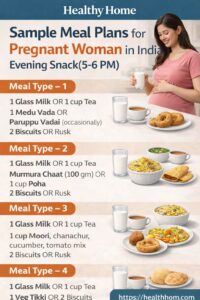
5. Evening Snack(5-6 PM) :
- Meal Type – 1
- 1 Glass Milk OR 1 cup Tea
- 1 Medu Vada OR Paruppu Vadai (occasionally)
- 2 Biscuits OR Rusk
- Meal Type – 2
- 1 Glass Milk OR 1 cup Tea
- Murmura Chaat (100 gm)OR 1 cup Poha 2 Biscuits OR Rusk
- Meal Type – 3
- 1 Glass Milk OR 1 cup Tea
- 1 cup Moori, chanachur, cucumber, tomato mix OR 2 Biscuits OR Rusk
- Meal Type – 4
- 1 Glass Milk OR 1 cup Tea
- 1 Veg Tikki OR 2 Biscuits OR Rusk
6. Soup (7-8 PM) :
- Meal Type – 1
- Rasam (Tomato, Tamarind, Garlic, Heeng) – 1 Bowl
- Meal Type – 2
- Vegetable Soup -1 Bowl/Tomato Soup -1 Bowl.
7. Dinner (9-10 PM) :
- Meal Type – 1
- 1 bowl rice OR
- 1-2 Chapati
- Dal – 1 bowl (Sambar)
- Vegetable
- 1 bowl Ragi Ambli
- medium piece of fish 75 gm OR 1 full boiled egg
- Meal Type – 2
- Chapati 2 to 3 with Dal – 1 bowl (moong dal, masur, chana)
- 1 bowl vegetable dish
- Meal Type – 3
- 1 bowl cooked rice OR Chapati 2 to 3 with Dal – 1 bowl (moong dal, masur, chana)
- 1 bowl vegetable dish
- medium piece of fish 75 gm OR 1 full boiled egg
- Meal Type – 4
- 1 bowl cooked rice OR Chapati 2 to 3 with Dal : 1 bowl (moong dal, masur, chana)
- 1 vegetable dish
Approximate Nutrient Value (Sample Day Plan)
| Nutrient | Estimated Intake |
|---|---|
| Calories | 2100–2300 kcal |
| Protein | 65–75 g |
| Calcium | 900–1100 mg |
| Iron | 18–22 mg |
Vegetarian vs Non-Vegetarian Nutrient Sources
| Nutrient | Vegetarian Sources | Non-Vegetarian Sources |
|---|---|---|
| Protein | Dal, paneer, soy | Egg, fish, chicken |
| Iron | Spinach, rajma | Liver, red meat |
| Calcium | Ragi, milk | Milk, fish |
| Omega-3 | Flax, walnuts | Fish |
Ideal Pregnancy Meal Plate (Indian Context)
| Food Group | Portion Size |
|---|---|
| Grains | 1 bowl rice / 2 chapati |
| Protein | 1 bowl dal / 1 egg / 75g fish |
| Vegetables | 1–2 bowls |
| Dairy | 1 cup milk/curd |
| Fruits | 1 medium fruit |
A safe and nutritious diet is the foundation of a healthy pregnancy, understand the role of key nutrients in our complete guide on Healthy living Guide.
Common Mistakes Pregnant Women Make
- Skipping breakfast
- Reusing cooking oil
- Eating leftover food repeatedly
- Excess caffeine
- Too much packaged food
Concluding Points:
Healthy pregnancy doesn’t says to eat more, but it’s about the eating safer and a balanced meal everyday.
A very small daily habits such as washing of vegetables before cooking, avoiding reused oils, following safe cooking methods, eating more iron-rich foods etc. may reduce many infection risks and may support your baby’s brain, bone and immunity development.
As per the researched published by World Health Organization and UNICEF, they show that a balanced maternal nutrition may plays a key role in the reduction of pregnancy complications and newborn health outcomes.
Small kitchen decisions made during pregnancy can create lifelong health benefits for your child.
Expert Tip:
Pair iron-rich foods like spinach or dal with vitamin C sources such as lemon or orange to improve iron absorption during pregnancy.
Looking for more pregnancy nutrition guides?
Explore our evidence-based articles on folic acid, iron supplementation, omega-3 intake, and trimester-wise healthy eating plans for mothers.
FAQs on Cooking Tips for Pregnant Women:
1. Does food safety important during pregnancy period?
2. What foods are not advised to pregnant women?
3. What are the healthiest ways of cooking when pregnant?
4. What are the most significant nutrients in the state of pregnancy?
5. Is food safety important during pregnancy?
6. What foods should pregnant women avoid?
7. Is spicy food safe during pregnancy?
8. Can pregnant women eat leftovers?
Related Health Articles from Healthy Home:
- Healthy Home – Iodized Salt During Pregnancy:
https://healthhom.com/iodized-salt-during-pregnancy/ - Healthy Home – Vitamin B12 Benefits and Deficiency:
https://healthhom.com/vitamin-b12/ - Healthy Home – Antenatal Iron Supplementation:
https://healthhom.com/antenatal-iron-supplementation/ - Healthy Home – Folic Acid Benefits During Pregnancy:
https://healthhom.com/folic-acid/ - Healthy Home – Health Benefits of Papaya:
https://healthhom.com/health-benefits-of-papaya/
Trusted References and Research Sources:5 Benefits of Reducing Salt and Sugar : Health Effects and Practical Tips
- National Institute of Nutrition (NIN), India – Dietary Guidelines:
https://www.nin.res.in/downloads/DietaryGuidelinesforNINwebsite.pdf - WebMD – Eating Right During Pregnancy:
https://www.webmd.com/baby/eating-right-when-pregnant - Mayo Clinic – Pregnancy Nutrition Guidelines:
https://www.mayoclinic.org/healthy-lifestyle/pregnancy-week-by-week/in-depth/pregnancy-nutrition/art-20045082 - PubMed Central – Pregnancy Nutrition Research Article:
https://pmc.ncbi.nlm.nih.gov/articles/PMC5104202/ - World Health Organization (WHO) – Nutrition Counselling During Pregnancy:
https://www.who.int/tools/elena/interventions/nutrition-counselling-pregnancy