
Last Updated on June 18, 2026 by Bibhu Ranjan Mund, MPH
Folic acid during pregnancy helps to prevent neural tube defects, supports fetal brain development, and reduces anemia risk. Learn recommended dosage, deficiency symptoms, folate-rich foods and WHO-based prevention tips.
Reviewed by Bibhu Ranjan Mund, MPH (Public Health Expert) with experience in maternal, infant, child, and adolescent health programs. Content is based on evidence-informed guidelines aligned with organizations such as the World Health Organization, UNICEF, Centers for Disease Control and Prevention, and National Institutes of Health.
Medical Disclaimer: This content is for informational and educational purposes only and is not intended as medical advice, diagnosis, or treatment. Always seek the advice of a qualified healthcare professional regarding any medical condition or concerns.
Introduction:
As per the report published by the World Health Organization (WHO, 2024), it shows that thousands of babies around the globe affected by NTD every year, which may be easily preventable with adequate folic acid supplementation just before and during early pregnancy period.
A baby’s development mostly depends upon the first few weeks of pregnancy. During this short period, the baby’s brain and spinal cord begin to form and a lack of folic acid during this period can increase the risk of serious NTD such as spina bifida.
But, the important point is that only by doing simple daily habits of taking enough folic supplementation through diet, it can support the healthy brain development, reduce the risk of anemia and also improve the pregnancy outcomes.
In this article, you will find-out the real benefits of folic acid, its dosage, its deficiency risk, best food sources and prevention tips for a healthier pergnancy.
Preparing your body before conception is equally important. Read our complete guide on pre-pregnancy planning to ensure a healthy start for your baby.
Quick Summary:
| Key Point | Details |
|---|---|
| Main Benefit | Prevents neural tube defects |
| Recommended Dose | 400–600 mcg/day |
| Best Time to Start | Before conception |
| High-Risk Groups | Previous NTD pregnancy, poor diet |
| Best Food Sources | Spinach, lentils, citrus fruits |
| Major Risks of Deficiency | Spina bifida, anemia, preterm birth |
A Situation I Have Seen During Maternal Health Programs:
During my community nutrition sessions in different parts of Odisha, I have met with many women who come for antenatal check-ups only after missing their menstrual period for several weeks. Most of them surprised when the Health Workers counsels them about folic acid supplementation.
Among them, one expecting mother asked me that why she will take folic acid, she is already feeling healthy.
The answer is that folic is not only for the mother’s health, but also it support the baby’s brain and spinal cord development which occur early in pregnancy.
When the mother confirm the pregnancy, many of the developmental process of baby have already started.
So, the health workers focus the taking of folic acid even much before the conception if possible.
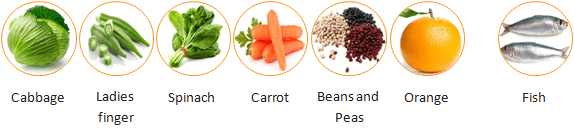
Did you follow the diet, which included the following:
Why Folic Acid Matters Before Most Families Realize It?
Many parents think that the pregnancy begins when the Urine test become positive.
From the biological point of view, it is clear that some of the baby’s important development begins even earlier.
During the first few weeks of pregnancy, the brain and spinal cord start the forming and in this stage the mother even not know she is pregnant.
So, folic acid is highly recommended by the health workers worldwide and a small tablet taken regularly can help to support a healthy pregnancy.
Why Many Women Don’t Realize They Need Folic Acid Early?
Neural tube development begins within the first month of pregnancy, often before a woman confirms she is pregnant. This is why health experts recommend folic acid even before conception.
A Common Situation in Indian Families:
In many of Indian families, the planning for pregnancy focuses on health foods, proper rest and antenatal check-ups.
But, still they are not discussing about the preconception nutrition.
In Odisha also, most of the mother take supplements only after when pregnancy is confirmed.
As the Neural Tube development start very early during pregnancy, it creates a gap that the baby may receive sufficient folate support.
Therefore, awareness among the newly married couples can help to minimize this gap.
A Story That Reflects Many Families:
During my community activities, I met one young couple from Odisha, who were very much happy to increase their family member. Like others, they only focused on health meals, exercise and routine medical check-ups.
After confirmation of pregnancy, they tried to read Internet and learnt about nutrition. Subsequently, during an antenatal visit to nearest public health care institution, they found that they have missed taking Folic acid which was an important nutrition during early pregnancy weeks.
Fortunately, the mother had already started to take folic acid supplementation during planning period of pregnancy.
So, such experience focus that preconception period is also important as well as during pregnancy itself.
What Is Folic Acid (Vitamin B9)?
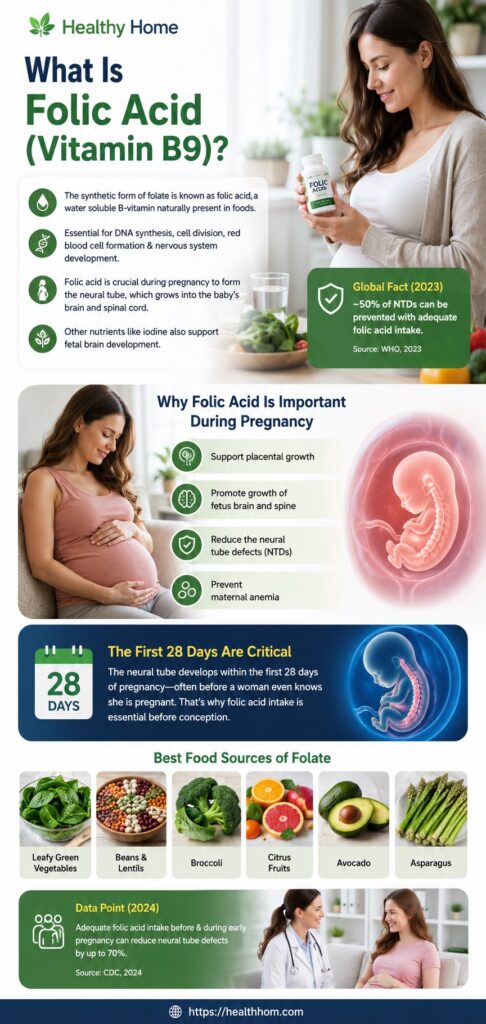
The synthetic form of folate is known as folic acid which is a water soluble B-vitamin that is naturally present in foods. It is an important part of the DNA synthesis, cell division, red blood cell formation and development of the nervous system.
Folic acid is particularly crucial during pregnancy to form the neural tube which in the future grows to form the brain and the spinal cord of the baby.
Along with folic acid, other essential nutrients like iodine also play a critical role in fetal brain development during pregnancy.
Why Folic Acid Is Important During Pregnancy
The rapid cell growth and placental development of pregnancy predisposes the body to an excessive demand of folic acid. Adequate intake helps to:
- Support placental growth
- Promote growth of fetus brain and spine.
- Reduce the NTDs
- Prevent maternal anemia
The neural tube develops within the first 28 days of pregnancy and in most cases, the neural tube develops even before the woman is aware of the pregnancy. This is the reason why the intake of folic acid is very critical before conception.
Proper brain and spinal cord development during pregnancy directly influences your child’s future growth and developmental milestones.
Public Health Observation:
During the maternal nutrition community level programs, I have observed that many families are well-known about the iron tablets as it prevents anemia.
But, folic acid sometimes viewed as a supplement not as a nutrient which actually has a role in fetal brain and spinal cord development.
If the parent will understand the importance of folic acid, it uses can be improved gradually.
So, awareness is the one of the important tools to prevent from spinal cord problems.
Daily recommended dose of Folic Acid
Those in charge of health advise:
- 400 mcg/day female pregnancy planners.
- 400–600 mcg daily during pregnancy
- Increased dose only in case of high risk pregnancies.
Never take larger doses without the advice of the health care provider.
Following a balanced pregnancy diet ensures you meet daily nutrient requirements for both mother and baby.
A Practical Example:
Think about of two pregnant women of same time pregnancy.
Out of two, one who was planning her pregnancy and started to take folic acid supplementation before conception.
The second one didn’t plan and due to unplanned pregnancy, she started to take folic acid several weeks later.
Both progress the normal pregnancy, but the first women had the advantage of giving folate support to baby for neural tube formation.
]So, such type of examples suggests by the public health experts for the encouragement of folic acid much earlier before conception.
Risks of Folic Acid Deficiency During Pregnancy
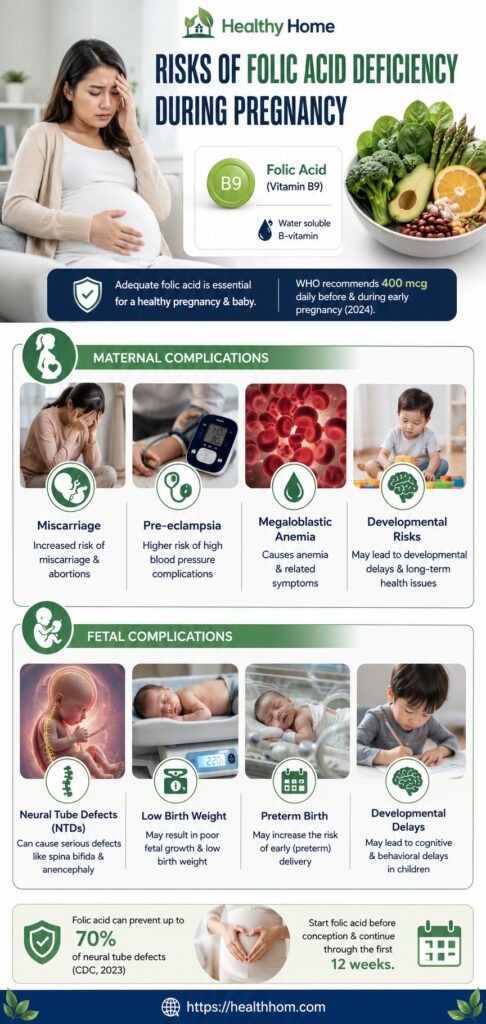
Maternal Complications:
- Miscarriage: Low folate status has been associated with adverse pregnancy outcomes, although many factors contribute to miscarriage risk.
- Risk of pre-eclampsia- Some studies suggest an association between low folate status and pregnancy complications, though evidence remains mixed. Such as pre-eclampsia (a condition where pregnant ladies develop high blood pressure).
- Megaloblastic Anemia: Megaloblastic Anemia Signs and Symptoms.
Nutritional deficiencies during pregnancy can increase the risk of developmental delays and long-term health issues in children.
Fetal Complications:
- NTDs: A deficiency of folic acid can cause health complications in the mother as well Fetal Complications. Reduced levels of folate in a person’s body lead to conditions such as spina bifida and anencephaly.
- Inadequate folate may result in the fetus having limited growth and lead to low birth weight.
- Too little folic acid in your diet may result in preterm birth.
- Developmental Delays: Adequate folate is important for fetal brain development and researchers are continuing to study its relationship with long-term developmental delays.
Early identification of developmental concerns can help parents take timely action and improve outcomes.
What Causes Folate Deficiency During Pregnancy?
- Poor dietary intake
- Gastrointestinal disease like the celiac disease or inflammatory bowel disease.
- Nutritional needs during pregnancy.
- Prenatal supplement deficiency.
- There are some drugs (e.g., anti-seizure drugs) which affect absorption.
Questions that I frequently hear from the expecting mothers like:
- Can healthy food alone provide enough folate for me and baby?
- Do I still need supplements if I eat green vegetables daily?
- Why should I start taking supplements before pregnancy?
- Will missing a few doses of folic acid affect my baby?
These concerns are normal among mothers. Folate rich foods are important, but taking supplementation is equally important to meet the adequate folic acid.
Common Mistakes Families Make About Folic Acid:
- Starting supplementation only after the first trimester.
- Assuming healthy food alone is always enough for folic acid.
- Stop the intake of supplements without any medical advice.
- A belief that folic acid is only needed when symptoms appear.
- Ignoring the supplementation during planning pregnancy.
Better awareness of these misconceptions among communities can help the families for informed decisions during pregnancy.
Prevention and Treatment of the Folic Acid Deficiency:
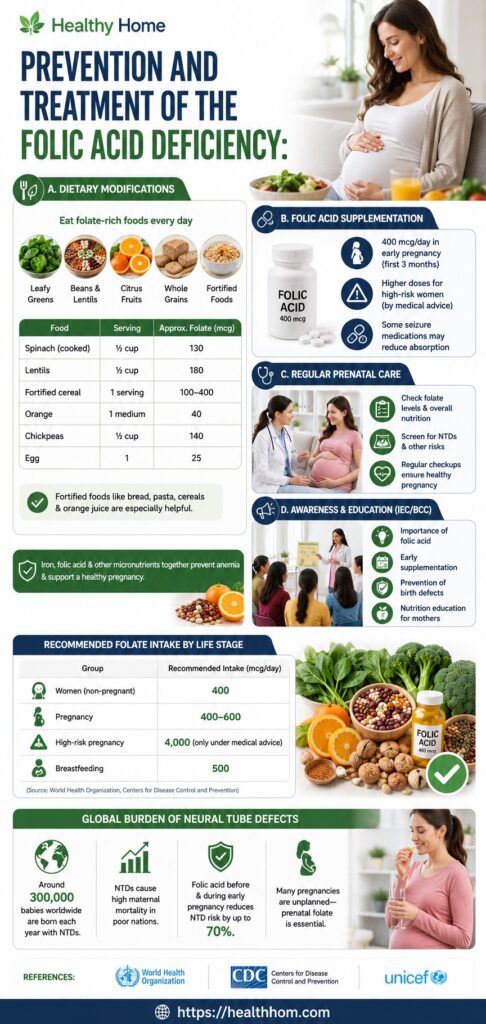
A. Dietary Modifications:
Cereals, whole grains are rich folate foods. Folates contain veggies like spinach, kale, citrus fruits and beans and lentils and even the bread fortified with folic acid. Enriched foods like bread, pasta, cereals and orange juice come in particularly handy like orange juice, pasta etc.
The diet includes Folate Rich Foods as follows:
| Food | Serving | Approx. Folate (mcg) |
|---|---|---|
| Spinach (cooked) | ½ cup | 130 |
| Lentils | ½ cup | 180 |
| Fortified cereal | 1 serving | 100–400 |
| Orange | 1 medium | 40 |
| Chickpeas | ½ cup | 140 |
| Egg | 1 | 25 |
Particularly useful foods that contain folic acid, e.g. bread, pasta, and cereals.
A combination of iron, folic acid, and other micronutrients is essential to prevent anemia and support healthy pregnancy outcomes.
Affordable Folate-Rich Foods Commonly Found in Indian Kitchens:
| Food | Why It Helps |
|---|---|
| Moong dal | Good natural folate source |
| Masoor dal | Widely available and affordable |
| Bengal gram (chana) | Rich in folate and protein |
| Spinach (palak) | Easy to include in daily meals |
| Mustard greens (sarson) | Seasonal folate-rich option |
| Groundnuts | Convenient snack source |
| Citrus fruits | Support overall nutrient intake |
In my field experience, many Indian families think that the healthy nutrition is just expensive foods. But, so many folate rich foods are already locally & seasonally available as natural source from the traditional Indian diets.
B. Folic Acid Supplementation:
- Within the first 3 months of pregnancy, Health care providers may advise that women should consume 400 mcg/day and that more intense doses are only prescribed in high-risk women under the medical guidance before several weeks of pregnancy.
- Some drugs if used against seizures may hinder the folic acid absorption, if your previous pregnancy was related to the risk of spinal cord problems.
C. Regular Prenatal Care:
Determine the level of folic acid, hope that mothers will be given the nutrition they need. Screening of other NTD as well as routine visits. Risk factors will enable health care providers to early testing to identify nutritional deficiencies.
Regular antenatal checkups help monitor fetal growth and detect nutritional deficiencies early.
D. Awareness and educating the community through IEC/BCC.
Public health campaigns based on Information, Education and Communication (IEC), Behavior Change Communication (BCC) helps in creating awareness about:
- Importance of folic acid
- Early supplementation
- Prevention of birth defects
- Nutrition education of the mother.
Small Habits That Make Folic Acid Easier to Remember:
Many women do not intentionally skip to take the supplements. But, they simply forget during busy schedule.
Some practical approaches:
- Keeping supplements near the toothbrush stand or water bottle.
- Taking them at the same time each day.
- Using phone reminders.
- Asking to spouse or any family member to help and remind her.
- Link the supplement intake with breakfast or dinner.
Simple routines may improve the consistency level.
How Family Members Can Help?
Pregnancy nutrition becomes more easier if the the family help the pregnant women.
Husbands, mothers-in-law and other family members can do:
- Remind about daily supplements.
- Support healthy meal preparation.
- Encourage antenatal visits.
- Help maintain a healthy routine.
These small support may improve the recommended nutritional supplements.
Recommended Folate Intake by Life Stage
| Group | Recommended Intake (mcg/day) |
|---|---|
| Women (non-pregnant) | 400 |
| Pregnancy | 400–600 |
| High-risk pregnancy | 4,000 (only under medical advice) |
| Breastfeeding | 500 |
(Source: World Health Organization, Centers for Disease Control and Prevention)
Global Burden of Neural Tube Defects
- Around 300,000 babies worldwide are born each year with NTDs
- NTDs cause high maternal mortality in poor nations.
- Periconceptual folic acid reduces the risk of NTD by up to 70 percent.
- Numerous women get pregnant when their pregnancies are not planned, therefore prenatal folate is essential.
Reference:
- WHO
- CDC
- UNICEF
What These Numbers Mean for Families?
Such statistics about the neural tube defects may seem alarming, but it is an opportunity to take proper prevention not to fear.
Public Health researches are always showing that the NTD of newborn babies may be prevented if adequate folic acid intake before conception and within first trimester of pregnancy.
The statistics also not says that every deficiency lead to a complication. These findings suggests to take nutritional interventions so as to avoid any complication.
What Public Health Experts Learn From These Findings:
During the maternal health programs, one easy lesson from the study and field experiences that
- The challenge is not the treatment.
- It is only awareness before pregnancy
- NTD occurs when even the mother not know she is pregnant
So, public health personnel focus on folic acid awareness among all women of reproductive age, not just for pregnant women.
Importance of Folate by Pregnancy Stage
| Stage | Why Folate Matters |
|---|---|
| Preconception | Prevents early neural tube defects |
| First 4 Weeks | Neural tube formation |
| First Trimester | Rapid cell division |
| Second Trimester | Placental growth |
| Third Trimester | Fetal growth & RBC formation |
Each stage of pregnancy plays a vital role in shaping your baby’s overall development after birth.
Who Is at Higher Risk of Folate Deficiency?
| Risk Factor | Why It Matters |
|---|---|
| Previous NTD pregnancy | Higher recurrence risk |
| Diabetes | Increased birth defect risk |
| Obesity | Higher folate requirement |
| Anti-seizure medication | Reduces folate absorption |
| Malabsorption disorders | Poor nutrient absorption |
From a Public Health Perspective:
I want to share one key message to the family members that:
You shouldn’t wait to develop any symptom of folic acid deficiency and take tablets prior to this.
Many health conditions show the warning signs, but folate deficiency may not produce any obvious warning signs during the early stage of baby’s neural tube development.
So, taking prevention is more easier than its treatment after symptoms.
The maternal health programs worldwide prioritize the consumption of folic acid and also aware among women of reproductive age.
Final Thoughts :
It is clear from the above article that, folic acid is the most simplest nutritional interventions during pregnancy.
During my more than 18 years of experience in maternal and child health programs, I have observed that the many Indian families focus the pregnancy care after confirmation but may overlook before conception.
The few earliest weeks of pregnancy time is very much critical for brain and spinal cord development and so, timely folic acid intake is important.
The pregnancy may be planned or unexpected, the proper awareness for healthy eating, antenatal visits and supplementations may help to build a healthier mother and baby.
If you know someone planning a pregnancy, please share this guide to know about the importance of folic acid for healthy fetal development.
FAQs:
Q1. What is the use of folic acid among pregnant women?
Folic acid helps in the growth of the baby brain and spinal cord as well as prevent neural tube malformations like spina bifida.
Q2. What is consequences of inadequate folic acid level in pregnancy?
Low concentrations can put a child at a risk of developing birth-related anomalies, anemia, miscarriage, preterm birth, and low birth weight.
Q3. What is the recommended daily folic acid intake by expectant women?
The majority of specialists suggest that the daily dose of 400-600 mcg should be used in the form of a prenatal supplement, as well as during the early stages of pregnancy.
Q4. What are the foods that are high in folic acid?
Sources include spinach, lentils, citrus fruits, beans, fortified cereals and eggs.
Q5. Does folic acid deficiency impact a child post-natal?
Yes. It can cause physical impairments, retarded learning and developmental problems.
Q6. Folic acid supplements: Do we need them when pregnant?
Yes. Supplements are used to augment the nutritional needs in case the nutritional intake is inadequate.
Q7. Does excessive levels of folic acid is harmful?
Vitamin B12 deficiency may happen by excessive intake. Always follow your healthcare provider’s advice.
Related Health Articles from Healthy Home:
- Antenatal Iron Supplementation – Importance for Mother and Baby
Learn how iron supplementation during pregnancy supports healthy fetal growth and prevents maternal anemia. - Can My Infant Still Have an Iodine Shortage If I Take Iodized Salt?
Understand the importance of iodine in infant brain development and how maternal diet affects newborn health. - Global Developmental Delay – Early Signs and Parental Care
Discover the causes, symptoms, and early interventions for children showing developmental delays. - Early Childhood Development – Milestones and Parental Guidance
Track your child’s physical, emotional, and cognitive growth with expert-backed tips and development milestones. - Antenatal Iron Supplementation – Best Practices and WHO Guidelines
Explore WHO-recommended daily iron intake, dietary sources, and benefits for expectant mothers.
Trusted References and Research Sources:
- World Health Organization (WHO) – Folate: Periconceptional Supplementation
Comprehensive WHO guidance on folate intake and its importance during early pregnancy. - NCBI Bookshelf – Folate (Vitamin B9)
Detailed medical overview of folate functions, deficiency symptoms, and dietary sources. - Centers for Disease Control and Prevention (CDC) – About Folic Acid
CDC recommendations on folic acid intake for women of childbearing age. - NCBI Bookshelf – Folate Deficiency
Clinical explanation of folate deficiency, causes, and prevention strategies. - Mayo Clinic – Folate (Folic Acid) Supplement Guide
Trusted information on folate supplements, dosage, and health benefits. - WebMD – Folic Acid Overview and Benefits
Easy-to-understand insights about folic acid, its role in health, and food sources.


About the Author – “Bibhu Ranjan Mund”, Master in Public Health (MPH) from IIHMR University, Jaipur (Rajasthan) has more than 18 years of experience in Public Health activities in maternal health, child health, adolescent health, nutrition and community wellness programs under National Health Mission, Health & Family Welfare Department, Odisha. He is the founder of “Healthy Home” and translates the evidence based public health information into a practical source so that families may able to apply in everyday life. All the information are for educational purposes only and not replaces the professional medical advice. ORCID Researcher ID – 0009-0003-0158-4992. Connect LinkedIn – https://www.linkedin.com/in/bibhu-ranjan-mund-b72171358/