10 Health Benefits of Turmeric : Nutrition, Uses and Curcumin Research
Discover 10 science-backed benefits of turmeric (curcumin), dosage guidelines, safety tips, side effects & latest 2026 research updates.
Reviewed by Bibhu Ranjan Mund, MPH (Public Health Expert) with experience in maternal, infant, child, and adolescent health programs. Content is based on evidence-informed guidelines aligned with organizations such as the World Health Organization, UNICEF, Centers for Disease Control and Prevention, and National Institutes of Health.
Medical Disclaimer: This content is for informational and educational purposes only and is not intended as medical advice, diagnosis, or treatment. Always seek the advice of a qualified healthcare professional regarding any medical condition or concerns.
Introduction:
Can you image that a simple spice which is readily available at your kitchen may support your digestion process, joints, heart health and also brain health?
This is Turmeric and popularly known as “Golden Spice” which has been used by Ayurveda from last 4000 years and now it’s modern remedy for health preventions.
As per the research conducted by World Health Organization (WHO, 2023) and National Institute of Health (NIH, 2024), it shows that most of the lifestyle diseases are linked with chronic inflammation and Turmeric i.e. Curcumin has been studied to reduce the inflammation.
But the important thing is that,
- Not all turmeric works like the same way.
- Dosage, absorption matters more than most people realize it.
In this evidence-based article 2026, you will find the following:
- The 10 science-backed health benefits of turmeric
- The right dosage (food vs supplements)
- Who should avoid or limit the turmeric use
- Latest clinical research & its effectiveness
Quick Summary :
- Turmeric has curcumin which has been studied on anti-inflammatory and antioxidant properties.
- There is also the evidence that Turmeric may support for joint and inflammation.
- May help the heart, digestive, and immune health.
- It is a standardized supplement, but not small amounts of food are having the most benefits
- Safe in cooking, consult a doctor before any high-dose use.
Turmeric is a yellow spice derived from Curcuma longa, known for its anti-inflammatory compound curcumin.
History and origin of Turmeric
The Turmeric (Curcuma longa) is also a flowering plant and belongs to the ginger family. Its root or rhizome is most widely used as a spice, medicine and dye. Turmeric is a product native to South Asia and has been used over 4 millennia.
- Turmeric was also used in Ayurveda medicine in India, where it was used for digestive disorders, respiratory system disorders, wound treatment and purifying the blood.
- Traditional Chinese Medicine saw its application in liver issues, menstrual disorders, chest pain and inflammations.
- Turmeric was spread to different trade routes around the world, it was used in the cuisines of Southeast Asia, the Middle East and Africa.
It is based on this rich history of application that turmeric deserves attention as food, as an aiding and protective herb.
You may visit to my previous website for Turmeric use – Best 10 Functional Food Benefits.
Nutritional Composition
Turmeric is a spice that can be used as a flavoring agent as well as a source of nutrients. It is a relatively low-consumption, yet it has bioactive plant compounds, which will ensure that you are healthy.
The main ingredients discussed as follows:
- Curcumin: It is the active ingredient that is known to give it an antioxidant and anti-inflammatory effect.
- Volunteer oils: These include turmerone and zingiberene which also help in its medicinal properties.
- Vitamins and minerals: Low vitamin C, vitamin B 6, iron, manganese and potassium.
Curcumin may be a low bioavailable product that which means the body can’t absorb it well. But when combined with black pepper (piperine contained), it is possible to boost the absorption of curcumin to 200%.
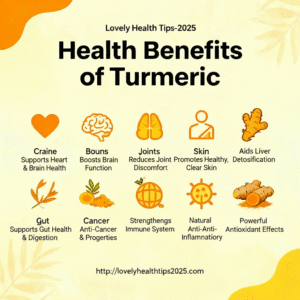
Health Benefits of Turmeric
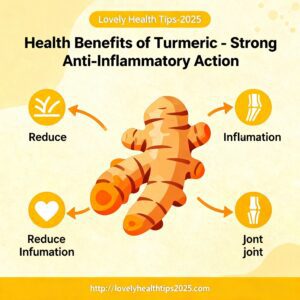
1. Strong Anti-Inflammatory Action
Low-level and chronic inflammation is associated with heart disease, cancer and other related diseases like arthritis. The curcumin has its support by suppressing most of the inflammatory processes produced by the body and may diminish the formation of inflammatory markers. This helps in reducing the risk or development of inflammatory diseases.
You can further reduce chronic inflammation by including other anti-inflammatory foods in your daily diet.
A science-backed list of supplements that promote skin health, longevity, and cellular repair : Top 5 Anti-Aging Supplements
2. Antioxidant Protection
The free radicals destroy cells which lead to aging and chronic disease. Turmeric contains high levels of antioxidants, especially curcumin, that serve as neutralizing free radicals and also enhances the natural enzymes within the body that help to neutralize free radicals.
A balanced weekly meal plan designed to improve energy, digestion, and overall nutritional intake : 7 Days Meal Plan for Better Nutrition
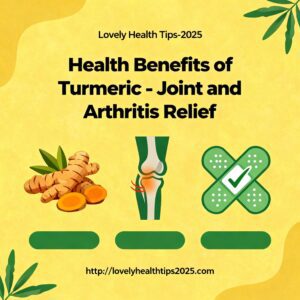
3. Joint and Arthritis Relief
Turmeric supplementation has been demonstrated in many studies to decrease the symptoms of osteoarthritis and rheumatoid arthritis including swelling and stiffness of the joints. It is also an anti-inflammatory product and a good alternative to people who are using pain relief drugs in the long term.
4. Mental Illnesses and Psychosomatic Problems.
Furthermore, curcumin may raise brain-derived neurotrophic factor (BDNF), a protein that facilitates the brain neuroplasticity by enhancing the growth of the brain neurons. BDNF levels are low in depression. It has been shown that clinically, turmeric has the potential to positively influence memory, neurodegenerative disease and mood.
Some clinical studies suggest that curcumin may support mood balance, but evidence is still awaited and it should not replace psychiatric treatment.
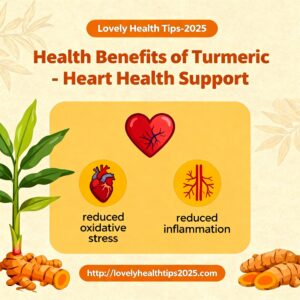
5. Heart Health Support
The preventive effect of turmeric is against heart diseases and improves the functioning of endothelium (the lining of blood vessels) and reduces oxidative stress and inflammation. One can use it to test cholesterol and arterial plaque.
Healthy lifestyle habits, including diet and activity, play a crucial role in preventing heart disease and obesity.
6. Psychotherapy Potential: Anti-Cancer.
Laboratory and early phase clinical research are studying for the possibility of the use of curcumin in cancer. Nevertheless, turmeric is not an intervention/ cure to cancer and it should never substitute normal medical therapy. It just reduces inflammation and is an antioxidant. Though not a replacement of medical care, now it is a choice by many medical care.
Turmeric should not replace prescribed treatment for inflammatory bowel disease.
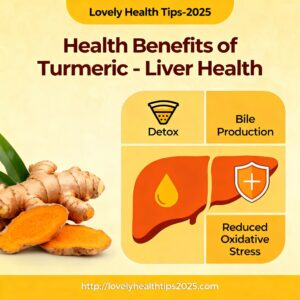
7. Liver Health
Traditionally, Turmeric supports liver function through antioxidant mechanisms. Some studies suggest curcumin may support liver function through antioxidant mechanisms as well as by increasing the production of bile. It is able to offer protection against hepatic steatosis.
8. Gut and Digestive Wellness
The ingredient is popular when it comes to gut health & digestive wellness because turmeric has anti-inflammatory, antioxidant and antibacterial properties. It may possesses antimicrobial qualities which is able to keep the intestine healthy. Clinical trials are also helpful when it comes to treating irritable bowel syndrome (IBS) and ulcerative colitis.
Pair turmeric with gut-healing foods to further support digestion and microbiome balance.
Discover daily foods that naturally reduce inflammation, boost immunity, and support long-term health : Anti-Inflammatory Foods
9. Skin Health and Healing
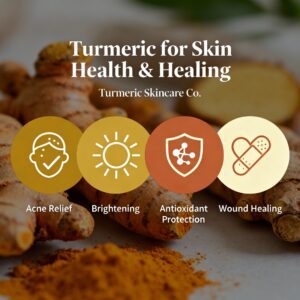
The turmeric is popular in the skincare process because it has an anti-inflammatory, antibacterial and antioxidant attribute. It aids in curing acne, lightening the skin as well as hastening heals. Turmeric face mask is an ancient South Asian beauty tradition.
Nutrient-rich foods that help to regulate hormones, reduce PMS symptoms, and support reproductive health : 7 Natural Foods for Women’s Hormonal Balance
10. Immune System Boost
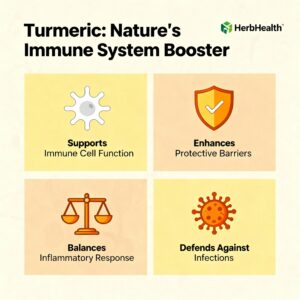
Curcumin enhances the immune system by balancing the functions of immune cells and persistent inflammation. This enhances the resistance against infection in the body.
Along with immune-supporting foods like turmeric, optimizing sleep is essential for overall health.
Culinary Uses of Turmeric
Turmeric is an excellent food additive, which provides food with a tangy flavor and nutritious:
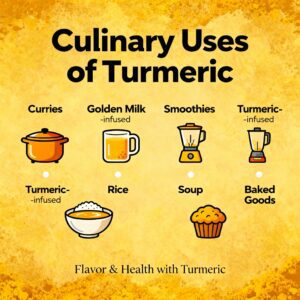
- Curries and stews: This is the most passionate and homeliest flavor of Indian curries and lentils.
- Golden milk (haldi doodh): Turmeric, milk, black pepper and honey are combined in a mixture that is typically consumed to improve immunity.
- Smoothies and teas: Turmeric powder may be taken in small portions as a smoothie and also as a herbal tea.
- Rice and grains: Turmeric is a spice that can be added in rice to give it a golden colour and light taste.
- Soups : Improves the taste & nutrition.
- Baked products: Turmeric may be used to give natural tint and distinct aroma to such products as bread, muffins and energy bites.
Incorporating turmeric into a balanced daily meal plan can improve overall nutritional quality.
Current Research and Evidence.
On-going clinical trials suggest the use of turmeric in the treatment of chronic diseases. It’s ability to treat inflammation and oxidative damage is demonstrated in scientific reviews. Scientists still under study that dietary turmeric is not as helpful as supplements with curcumin due to the concentration and absorption issues.
Other possible lines of research are:
- Curcumin may support cancer therapy.
- Typical procedures in controlling depression and anxiety.
- Research of metabolic condition, such as weight management, type 2 diabetes, insulin resistance.
Researchers warn that turmeric should not be taken as a mono-therapy even with its proven healing powers.
How to Take Turmeric & its Doses:
The daily dose may be as follows:
- Commonly studied dosages in clinical trials range between 500–2000 mg/day under medical supervision.
Tips:
- You should always use turmeric with black pepper as well as a fatty substance (coconut oil, ghee or olive oil) to absorb it better.
- Start with lesser amount especially as supplements because higher amounts cause stomach upset.
- Never take any form of supplement without consulting your health care provider especially when you are pregnant, breastfeeding or on any kind of medication like blood thinning medication.
Proper hydration also enhances nutrient absorption and overall metabolic function.
Side Effects and Precautions
Turmeric is believed to be safe when taken in food, but when taken in large doses, the supplement may cause issues in some people:
- Intestinal problem, nausea or may cause diarrhoea.
- It may leads to issues with the gallbladder or kidney stones since it contains oxalate.
Home Remedies and Wellness
Home remedies- Turmeric is still used in home remedies:
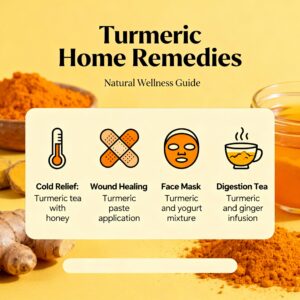
- It may support to manage the cold and the cough: Golden milk soothes the throat and boosts immunity.
- Wounds and cuts: Turmeric is a substance that is topically applied in the form of a paste to prevent infection and speed up healing.
- To attain the glowing look of the skins: Turmeric face mask (mixed with honey or yogurt) provide the skin with an effect of natural lightening.
- To help in the digestion process: Turmeric water or tea is boiled and helps to relieve bloating and works on gut health.
Beauty industry
It is a known fact that turmeric has been utilized in the beauty industry since ancient times.
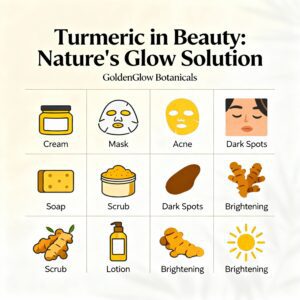
The natural anti-inflammatory and antioxidant properties of Turmeric have brought it to the prestigious position of skincare ingredient. It is now available in face creams, masks, soaps, scrubs and lotions that remove acne, dark spots and dull skin. It is the skincare that has gained popularity all over the world as it brightens the skin.
Turmeric in Food vs Supplement
| Feature | Culinary Turmeric | Curcumin Supplement |
|---|---|---|
| Dose | Small (spice level) | Concentrated extract |
| Absorption | Low | Enhanced formulations |
| Research Support | General wellness | Clinical trials |
| Safety | Very safe in food | Monitor high doses |
| Best For | Daily prevention | Targeted support |
Who Should Avoid or Limit Turmeric?
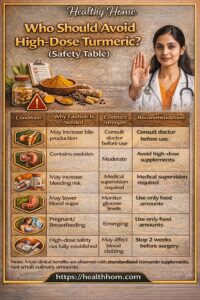
The usage of turmeric is largely safe in the normal food quantities. High-dose supplements should not be used by people or they need to be talked to with a health care professional.
- Patients having Gallbladder Disease.
- Patients with a History of Kidney Stones.
- Patients using Anticoagulant (Blood-Thinning) Drugs.
- Pregnant or Breastfeeding Women (High-Dose Supplements)
- Have scheduled surgery within the next 2 weeks
- Taking medication for diabetes or blood sugar control
- Experience unusual bleeding or stomach pain after use
Safety Reminder
- Safe in normal amounts of cooking.
- Caution: High-dose (500-2000mg/day-range) are contraindicated.
- Long term supplementation should always be done after consulting a qualified health care professional.
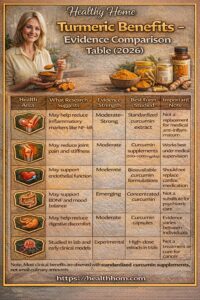
Turmeric Benefits – Evidence Comparison Table (2026)
| Health Area | What Research Suggests | Evidence Strength | Best Form Studied | Important Note |
|---|---|---|---|---|
| Inflammation | May help reduce inflammatory markers like NF-kB | Moderate–Strong | Standardized curcumin extract | Not a replacement for medical anti-inflammatory treatment |
| Osteoarthritis | May reduce joint pain and stiffness | Moderate | Curcumin supplements (500–1000 mg/day) | Works best under medical supervision |
| Heart Health | May support endothelial function | Moderate | Bioavailable curcumin formulations | Should not replace cardiac medication |
| Mood Support | May support BDNF and mood balance | Emerging | Concentrated curcumin | Not a substitute for psychiatric care |
| Gut Health (IBS) | May help reduce digestive discomfort | Moderate | Curcumin capsules | Evidence varies between individuals |
| Cancer Research | Studied in lab and early clinical models | Experimental | High-dose extracts in trials | Not a treatment or cure for cancer |
Note: Most clinical benefits are observed with standardized curcumin supplements, not small culinary amounts.
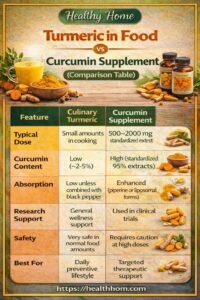
Turmeric in Food vs Curcumin Supplement (Comparison Table)
| Feature | Culinary Turmeric | Curcumin Supplement |
|---|---|---|
| Typical Dose | Small amounts in cooking | 500–2000 mg standardized extract |
| Curcumin Content | Low (~2–5%) | High (standardized 95% extracts) |
| Absorption | Low unless combined with black pepper | Enhanced (piperine or liposomal forms) |
| Research Support | General wellness support | Used in clinical trials |
| Safety | Very safe in normal food amounts | Requires caution at high doses |
| Best For | Daily preventive lifestyle | Targeted therapeutic support |
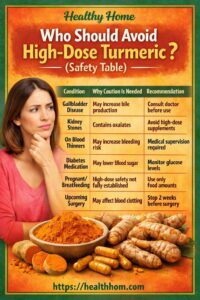
Who Should Avoid High-Dose Turmeric? (Safety Table)
| Condition | Why Caution Is Needed | Recommendation |
|---|---|---|
| Gallbladder Disease | May increase bile production | Consult doctor before use |
| Kidney Stones | Contains oxalates | Avoid high-dose supplements |
| On Blood Thinners | May increase bleeding risk | Medical supervision required |
| Diabetes Medication | May lower blood sugar | Monitor glucose levels |
| Pregnant/Breastfeeding | High-dose safety not fully established | Use only food amounts |
| Upcoming Surgery | May affect blood clotting | Stop 2 weeks before surgery |
Turmeric Dosage Guide (Evidence-Based Snapshot)
| Form | Commonly Studied Dose | Absorption Tip | Safety Note |
|---|---|---|---|
| Fresh Root | 1.5–3 grams daily | Consume with healthy fat | Safe in food amounts |
| Dried Powder | 400–600 mg up to 3 times daily | Add black pepper | May cause stomach upset in high doses |
| Curcumin Extract | 500–2000 mg/day (clinical trials) | Choose bioavailable formulations | Use under medical supervision |
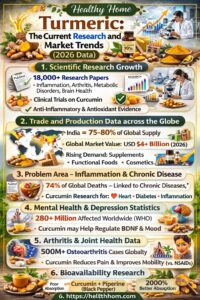
Turmeric: The current research and market trends (2026 Data)
The active constituent of turmeric is curcumin and scientific studies have increased tremendously in the last 20 years on this compound and its medical benefits. Some of the major statistics indicating its relevance to health, nutrition and research across the globe are provided below.
1. Scientific Research Growth
- In PubMed there are more than 18000+ published papers on curcumin indexed in inflammation, arthritis, metabolic disorders, cancer research and brain health.
- The use of curcumin as a complimentary therapeutic agent in chronic inflammatory conditions is tested in clinical trials.
- Various systematic reviews of peer-reviewed journals provide moderate evidence on the use of turmeric as an anti-inflammatory and antioxidant agent.
- The majority of benefits have been associated with concentrated curcumin extracts but not the small amounts of curcumin used in culinary preparation.
You can combine turmeric with low-GI foods like millets for better blood sugar management
2. Trade and Production Data across the globe.
- India is the largest producer of turmeric in the globe, about 75-80 percent of the global supply.
- As it has been reported by the Food and Agriculture Organization, in South Asia, the production of turmeric has grown to notable proportions as the international demand grows.
- The global turmeric market has estimated that, it may further growth for more than USD 4 billion within 2027-2030 due to the demand in the supplements, functional foods and the cosmetics industry.
3. Problem Area Inflammation/Chronic Disease
- The World Health Organization has reported that chronic diseases including cardiovascular disease and diabetes contribute to almost 74 percent of deaths worldwide.
- Inflammation has been known to be a cause of many non-communicable diseases.
- The anti-inflammatory effects of curcumin are under research.
4. Mental Health and Depression Statistics.
- According to World Health Organization, depression is experienced by more than 280 million people of this world.
- There is some limited clinical evidence which indicates that curcumin can help to maintain mood by modulating Brain-Derived Neurotrophic Factor (BDNF) but further larger clinical trials are required.
5. Arthritis & Joint Health Data
- Osteoarthritis is a disease that affects over half a billion individuals in the world.
- Meta-analyses suggest that curcumin supplementation can be used to decrease joint pain and stiffness in a similar way as a few NSAIDs and with fewer side effects reported.
6. Bioavailability Research
- The research made by the National Center of Complementary and Integrative Health, it indicates the poor natural absorption of curcumin.
- When curcumin is combined with piperina (black pepper) it has been demonstrated that there is an increase in absorption of up to 2000 percent depending on formulation.
Regular health checkups are essential to monitor chronic disease risks alongside dietary improvements.
Concluding Points:
It is not just a spice, but a path to reduce inflammation and also an example of traditional and modern science co-incides its view.
As per the global health data from World Health Organization (2023), worldwide about 74% of deaths are account for chronic diseases linked to inflammation and diet plays a vital role in lifestyle.
Also the study from past decade shows that, curcumin may support in inflammation balance, joint pain and metabolic health subject to appropriate doses, absorption and maintenance of consistency.
The important takeaway:
- Use turmeric regularly in food for prevention
- Take supplements only with medical advice
- Combine with black pepper & healthy fats for better absorption
Turmeric will not cure dramatically, but when it is used correctly, it may be a step toward long-term good health.
Did You Know?
- Curcumin absorption increases up to 2000% with piperine (NIH, 2024)
Related Health Articles from Healthy Home
- Health Benefits of Papaya – Full Article
- Healthy Lunch Box Ideas for Kids
- Choline-Rich Foods Guide
- Early Childhood Development
Covers essential milestones, brain development tips, and activities that support a child’s early growth.
Reference from Harvard Health:
- Turmeric benefits: A look at the evidence — Harvard Health
- Harvard Health Publishing – Curcumin Supplements Might Ease Meal-Related Discomfort
An article examining how curcumin (from turmeric) could help digestive discomfort after meals. - Economic Times – Fatty Liver & Turmeric: Good or Bad?
Article featuring a Harvard-doctor explanation on safety and caution of using turmeric for fatty liver disease. - Wikipedia – Turmeric
Comprehensive overview of turmeric: taxonomy, history, uses, chemistry and medicinal claims. - Times of India – Ancient Kitchen Ingredient for Weight & Diabetes
Explores how turmeric could play a role in weight management and diabetes via research prompts. - PMC (NCBI) – Turmeric: Review of Health Benefits (2017)
Peer-reviewed article summarizing multiple clinical trials on turmeric’s health benefits and mechanisms. - Healthline – Top 10 Evidence-Based Health Benefits of Turmeric
Clear list and explanation of several health benefits of turmeric backed by scientific evidence. - WebMD – Turmeric Slideshow: Uses and Benefits
Interactive slideshow covering uses, benefits, safety and dosage considerations of turmeric. - Mayo Clinic News Network – Are There Health Benefits to Taking Turmeric?
A brief discussion by the Mayo Clinic on the current evidence and limitations of using turmeric as a supplement.
FAQs:
Q1. What is turmeric?
Q2. What are the ways of incorporating turmeric into my day or everyday food?
Q3. Does turmeric contain effects in pain in joints and arthritis?
Q4. Does it mean that turmeric is good to the skin?
Q5. Is turmeric effective in the process of weight loss?
Q6. Do you have any side effects of consuming excessive amounts of turmeric?
Q7. Does turmeric has the ability to improve immunity?
Q8. What is Curcumin & why is it so important?
Q9. Should turmeric be used as home remedy?