Eat Healthy & Save the Planet: 7-Day Low Carbon Cooking Plan
Try this 7-day low carbon cooking plan with sustainable, plant-based recipes that support your health and reduce your environmental footprint.
Reviewed by Bibhu Ranjan Mund, MPH (Public Health Expert) with experience in maternal, infant, child, and adolescent health programs. Content is based on evidence-informed guidelines aligned with organizations such as the World Health Organization, UNICEF, Centers for Disease Control and Prevention, and National Institutes of Health.
Medical Disclaimer: This content is for informational and educational purposes only and is not intended as medical advice, diagnosis, or treatment. Always seek the advice of a qualified healthcare professional regarding any medical condition or concerns.
Introduction
We are in the 21st century and today’s global food system is responsible for nearly 34% of total greenhouse gas emission as per report of Food and Agricultural Organization (FAO, 2021).
Did you know that a few simple changes in your daily cooking habits can support both your family’s health and the environment? Many families still do not realize that everyday food choices can directly affect environmental sustainability.
The encouraging part is that sustainable cooking does not require expensive organic foods or complicated diets.
Just changing some food, you can be able to create a delicious, nutritious, cost-effective and environmental-friendly meals.
In this article, you will find-out the simple 7-day low carbon cooking plan which are easy, plant-based recipes that support your health including reducing the environmental footprint.
In this guide, you’ll find-out a simple 7-day low carbon cooking plan with plant-forward recipes which support your health and reducing the environmental footprint.
Many plant-based ingredients used in low-carbon cooking are also powerful anti-inflammatory foods that support long-term health and disease prevention.
What is low carbon cooking?
Low carbon cooking means to prepare meals using plant-based, seasonal locally available and minimally processed foods and methods that produce fewer greenhouse gas emissions.
As a public health profession working under the nutrition and family wellness programs in Odisha (India), I have observed that many traditional eating habits are already a sustainable one. Just a simple habit of cooking meals with rice, dal, vegetables and seasonal plant-based foods actually a more healthier choice with low cost and environmental friendly alternatives.
Quick Summary:
7-Day Low Carbon Meal Plan (Quick View):
- Monday: Chickpea & spinach curry
- Tuesday: Roasted vegetable quinoa salad
- Wednesday: Lentil & mushroom pie
- Thursday: Tofu broccoli stir-fry
- Friday: Pasta primavera
- Saturday: Sweet potato & black bean
- Sunday: Vegetable barley soup
Global Food System and Environmental Impact
| Indicator | Estimate | Source |
|---|---|---|
| Share of global greenhouse gas emissions linked to food systems | ~34% of total emissions | FAO Global Food Systems Report (2021) |
| Food lost or wasted globally | About one-third of all food produced | FAO Food Waste Index (2021) |
| Livestock sector contribution to agricultural emissions | Around 14.5% of global emissions | FAO Livestock Environmental Assessment (2019) |
| Plant-based diets often associated with lower environmental impact | Observed in multiple sustainability studies | Nature Food Journal (2020) |
Meaning of Low Carbon Cooking
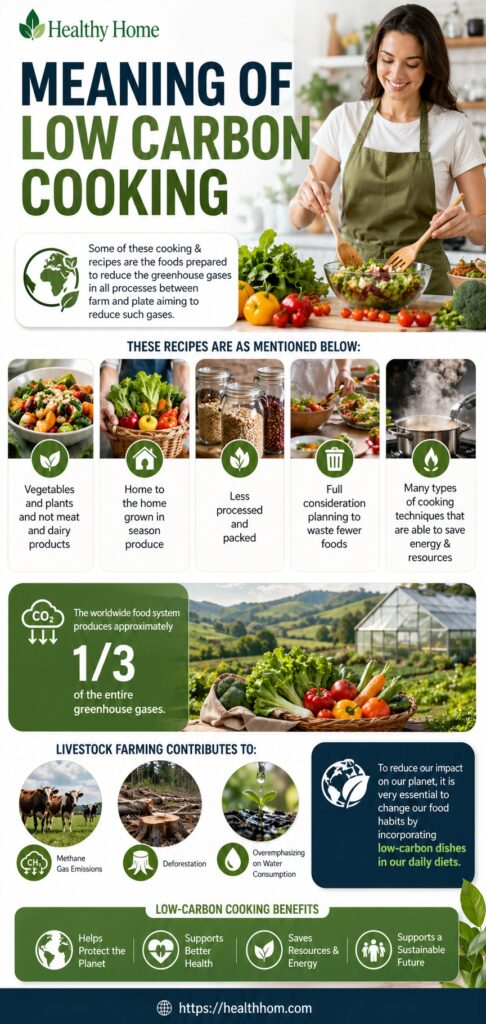
These recipes are designed to reduce greenhouse gas emissions at every stage, from farm to plate.
These recipes are as mentioned below:
- Families can prepare plant-based and not the meat & dairy products
- Home grown as seasonal produce
- Less processed and packed
- Full consideration planning to waste fewer foods
- Many types of cooking techniques that are able to save energy & resources
The worldwide food system produces approximately one-third of the entire greenhouse gases. The livestock farming contributes much by way of methane gas emissions, deforestation and overemphasizing on water consumption. To reduce our impact on our planet, it is very essential to change our food habits by incorporating low-carbon dishes in daily diets.
Approximate Carbon Footprint of Selected Foods
| Food Type | Approximate Carbon Footprint (kg CO₂-eq per kg food) | Source |
|---|---|---|
| Lamb | ~24 kg CO₂-eq | Oxford Environmental Food Dataset (2018) |
| Chicken | ~6 kg CO₂-eq | Our World in Data Food Study (2020) |
| Lentils | ~0.9 kg CO₂-eq | Our World in Data Sustainable Diets Study (2020) |
| Vegetables | ~0.5–2 kg CO₂-eq | FAO Sustainable Food Systems Report (2021) |
Sustainable nutrition:
Sustainable nutrition focuses the consumption of food which are beneficial for both human and environment. The main principle is to provide everyday nutritious food which can meet the local culture along-with preserve the ecosystem.
Adopting healthy food choices for lifelong wellness ensures that your diet supports both personal health and environmental sustainability.
The advantages:
- Emitting the lower carbon in the environment
- Public Health outcomes are improving a lot
- Many natural resources like soil, water, bio-diversity etc. are being protected
- Less dependent on fossil fuels including chemicals
Research also shows that how food affects mental health is closely linked to nutrient-rich, plant-based diets.”
In many Indian households, sustainable cooking may be more affordable than highly processed eating habits. Seasonal vegetables, dal, millets, local greens and homemade meals are usually low cost than packaged snacks, processed meat or restaurant food.
Principles of 5-Low Carbon Cooking
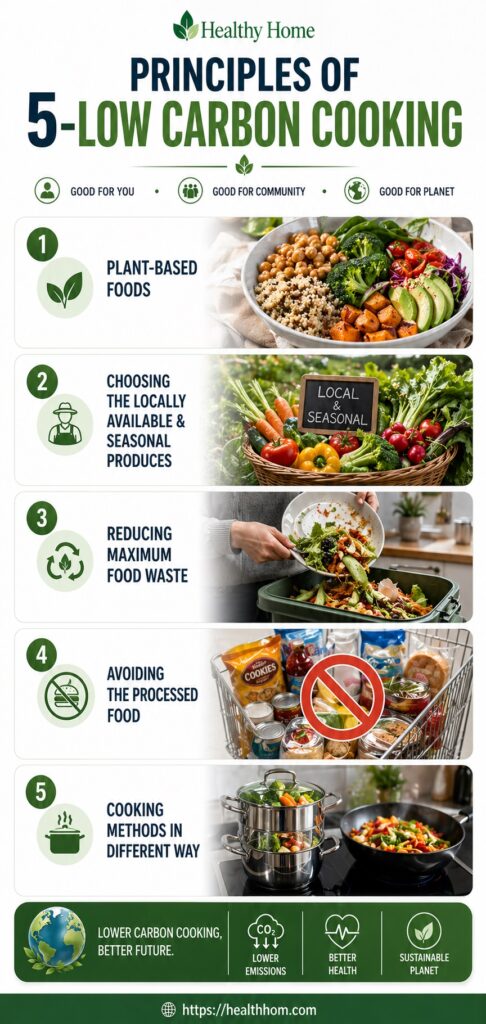
1. Plant-Based Foods:
Carbon footprints are lower in plant-based products rather than animal products viz. lentils, beans & tofu are producing the fewer emissions than mutton or lamb meat.
Plant Protein vs Animal Protein Environmental Considerations
| Protein Source | Example | General Environmental Observation | Source |
|---|---|---|---|
| Plant proteins | Lentils, beans, tofu | Lower land and water use | FAO Sustainable Diet Report (2021) |
| Animal proteins | Beef, lamb | Higher emissions and land requirements | Our World in Data Food System Analysis (2020) |
| Mixed diets | Eggs, dairy | Moderate environmental impact | Oxford Martin School Research (2019) |
For a more structured approach, you can combine this with a 7-day gut health plan to support digestion and immunity
2. Choosing the locally available & seasonal produces:
If we purchase food from outside & which travels long distances or which are not produced are more vulnerable to emissions. Local & seasonal products are tasty, nutritious & also eco-friendly.
3. Reducing maximum Food Waste:
Averagely one-third of every food produced is wasted by us. Hence, we should plan our meal tactfully & use leftovers food in creative way including composting if possible.
4. Avoiding the processed food:
Using of processed foods means using of extra energy and resources in production, transportation & waste management.
5. Cooking Methods in different way:
If actually we want to save energy, time & resources, we must use slow cookers, pressure cookers and batch cooking which helps such.
Cooking Methods and Energy Efficiency
| Cooking Method | Energy Efficiency Observation | Source |
|---|---|---|
| Pressure cooker | Shorter cooking time reduces energy use | International Energy Agency (2021) |
| Slow cooker | Uses low continuous heat | Energy Saving Trust (2020) |
| Batch cooking | Reduces repeated energy use | Sustainable Kitchens Initiative (2021) |
| Steaming | Often requires less cooking oil and water | Harvard Nutrition Source (2022) |
In the maximum regions of Odisha (India), many families already use the low-carbon cooking methods un-knowingly. Few examples are – they cook dal in pressure cooker once in the morning and use it at dinner also, any left-over curry becomes the stuffing for paratha next day. Such types of daily small habits actually save the LPG gas, reduce the food waste and save time for cooking.
So, in Odisha some healthy practices with local foods like:
| Generic Term | Replace or Add With |
|---|---|
| grains | ragi, mandia, millets |
| greens | poi saag, kulthi dal combinations |
| soups | dalma-style vegetable dishes |
| root vegetables | sweet potato, yam, arbi |
| seasonal produce | drumstick leaves, pumpkin, raw papaya |
7-Days Low Carbon Cooking Recipes:
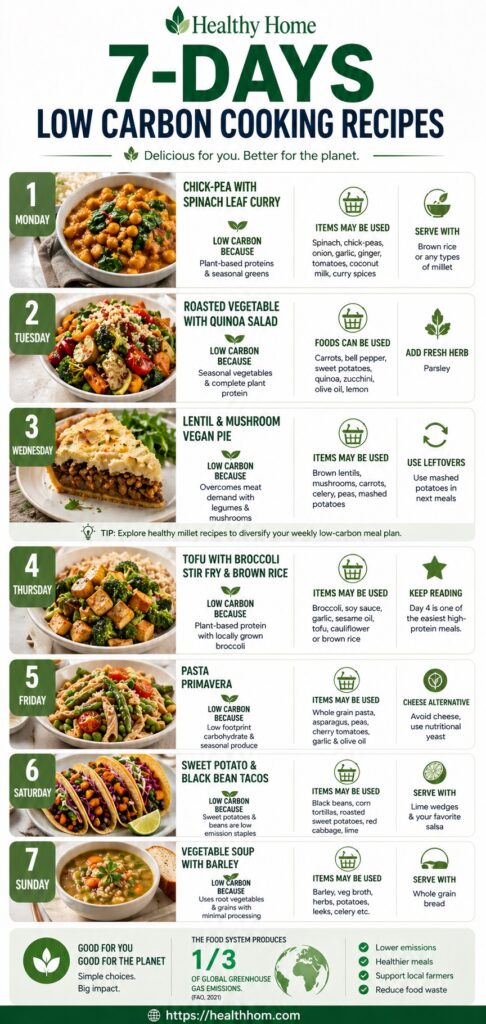
Easy to prepare, tasty, energy saving eco-friendly recipes as below:
1. Monday:- Chick-pea with Spinach leaf Curry
It is low carbon recipe because: These foods provide with Plant-based proteins & also uses in seasonal greens.
- Items may be used: Fresh spinach leaf, Canned chick-peas, onion, garlic, ginger, tomatoes, coconut milk, curry spices etc.
- You may serve with: Brown rice or any types of millet. In many of the Indian homes, this curry tastes best with steamed rice, ragi mudde or leftover millet rotis. If extra curry remains, it can also be packed for next-day office lunch.
2. Tuesday:- Roasted Vegetable with salads
The dish uses vegetables and a complete plant protein based recipe
- Foods can be utilized: Carrots, bell pepper, sweet potatoes, quinoa, zucchini, olive oil, lemon and so on.
- Fresh coriander or mint can also be used instead of parsley depending on what is easily available in Indian kitchens.
3. Wednesday: (I have this recipe from one of the vegetable magazines):- Lentil and Mushroom Vegan Pie recipe
It overcomes the demand of meat with hearty legumes & mushrooms
- Items may be used: Brown lentils, mushrooms, carrots, celery, peas, mashed potatoes
- The mashed potatoes left after cooking may be used in the next meals
Families trying to reduce their dependence on refined foods may also get benefit from including traditional millet-based meals during the week.
4. Thursday:- Tofu with Broccoli Stir fry & Brown Rice recipe
It is having Plant based protein with locally grown broccoli
- Items may be used: Broccoli, soy sauce, garlic, sesame oil, tofu etc.
- Cauliflower or brown rice may be used in this recipe.
Keep reading : Day 4 is one of the easiest high-protein meals.
5. Friday:- Pasta Primavera recipe
Pasta is a low footprint carbohydrate & the vegetables may be a seasonal produce
- Items may be used: Whole grain pasta, asparagus, peas, cherry tomatoes, garlic & olive oil
- Cheese may be avoided and Sprinkle of nutritional yeast may be used
6. Saturday:- Recipe make with Sweet Potato & Black Bean Tacos
Sweet potatoes & beans are having low emission staples
- Items may be used: Black beans, corn tortillas, roasted sweet potatoes, red cabbage, lime etc.
7. Sunday:- Vegetable Soup with Barley
It uses root vegetable & grains with minimal processing
- Items may be used: Barley, veg broth, herbs, potatoes, leeks, celery etc.
- Bread made with whole grain are to be taken.
Including traditional grains like millets and their nutritional benefits can further reduce carbon footprint while improving nutrient intake.
Try one recipe today and notice the difference.
Bookmark this plan for your weekly grocery shopping
The success of low-carbon cooking starts before entering into the kitchen. So, grocery shopping is an important part which will help to reduce both the household expenses and environmental waste.
It is now right time to be cautious and shop the grocery items which are useful in cooking. Hence, we may follow as follows:
- Planning of meal: Weekly plan to be prepared and buy the products which actually we want.
- Bulk buy: Grains, legumes & nuts may be bought in bulk with re-usable bags
- Local produces may be preferred for shopping: Locally available farmer to be visited and preferred for buying the products which are easily available and also judicious.
- Whole foods to be preferred: We have to limit the use of packaged & processed food items.
- Plastic to be avoided: We must use own bags made with cotton clothes and other containers and avoid using the plastic which are not bi-degradable.
Even the healthiest meal plan may lose its environmental value if always food is regularly wasted at home. Hence, small kitchen habits can make a big difference.
After sending of food waste to landfills, it generates methane & hence, here are some of the creative method to reduce food waste:
- We can use veggie scraps
- Overripen bananas can be reused to make dishes like smoothies
- Uneaten food can be stored in refrigerator to be used later
- We may last night’s dinner may be re-purposed into lunch
- Cold storage or any other storage method may be used to the food properly so that its shelf life can be extended.
Cooking : involvement of families
In our day-to-day busy schedule, we may involve our family members in cooking which is not complicated at all.
- Involvement of kids: They may choose their liked food
- Refrigerating food after cooking in batches: We may cook food in double batches like soups and keep it for further use.
- Monday to be meatless, Tuesday to be used Taco etc. for other days
- Different varieties of foods: Rotation of many types of grains like millets, barley for exciting meals
How Low-Carbon Cooking Looks in Real Indian Homes:
Some real examples are:
- A mother in Odisha using leftover dal to make breakfast cheela next morning
- Grandmothers sun-drying vegetables during summer
- In many Odisha households, weekend visits to the local haat are still an important family routine. Fresh seasonal vegetables, leafy saag, pumpkin and local grains are sometimes cheaper, fresher and less processed than packaged supermarket foods.
- Pressure cooker cooking saving LPG gas
- Reusing rice water in curries
- Seasonal cooking during summer/rainy season
Many nutritional benefits of Low-Carbon food:
This recipe includes:
- Fiber rich
- Many types of Vitamins & minerals
- Saturated fat are very less
- Managing the heart health
- Gut health improvement
Adding small portions of fermented foods for gut health can enhance digestion and improve gut microbiome balance.
It also reduces the risk of heart disease, type-2 diabetes, obesity & some types of cancers.
Cooking practices from the local tradition:
In Odisha, few local healthy practices which are more plant based, cost-effective, easily available like:
- Dalma with local vegetables
- Mandia pej
- Seasonal saag
- Chhatua
- Homemade fermented rice (pakhala context carefully)
- Local pumpkin dishes
- Black gram dishes
It does not give-up the local traditional foods. In India, Lentil dals, vegetable curries, flatbreads are addressing such.
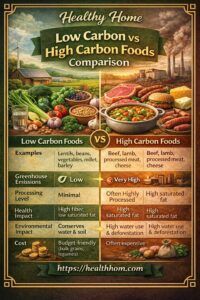
Low Carbon vs High Carbon Foods Comparison
| Category | Low Carbon Foods | High Carbon Foods |
|---|---|---|
| Examples | Lentils, beans, vegetables, millet, barley | Beef, lamb, processed meat, cheese |
| Greenhouse Emissions | Low | Very High |
| Processing Level | Minimal | Often Highly Processed |
| Health Impact | High fiber, low saturated fat | High saturated fat |
| Environmental Impact | Conserves water & soil | High water use & deforestation |
| Cost | Budget-friendly (bulk grains, legumes) | Often expensive |
The above comparison clearly shows that the lentils and vegetables produce few emissions than red meat. So, for the Indian families this is an important part that the traditional meals are already with dal, rice, vegetables and grains.
Teaching Children Sustainable Eating Habits:
Children can also learn sustainable habits through simple daily activities. Parents can involve them in washing vegetables, growing mint or coriander at home, carrying steel water bottles and learning not to waste food during meals. These small habits often stay with children for years.
During the community nutrition programs, I have observed that in many rural areas, the families consumes sustainable diets naturally as they are taking most of the seasonal vegetables, dal, rice etc. Such practices actually a good sign of shifting from packaged food to local foods.
Why it is important for next generations
- Today food choices affect the air that they breath and the water that they drink.
- The selection of low carbon meals helps to save forests, water, as well as minimize pollution.
- Plant-based diets can help the individuals to maintain a healthy lifestyle and health, as well as the environmental health.
- Food waste reduction is a lesson that teaches children to be responsible and respectful of the available natural resources.
- The long-term influence can be produced by small changes in daily routines such as having a single meal that is plant-based.
- Cooking sustainably does not imply being perfection; it means caring, responsibility, and future expectations.
Combining sustainable eating with outdoor wellness and nature benefits can further enhance physical and mental well-being.
Along with sustainable meals, maintaining a proper hydration routine is essential for overall health and energy levels.

Case based example:
A working couple at Bhubaneswar may not be able to cook always fresh meals for three times daily due to their busy schedule. So, in such situations, they may prepare the batch-cooking dal, chopping of vegetables, boiled millets during weekends can reduce the time during weekdays. It will also avoid the ordering of processed foods from online.
Key points:
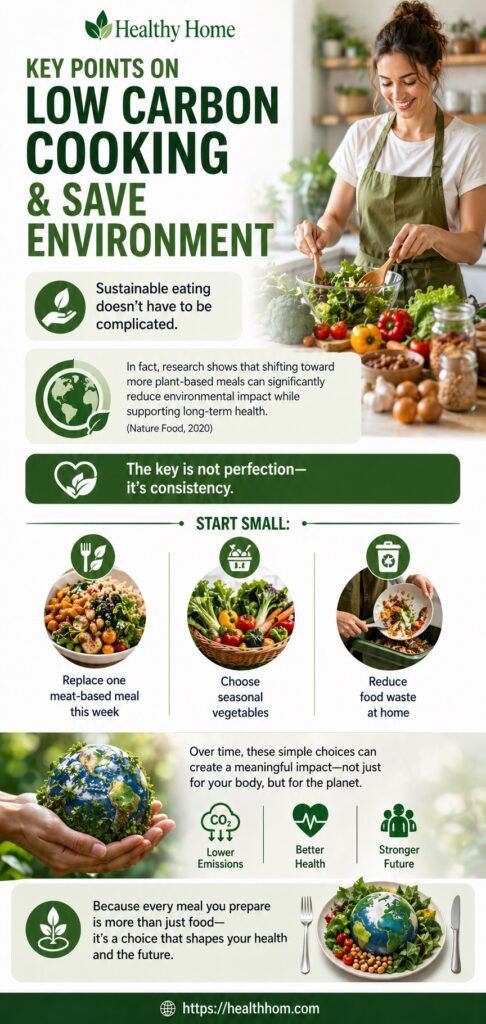
As per report of Nature Food (2020), it shows that shifting to more plant-based meals may be able to reduce to environmental impact with long-term health of individuals.
I personally belief that, the sustainable eating becomes easier if the families will start with one real change instead of changing the whole food system overnight. As per my opinion, if two or three meat meals per week may be replaced with traditional dal, rice-vegetables can be a long-term health and environmental benefits.
Always, sustainable eating doesn’t mean to be complicated. It’s needs consistency instead of perfection.
So, start with small daily like:
- Replace one meat-based meal this week
- Choose seasonal vegetables
- Reduce food waste at home
Subsequently, these small steps may create a meaningful impact, not just for your body, but for the planet.
A healthy lifestyle also includes sleep optimization strategies, which work together with nutrition to improve long-term wellness.
FAQs:
1. What is low carbon cooking?
2. Is plant-based food really lowering carbon footprint?
3. Is low carbon diet healthy?
4. Is low carbon diet very costly?
5. Can families adhere to a 7-day low carbon meal plan?
6. What can I do to minimize food waste in the house?
Related Health Articles from Healthy Home
- 8 Best Fermented Food for Gut Health in Adolescents – Healthy Home – Trusted Health Tips for Kids, Teens & Families (healthhom.com)
- How food affects mental health and Emotional Well-Being – Healthy Home – Trusted Health Tips for Kids, Teens & Families (healthhom.com)
- 7-Day Gut Health Plan for Families – Improve Digestion Naturally – Healthy Home – Trusted Health Tips for Kids, Teens & Families (healthhom.com)
- 7 days meal plan with accessible nutrition – Healthy Home – Trusted Health Tips for Kids, Teens & Families (healthhom.com)
- Outdoor Wellness Benefits: Sunlight & Nature for Family Health – Healthy Home – Trusted Health Tips for Kids, Teens & Families (healthhom.com)
Trusted References and Research Sources:
- Fresh ideas to improve health habits – Harvard Health
- A Guide to Healthy Eating: Strategies, tips, and recipes to help you make better food choices – Harvard Health
- Nutrition and healthy eating Healthy cooking – Mayo Clinic
- 9 Nutrition Tips for Reducing Your Carbon Footprint (healthline.com)
- Healthy diet (who.int)