6 Healthy Indian Millet Recipes for Weight Management and Blood Sugar Control
Discover 6 easy Healthy Indian millet recipes with a 7-day meal plan backed by 2026 research. High-fiber, low GI & diabetes-friendly.
Reviewed by Bibhu Ranjan Mund, MPH (Public Health Expert) with experience in maternal, infant, child, and adolescent health programs. Content is based on evidence-informed guidelines aligned with organizations such as the World Health Organization, UNICEF, Centers for Disease Control and Prevention, and National Institutes of Health.
Medical Disclaimer: This content is for informational and educational purposes only and is not intended as medical advice, diagnosis, or treatment. Always seek the advice of a qualified healthcare professional regarding any medical condition or concerns.
Introduction
Is it possible to manage your weight, stabilize the blood sugar level, improve digestion process by just taking one simple grain, naturally?
In India, as per the report of IDF, 2025 it shows that about 1 in 10 adults (10.5%) are living with diabetes and it is rising every year. Also the everyday food choices to reduce the obesity becomes more essential. Now the solution may be found from our traditional meal like Millets.
Now the “poor man’s food” i.e. Millets are not most popular for its low glycemic index, high fiber and metabolic benefits.
In this article we will discuss about 6 easy and tasty healthy Indian millet recipes along-with a 7 day balanced meal plan which is prepared to help in weight loss and blood sugar control and the most important thing is that without leaving any flavor.
Let now try to bring back the ancient superfood Millet in your plate with consistency.
Quick Summary
- Gluten-free whole grains that are old and popular in Indian traditional recipes
- The most popular ones are finger millet (ragi), little millet and foxtail millet.
- They are rich in the dietary fiber, plant-based protein, iron, and calcium.
- Popular recipes in millet are upma, khichdi, kheer, laddus and steamed dumplings.
- Pre-soaking of millets prior to cooking can be beneficial in enhancing the digestive process and minimizing time of cooking.
- Millets are the crops that are friendly to the environment which take less water as compared to most of the major grains.
- Due to their fiber content, they may support in weight management when included in a balanced diet.
For a complete approach to balanced eating, explore our detailed daily meal plan for sustainable nutrition.
What Are Millets?
The millets are the small- seeded whole grains that have been grown traditionally in India and other areas in Asia and Africa. Common varieties include:
- Finger Millet (Ragi)
- Little Millet
- Foxtail Millet
- Pearl Millet (Bajra)
- Sorghum (Jowar)
Millets are:
- Naturally gluten-free
- High in dietary fiber
- A source of iron and calcium
- Related with better intestinal conditions.
Millets can complement a nutritious diet and lead to blood sugar and weight control.
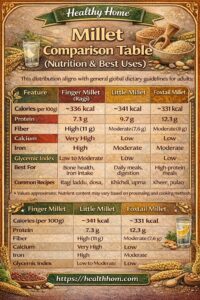
Millet Comparison Table (Nutrition & Best Uses)
| Feature | Finger Millet (Ragi) | Little Millet | Foxtail Millet |
|---|---|---|---|
| Calories (per 100g) | ~336 kcal | ~341 kcal | ~331 kcal |
| Protein | 7.3 g | 9.7 g | 12.3 g |
| Fiber | High (11 g) | Moderate (7.6 g) | Moderate (8 g) |
| Calcium | Very High | Low | Low |
| Iron | High | Moderate | Moderate |
| Glycemic Index | Low to Moderate | Low | Low |
| Best For | Bone health, iron intake | Daily meals, digestion | High-protein meals |
| Common Recipes | Ragi laddu, dosa, chakuli | Khichdi, upma | Kheer, pulao |
Values approximate. Nutrient content may vary based on processing and cooking methods.
Healthy Indian Millet Recipes for Weight Loss
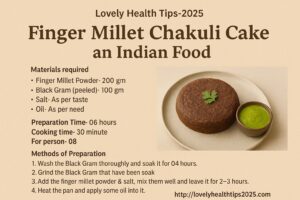
1. Finger Millet Chakuli Cake an Indian Food
Materials required —
Preparation Time — 06 hours, Cooking time — 30 minute & For person — 08
- Finger Millet Powder— 200 gm
- Black Gram (peeled) — 100 gm
- Salt — As per taste
- Oil — As per need
Methods of Preparation:
- Wash the Black Gram thoroughly and soak it for 04 hours.
- Grind the Black Gram that have been soaked
- Add the finger millet powder & salt, mix them well and leave it for 2–3 hours.
- Heat the pan and apply some oil into it.
- Please have a batter in the bowl and roll it in the pan like the making process of a pancake.
- Let it sit in the pan for 4 -5 minutes
- Now the finger millet Chakuli Cake is ready and serve with Green Chutney or any curry of your choice.
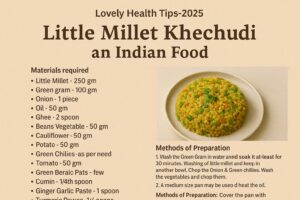
2. Little Millet Khechudi an Indian Food
Materials required —
Preparation Time — 30 minutes, Cooking time — 25 minute & For person — 06
- Litle Millet — 250 gm
- Green gram — 100 gm
- Onion — 1 piece
- Oil — 50 gm
- Ghee — 2 spoon
- Beans Vegetable — 50 gm
- Cauliflower — 50 gm
- Potato — 50 gm
- Carrots — 50 gm
- Green Chilies — as per need
- Tomato — 50 gm
- Fenugreek leaves — few
- Mustard seeds— 1/4th spoon
- Cumin — 1/4th spoon
- Ginger Garlic Paste — 1 spoon
- Turmeric Power — 1/4th spoon
- Coriander Leaves — few
- Salt — as per taste
Methods of Preparation:
- Wash the Green Gram in water and soak it at-least for 30 minutes.
- Washing of little millet and keep in another bowl.
- Chop the Onion & Green chilies. Wash the vegetables and chop them.
- A medium size pan may be used and heat the oil.
- Add mustard seeds, Cumin seeds, Coriander leaves, chopped onions & chilly and fry on low flame till 2–3 minutes.
- Now add ginger garlic paste and fry on low flame for 2 minutes.
- Now add all vegetables, turmeric powder & tomato and fry for 5–10 minutes. Add Green Gram (Moong Dal) & Water into it and heat in medium flame till water boils.
- Add Little Millet & salt as per taste.
- Cover the pan with a plate and cook it for at-least 20–25 minutes. You have to stir occasionally.
- Soon after completion of cooking process, add chopped Coriander Leaves with Ghee & serve.
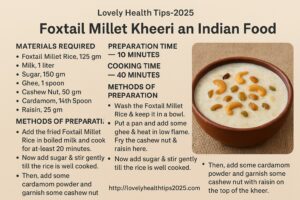
3. Foxtail Millet Kheeri – Millet Recipe
Materials required —
Preparation Time — 10 minutes, Cooking time — 40 minute & For person — 06
- Foxtail Millet Rice— 125 gm
- Milk — 1 liter
- Sugar — 150 gm
- Ghee — 1 spoon
- Cashew Nut — 50 gm
- Cardamom— 1/4th Spoon
- Raisin — 25 gm
Methods of Preparation:
- Wash the Foxtail Millet Rice & keep it in a Bowl.
- Put a Pan and add some Ghee & heat in low flame
- Fry the Cashew Nut & Raisin here
- Take the Foxtail Millet Rice in a bowl & fry it in Ghee for 3 -4 minutes
- Taking of 01 Cup Milk with Water in another pot & boil it.
- Add the fried Foxtail Millet Rice in boiled Milk and cook for at-least 20 minutes.
- Now add sugar & stir gently till the rice is well cooked.
- Then, add some Cardamom powder and garnish some Cashew Nut with Raisin on the top of the Kheer.
- Now serve and taste
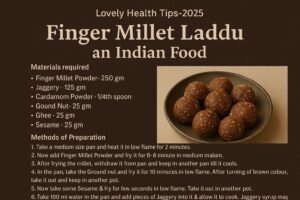
4. Finger Millet Laddu
Materials required —
Preparation Time — 15 minutes, Cooking time — 25minute & For person — 06
- Finger Millet Powder — 250 gm
- Jaggery — 125 gm
- Cardamom Powder — 1/4th spoon
- Gound Nut — 25 gm
- Ghee — 25 gm
- Sesame — 25 gm
Methods of Preparation:
- Take a medium size pan and heat it in low flame for 2 minutes.
- Now add Finger Millet Powder and fry it for 6–8 minute in medium flame.
- After frying the millet, withdraw it from pan and keep in another pan till it cools.
- In the pan, take the Ground nut and fry it for 10 minutes in low flame. After turning of brown colour, take it out and keep in another pot.
- Now take some Sesame & fry for few seconds in low flame. Take it out in another pot.
- Take 100 ml water in the pan and add pieces of Jaggery into it & allow it to cook. Jaggery syrup may be prepared in a low to medium flame.
- After preparation of syrup, we have to strain it.
- Heat the Ghee in another pan. Add the fried Finger Millet powder, Cardamom Powder, Fried Gound Nut and Sesame into it and mix well.
- Add the Jaggery syrup into it and mix well
- Take some Ghee in Palm & prepare the Laddu.
- Place the remaining Sesame in a plate & scroll the Laddu over it, so that a layer of sesame is formed in Laddu.
- Now Laddu is fully prepared to taste
5. Finger Millet Manda Cake
Materials required —
Preparation Time — 10 minutes, Cooking time — 30 minute & For person — 06
- Finger Millet Powder — 300 gm
- Rice Powder — 200 gm
- Dry grated Coconut — 4 cup
- Jaggery — 200 gm
- Cardamom Powder — 1 spoon
- Round Peppercorns Powder— 1/2 spoon
- Ghee — 1 spoon
- Oil — 1 spoon
- Salt — as per taste
Methods of Preparation:
a. Preparation of stuff-
- Take a pan and keep grated coconut & jaggery. Heat it for 5 minutes in low flame. Stir gently & continuously so that jaggery & coconut will not burn.
- Add Cardamom powder & chilli powder and stir well.
- Take this mixture and heat it for 2 – 3 minute. Leave it to cool.
b. Preparation of Cake –
- Mix well the Millet and Rice Powder in a pot.
- Now take another pot and boil 04 cup of water. Then add ghee, salt, mixture of Millet-Rice powder and heat for 3 minute in low flame.
- Take it out & transfer all in another pot.
- Add water as per requirement in the mixture & mash in oiled hand till it becomes soft. Now prepare small round shape balls.
- After mashing this dough in hand, fill the fillings/stuffs & close it.
- Boil it for at-least 10 minutes.
- Now take it out in a plate and serve in hot.

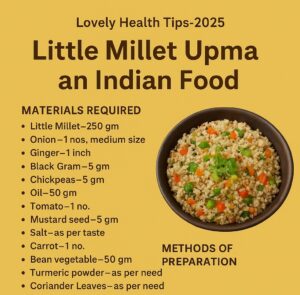
6. Little Millet Upma
Materials required —
Preparation Time — 10 minutes, Cooking time — 25 minute & For person — 05
- Little Millet — 250 gm
- Onion — 1 nos. medium size
- Ginger — 1 inch
- Black Gram — 5 gm
- Chickpeas — 5 gm
- Oil — 50 gm
- Tomato — 1 no.
- Mustard seed— 5 gm
- Salt — as per taste
- Carrot — 1 no.
- Bean vegetable— 50 gm
- Turmeric powder — as per need
- Coriander Leaves — as per need
Methods of Preparation:
- Little Millet rice to be washed and keep in a dry place.
- Now chop the green chilli, onion, tomato & vegetables and keep separately.
- Take a medium size pan and heat the oil.
- Add the Cheakpeas & Black Gram into it & fry till become brown colour.
- Later please add mustard seeds, chopped ginger, coriander leaves, onion & chilli in pan and fry for at-least 2–3 minutes.
- Now add all chopped vegetables & tomato and fry it for 2–3 minutes.
- Salt, Turmeric powder & Water to be mixed and cook for 3–4 minutes.
- After boiling of water add the little millet rice & stir well.
- Cover the pan with a lid & cook for 10 minutes in low flame till drying of water.
- Now serve the hot Upma with sprinkled Coriander leaves over it.
Millets are rich in iron. Improve iron supplementation and its benefits
Health Benefits of Millets
When taken as a part of the balanced diet, millets:
- It may be a good support of digestive health because of high fiber.
- These are naturally gluten-free
- Provide plant-based protein
- Can contribute to satiety due to fiber content
- Linked to healthy dietary habits of the heart.
High-fiber millet diets can further support digestion when combined with gut-healing foods.
Who Should Be Careful?
- Some millets contain goitrogenic compounds. Individuals with thyroid disorders should consult a healthcare provider before consuming large quantities regularly.
- Millets need to be soaked and then cooked for the person who are sensitive to digestion.
- Eating the right amount of food is vital for the people who want to control the glucose levels.
- Ask a doctor who have any medical conditions.
If you have thyroid concerns, refer to our specialized thyroid-friendly meal plan for better dietary guidance.
Cooking & Storage Tips
- Always wash thoroughly
- Soak 20-30 minutes to be better digested.
- Store in air tight containers.
- Use within 2–3 months for freshness
Including high-fiber foods like millets is one of the proven lifestyle habits for preventing obesity
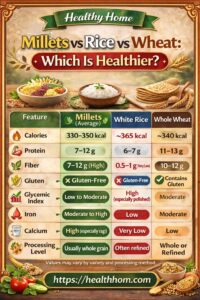
Millets vs Rice vs Wheat: Which Is Healthier?
These grains are essential to a balanced diet. The popular grains in India are millets, rice, and wheat, although they vary in terms of the amount of fibers, protein level, and micronutrient content.
The following is a comparison to help the readers in making a good selection.
| Feature | Millets (Average) | White Rice | Whole Wheat |
|---|---|---|---|
| Calories | 330–350 kcal | ~365 kcal | ~340 kcal |
| Protein | 7–12 g | 6–7 g | 11–13 g |
| Fiber | 7–12 g (High) | 0.5–1 g (Very Low) | 10–12 g |
| Gluten | ❌ Gluten-Free | ❌ Gluten-Free | ✅ Contains Gluten |
| Glycemic Index | Low to Moderate | High (especially polished) | Moderate |
| Iron | Moderate to High | Low | Moderate |
| Calcium | High (especially ragi) | Very Low | Low |
| Processing Level | Usually whole grain | Often refined | Whole or refined |
Values may vary by variety and processing method.
Adding anti-inflammatory foods alongside millets may help to reduce chronic inflammation and improve metabolic health.
Which One Should You Choose?
- To manage weight: Millets or whole wheat (due to availability of fibers)
- For gluten-free diets: Millets or rice.
- To digest fast and have light meals: Rice
- To increase calcium consumption: Finger millet (ragi).
- In case of balanced traditional meals: Alternate all the three.
Dietary diversity is key. Grains rotation may enhance the intake of nutrients and decrease the dependency on refined carbohydrates.
Expert Tip
Instead of completely eliminating rice or wheat, consider
- Substituting two or three meals a week with millet-based meals.
- Using brown rice as a substitute of polished white rice.
- Multigrain flour combinations to be used.
Key Differences
1. Fiber Content
Both the millets and whole wheat have much more fiber compared to the white rice. Increasing the fiber intake is related to increased gut health and satiety.
2. Blood Sugar Impact
White rice also has a high glycemic index as compared to most millets. When consumed in the right amount as a balanced meal, millets can help in stabilizing the blood sugar levels.
Along-with choosing low GI foods, reducing excess sugar and salt intake plays a key role in blood sugar control.
3. Gluten Content
- Millets: Gluten free by nature.
- Rice: Naturally gluten-free
- Wheat: Contains gluten
Millets could be an appropriate alternative to persons who do not consume gluten.
4. Micronutrients
Finger millet (ragi) is thus a very good source of calcium. The millets usually contain more iron than polished white rice.
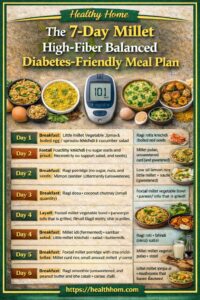
The 7-Day Millet High-Fiber Balanced Diabetes-Friendly Meal Plan
Note: This is a meal plan purely educational basis. A qualified healthcare provider may be consulted to accommodate portions and carbohydrate consumption by patients with diabetes.
General follow-up
- Use half cup of cooked millet with each meal (portion control is essential).
- Combine protein & vegetables with millets.
- Refined sugar to be avoided, little jaggery or natural sweetness to be preferred.
- Add healthy fats (nuts, seeds, small ghee).
1. Day 1
- Breakfast: Little millet Vegetable Upma and boiled egg / sprouts.
- Lunch: Foxtail Millet Khichdi + cucumber salad
- Dinner: Ragi roti + mixed vegetable curry + dal.
2. Day 2
- Breakfast: Ragi porridge (no sugar, nuts, and seeds)
- Lunch: Millet Pulao, unsweetened, curd (unsweetened)
- Dinner: Low oil Lemon rice of little millet + sauted vegetables.
3. Day 3
- Breakfast: Ragi dosa + coconut chutney (small quantity)
- Lunch: Foxtail Millet vegetable bowl + panneer/tofu that is grilled.
- Dinner: Millet vegetable soup, stir-fried greens.
4. Day 4
- Breakfast : Millet idli (fermented) + sambar.
- Lunch: Little Millet khichdi + salad + butter milk.
- Dinner: Ragi roti + bhindi (okra) sabzi.
5. Day 5
- Breakfast : Foxtail millet porridge with chia seeds.
- Lunch: Millet curd rice (with a small amount of millet) +carrot salad.
- Dinner: Mixed millet upma and mushrooms that have been sautéed.
6. Day 6
- Breakfast: Ragi smoothie (unsweetened, and peanut butter and flaxseeds)
- Lunch : Barnyard millet vegetable pulao + dal
- Dinner : Millet soup + cabbage stir fry.
7. Day 7
- Breakfast: Ragi laddu (small portion) + herbal tea.
- Lunch: Foxtail millet khichdi + salad.
- Dinner: Little millet pongal + vegetables that have been steamed.
Proper hydration is essential to support digestion, metabolism, and blood sugar balance
Smart Portion Guide (Per Meal)
| Component | Recommended Portion |
|---|---|
| Cooked Millet | ½–1 cup |
| Vegetables | 1–2 cups |
| Protein (Dal/Paneer/Egg) | ½–1 cup |
| Healthy Fats | 1–2 tsp |
You can further enhance digestive health with a structured gut microbiome reset plan.
Blood Sugar Friendly Tips
- Use whole millets, instead of processed millet flour.
- Add it with protein in order to lower glucose spikes.
- One should not combine millet with sweet desserts.
- Use steaming/boiling instead of deep frying.
- Check blood sugar reaction individually.
Why the above formula works?
- High in fiber
- Balanced macronutrients
- Average quantities of carbohydrates.
- Rotates millet types for nutrient diversity
- Takes protein with each meal.
The fiber content of milled grains and reduced glycemic index may help to maintain blood sugar levels in the body because milled grains have high fiber content. General diet, physical activity, adherence to medications and regular check-ups are critical in diabetes treatment.
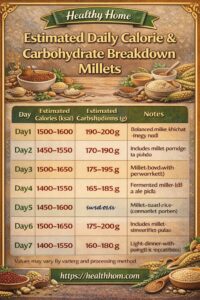
Estimated Daily Calorie & Carbohydrate Breakdown
| Day | Estimated Calories (kcal) | Estimated Carbohydrates (g) | Notes |
|---|---|---|---|
| Day 1 | 1500–1600 | 180–200 g | Balanced millet khichdi + ragi roti |
| Day 2 | 1450–1550 | 170–190 g | Includes millet porridge & pulao |
| Day 3 | 1500–1650 | 175–195 g | Millet bowl with paneer/tofu |
| Day 4 | 1400–1550 | 165–185 g | Fermented millet idli & khichdi |
| Day 5 | 1450–1600 | 170–190 g | Millet curd rice (controlled portion) |
| Day 6 | 1500–1650 | 175–200 g | Includes millet smoothie + pulao |
| Day 7 | 1400–1550 | 160–180 g | Light dinner with pongal & vegetables |
Macronutrient Distribution (Average Per Day)
| Nutrient | Approximate Range |
|---|---|
| Calories | 1450–1600 kcal |
| Carbohydrates | 170–190 g |
| Protein | 55–70 g |
| Fiber | 30–40 g |
| Fats | 45–55 g |
Calorie and carbohydrate needs vary based on:
- Age
- Gender
- Physical activity
- Medication use
- Blood sugar targets
Persons with diabetes should monitor blood glucose level and consult a healthcare provider for details.
Why Millets are becoming popular in India (2026 Data)
1. 2023 is the International Year of Millets (Global Recognition)
To highlight their nutritional and environmental sustainability, the Food and Agriculture Organization (FAO) of the United Nations and the United Nations general assembly (UNGA) have declared 2023 as the International year of millets (IYoM 2023), which aims at creating awareness on the health benefits of millets, food security and sustainable farming around the world.
2. The Increasing Production and Export Statistics of India.
India is still on the front for production and the trading of millets:
- India is the largest producer of global millet production with a figure of about 15.38 million metric tonnes of FY24, which is produced in more than 12.19 million hectares of land.
- In FY-24, India exported the Millets about 1.46 lakh metric tonnes with a total export value of approximately USD 70.89M in several of its leading markets such as the UAE, Saudi Arabia, the USA, Japan and Nepal.
These numbers indicate the developing capacity of production and the rising popularity of Indian millet products across the world.
3. The problem of increasing Diabetes Prevalence in India (IDF Insights).
In India, diabetes is a significant health problem of the population, some of the factors of low-glycemic, high-fiber food products are:
- Based on the International Diabetes Federation (IDF) Diabetes Atlas 2025 report, approximately 10.5% of the Indian adults (20-79 years) are living with diabetes.
- Diabetes cases among adults in India are close to 90 million and that is why it has one of the highest populations of diabetes cases in the world.
- Such numbers shows that why nutrition-rich diets, such as meals made using millet with a low glycemic index are attracting attention amongst health conscious Indians.
Regular screening and annual health checkups are essential for early detection and management of diabetes.
Key Takeaways
- Millets are naturally high in fibre and have a low glycaemic index, which helps to keep blood sugar levels stable.
- Regular eating may help you to lose weight and improve your digestion.
- Foxtail millet has more protein, while ragi has a lot of calcium.
- Adding protein and vegetables to millets makes the nutrient balance better.
- It’s very important to control your portions, especially if you have diabetes.
- Soaking and cooking millets in the right way, makes them easier to digest and absorb.
Quick Tips:
- Before cooking, soak the millets for 20 to 30 minutes.
- For balanced meals, eat with dal, paneer, or eggs.
- Don’t mix millets with sweet desserts too often.
- Instead of frying, try steaming or boiling.
- Change up the millets you eat to get a wider range of nutrients.
- If you have diabetes, keep an eye on your blood sugar levels.
Expert Insighth (by Bibhu Ranjan Mund, MPH)
- In community nutrition programs, substituting refined grains with millets enhanced satiety and energy levels.
- When I eat millets with foods high in protein, my blood sugar stays more stable.
- Soaking and fermenting, which are traditional cooking methods, make the gut much more tolerant.
- Millets are very good for Indian diets because they are high in refined carbohydrates.
- Millets are part of sustainable diets that also help the environment and food security.
Concluding Points:
Millets are now not a traditional grain to meet the daily needs of protein, it’s now a science-backed solution to day-to-day health challenges.
Millets may support in better digestion, increase energy levels, improve blood sugar balance or even more due to their low glycemic index, rich in nutrients, high fiber if we include in the balanced diet schedule.
If you properly combine the millet with protein, vegetables, healthy fats and take regularly, the simple meals will convert to a powerful nutritional food.
Start with small step. Just eat 2-3 meals per week with different millet recipes and you may observe the difference in our energy levels including overall health.
Which millet recipe you will try first?
Along with a healthy diet, optimizing sleep plays a vital role in weight management and metabolic health
Reference from Healthy Home:
- “What is millet & its gift to human”
- Supplementary Feeding for Infants – Lovely Health Tips-2025
Guidance on when and how to introduce complementary foods to support healthy infant growth and development. - Basic Infant Care – Lovely Health Tips-2025
A complete beginner-friendly guide for new parents on feeding, hygiene, safety, and soothing newborns. - Omega-3 Deficiency in Mothers – Lovely Health Tips-2025
Explains the effects of low omega-3 intake during pregnancy on maternal health and baby’s brain development. - Antenatal Iron Supplementation – Lovely Health Tips-2025
Essential information on why iron is crucial during pregnancy and how it prevents anemia and birth complications.
Trusted References and Research Sources:
- Indian Institute of Millets Research : Nutritional_health_benefits_millets.pdf
- Download Research Article – PMC11091339 (National Institutes of Health)
- Read Article – What Is Millet? (Healthline)
- Read Article – Health Benefits of Millet (WebMD)
- Download Research Article – PMC11482393 (National Institutes of Health)
- Nutritional and Health Benefits of Millets — Indian Institute of Millets Research (IIMR)
https://millets.res.in/m_recipes/Nutritional_health_benefits_millets.pdf - The nutrition and therapeutic potential of millets — NIH / PMC
https://pmc.ncbi.nlm.nih.gov/articles/PMC11091339/ - Managing Diabetes Mellitus With Millets — NIH / PMC
https://pmc.ncbi.nlm.nih.gov/articles/PMC10560538/ - Millets: Ancient Grains for Modern Nutrition (NIH/PMC review citing low GI aiding blood sugar regulation)
https://pmc.ncbi.nlm.nih.gov/articles/PMC11482393/
FAQs:
Q1. What are millets?
Q2. What is the reason why I should add millets into my food?
Q3. Can millets be included in the diet of diabetic patients?
Q4. Will millets substitute rice or wheat in the daily meals?
Q5. How to cook the millets for optimal taste and nutritional value?
Q6. Millets can be used to lose weight, is it true or false?
Q7. What are the commonly used Indian dishes of millet?
Q8. Is it possible to eat millet-based dishes by children and old people?
Q9. Do millets make the environment green?