Screen Time in Children and Adolescents: Health Effects, WHO Guidelines & Practical Parenting Tips
Learn how screen time in children affects the sleep, health, learning and behavior. Discover the WHO guidelines and practical parenting tips for balance.
Reviewed by Bibhu Ranjan Mund, MPH (Public Health Expert) with more than 18 years of experience in maternal, infant, child, and adolescent health programs. Content is based on evidence-informed guidelines aligned with organizations such as the World Health Organization, UNICEF, Centers for Disease Control and Prevention, and National Institutes of Health.
Research Archive
Mund BR. Screen Time in Children and Adolescents: Health Effects, WHO Guidelines & Practical Parenting Tips. Healthy Home. 2026.
DOI: https://doi.org/10.5281/zenodo.20785692
Zenodo Record:
https://zenodo.org/records/20785692
Medical Disclaimer: This content is for informational and educational purposes only and is not intended as medical advice, diagnosis, or treatment. Always seek the advice of a qualified healthcare professional regarding any medical condition or concerns.
Introduction:
Last Sunday evening, I was sitting in a local park and watching the playing of children who were busy in crickets, riding bicycles or laughing. Such energy reminded my childhood period. But suddenly my eyes turned to few children who were sitting quietly beside their parents and using mobile phones.
During my community health awareness event at Junagarh (Odisha), a mother worried about her son and said “My son was spending evening time in playing cricket with friends. But, now he comes home after school time, finishes his homework hurriedly and spends the rest of the evening hours on his phone. Even during family dinner, he’s thinking about the next video he wants to watch.”
My observations from the above examples may be a common issue of screen time in children.
Now throughout India, smartphones have been a part of daily life. Most children and adolescents use these devices for learning, communication and entertainment purpose. The new technology has provided the much benefits for them as educational videos, virtual classrooms and online information which it was not possible during last decade.
Till now many parents are asking one simple question that “How much screen time is recommended?”
Health experts are concerned that excessive screen time may negatively affect sleep routines, physical activity, mental well-being, social interaction, all of which are important for child health and development.. But completely denying the new digital technology is neither real and nor necessary. The actual solution is to find a balance.
This article discusses the latest evidence based information on screen time in children, its health effects, practical strategies for families for a healthier digital habits without too much conflict.
You may be a parent of a toddler, school going child or teen, this article may help you to find a best guide to protect the child’s health.
Quick Summary:
- Excessive screen time may affect the sleeping schedule of child, their focus, outdoor physical activity and emotional health.
- Parents should avoid the use of mobiles for less than 2 years child during any recreational time like eating, working. WHO has recommended this.
- Outdoor play, family meal time, quality sleep, study time, and regular physical activity and fitness should not be replaced by screen use.
- If you use the more screen use, it may leads to the eye strain, poor posture and also unhealthy habits.
- Heavy use of social media may increase the risk of anxiety, cyberbullying and other adolescent health challenges.
- The main aim is to balance the digital life and not to completely deny it.
What Is Screen Time in Children?
It is the amount of time children spend using different digital devices like smartphones, tablets, televisions, computers and gaming apps. The digital technology supports the effective learning and communication to the globe, but more use may affect the sleep time, physical activity, emotional well-being and also social interaction. The health experts now focus to balance the screen time and not to completely deny the system.
Is Your Child’s Screen Time Becoming a Problem? (5-Minute Self-Assessment)
Many parents think about their child’s screen use is normal or excessive. Please answer the below mentioned questions honestly:
Check all that apply:
☐ My child becomes upset or angry after ending of screen time.
☐ My child spends less time playing outdoors than earlier.
☐ Screen use regularly delays the sleep time.
☐ We are having our family meals with a phone, tablet or TV.
☐ Now hobby of my child is changed to screen.
☐ School performance or concentration in all the activities has decreased.
☐ My child frequently complains of headaches, tired eyes or poor sleep.
☐ Social media affects my child’s mood or confidence.
Your Results
0–2 checks: Screen habits are balanced with new technology.
3–5 checks: Please again review the family screen rules and daily routines.
6 or more checks: Excessive screen use may affects the health, behavior or well-being. So, to reduce it is recommended.
Remember: This checklist is not a medical diagnosis. It is just a simply a tool to help the parents for their child’s digital habits.
Global Screen Time Statistics: What the Data Shows
| Indicator | Statistics | Publication Year | Source |
| Internet users worldwide | More than 5.5 billion people | 2024 | International Telecommunication Union (ITU) |
| Children and adolescents online globally | Approximately 1 in 3 internet users is under 18 years | UNICEF Report | UNICEF |
| WHO recommendation for children under 2 years | No sedentary screen time recommended | 2019 | WHO |
| WHO recommendation for ages 2–5 years | Maximum 1 hour sedentary screen time daily | 2019 | WHO |
| Average daily screen use among teenagers in many developed countries | Often exceeds 7 hours per day excluding school work | 2023 | Common Sense Media |
| Sleep experts reporting screen-related sleep issues among adolescents | Significant increase over the last decade | 2023 | American Academy of Pediatrics |
Why These Statistics Matter
Think about a teenager boy who is spending seven hours daily during recreation time only. This actually means:
- This seven fewer hours not used for any physical activity
- Decreased the face-to-face interaction with family members
- Less opportunity for sports and self hobbies
- Increased social media pressure
- Limit the proper sleep quality
From a public health view, screen time is not an isolated issue which may affects the multiple areas of health. So that the health professionals focus on balanced digital lifestyles.
In reality, not all the screen time is the same. Examples are:
- When attending an online educational class is different from watching the short videos or reels for hours long.v
- If talking with grandparents through video calling is much difference than scrolling in social media
- Learning the coding skills from online sources differs from more online games at night.
So, the parents should also focus on quality screen use and time may not be a matter.
Why Screen Time Has Increased So Much?
Few external factors are contributing for increasing screen use among the children and teens.
1. Easy Access to Mobiles
In many Indian households, smartphones are easily available for the younger children and adolescents. Also due to low cost of devices and internet charges, it is popular in many rural areas.
2. Online Education
After the COVID-19 pandemic, the digital learning has increased a lot. Now students are in a trend to learn through online classes and spend several hours for the school related activities.
3. Entertainment Platforms
The new technologies like long & short videos, different social media platforms and online games are designed so as to keep the users engaged for a long periods.
4. Busy Family Schedules
Many Indian parents usually give the mobiles to the toddlers and children so that their household work will not be disturbed and children will remain busy otherwise. Such types of habit can gradually increase the dependency of digital screens.
Current Screen Usage Trends Among Children
As per recent studies from various countries, they show that presently the children and teens are spending more time on screen from last decades. The health professionals are now concerns about the :
- Reducing the outdoor play
- Physically inactive and busy in indoors
- Sleep disturbances due to several factors
- Not able to concentrate
- Social and emotional challenges
In urban India, now generally children are spending a lot of time on smartphones, tablets, televisions and computers for study purpose. The present issue is not to completely deny the latest technology but to balance the uses with essential childhood activities such as:
- Physical play
- Family interaction
- Reading books
- Creative activities
- Adequate sleep
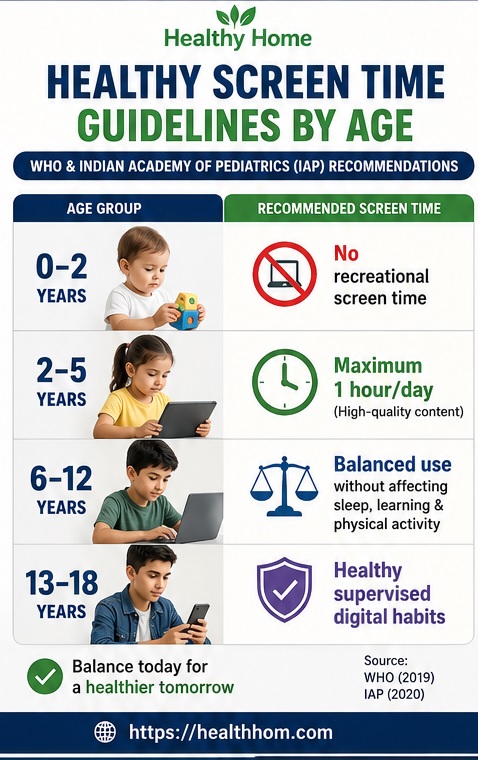
WHO Recommendations for Screen Time
The World Health Organization focuses on a balanced daily routines like sleep, physical activity and limited screen use.
Children Under 2 Years
Screen time is generally not recommended except for video communication with the family members.
Children Aged 2–5 Years
They should use one hour per day or less as recommended.
School-Age Children
WHO has not fixed the universal limit, but the experts recommend to use without affecting the followings:
- Sleep
- Physical activity
- School performance
- Social interactions
- Mental well-being
Teenagers
Parents should focus on healthy habits of adolescents rather than only counting screen hours. Parents can also use our health calculators to monitor important health indicators. The aim is to balance the digital use with responsibility. Parents to guide the teens in this regard.
Age-Wise Screen Time Guide
| Age Group | Recommended Approach |
| 0–2 Years | Avoid any leisure time screen use. Parents and caregivers should focus in talking, reading and play with children |
| 2–5 Years | Limit recreational screen time to about 1 hour daily. |
| 6–12 Years | Ensure that screen use is not interfering with sleep, learning, physical activity or social connections. |
| 13–18 Years | Focus on healthy digital habits, responsible social media use and balanced daily routines with proper supervision of parents. |
How Screen Time Affects Brain Development
Early childhood particularly within 02 years of birth is a critical period for growth of brain. During this time young children learn through:
- Face-to-face interaction
- Physical symbols
- Talking and listening from nearby surroundings
- Playing with others
If above activities will be done by screens, then the developmental opportunities may be delayed.
Children generally learn the language as mother-tongue through conversations with parents and caregivers. So that the passive screen viewing may not fully act like the real human like interaction.
Pediatric specialists suggest that regular conversation, story telling and interactive play with children supports the strong language development.
Attention and Concentration
Few digital contents are in fast mode, so that it may be difficult by some children in reading, studying or virtual classroom learnings.
Many Indian Parents report that after long hours of online classes, their children become impatient and lacking concentration.
India-Specific Evidence and Statistics
1. Indian Academy of Pediatrics (IAP):
A recent study with 771 children from Southern India found that IAP screen time recommendations are not being followed-up and its low. The average daily screen time was 2.62 hours and only 8.8% of children aged 2–5 years followed the recommended limits.
2. UNICEF and Children in the Digital World:
According to UNICEF, children and adolescents uses a major proportion of internet users globally, approximately one-third of all internet users is under 18 years of age.
India has a rapid growth in internet and smartphone access, but the balanced digital habits is also important for children and adolescents.
3. National Family Health Survey (NFHS) Perspective:
NFHS data show the lifestyle factors closely linked to healthy child development, including:
- Physical activity and active play
- Adequate sleep and nutrition
- Prevention of childhood overweight and obesity
- Healthy family environments
Key India Takeaway
- IAP recommends no screen time below 2 years.
- Children aged 2–5 years should have no more than 1 hour daily of supervised recreational screen use.
- A Southern India study found that most children exceeded the recommended screen-time limits.
- Experts advise to balance the digital learning with sleep, outdoor play, physical activity and family interaction
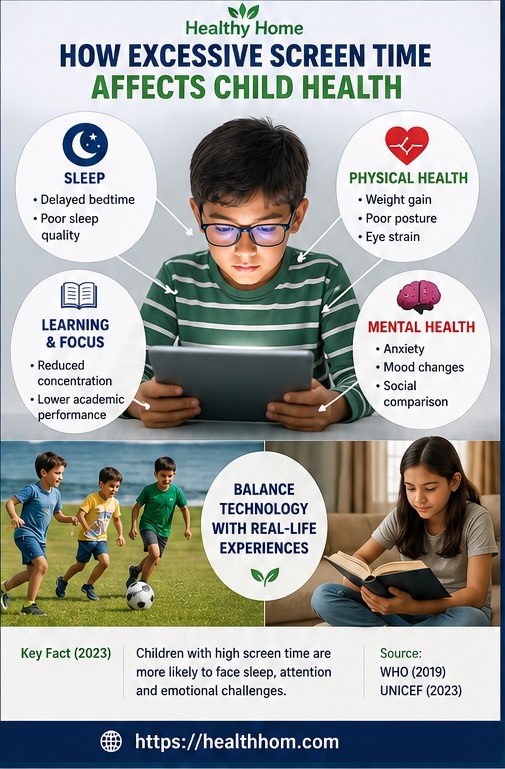
The Impact of Screen Time on Sleep
Poor sleep is one of the most common issue found in adolescents. Adequate sleep is one of the most important pillars of adolescent health and development.
A Real-Life Parenting Example
During my community awareness activity at Rayagada (Odisha), a mother worried about the behavior of her 12 year son who was in a habit to use phone after dinner. At first he was using for only 10-20 minutes, but gradually started to hours long. Mother observed in :
- Difficulty in falling asleep
- Morning tiredness
- Irritation
- Reduced concentration in school
After such activity, the family initiated a rule of “no-phone-after-9 PM”, so that his sleep improved within a few weeks.
Such types of experiences may be faced by many Indian families.
Why Screens Affect Sleep
Digital screens emit the blue light and it can limit the melatonin production in the body. As melatonin is a hormone which helps to regulate the sleep. So if you use screens in-front of eye during bedtime, it may leads to :
- Delay sleep onset
- Reduce sleep quality
- Cause daytime fatigue
- Affect mood and concentration
Effects on Physical Health
1. Reduced Physical Activity
Who spend a long time on screens may have less activities in :
- Outdoor games
- Sports
- Walking
- Cycling
These may lead to a limited fitness levels.
2. Weight Gain and Obesity
During watching TV or using mobiles, many Indian children and adolescents consume snacks or meals which may affect healthy eating habits for children. These types of mindless eating may increase the calorie intake as the children can’t realize how much they are eating.
Public health experts have started for research regarding the associations between more screen time and increased risk of obesity in children.
3. Poor Posture
Many children use the digital devices sitting in awkward positions. So, that they usually complain about:
- Neck pain
- Shoulder discomfort
- Back pain
- Wrist strain
Health professionals in few cases treat above issues as a part of the problem of “tech neck.”
4. Effects on Eye Health
I have observed in Odisha that, many parents worry about the side affects of screen on their child’s eyes. Screens may not cause permanent damage to eye, but if it will be used a long hours daily, it may leads to digital eye strain. Such symptoms may be:
- Dry eyes
- Headaches
- Eye fatigue
- Blurred vision
- Burning sensation
So, everyone should use the 20-20-20 rule i.e. Every 20 minutes, look at something about 20 feet away for at least 20 seconds. This simple habit can help to reduce eye strain during prolonged screen use.
Parents can also find-out our resources on healthy living guide to families to support healthy daily habits.
Screen Time and Mental Health
Mental health is always performs a key role in well-being of a child. New technology may help the children to learn, communicate with world, explore new ideas, but if excess or un-supervised use may leads to emotional health issues.
Mood Changes and Irritability
After using the mobiles or screens for a long period, the child may have different behavior like:
- Being frustrated when suggested to stop using a device.
- Less interested in family activities.
- Loose patients and irritated when internet facility is unavailable
- When seeing the entertainment serials or videos, may be emotional
Above behaviors does not mean that every child who enjoys screens has a mental health issue. But, if digital learning converts to a primary source of entertainment by children, it may affects the emotional balance.
Feelings of Isolation
Even the children are constantly connected through online, they may feel lonely. Some teenagers usually spend more hours for chatting, scrolling or watching videos, but don’t have face-to-face interaction with their families or friends. In reality the actual relationship are built through direct conversation, emotional attachment and sharing of experiences which the screen may not be able to do these.
Anxiety and Social Comparison
Teenagers generally compare themselves with others in online activities. Different social media sometimes show the edited contents of popular images & people’s lives, which may adolescents feel:
- Less confident with their work
- Not satisfied with their physical appearance
- Forces to meet the unrealistic things
- Anxious about social acceptance
As a parent or guardian, they should remind the children about the reality of social media which actually not affect the real life.
A Pediatrician’s Perspective: What Doctors Commonly Observe
During the pediatric consultations, now concerns about screen is a common thing. Parents say to the doctors that :
- My child is now refusing to eat without watching the mobile games.
- Child awake till late night to scroll the reels.
- He is not interested in outdoor playing with friends.
Every child is different from each other. So usually, pediatricians observe a similar pattern due to more screen use like:
- Poor sleep quality in children
- Reduced physical activity
- Unnecessary Weight gain
- Eye strain and headaches frequently
- Delayed language development in younger children
- Not concentrating on the homework which their teachers assign
- Irritation if mobiles were not given to them
So, most of the pediatricians encourage for a healthy routines like adequate sleep, outdoor play, family interaction and age-appropriate screen use.
Social Media Risks in Teenagers
The teenage year is a time for emotional and social development. Different social media provides benefits of learning opportunities, communication, but it has also few risks like:
Cyberbullying
Like traditional bullying, cyberbullying may also occur at any time of day. Several online harassment, negative comments, drop out from groups, sharing embarrassing content can have emotional effects on adolescents.
So, parents should such friendly with their teens that they will communicate each and every un-hygienic online experiences.
Access to Inappropriate Content
Children and teenagers may face:
- Violence
- Mis-information
- Harmful challenges
- Age-inappropriate content
Even with parental controls, total protection is difficult to maintain. Here, the role of parents is essential to control such activities.
Privacy and Safety Concerns
Many Indian young adolescent not know about the consequences of sharing personal information through online. The parents should discuss with them regarding:
- Privacy settings
- Safe online behavior
- Responsible sharing
- Digital footprints
Above interaction with the teens sometimes more effective than strict restrictions for entire internet use.
Healthy vs Unhealthy Screen Habits
| Healthy Habits | Unhealthy Habits |
|---|---|
| Educational use | Endless scrolling |
| Screen-free bedtime | Phone use at midnight |
| Outdoor play daily | Mostly sedentary lifestyle |
| Family discussions | Isolated device use |
| Age-appropriate content | Unsupervised content |
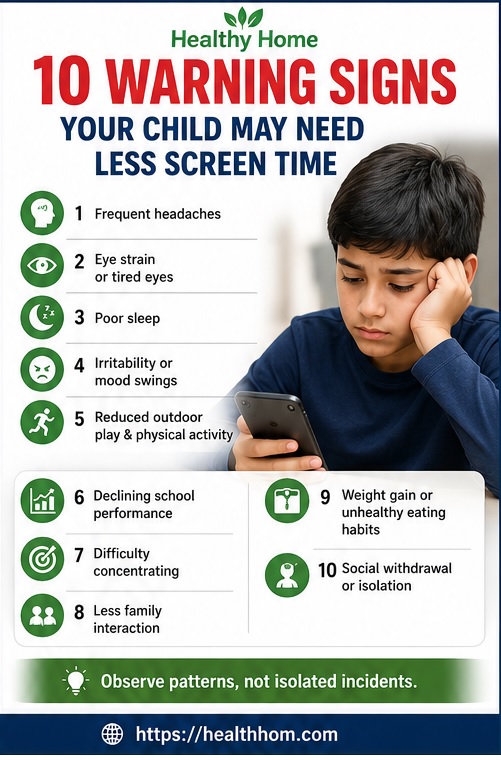
Warning Signs of Excessive Screen Use
Every child likes the enjoyment and entertainment with new technology. The actual issue arises when digital screen use interfere with the daily life. The parents may focus if they think their child is having the following signs:
Behavioral Signs
- Frequent arguments about device use
- Irritability when screens are unavailable
- Loss of interest in hobbies
- Reduced interaction with family
Academic Signs
- Declining school performance
- Difficulty concentrating
- Incomplete homework
- Reduced motivation to study
Physical Signs
- Poor sleep
- Frequent headaches
- Eye strain
- Lack of physical activity
- Weight gain
Social Signs
- Avoiding friends or family activities
- Spending most free time online
- Reduced participation in outdoor play
If the parent will observe multiple signs together may require attention, otherwise one or two is normal.
When Should Parents Seek Professional Help?
You should consult with a pediatrician, child psychologist, or mental health professional if:
- Screen use causes severe sleep problems in child
- Academic results declines consistently.
- Your child is not interested in socially active.
- Among the family, screen-related conflicts occur.
- Anxiety, depression or emotional issues appear after the digital habits.
So, if you support early to your child may be able to prevent a long-term difficulty.
A Real-Life Indian Family Story
During my health awareness sessions at Jaipur (Koraput, Odisha), a father worried about his 14 year daughter as described below.
During the Covid-19 pandemic, online classes was a necessary part for a student. Accordingly, a smartphone was provided to her for coaching. But after study time, she was using her phone for social media and videos gradually. At first, the families thought that it is a normal part, but subsequently they observe that:
- She was using phone till mid-night.
- Reduced interest in reading and always wanted to see mobile.
- Decreased the participation in family gatherings and social parties.
- Frequent complaints of tiredness and headache.
The parents then introduced for changes not a complete deny to mobile like:
- Phones usually remained outside the bedroom at night.
- Family meals were free from screen.
- Weekend small gatherings and walks with all together.
- Father suggested to join her in a dance class as she had previously enjoyed this.
After a few months of such changes, her sleep improved and became more engaged with family activities. Such type of example shows an important lesson that we have to focus on balance instead of complete restriction.
Practical Parenting Strategies to Reduce Screen Time
Many Indian parents now aware about the consequence of excessive screen use, but how to limit it is a concern. Following consistent changes may be effective:
1. Be a Role Model for the child
General tendency of every child is to observe the behavior of adults at home. If the parents use phone frequently like during meals or talking, children may also imitate such habits.
So, its clear that healthy family screen habits starts with the activity of adults.
2. Create Screen-Free Zones at home
Parents should identify few spaces for only family interaction not using any media. Such as:
- Dining tables
- Bedrooms
- Study areas
As screen-free zones may help to establish the healthy environment.
3. Prioritize Sleep
Avoid screens for at least one hour before bedtime if possible. This time case be used for:
- Reading
- Storytelling by grandparents
- Family conversations
- Relaxation activities
4. Encourage Outdoor Play
Children need movement daily to be fit and fine. Simple activities may reduce the sedentary screen. So the followings may be focused:
- Cycling
- Walking
- Cricket
- Football
- Skipping rope
5. Focus on Quality Not Only Quantity
Three hours of online education and three hours of others online videos are not equivalent. So parents should judge:
- What children are watching
- Why they are using screens
- Whether screen use supports learning or development
6. Avoid Using Screens as a Reward
If the guardian offer reward for more screen time in online activities, it may lose its value. Instead of such, alternative things may be thought like:
- Family outings in weekends
- Special activities or gatherings or ceremonies
- Creative physical projects
- Sports participation that may be at nearby park or playground
These approaches are part of broader healthy parenting practices that support children’s physical and emotional well-being.
Screen Time Myths vs Facts
| Myth | Fact |
| All screen time is harmful. | Educational and supervised screen use can be beneficial. |
| Only young children are affected by screen time. | Teenagers may also experience sleep, mental health and social effects. |
| More educational apps automatically improve learning. | Learning depends on content quality and parental support |
| Children naturally know when to stop using screens. | Many children benefit from clear instruction and guidance. |
| Denying screens completely is the best solution. | Balanced and healthy screen habits are usually more effective. |
Original Tips for Indian Families
In Western world, so many parenting recommendations have been developed. But the practical solutions is also required for Indian families.
Use Grandparent Interaction as Screen-Free Time
In India so many joint families are still exists and children can enjoy listening stories from them. The traditional storytelling can provide:
- Language development
- Cultural learning
- Family bonding
- Less screen use
Involve Children in Daily Household Activities
Simple tasks can be provided the meaningful engagements such as:
- Watering plants
- Arranging books
- Helping in the kitchen
- Shopping for groceries
Reintroduce Traditional Games
Indoor games can be encouraged for social interaction and active participation:
- Ludo
- Carrom
- Chess
- Kho-Kho
- Kabaddi
Create a Family Activity Evening
In weekends, the evening may be fixed for participatory activity where all family members avoid screens and share their experiences and activities.
Healthy Screen Time Checklist for Parents
Parents may ask the followings themselves:
- Has my child slept well?
- Does my child physically active today?
- Has homework completed in time?
- Has my child spent quality time with family or friends?
- Is the content he usually views age-appropriate?
- Is screen use replacing an study activity?
If most of answers are yes, limited screen use will not create problem.
Public Health Perspective
From a public health perspective, screen time should not be viewed in isolation and it should focus on the entire daily routine. A child who involve in daily small activities may have less screen time. Good acivities are:
- Sleeps well
- Exercises regularly
- Eats a balanced diet supported by healthy recipes for children and families.
- Performs well academically
- Maintains healthy relationships
The question is not quantity i.e. how many house of screen use, but the real question is “Does screen use interfere with healthy development?”
This actually provides a practical and realistic approach for families.
Creating a Family Digital Wellness Plan
Digital wellness plan for a family can help to establish a clear expectations.
Step 1: Set Shared Rules
Discussions and agreements on:
- Daily screen limits
- Bedtime rules
- Study-time expectations
- Appropriate content
Step 2: Define Screen-Free Times
- During meals
- During family conversations
- Before bedtime
Step 3: Encourage Alternative Activities
Maintain a list of screen-free time:
- Reading
- Sports
- Drawing
- Music
- Gardening
- Family games
Step 4: Review Progress Regularly
Families should analyze the rules made regularly and change as per need based on age, maturity and positive circumstances.

10 Screen-Free Activities Indian Children Actually Enjoy
Many Indian children enjoy these activities once they start:
- Cricket playing with friends
- Cycling around the neighborhood area
- Carrom competitions inside home also
- Chess challenges
- Ludo game at nights in weekends
- Gardening with parents in the morning or evening time
- Help the mother to prepare simple meals
- Drawing, painting or crafts if interested
- Storytelling with grandparents with affection
- Morning walks or park visits
Many Indian parents inform that their children initially not willing for screen free activities, but enjoy gradually and become a part of daily routine.
Printable Family Digital Wellness Agreement
As a family, we agree to:
- Keep phones away during our meals.
- Avoid screens at least one hour before bedtime.
- Spend time outdoors every day including weekends and morning walk is the best even for few minuters.
- Respect to the agreed screen time limits.
- Use the digital technology for learning along-with entertainment.
- Talk openly about online experiences and issues.
- Focus the family relationships besides digital behaviors.
Family Signatures
Parent: ___________________
Child: ___________________
Date: ___________________
A written agreement may help to encourage the responsibility for healthy digital habits.
If you want to test your knowledge, you may go through our health quiz on child wellness and healthy lifestyle habits.
Frequently Asked Questions
Is all screen time harmful?
How much screen time is good for school-age children?
Are educational videos better than entertainment videos?
Should phones be allowed in bedrooms?
What if my child becomes upset when screen time ends?
What is the 20-20-20 rule for digital eye strain?
What I Have Observed During Public Health Awareness Programs
During my community health awareness programs in last 18 years across Odisha, I have observed that excessive use of mobile phones among children are not discussed anywhere. Rather the Indian families discusses different challenges like irregular sleep pattern, reduce outdoor activities and more engagement in digital devices.
So as the new technology provides the educational benefits, the families shouldn’t completely deny to it and maintain a balance routine between online and offline life.
Concluding Points:
Children may not remember the videos they watch, but remember the cricket matches they watched, stories listen from grandparents, quality family trip to a hill station and attended marriage ceremony etc.
Now screen is a normal part during childhood and this trend may not leave soon. So, the main aim is not to keep the children away from new technology, but to help them for a healthy relationship with technology.
Content Review Information
Author: Bibhu Ranjan Mund, MPH
Reviewed On: June 2026
Review Method: Evidence-informed review
Primary Sources: WHO, UNICEF, AAP, IAP, CDC, NIMH
Next Review Due: June 2027
Trusted References and Research Sources:
- World Health Organization (WHO). Guidelines on Physical Activity, Sedentary Behaviour and Sleep for Children Under 5 Years of Age. Available at: WHO Guidelines on Physical Activity, Sedentary Behaviour and Sleep for Children Under 5 Years of Age (PDF)
- World Health Organization (WHO). Physical Activity Factsheets and Child Health Resources. Available at: WHO Physical Activity Fact Sheet
- UNICEF. Children in a Digital World Report. Available at: UNICEF – Children in a Digital World Report
- American Academy of Pediatrics (AAP). Media and Young Minds. Available at: AAP – Media and Young Minds
- American Academy of Pediatrics (AAP). Family Media Use Plan. Available at: AAP Family Media Use Plan
- Indian Academy of Pediatrics (IAP). Guidelines and Recommendations on Screen Time in Children. Available at: Indian Academy of Pediatrics (IAP)
- Centers for Disease Control and Prevention (CDC). Child Development and Healthy Lifestyle Resources. Available at: CDC Child Development Resources
- National Institute of Mental Health (NIMH). Social Media and Youth Mental Health Resources. Available at: NIMH Child and Adolescent Mental Health Resources
Sources reviewed: WHO, UNICEF, American Academy of Pediatrics (AAP), Indian Academy of Pediatrics (IAP), CDC and NIMH.
If you have any question, suggestions or topic requests, please contact us.