Top 10 Functional Food Benefits and Their Role in Healthy Nutrition
Discover the top 10 Functional Food Benefits backed by research. Learn how turmeric, garlic, yogurt & more support immunity, heart & gut health.
Reviewed by Bibhu Ranjan Mund, MPH (Public Health Expert) with experience in maternal, infant, child, and adolescent health programs. Content is based on evidence-informed guidelines aligned with organizations such as the World Health Organization, UNICEF, Centers for Disease Control and Prevention, and National Institutes of Health.
Medical Disclaimer: This content is for informational and educational purposes only and is not intended as medical advice, diagnosis, or treatment. Always seek the advice of a qualified healthcare professional regarding any medical condition or concerns.
Affiliate Disclosure: This article contains affiliate links. If you purchase through these links, we may earn a small commission at no extra cost to you.
Introduction:
As per the research of World Health Organization (2023), it shows that about 60% of chronic diseases are linked with the diet schedule and lifestyle. To overcome this problem, one shouldn’t depend on the costly supplements, but the available natural products in your daily kitchen is helpful.
Starting from turmeric in the curry to yogurt in the breakfast, many day-to-day foods are not only filling your stomach but also support in immunity, gut & heart health, even for functioning of brain.
So, these are called as functional foods. As per the study by Harvard Health (2022) and the National Institute of Health (NIH, 2023), they show that functional foods play a key role for reduction of inflammation, improvement in digestion process and also supporting the long-term health.
The important thing is that, which type of functional foods are best and how to use them on daily basis.
Here, in this article, you will find the 10 science-backed functional food benefits, their real benefits, how to include in daily schedule for the entire family.
Many functional foods also act as anti-inflammatory agents, discover the best anti-inflammatory foods to include in your diet.
Quick Summary:
- Functional foods have the bioactive compounds, which are beneficial for healthy outcomes
- They may reduce the inflammation along-with promotion of immunity
- These may be safer as compared to other concentrated supplements.
- Some people (pregnant women, thyroid patients, blood thinners) must take the advice of doctor before any such foods
- Small daily habits may enhance the natural wellness in the long-term.
What I Often Observe During Community Nutrition Programs?
While working under maternal, child health and adolescent health programs, I have observed a common habit pattern in many Indian families.
People are in a thought that for a health diet, more costly supplements, imported super-foods or any complicated diet schedule is always required.
But, during my discussion with them, they explain their eating habits and already they are consuming many functional properties like turmeric, garlic, yogurt, ginger, flaxseeds etc.
So, the actual challenge is not the unavailability, but the consistency matters.
Most of the Indian family members consume such types of foods occasionally, but not taking regularly to gain the lon-term benefits.
Such, observation shows me that people are already have better choice for improving the nutrition, but searching for a new products always.
What Are Functional Foods?
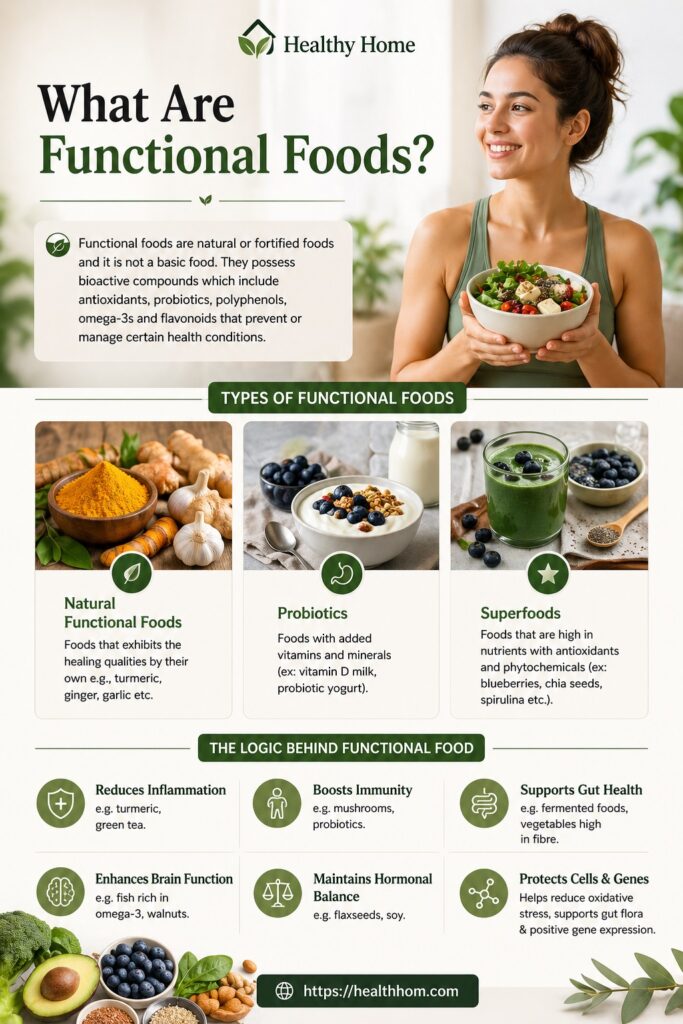
Functional foods are natural or fortified foods and it is not a basic food. They possess bioactive compounds which include antioxidants, probiotics, polyphenols, omega-3s and flavonoids that prevent or manage certain health conditions.
Types of Functional Foods:
- Natural Functional Foods : Foods that exhibits the healing qualities by their own e.g., turmeric, ginger, garlic etc.
- Probiotics : Foods with added vitamins and minerals (ex: vitamin D, milk, probiotic yogurt).
- Superfoods: Foods that are high in nutrients with antioxidants and phytochemicals (ex: blueberries, chia seeds, spirulina etc.).
The logic behind functional food:
Studies have supported the use of functional foods in the following ways:
- Reduction of inflammation (ex: turmeric, green tea).
- Increasing immunity (e.g. mushrooms, probiotics).
- Better gut health (e.g. fermented foods, vegetables high in fibre).
- Helping the brain functions (e.g., fish, which is rich in omega-3, walnuts).
- Maintaining hormonal balance (e.g. flaxseeds, soy).
They contains compounds like preventing oxidative stress, stimulating the intestinal flora and altering the expression of genes associated with preventing diseases.
A Real Example from an Indian Household:
During a nutrition awareness discussion in Odisha, a mother of two school going children expressed her worriedness regarding the frequent digestion problem and repeated illness when season changes of the family members.
She was thinking that she has to bury more costly supplements to meet the health needs.
I had discussed with her regarding their daily food habits and accordingly some changes made like:
- Plain homemade curd during lunch
- Turmeric in daily cooking meals
- Ginger Jaggery tea instead of sugary beverages
- Ground flaxseed added in roti dough
After few months of use, the family gradually adopted these small habits.
As, not a single food can prevent the disease, the family reported improved digestion, fewer complaints of bloating and healthier eating habits.
This small experience shows me an important learning that:
Functional foods work best when they are used in everyday meals rather a short term health changes.
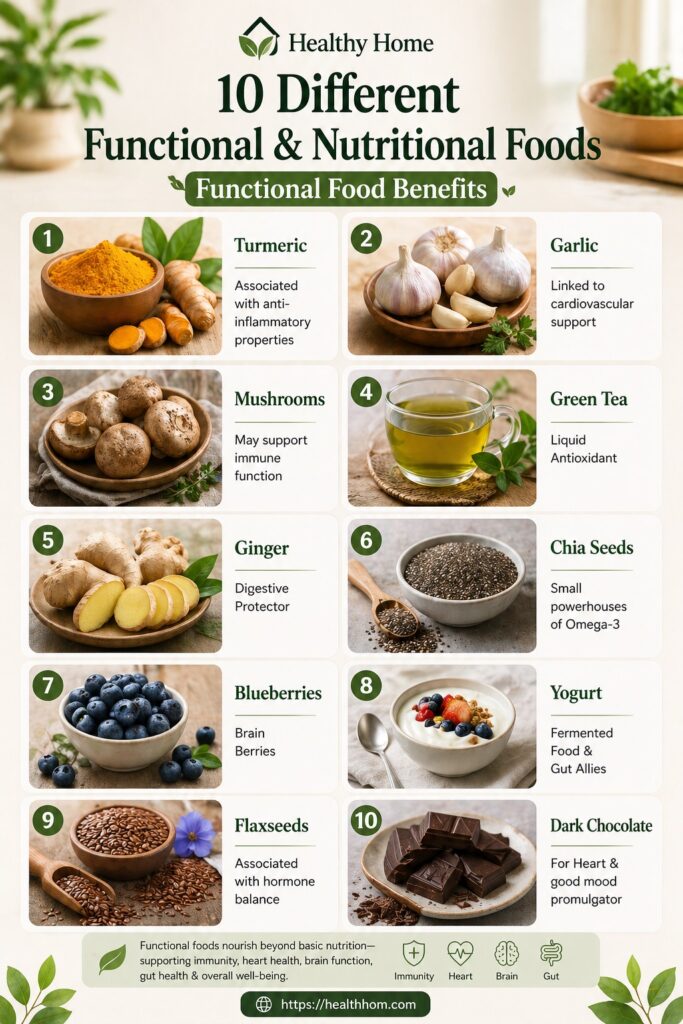
10 different Functional & Nutritional foods: Functional Food Benefits
Lets discuss some of the suggested functional foods which can be easily incorporated into the family meals.
1. Turmeric : Associated with anti-inflammatory properties
a. Key compound: Curcumin
b. Benefits:
- May help to reduce chronic inflammation.
- Promotes the health of joints and bones.
- Enhances the mood and functionality of the brain.
c. How to prepare: Turmeric can be added to curries, soups, golden milk or smoothies.
For a deeper understanding, explore the complete science-backed benefits of turmeric and how to use it effectively in daily life.
2. Garlic : Linked to cardiovascular support
a. Key compound: Allicin
b. Benefits:
- Antiviral and natural antibacterial properties.
- May help to support healthy cholesterol levels
- Helps the heart health
c. Applications: With sauces, stir-fries and salads, use raw or for light cooking.
3. Mushrooms : May support immune function
a. It includes Reishi, Shiitake, Maitake, Lion’s Mane.
b. Benefits:
- Strengthen immune response
- Contain beta-glucans that may support immune defense
- Some mushroom varieties are being studied for potential cognitive benefits.
c. Preparation: Mushrooms could serve in soups and stir-fries or as the basis for herbal tea.
4. Liquid Antioxidant Green Tea.
a. Key compound: Catechins
b. Benefits:
- Full of antioxidants to protect the cells.
- Promotes metabolism and weight level.
- Enhances brain and heart wellbeing.
c. Routes of administration: Consume 125 ml to 250 ml per day, hot or cold but not too much sugar.
5. Ginger : Digestive Protector
a. Key compound: Gingerol
b. Benefits:
- Reduces nausea and stomach problems.
- Reduces muscle soreness
- Is anti-inflammatory.
c. How to use: Fresh ginger can be used in tea, soups or smoothies.
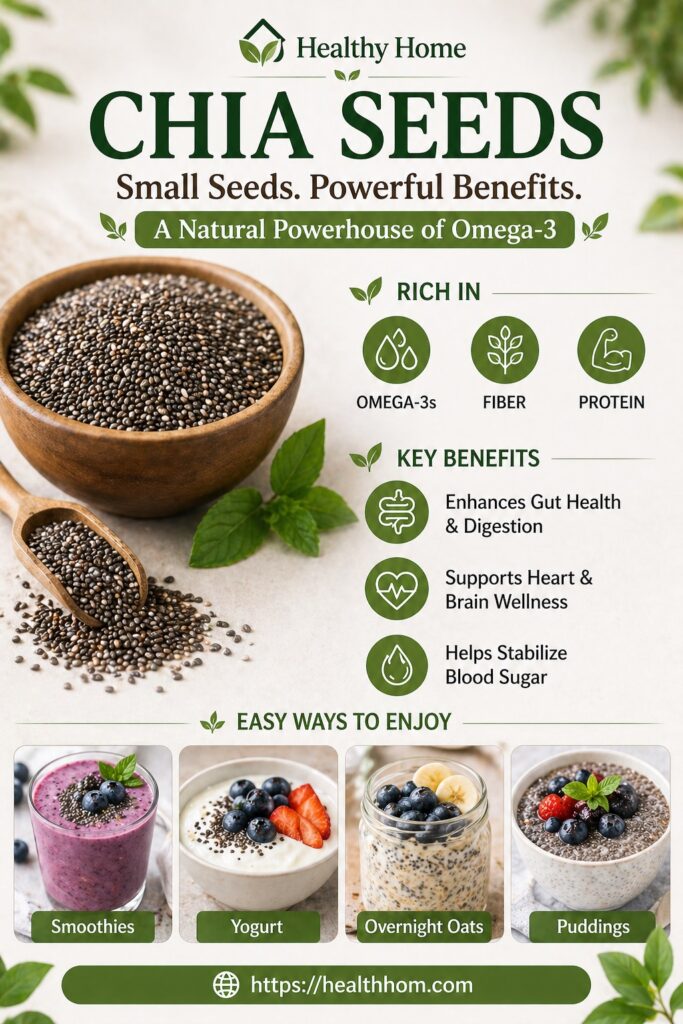
6. Chia Seeds Chia seeds are small powerhouses of Omega-3.
a. Nutrients: Omega-3s, fiber and protein.
b. Benefits:
- Enhance intestinal wellbeing and digestion.
- Aid cardiovascular and cerebral wellness.
- Stabilize blood sugar
c. Use: Add to Smoothies, yogurt, overnight Oats or puddings.
Chia Seeds from Amazon : https://amzn.to/45TjHBN
7. Blueberries : Brain Berries
a. Nutrients: antioxidants, Anthocyanins.
b. Benefits:
- Keep brain cells young.
- Improve memory and focus
- Get healthy skin and heart
c. Uses: Perhaps the best use is to eat fresh, as a salad or smoothie.
8. Yogurt which is a type of Fermented Food & helps for Gut Allies.
a. These are probiotics: Lactobacillus, Bifidobacterium.
b. Benefits:
- Bring back healthy gut bacteria.
- Strengthen immunity
- Viewed as a way to improve digestion and decrease bloating.
c. How to use: Consume low fat (plain) yogurt, kefir, sauerkraut or kimchi regularly.
Fermented foods like yogurt play a key role in gut health, explore the best probiotic-rich foods for daily consumption
9. Flaxseeds- Associated with hormone balance
a. Nutrients: Lignans, omega-3s, fiber.
b. Benefits:
- Flaxseeds contain lignans that may support the hormonal balance in some women.
- Reduce cholesterol level in human
- Keep the skin and hair healthy.
c. Usage: Flaxseeds can be used in ground form, added to smoothies or porridge or baked goods.
10. Dark Chocolate for Heart & good mood promulgator.
a. Key compound: Flavanols
b. Benefits:
- Enhances cardiovascular and heart condition.
- Boosts serotonin and mood
- Gives antioxidants to the cells.
c. How to use it: Dark chocolate (70% + cocoa) can be taken as a healthy snack
Foods that different ages can use:
A. Kids & Teens
- Yogurt and fermented foods : good gut and immunity
- Blueberries : Cognitive development.
- Chia seeds : Energy for growth
B. Mothers & Women
- Flaxseeds : Hormonal balance
- Turmeric & Ginger : Not only anti-inflammatory.
- Green tea : Provides antioxidant protection.
C. Men & Adults
- Garlic and mushrooms : Heart and immunity.
- Dark chocolate : Heart health
- Green tea : Metabolism and mental clarity
D. Seniors
- Turmeric + mushrooms : Joint and cognitive support
- Yogurt : Bone strength
- Blueberries : Memory preservation
Detail article on : 10 Evergreen Gut Friendly Foods That Support Gut Health Naturally
Integrating the use of functional foods everyday:
- Have a breakfast of chia pudding or yogurt and blueberries.
- Give a boost at midday with green tea and a dark chocolate.
- Lunch & dinner: If preparing curries, stirfries or soups, add ginger, garlic and turmeric.
- Snacks: Mushrooms with roast, also flax seed crackers or smoothie bowls.
- Weekly routine: Eat one or more fermented foods (sauerkraut, kefir, kimchi).
Including functional foods is a key part of preventive health, explore daily habits that reduce disease risk naturally.
Affordable Functional Foods Already Found in Most Indian Kitchens:
In reality, many easily available Indian foods contain beneficial bioactive compounds such as:
| Budget-Friendly Food | Functional Benefit |
|---|---|
| Turmeric | Anti-inflammatory compounds |
| Garlic | Heart-supportive properties |
| Curd | Probiotics |
| Ginger | Digestive support |
| Amla | Vitamin C |
| Moringa leaves | Micronutrients |
| Roasted chana | Fiber and protein |
| Flaxseeds | Omega-3 fats |
For most of the families, improvement in nutrition may be done by a smart food choices from the available sources.
Care and caution
- The most important is moderation : excessive consumption of some foods (e.g., garlic) can lead to digestive problems.
- Individual Differentiation: Every functional food may not be suited for everybody e.g. soy for thyroid patients
- Functional foods should not be used as an alternative to regular medicine or during pregnancy
Functional Foods vs Supplements
Many people confuse functional foods with dietary supplements. Here’s the difference:
| Feature | Functional Foods | Supplements |
|---|---|---|
| Form | Natural whole foods | Pills, capsules, powders |
| Nutrient Absorption | Slower, more balanced | Concentrated, fast |
| Risk of Overdose | Low (from food) | Possible if excessive |
| Cost | Usually affordable | Often expensive |
| Regulation | Food safety laws | Supplement regulations |
While whole foods are preferred, some individuals may require supplements, learn when iron supplementation is necessary.
Functional Foods: Are they scientifically proven?
Yes, a lot of functional foods are under clinical and epidemiological research. It must be known however that:
- Functional foods do not treat diseases, they enhance health.
- The benefits are based on the regular consumption, general diet, and lifestyle.
- Their effects are not direct, but rather preventive and supportive.
For example:
- The inflammatory effects of Turmeric (Curcumin) are researched.
- Garlic (Allicin) is linked with the support of the cardiovascular.
- Catechins (Green tea) is associated with antioxidant protection.
- Probiotic yogurt helps to maintain microbiomes in the gut.
- Anthocyanins (blueberries) are studied on the purposes of cognitive and heart health.
Large bodies such as the World Health Organization and American Heart Association promote eating whole, nutrient-rich foods as one of the measures of reducing the risk of chronic health conditions.
Key points: The emerging scientific data is in favor of functional food, but they should not be used as medical interventions, but rather as supplements to an overall diet.
You can easily include functional foods in meals, try these healthy millet-based recipes for better nutrition.
The Reason behind the preference of Whole Foods?
- Contain synergistic nutrients (fiber + antioxidants + vitamins together).
- Reduced chances of over consumption.
- Offer other advantages such as intestinal well-being and contentment.
The supplements can be applicable in a case when:
- Deficiency is found to be diagnosed.
- A doctor recommends them.
- When one is pregnant or when one is having medical conditions.
To maintain overall health, a specialist should first of all focus on whole functional foods.

Who Should Avoid Functional Foods?
Despite the fact that functional foods are natural, the groups to consider include:
1. Pregnant and breastfeeding Women.
Certain herbs or concentrated bioactive foods can not be used in large quantities. A healthcare provider should never be ignored.
2. People on Blood Thinners
Garlic, ginger and turmeric could boost the effect of thinning the blood.
3. Thyroid Patients
High-fiber food and the soy could also disrupt thyroid medication absorption.
4. Kidney Disease Patients
Foods that contain high levels of potassium (such as some fruits) might have to be restricted.
5. People with Food Allergies
Dairy yogurt, mushrooms, flaxseeds or nuts can cause an allergy.
Important Note: Prescribed medicine should not be substituted with functional food. They are facilitative rather than remedial.
During pregnancy, food choices require extra care, follow these safe and nutritious cooking tips for better maternal health.

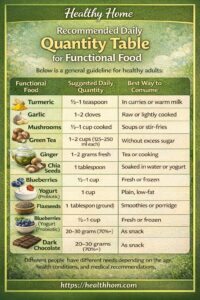
Recommended Daily Quantity Table
Below is a general guideline for healthy adults:
| Functional Food | Suggested Daily Quantity | Best Way to Consume |
|---|---|---|
| Turmeric | ½–1 teaspoon | In curries or warm milk |
| Garlic | 1–2 cloves | Raw or lightly cooked |
| Mushrooms | ½–1 cup cooked | Soups or stir-fries |
| Green Tea | 1–2 cups (125–250 ml each) | Without excess sugar |
| Ginger | 1–2 grams fresh | Tea or cooking |
| Chia Seeds | 1 tablespoon | Soaked in water or yogurt |
| Blueberries | ½–1 cup | Fresh or frozen |
| Yogurt (Probiotic) | 1 cup | Plain, low-fat |
| Flaxseeds | 1 tablespoon (ground) | Smoothies or porridge |
| Dark Chocolate | 20–30 grams (70%+) | As snack |
Different people have different needs depending on the age, health conditions, and medical recommendations.
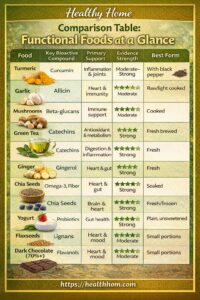
Comparison Table: Functional Foods at a Glance
| Food | Key Bioactive Compound | Primary Support Area | Evidence Strength | Best Form |
|---|---|---|---|---|
| Turmeric | Curcumin | Inflammation & joints | Moderate–Strong | With black pepper |
| Garlic | Allicin | Heart & immunity | Moderate | Raw/light cooked |
| Mushrooms | Beta-glucans | Immune support | Moderate | Cooked |
| Green Tea | Catechins | Antioxidant & metabolism | Strong | Fresh brewed |
| Ginger | Gingerol | Digestion & inflammation | Moderate | Fresh |
| Chia Seeds | Omega-3, Fiber | Heart & gut | Strong | Soaked |
| Blueberries | Anthocyanins | Brain & heart | Strong | Fresh/frozen |
| Yogurt | Probiotics | Gut health | Strong | Plain, unsweetened |
| Flaxseeds | Lignans | Hormonal & heart | Moderate | Ground |
| Dark Chocolate (70%+) | Flavanols | Heart & mood | Moderate | Small portions |
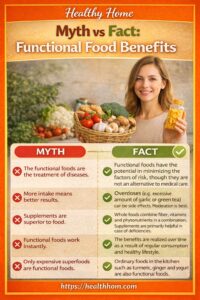
Myth vs Fact: Functional Food Benefits
| Myth | Fact |
|---|---|
| The functional foods are the treatment of diseases. | Functional foods have the potential in minimizing the factors of risk, though they are not an alternative to medical care. |
| More intake means better results. | Overdoses (e.g. excessive amount of garlic or green tea) can be side effects. Moderation is best. |
| Supplements are superior to food. | Whole foods combine fiber, vitamins and phytonutrients in a combination. Supplements are primarily helpful in case of deficiencies. |
| Functional foods work instantly. | The benefits are realized over time as a result of regular consumption and healthy lifestyle. |
| Only expensive superf-oods are functional foods. | Ordinary foods in the kitchen such as turmeric, ginger and yogurt are also functional foods. |
A Simple 7-Day Functional Food Challenge
If you are new to take the functional foods, please avoid to change the everything at once.
Try these:
| Day | Habit |
|---|---|
| Monday | Add turmeric to one meal |
| Tuesday | Include plain yogurt |
| Wednesday | Drink unsweetened green tea |
| Thursday | Add ginger to cooking |
| Friday | Sprinkle ground flaxseed on food |
| Saturday | Include mushrooms or seasonal vegetables |
| Sunday | Enjoy a healthy fruit-rich breakfast |
These small habits may be easier to sustain than any costly dietary changes.
Functional Foods for Indians
- Turmeric
- Amla
- Moringa
- Curd
- Millets
- Flaxseed
- Garlic
My Opinion as a Public Health Professional:
In my field experience, I want to share that many Indian people usually spend money on costly supplements whereas nutritious foods are already available at their kitchen and nearby market.
I would suggest one long-term nutrition strategy as:
Firstly prepare meals taking the diverse whole foods and then go for supplements if there is medical recommendation.
As the sustainable daily habits may bring the health improvements rather the costly health products.
Concluding Points:
The overall health & well-being doesn’t need any dramatical changes, but small and consistent step like your diet may change it.
As per the study report of Harvard Health (2022) and National Institute of Health (2023), diet having whole and functional foods may be directly linked with the lower risks of diabetes, heart diseases and inflammation etc.
The important is that, these functional foods are very simple, easily & readily available from natural sources, cost effective and kitchen friendly.
You shouldn’t try to be healthy at once by taking costly supplements, but focus on a daily routine of adding turmeric in meals, yogurt for gut health, swapping snacks for nuts & berries etc. Subsequently, these small habits can create a powerful impact on your long-life wellness.
Only the key is consistency, it doesn’t require perfection.
Start with a small habit of taking just 1-2 functional food daily and gradually able to build a long-term health naturally.
Introducing functional foods early in life supports long-term health, read this complete guide on child growth and development.
Related Health Articles from Healthy Home :
- Food Guide for Balanced Nutrition – Healthy Food Choices
- What Is Millet? Nutritional Benefits and Its Gift to Human Health
- Cooking Tips for Pregnant Women – Safe, Nutritious & Balanced Eating
- Folic Acid Benefits – Importance for Pregnancy, Growth & Overall Health
- How to Reduce Salt and Sugar Intake for Better Long-Term Health
Trusted References and Research Sources:
Evidence Sources Used in This Article
- World Health Organization nutrition guidance
- National Institutes of Health research publications
- American Heart Association dietary recommendations
- Harvard T.H. Chan School of Public Health nutrition research
- Foods linked to better brainpower – Harvard Health
- Functional Foods and Their Role in Disease Prevention – Comprehensive Review (PubMed Central)
- Nutritional Composition and Health Benefits of Functional Foods – ScienceDirect Study
- Functional Foods: Mechanisms, Bioactive Compounds, and Human Health Benefits – ResearchGate Review
- Functional Foods and Chronic Disease Prevention – Detailed Biomedical Research (PMC)
- Overview of Functional Foods in Human Health: Latest Scientific Perspectives (ResearchGate)
- Nutritional Biochemistry of Functional Foods – Foundational Study (PubMed Central)
- Amino Acids Explained: Functions, Types, and Daily Needs – Cleveland Clinic Guide
- Heart-Healthy Eating & Lifestyle Recommendations – American Heart Association
- Global Nutrition Overview – WHO Nutrition Health Topics
- Dietary Fiber: Benefits for Heart, Gut, and Weight – Mayo Clinic Research
- Functional Foods – Definition, History, and Global Perspectives (Wikipedia)
- Functional Food Mechanisms and Bioactive Components – Updated Scientific Article (PMC)
Common Mistakes People Make with Functional Foods
Many people may unintentionally reduce the benefits of functional foods like:
- Adding sugar to green tea
- Consuming flavored yogurt with added sugar
- Taking large amounts of turmeric supplements without the proper medical advice
- Expecting results after only a few days of usage
- Ignoring the diet quality and focusing only on a single superfood
The goal is not to be perfect, but should be consistent for months and years.
Frequently Asked Questions People Ask Me About Functional Foods
Can I eat all 10 functional foods every day?
No. Diversity is more important than trying to consume every food daily.
Which functional food should beginners start with?
Yogurt, turmeric, ginger, garlic, and seasonal fruits are practical starting points.
Are expensive imported superfoods necessary?
Not usually. Many affordable Indian foods provide similar nutritional benefits.
How long does it take to see benefits?
Benefits generally develop over weeks or months through consistent dietary habits.
FAQs:
What are functional foods?
Why are functional foods important?
Are the functional foods effective in enhancing immunity?
Is it possible to improve digestion with the help of functional foods?
Do the weight management benefits from the functional foods?