Last Updated on March 22, 2026 by Bibhu Ranjan Mund, MPH
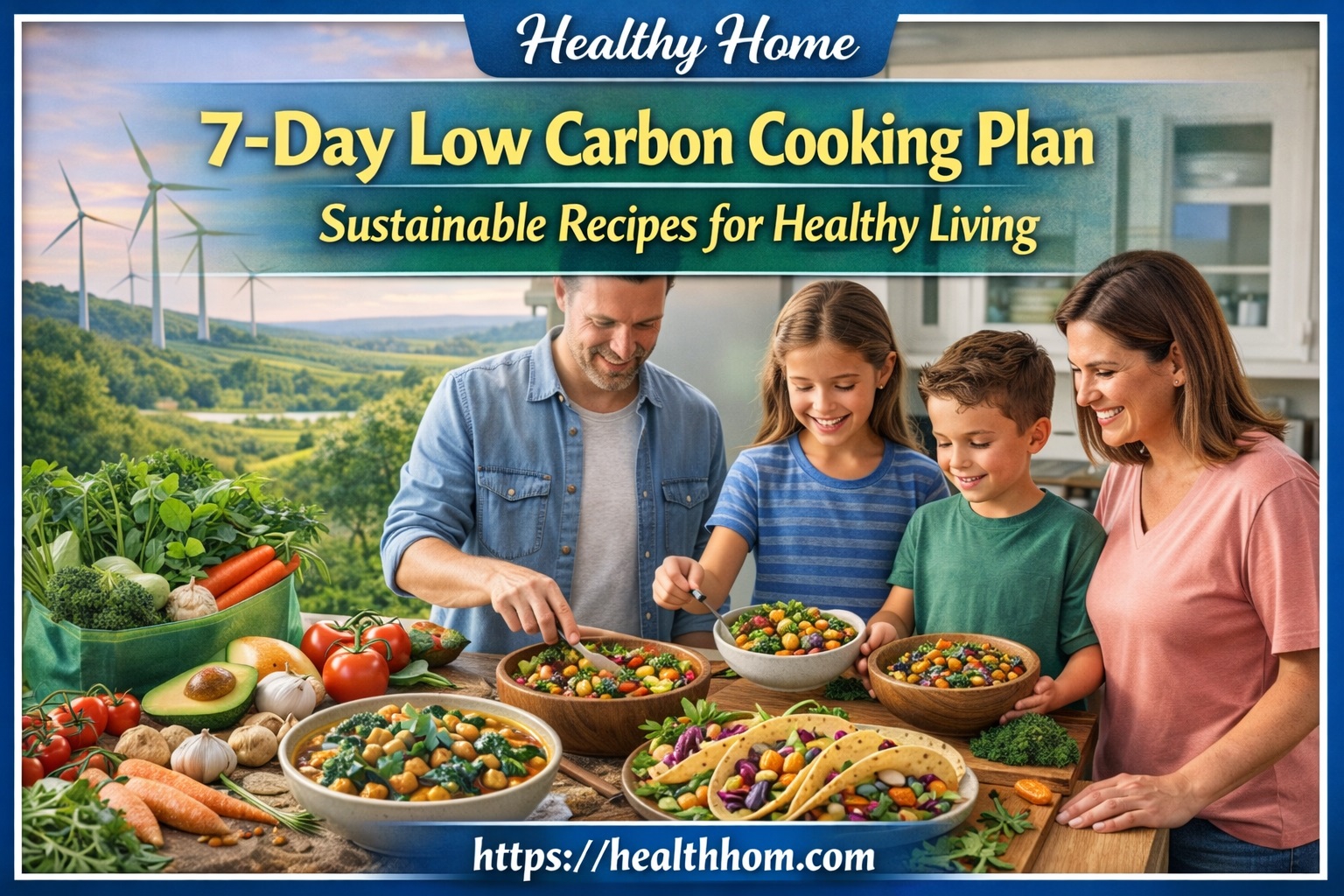
Try this 7-day low carbon cooking plan with sustainable, plant-based recipes that support your health and reduce your environmental footprint.
Reviewed by Bibhu Ranjan Mund, MPH (Public Health Expert) with experience in maternal, infant, child, and adolescent health programs. Content is based on evidence-informed guidelines aligned with organizations such as the World Health Organization, UNICEF, Centers for Disease Control and Prevention, and National Institutes of Health.
Last reviewed on: 22 March 2026.
Medical Disclaimer: This content is for informational and educational purposes only and is not intended as medical advice, diagnosis, or treatment. Always seek the advice of a qualified healthcare professional regarding any medical condition or concerns.
Affiliate Disclosure: This article contains affiliate links. If you purchase through these links, we may earn a small commission at no extra cost to you.
Climate change is already impacting communities worldwide. Food choices are one of the most powerful ways individuals can reduce their environmental impact. Our diet determines how healthy we are and the health of the earth. This is the reason why the issue of cooking & recipes is relevant.
By choosing foods with a lower carbon footprint, we can support both personal health and environmental sustainability. This post describes low-carbon recipes, their relevance and how one can include them in life yet gain no loss in flavor, nutrients and satisfaction.
Global Food System and Environmental Impact
| Indicator | Estimate | Source |
|---|---|---|
| Share of global greenhouse gas emissions linked to food systems | ~34% of total emissions | FAO Global Food Systems Report (2021) |
| Food lost or wasted globally | About one-third of all food produced | FAO Food Waste Index (2021) |
| Livestock sector contribution to agricultural emissions | Around 14.5% of global emissions | FAO Livestock Environmental Assessment (2019) |
| Plant-based diets often associated with lower environmental impact | Observed in multiple sustainability studies | Nature Food Journal (2020) |
Low Carbon Cooking – meaning
Some of these cooking & recipes are the foods prepared to reduce the greenhouse gases in all processes between farm and plate aiming to reduce such gases.
These recipes are as mentioned below:
- Vegetables and plants and not meat and dairy products
- Home to the home grown in season produce
- Less processed and packed
- Full consideration planning to waste fewer foods
- Many types of cooking techniques that are able to save energy & resources
The worldwide food system produces approximately the one-third of the entire greenhouse gases. The livestock farming contributes much by way of methane gas emissions, deforestation and overemphasizing on water consumption. To reduce our impact on our planet, it is very essential to change our food habits by incorporating low-carbon dishes in our daily diets.
Approximate Carbon Footprint of Selected Foods
| Food Type | Approximate Carbon Footprint (kg CO₂-eq per kg food) | Source |
|---|---|---|
| Lamb | ~24 kg CO₂-eq | Oxford Environmental Food Dataset (2018) |
| Chicken | ~6 kg CO₂-eq | Our World in Data Food Study (2020) |
| Lentils | ~0.9 kg CO₂-eq | Our World in Data Sustainable Diets Study (2020) |
| Vegetables | ~0.5–2 kg CO₂-eq | FAO Sustainable Food Systems Report (2021) |
Implication of Sustainable nutrition:
Sustainable nutrition implies the consumption of food, which is not only beneficial to humanity, but also to the environment. The thought is to provide everybody with safe foods which are nutritious and also meet their cultures and at the same time preserve the ecosystem, as well as biodiversity.
The advantages of Sustainable Nutrition:
- Emitting the lower carbon in the environment
- Public Health outcomes are improving a lot
- Many natural resources like soil, water, bio-diversity etc. are being protected
- The right morality of animals
- Less dependent on fossil fuels including chemicals
Core Principles of Sustainable Diets
| Principle | Example |
|---|---|
| Environmental sustainability | Choosing foods with lower emissions |
| Nutritional adequacy | Balanced intake of essential nutrients |
| Cultural suitability | Respecting local food traditions |
| Economic accessibility | Affordable and widely available foods |
| Reduced food waste | Efficient use of ingredients |
Source: WHO Sustainable Healthy Diet Guidelines (2019)
5-Low Carbon Cooking Plan -Principles
A. Plant-Based Foods:
Carbon footprints are lower in plant-based products rather than animal products viz. lentils, beans & tofu are producing the fewer emissions than beef, mutton or lamb meat.
Plant Protein vs Animal Protein Environmental Considerations
| Protein Source | Example | General Environmental Observation | Source |
|---|---|---|---|
| Plant proteins | Lentils, beans, tofu | Lower land and water use | FAO Sustainable Diet Report (2021) |
| Animal proteins | Beef, lamb | Higher emissions and land requirements | Our World in Data Food System Analysis (2020) |
| Mixed diets | Eggs, dairy | Moderate environmental impact | Oxford Martin School Research (2019) |
B. Choosing the locally available & seasonal produces:
If we purchase food from outside & which travels long distances or which are not produced in the present session, are more vulnerable to emissions. Local & seasonal products are tasty, nutritious & also eco-friendly.
Benefits of Seasonal and Local Foods
| Factor | Potential Benefit | Source |
|---|---|---|
| Reduced transport distance | Lower transportation emissions | FAO Sustainable Food Systems (2021) |
| Fresher produce | Better taste and storage life | Harvard Health Publishing (2022) |
| Local economy support | Benefits local farmers and markets | USDA Local Food Systems Report (2020) |
| Reduced packaging | Lower plastic waste | Environmental Protection Agency (2021) |
C. Reducing maximum Food Waste:
Averagely one-third of evert food produced is wasted by us. Hence, we should plan our meal tactfully & use leftovers food in creative way including composting if possible.
D. Avoiding the processed food:
Using of processed foods means using of extra energy and resources in production, transportation & waste management.
E. Cooking Methods in different way:
If actually we want to save energy, time & resources, we must use slow cookers, pressure cookers and batch cooking which helps such.
Cooking Methods and Energy Efficiency
| Cooking Method | Energy Efficiency Observation | Source |
|---|---|---|
| Pressure cooker | Shorter cooking time reduces energy use | International Energy Agency (2021) |
| Slow cooker | Uses low continuous heat | Energy Saving Trust (2020) |
| Batch cooking | Reduces repeated energy use | Sustainable Kitchens Initiative (2021) |
| Steaming | Often requires less cooking oil and water | Harvard Nutrition Source (2022) |
Weekly Low Carbon Cooking Plan Overview
| Day | Main Dish | Key Ingredients |
|---|---|---|
| Monday | Chickpea & spinach curry | Chickpeas, spinach |
| Tuesday | Roasted vegetable quinoa salad | Quinoa, seasonal vegetables |
| Wednesday | Lentil & mushroom vegan pie | Lentils, mushrooms |
| Thursday | Tofu broccoli stir-fry | Tofu, broccoli |
| Friday | Pasta primavera | Whole-grain pasta, vegetables |
| Saturday | Sweet potato & black bean tacos | Sweet potatoes, beans |
| Sunday | Vegetable barley soup | Barley, root vegetables |
Low Carbon Cooking Recipes for 7 days:
Easy to prepare, tasty, energy saving eco-friendly recipes as below:
1. Monday:- Chick-pea with Spinach leaf Curry
It is low carbon recipe because: These are filled with Plant-based proteins & also uses in seasonal greens.
- Items may be used: Fresh spinach leaf, Canned chick-peas, onion, garlic, ginger, tomatoes, coconut milk, curry spices etc.
- You may serve with: Brown rice or any types of millet
2. Tuesday:- Roasted Vegetable with Quinoa salads
It is low carbon recipe because: These are seasonal vegetables and a complete plant protein based recipe
- Foods can be utilized: Carrots, bell pepper, sweet potatoes, quinoa, zucchini, olive oil, lemon and so on.
- Parsley which is a kind of fresh herb may be added
3. Wednesday: (I have this recipe from one of the vegetable magazines):- Lentil and Mushroom Vegan Pie recipe
It is low carbon recipe because: It overcomes the demand of meat with hearty legumes & mushrooms
- Items may be used: Brown lentils, mushrooms, carrots, celery, peas, mashed potatoes
- The mashed potatoes left after cooking may be used in the next meals
4. Thursday:- Tofu with Broccoli Stir fry & Brown Rice recipe
It is low carbon recipe because: It is having Plant based protein with locally grown broccoli
- Items may be used: Broccoli, soy sauce, garlic, sesame oil, tofu etc.
- Cauliflower or brown rice may be used in this recipe.
5. Friday:- Pasta Primavera recipe
It is low carbon recipe because: Pasta is a low footprint carbohydrate & the vegetables may be a seasonal produce
- Items may be used: Whole grain pasta, asparagus, peas, cherry tomatoes, garlic & olive oil
- Cheese may be avoided and Sprinkle of nutritional yeast may be used
6. Saturday:- Recipe make with Sweet Potato & Black Bean Tacos
It is low carbon recipe because: Sweet potatoes & beans are having low emission staples
- Items may be used: Black beans, corn tortillas, roasted sweet potatoes, red cabbage, lime etc.
7. Sunday:- Vegetable Soup with Barley
It is low carbon recipe because: It uses root vegetable & grains with minimal processing
- Items may be used: Barley, veg broth, herbs, potatoes, leeks, celery etc.
- Bread made with whole grain are to be taken.
Proceed for shopping of Sustainable Grocery items:
It is now right time to be cautious and shop the grocery items which are useful in cooking. Hence, we may follow as follows:
- Planning of meal: Weekly plan to be prepared and buy the products which actually we want.
- Bulk buy: Grains, legumes & nuts may be bought in bulk with re-usable bags
- Local produces may be preferred for shopping: Locally available farmer to be visited and preferred for buying the products which are easily available and also judicious.
- Whole foods to be preferred: We have to limit the use of packaged & processed food items.
- Plastic to be avoided: We must use own bags made with cotton clothes and other containers and avoid using the plastic which are not bi-degradable.
Reduction of food waste : a creative method
After sending of food waste to landfills, it generates methane & hence, here are some of the creative method to reduce food waste:
- We can use veggie scraps to Turkey soupo concept:
- Overripen bananas can be reused to make dishes like smoothies
- Uneaten food can be stored in refrigerator to be used later
- We may last night’s dinner may be re-purposed into lunch
- Cold storage or any other storage method may be used to the food properly so that its shelf life can be extended.
Practical Ways to Reduce Food Waste at Home
| Strategy | Example |
|---|---|
| Meal planning | Weekly grocery list |
| Using leftovers | Turning dinner leftovers into lunch |
| Proper storage | Refrigerating fresh produce |
| Composting | Converting food scraps into compost |
| Creative cooking | Using overripe fruit in smoothies |
Source: UN Environment Programme Food Waste Index Report (2021)
Cooking — involvement of families
In our day-to-day busy schedule, we may involve our family members in cooking which is not complicated at all.
- Involvement of kids: They may choose their liked food
- Refrigerating food after cooking in batches: We may cook food in double batches like soups and keep it for further use.
- Must create our theme nights: Monday to be meatless, Tuesday to be used Taco etc. for other days
- Different varieties of foods: Rotation of many types of grains like millets, barley for exciting meals
Many nutritional benefits of Low-Carbon food:
These are having:
- Fiber rich
- Many types of Vitamins & minerals
- Saturated fat are very less
- Managing the heart health
- Gut health improvement
It also reduces the risk of heart disease, type-2 diabetes, obesity & some types of cancers.
Cooking focuses the local culture
It does not give-up the local traditional foods. In India, Lentil dals, vegetable curries, flatbreads are addressing such.
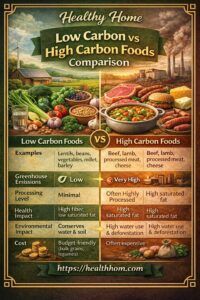
Low Carbon vs High Carbon Foods Comparison
| Category | Low Carbon Foods | High Carbon Foods |
|---|---|---|
| Examples | Lentils, beans, vegetables, millet, barley | Beef, lamb, processed meat, cheese |
| Greenhouse Emissions | Low | Very High |
| Processing Level | Minimal | Often Highly Processed |
| Health Impact | High fiber, low saturated fat | High saturated fat |
| Environmental Impact | Conserves water & soil | High water use & deforestation |
| Cost | Budget-friendly (bulk grains, legumes) | Often expensive |
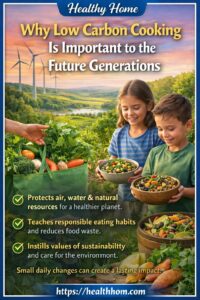
Why this is important to the future generations
- Today food choices affect the air that they breath and the water that they drink.
- The selection of low carbon meals assists to save forests, water, as well as minimize pollution.
- Plant-based diets can help individuals to maintain a healthy lifestyle and health, as well as the environmental health.
- Food waste reduction is a lesson that teaches children to be responsible and respectful of the available natural resources.
- The long-term influence can be produced by small changes in daily routines such as having a single meal that is plant-based.
- Cooking sustainably does not imply being perfection; it means caring, responsibility, and future expectations.
Environmental Benefits of Sustainable Diets
| Environmental Area | Potential Impact | Source |
|---|---|---|
| Greenhouse gas emissions | Lower emissions from food production | Nature Food Journal (2020) |
| Water conservation | Reduced water demand | FAO Water and Food Report (2021) |
| Biodiversity protection | Reduced land clearing for livestock | UNEP Biodiversity Report (2022) |
| Soil health | More diverse crop systems | FAO Sustainable Agriculture Report (2020) |
Key points:
Nutrition & sustainability means we have to use low carbon recipes. Reduction of environmental emission by using Plant-rich, low processed, locally available foods which also impacts our nourishment & community.
Dietary changes take time and should be introduced gradually. Hence, we should start a small i.e. one meal a day & one new healthy plant-based recipe a week. Overtime, it can become sustainable eating around the world.
Sustainable Grocery Shopping Tips
| Tip | Example |
|---|---|
| Buy seasonal produce | Choose fruits and vegetables in season |
| Prefer whole foods | Whole grains and legumes |
| Reduce packaging | Buy in bulk or reusable containers |
| Support local farmers | Farmers’ markets |
| Plan meals ahead | Weekly meal planning |
Source: Harvard T.H. Chan School of Public Health Sustainable Diets Guide (2022)
FAQs:
Related Health Articles from Healthy Home
- 8 Best Fermented Food for Gut Health in Adolescents – Healthy Home – Trusted Health Tips for Kids, Teens & Families (healthhom.com)
- How food affects mental health and Emotional Well-Being – Healthy Home – Trusted Health Tips for Kids, Teens & Families (healthhom.com)
- 7-Day Gut Health Plan for Families – Improve Digestion Naturally – Healthy Home – Trusted Health Tips for Kids, Teens & Families (healthhom.com)
- 7 days meal plan with accessible nutrition – Healthy Home – Trusted Health Tips for Kids, Teens & Families (healthhom.com)
- Outdoor Wellness Benefits: Sunlight & Nature for Family Health – Healthy Home – Trusted Health Tips for Kids, Teens & Families (healthhom.com)
Trusted References and Research Sources:
- Fresh ideas to improve health habits – Harvard Health
- A Guide to Healthy Eating: Strategies, tips, and recipes to help you make better food choices – Harvard Health
- Nutrition and healthy eating Healthy cooking – Mayo Clinic
- 9 Nutrition Tips for Reducing Your Carbon Footprint (healthline.com)
- Healthy diet (who.int)
For more detail, please visit to my website as mentioned below:


About the Author – “Bibhu Ranjan Mund”, Master in Public Health (MPH) from IIHMR University, Jaipur (Rajasthan- IHMR-U/12/2021 -23/0015) has experience of 18 years in Public Health activities like maternal health, child health, adolescent health, nutrition and community wellness programs. Through “Healthy Home”, he shares evidence-based health and wellness guidance designed to support families in making informed lifestyle decisions. This content is for educational purposes only and does not replace professional medical advice. Connect LinkedIn – https://www.linkedin.com/in/bibhu-ranjan-mund-b72171358/