Last Updated on September 15, 2026 by Bibhu Ranjan Mund, MPH
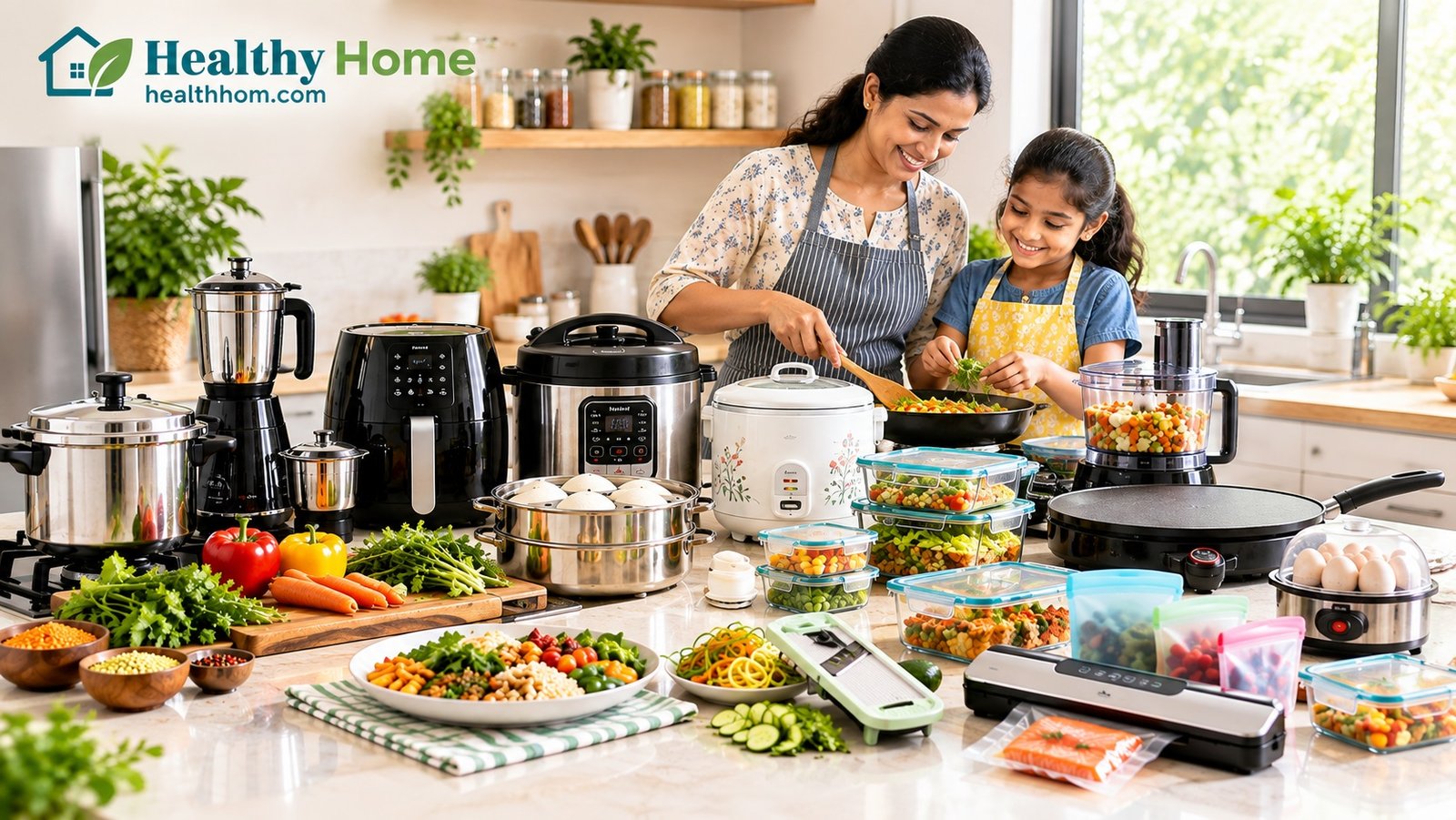
Find out practical meal prep tools for families that make cooking, storing and organising healthy homemade meals easier, faster and more convenient.
Reviewed by Bibhu Ranjan Mund, MPH (Public Health Expert) with more than 18 years of experience in maternal, infant, child and adolescent health programs.
Preparing healthy meals for a family is not always difficult because of a lack of nutrition knowledge. For many households, the bigger challenge is time.
Parents may need to prepare breakfast before work, pack school lunches, cook dinner after returning home, prepare snacks for children and still manage household responsibilities. When meal preparation becomes exhausting, convenience foods, takeaways and packaged meals can become an easy alternative.
Therefore, the right meal-prep tools can make a practical difference for busy families.
The purpose of meal-prep equipment is not to fill your kitchen with gadgets. A useful appliance or storage system should make a real task easier such as cooking dal, preparing rice, kneading dough, steaming vegetables, batch cooking, storing leftovers or keeping prepared food organized.
For Indian families, some tools can be particularly useful because everyday cooking may involve several components like dal, rice, roti, vegetables, idli or dosa batter, chutneys, curries and homemade snacks.
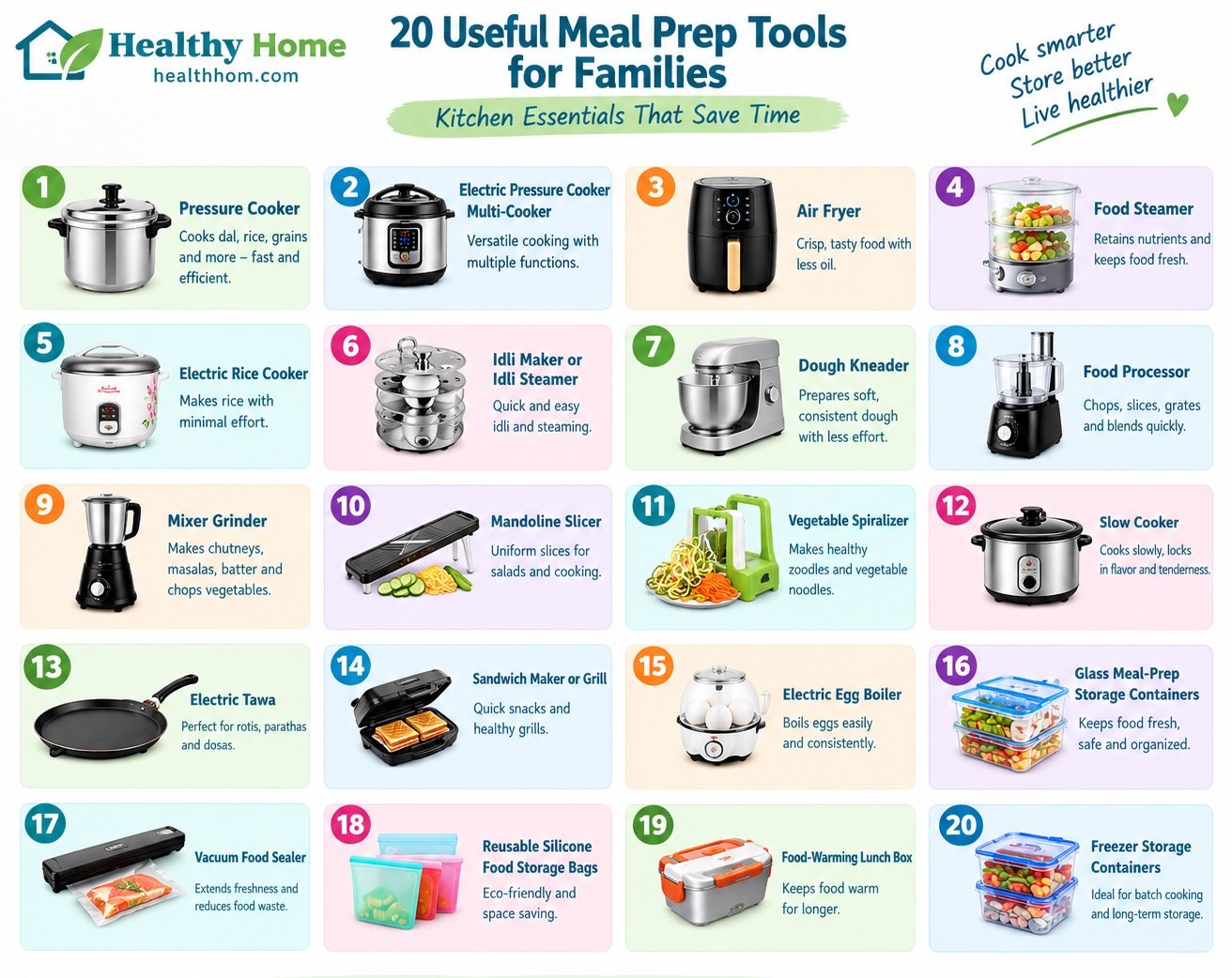
This guide covers 20 practical meal-prep tools that can help the families to save time, organize food and make healthy home cooking more manageable.
Healthy Home principle: The healthiest kitchen is not necessarily the one with the most appliances. It is the one that makes nutritious home cooking easier to prepare and repeat.
Amazon Associates Disclosure :Healthy Home participates in the Amazon Associates Program, an affiliate advertising program designed to provide a means for sites to earn advertising fees by advertising and linking to Amazon.in. Some links in this article may be affiliate links. If you purchase a qualifying product through one of these links, Healthy Home may earn a commission at no additional cost to you.
Product prices, availability, specifications, customer ratings and offers can change. Always check the current Amazon product page before purchasing. Product recommendations in this article are based on practical usefulness and are not medical endorsements. No kitchen appliance or food-storage product can independently make a diet healthy.
What Is Meal Preparation?
Meal preparation, commonly called meal prep, means preparing some meals or ingredients ahead of time so that cooking and eating during busy days becomes easier.
It can be as simple as:
- Cooking dal in advance
- Preparing rice for the next meal
- Kneading dough ahead of time
- Preparing idli or dosa batter
- Washing and preparing suitable vegetables
- Making homemade chutney
- Cooking a batch of beans or pulses
- Portioning leftovers into containers
- Preparing children’s lunch boxes
- Organizing freezer-friendly foods
Meal prep does not mean that everything has to be cooked on Sunday for the entire week.
For many families, preparing ingredients or one or two components in advance is enough.
The goal is to reduce the amount of work required at the busiest time of the day.
Why Meal-Prep Tools Can Help the Families
Healthy eating involves more than choosing nutritious foods.
- Time
- Cost
- Food availability
- Cooking skills
- Storage
- Food safety
- Children’s preferences
- Work and school schedules
A useful kitchen appliance can reduce preparation time and make homemade meals more practical.
The World Health Organization recommends a varied diet based on nutritious foods such as vegetables, fruits, pulses, whole grains, nuts and other minimally processed foods and limiting excess free sugars, unhealthy fats and highly processed foods.
Meal-prep tools can support that pattern by making it easier to prepare food at home.
20 Useful Meal Prep Tools for Families
You do not need all 20.
The right combination depends on your family’s cooking habits, kitchen space, budget and the amount of food you prepare.
1. Pressure Cooker
For many Indian families, the pressure cooker remains one of the most useful meal-preparation appliances.
It can reduce cooking time for foods that otherwise require long cooking periods.
It is commonly used for:
- Dal
- Rajma
- Chana
- Other pulses
- Rice
- Potatoes
- Vegetables
- Khichdi
- Certain meat preparations
A pressure cooker may be useful during batch cooking. For example, instead of cooking dal separately every day, a family may prepare an appropriate quantity and store portions safely for later meals.
What to think about purchsing, look at:
- Capacity
- Material
- Safety mechanisms
- Handle design
- Replacement gasket availability
- Compatibility with your cooktop
- Manufacturer support
[See current pressure cooker options]
Healthy Home tip : Pressure cooking is a cooking method, not a nutrition guarantee. The overall ingredients and recipe still matter.
2. Electric Pressure Cooker / Multi-Cooker
An electric pressure cooker or multi-cooker can combine several functions in one appliance.
Depending on the model, it may provide functions such as:
- Pressure cooking
- Slow cooking
- Steaming
- Rice cooking
- Sauting
- Reheating
- Keeping food warm
This may be for busy households where one appliance can perform several cooking tasks.
[Compare Electric Pressure Cookers]
Who may benefit?
- Working parents
- Larger families
- People who batch cook
- Households with limited cooking time
Before purchasing : Do not select a multi-cooker simply because it has the largest number of programmes.
Think whether you will actually use those functions.
3. Air Fryer
An air fryer may be useful for families who enjoy crisp foods but want an alternative to traditional deep frying. It can prepare foods such as:
- Homemade potato wedges
- Roasted vegetables
- Paneer
- Fish
- Chicken
- Homemade snacks
- Certain reheated foods
Air-fried does not automatically mean healthy.
If highly processed food is placed inside an air fryer, the appliance does not transform it into a nutritious food.
The main potential advantage is that certain foods can be prepared with less added oil than traditional deep frying.
What to check
- Basket capacity
- Family size
- Temperature range
- Cleaning requirements
- Countertop space
- Power consumption
- Warranty
- Availability of replacement parts
4. Food Steamer
A food steamer can make it more convenient to prepare vegetables and other suitable foods, such as:
- Broccoli
- Carrots
- Beans
- Cauliflower
- Corn
- Fish
- Certain dumplings
- Other vegetables
WHO identifies steaming and boiling as cooking methods that can be used instead of frying.
Family advantage
A steamer can help families add more vegetables to meals without requiring elaborate cooking.
For a small household, a basic steaming basket may be sufficient. A larger electric steamer may make sense for families that use it frequently.
5. Electric Rice Cooker
Rice is an important staple in many Indian households, particularly in eastern and southern India.
An electric rice cooker can simplify meal preparation and allow rice to cook with little active supervision. Some models can also prepare:
- Khichdi
- Porridge
- Steamed vegetables
- Certain one-pot meals
[VIEW AVAILABLE ELECTRIC RICE COOKERS OPTIONS ]
But, look for:
- Capacity
- Cooking modes
- Inner-pot quality
- Keep-warm function
- Ease of cleaning
- Warranty
A rice cooker can be convenient when the family wants rice to cook while other dishes are being prepared.
6. Idli Maker or Idli Steamer
For families that regularly prepare idli, an idli steamer or idli-making system can be a practical meal-prep tool.
Idli can be paired with foods such as:
- Sambar
- Vegetable preparations
- Chutney
- Other nutritious accompaniments
It can also be useful for batch preparation when several family members need breakfast.
[SEE IDLI MAKERS & STEAMERS WITH FEATURES]
Buying tip and look the followings:
- Number of idli plates
- Stainless-steel construction
- Easy cleaning
- Suitable size for your family
There is no need to buy a very large model if you only prepare idlis occasionally.
7. Dough Kneader
Preparing roti or chapati dough by hand is manageable, but for a family that prepares rotis regularly, an electric dough kneader can save time and effort.
It can be particularly useful when preparing dough for:
- Roti
- Chapati
- Paratha
- Poori
- Certain breads
[COMPARE ELECTRIC DOUGH KNEADERS MODELS]
What to notice:
- Dough capacity
- Motor strength
- Bowl size
- Cleaning
- Warranty
- Availability of replacement components
For families making only a few rotis occasionally, manual kneading may remain simpler.
8. Food Processor
A food processor can be one of the most useful meal-preparation appliances.
As per model, it may help with:
- Slicing vegetables
- Grating
- Shredding
- Chopping
- Pureeing
- Dough preparation
- Batch preparation
Why it can be valuable
Imagine preparing vegetables for six people every evening. A food processor can reduce the repetitive preparation work and make batch cooking more practical.
There is one important drawback: food processors also require cleaning.
If your household prepares only small quantities, the time required to assemble and clean the machine may outweigh the benefit.
9. Mixer Grinder
The mixer grinder is particularly relevant to Indian family kitchens. It can support preparation of:
- Chutneys
- Masalas
- Ginger-garlic paste
- Batters
- Dips
- Spice mixtures
- Smooth preparations
It can also make homemade cooking more convenient.
[COMPARE MIXER GRINDERS FROM AVAILABLE SOURCES]
Please Verify:
- Motor performance
- Jar sizes
- Blade quality
- Noise
- Warranty
- Service network
- Availability of replacement jars and parts
A durable mixer grinder may be more valuable than a model with numerous features that you rarely use.
10. Mandoline Slicer
A mandoline slicer can quickly produce uniform slices of suitable vegetables and fruits such as:
- Cucumber
- Carrot
- Potato
- Radish
- Beetroot
- Other suitable produce
[SEE MANDOLINE SLICERS OPTIONS]
Important safety point : Mandoline slicers can have extremely sharp blades.
Always use the safety guard supplied with the product and follow the manufacturer’s instructions. This is not a tool that should be handed to young children.
11. Vegetable Spiralizer
A spiralizer can turn suitable vegetables into spiral-shaped strands. For families trying to introduce more variety into vegetable meals, this can make food preparation more interesting.
It can be used with vegetables such as:
- Zucchini
- Carrot
- Cucumber
- Beetroot
[EXPLORE VEGETABLE SPIRALIZERS]
Is it essential? No.
This is an optional tool, not a basic kitchen requirement. Buy it if your family enjoys experimenting with vegetables and you expect to use it regularly.
12. Slow Cooker
A slow cooker is beneficial for foods that benefit from longer, gentle cooking. As compared different model and recipe, it may be used for:
- Beans
- Stews
- Soups
- Certain curries
- Slow-cooked vegetables
- Pulled meat preparations
Why busy families may like it : The major advantage is convenience.
You can prepare ingredients, start the cooking process according to the manufacturer’s instructions and have a meal ready later.
Always follow food-safety guidance and the appliance manufacturer’s instructions when slow cooking and storing food.
13. Electric Tawa
An electric tawa is helpful for families that regularly prepare:
- Roti
- Chapati
- Dosa
- Pancakes
- Paratha
- Toasted foods
[SEE ELECTRIC TAWAS WITH OPTIONS]
Look for:
- Temperature control
- Cooking surface
- Size
- Non-stick coating specifications
- Ease of cleaning
- Electrical safety
- Warranty
An electric tawa is particularly useful when countertop cooking is convenient for your household.
14. Sandwich Maker or Grill
A sandwich maker or grill can make quick homemade meals easier. Instead of relying on packaged snacks, families can prepare simple homemade combinations using ingredients such as:
- Whole-grain bread
- Vegetables
- Paneer
- Egg
- Homemade fillings
[COMPARE SANDWICH MAKERS & GRILLS]
Healthy Home tip : The appliance does not determine the nutritional quality of the sandwich.
Choose nutritious fillings and avoid turning every grilled sandwich into a high-salt, high-fat meal.
15. Electric Egg Boiler
For families that eat eggs, an electric egg boiler can make batch preparation convenient. Eggs can be used as part of meals such as:
- Breakfast
- Salads
- Sandwiches
- Roti rolls
- Rice meals
[SEE MORE ELECTRIC EGG BOILERS]
It is useful for its convenience. It can reduce the need to monitor eggs manually while they cook, depending on the appliance design.
Choose a model with appropriate safety features and easy cleaning.
16. Glass Meal-Prep Storage Containers
Storage is an important part of meal preparation. Glass containers can store suitable foods and leftovers.
They are available in different shapes and sizes and may be particularly convenient for families that prepare food in batches.
[VIEW GLASS MEAL-PREP CONTAINERS]
What to look for
- Secure lids
- Appropriate capacity
- Stackability
- Refrigerator suitability
- Freezer suitability
- Microwave instructions
- Resistance to thermal shock
Never assume that any glass container can safely move directly from a refrigerator or freezer into a hot oven. Follow the manufacturer’s instructions.
17. Vacuum Food Sealer
A vacuum sealer removes much of the air from specially designed storage bags or containers. It can be used for organizing and storing certain foods and may help to reduce exposure to air during storage.
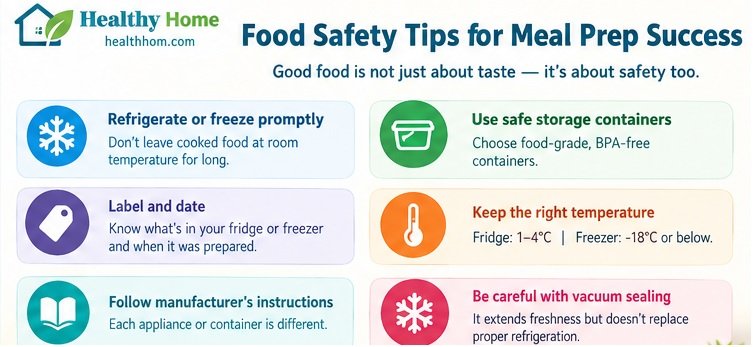
Important food-safety point : Vacuum sealing is not a substitute for refrigeration or safe food handling.
Some foods can present serious food-safety risks if stored improperly in low-oxygen environments. Always follow reliable food-safety guidance and the manufacturer’s instructions.
For most families, a vacuum sealer is an optional upgrade, not a basic meal-prep requirement.
FDA : for kitchen hygiene, separating raw foods, cooking and chilling.
18. Reusable Silicone Food Storage Bags
Reusable silicone storage bags can provide an alternative to disposable food-storage bags for suitable uses. They may be used for:
- Cut vegetables
- Fruit
- Snacks
- Marinating
- Freezer storage where permitted
[SEE REUSABLE SILICONE FOOD BAGS OPTIONS]
Before buying, verify:
- Food-contact suitability
- Temperature limits
- Leak resistance
- Closure mechanism
- Ease of cleaning
- Dishwasher compatibility
Choose products from reputable manufacturers and use them according to their instructions.
19. Food-Warming Lunch Box
For people who carry homemade meals to work or school, an electric food-warming lunch box can be convenient where access to electrical power is available. It may allow food to be warmed before eating rather than relying on a microwave.
[VIEW ELECTRIC FOOD-WARMING LUNCH BOXES]
Important distinction : A food warmer is not necessarily a food-preservation device.
Food should be stored and transported safely and the appliance should be used according to its actual purpose.
For children, parents should also think whether the device is appropriate for school use and whether electrical access is available.
20. Freezer Storage Containers
Freezer-friendly containers can be particularly useful for families who prepare food in batches. They can help organize foods such as:
- Cooked pulses
- Homemade sauces
- Certain prepared meals
- Suitable vegetables
- Homemade snacks
[COMPARE FREEZER STORAGE CONTAINERS]
Healthy Home tip : Do not fill containers completely to the top when freezing foods that expand. Follow the manufacturer’s recommendations regarding headspace and temperature limits.
USDA food safety recommendations – for leftovers, refrigeration and food storage. USDA specifically recommends prompt refrigeration and provides guidance on safely storing leftovers.
How to Prioritize Meal-Prep Tools for an Indian Family
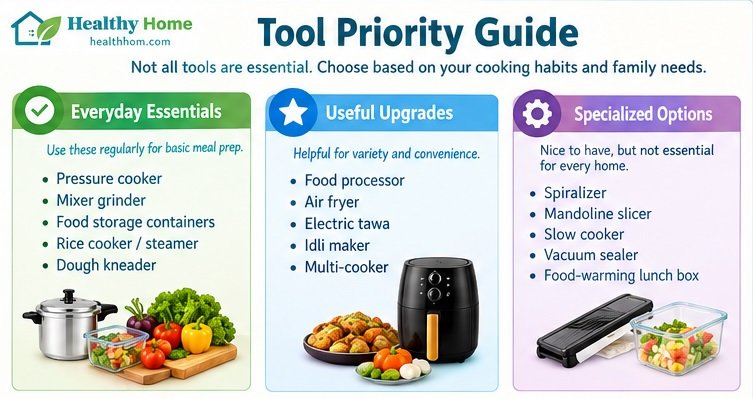
If I had to select a smaller group for a typical Indian family, I would prioritize:
Everyday essentials
1. Pressure cooker
For dal, pulses, rice and other foods.
2. Mixer grinder
For chutneys, masalas, batters and pastes.
3. Food-storage containers
For leftovers and prepared ingredients.
4. Rice cooker
For families that eat rice frequently.
5. Dough kneader
For households that prepare rotis regularly.
Useful upgrades
6. Food processor
7. Steamer
8. Air fryer
9. Electric tawa
10. Electric egg boiler
Specialized options
11. Vacuum sealer
12. Slow cooker
13. Spiralizer
14. Mandoline slicer
The right combination depends on your household.
CDC — for the family food-safety principle of Clean, Separate, Cook and Chill.
Best Meal-Prep Tools for Working Parents
Working parents often benefit most from tools that reduce active preparation time.
A practical combination could be:
- Pressure cooker
- Mixer grinder
- Food processor
- Dough kneader
- Storage containers
- Rice cooker
- Air fryer
The objective is not to cook everything in advance.
Instead, these tools can help to create a system where some preparation can be possible earlier and the final meal can be assembled quickly.
Best Meal-Prep Tools for Families With Children
Families with children have some additional requirement. Children may need:
- Regular meals
- School lunches
- Snacks
- Different portion sizes
- Food prepared according to their age and developmental stage
A useful setup might be:
- Meal-prep containers
- Freezer-safe containers
- Pressure cooker
- Rice cooker
- Mixer grinder
- Food warmer where appropriate
- Food steamer
Parents should also consider food texture, choking risks, allergies and individual nutritional requirements when preparing food for young children.
A Simple Weekend Meal-Prep Routine
You do not need to spend an entire Sunday cooking. Try a smaller system.
Step 1: Choose 3–4 meals
Select meals your family already enjoys. For example:
- Dal, rice with vegetable
- Roti, dal with vegetable
- Khichdi
- Idli and sambar
- Vegetable pulao
- Homemade egg or paneer preparation
Step 2: Prepare selected ingredients
Use appropriate appliances to:
- Cook pulses
- Prepare batter
- Knead dough
- Prepare chutney
- Wash and prepare suitable vegetables
Step 3: Store safely
Place food in appropriate containers and refrigerate or freeze promptly as required.
Food-safety authorities recommend keeping refrigerators at 40°F/4°C or below and following appropriate food-handling practices.
Step 4: Label containers
For batch-prepared foods, label containers with:
- Food name
- Preparation date
- Intended use
Step 5: Assemble meals during the week
Instead of cooking everything from scratch every evening, combine prepared components into complete meals.
One common misconception is that meal preparation means eating the same food throughout the week.
It does not. You can prepare components not the complete meals.
For example, you may prepare and use them:
- Dal
- Cooked rice
- Dough
- Chutney
- Prepared vegetables
Monday: Dal + rice + vegetable
Tuesday: Dal + roti + vegetable
Wednesday: Khichdi using suitable ingredients
This approach can save time while maintaining variety.
How to Choose the Right Meal-Prep Tool
Prior to buy a product, ask these questions.
1. What problem does it solve?
If you cannot identify the problem, you probably do not need the gadget.
2. How often will we use it?
Daily-use equipment generally provides greater practical value.
3. How much food do we prepare?
Capacity should match your family size.
4. Is it easy to clean?
This is one of the most overlooked considerations.
5. Is there enough kitchen space?
A large appliance that permanently occupies valuable space may be frustrating.
6. Is it safe?
Look for appropriate safety features and follow manufacturer instructions.
7. Is after-sales service available?
For electrical appliances, warranty and service support can be more important than a long list of features.
What Should You Buy First?
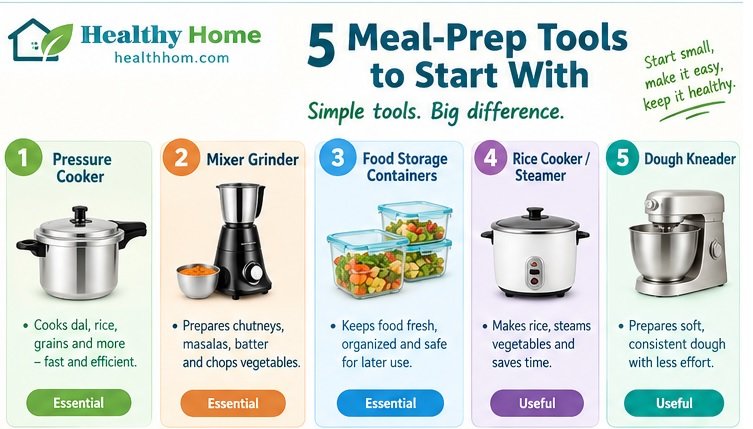
If you are starting a family meal-prep system from scratch, do not buy 20 products.
Start with five:
1. Pressure cooker
For everyday cooking.
2. Mixer grinder
For Indian meal preparation.
3. Food-storage containers
For storing prepared food.
4. Rice cooker or steamer
Depending on your family’s cooking habits.
5. Dough kneader
If your family regularly prepares roti or chapati.
Then observe your routine for a few weeks.
If chopping and slicing are still taking too much time, think about a food processor.
If crisp foods are frequently prepared, think an air fryer.
If batch cooking is common, you may consider specialized freezer containers
This approach prevents unnecessary spending.
A family can own an expensive air fryer, food processor and multi-cooker and still eat a diet dominated by ultra-processed foods.
But, a simple kitchen with a pressure cooker, pan, knife and storage containers can support nutritious home cooking.
A healthy family meal may be as simple as:
Dal + rice + vegetables + fruit
or
Roti + vegetable + dal + curd
The equipment makes preparation easier, but the ingredients and overall dietary pattern remain central.
WHO : for the healthy-diet section, particularly variety, balance, moderation and minimally processed foods.
How Meal Prep Can Reduce Food Waste
Meal preparation can also support better food management. For example, a family may purchase vegetables for the week but fail to use them before they deteriorate.
A planned preparation system can help by:
- Organizing ingredients
- Preparing appropriate quantities
- Freezing suitable foods
- Storing leftovers properly
- Planning meals around ingredients already available
Also, batch cooking should not result in preparing more food than your family can safely consume.
Food safety should always come before convenience.
The best meal-prep system is the one your family can continue using. Instead, start with:
- Two or three prepared components
- A few reliable family recipes
- Appropriate storage containers
- One or two useful appliances
As the routine becomes comfortable, you can expand it. Healthy habits are generally more sustainable when they fit naturally into everyday life.
Tools with Priority and Best use for:
| Tool | Priority | Best for |
|---|---|---|
| Pressure cooker | Essential | Dal, pulses, rice |
| Mixer grinder | Essential | Chutneys, masalas, batter |
| Storage containers | Essential | Leftovers and meal prep |
| Rice cooker | Useful | Regular rice preparation |
| Dough kneader | Useful | Frequent roti preparation |
| Air fryer | Optional | Lower-oil crisp cooking |
| Food processor | Optional | Large-volume chopping |
| Vacuum sealer | Specialized | Longer-term food organization |
Concluding Points
Meal-prep tools can make family cooking faster, more organized and more manageable.
For Indian households, appliances such as pressure cookers, mixer grinders, rice cookers, dough kneaders, food processors, steamers and storage containers can be particularly useful.
Other products including air fryers, slow cookers, electric tawas, vacuum sealers and specialized storage systems may be valuable depending on your cooking habits.
But you do not need every product on this list. The best purchase is the tool that solves a genuine problem in your kitchen and gets used regularly.
A practical meal-prep system can help your family to:
- Cook more meals at home
- Reduce daily preparation stress
- Organize leftovers
- Prepare school and office meals
- Reduce unnecessary food waste
- Make nutritious foods more convenient
- Spend less time starting every meal from scratch
Good meal preparation is about making healthy home cooking easier to maintain.
Frequently Asked Questions
What are the most useful meal-prep tools for families?
Pressure cookers, mixer grinders, food-storage containers, rice cookers, steamers, dough kneaders and food processors are among the most useful options for many families. The best choice depends on your cooking habits.
What is the best meal-prep appliance for an Indian family?
There is no single best appliance, but a pressure cooker and mixer grinder are highly practical in many Indian kitchens because they can be used for a wide variety of everyday foods.
Is an air fryer necessary for healthy meal preparation?
No. An air fryer is optional. It can reduce the amount of added oil needed for certain foods compared with deep frying, but healthy cooking can be achieved using many other methods.
Is a rice cooker useful for Indian families?
It can be, particularly for households that eat rice regularly. Some models can also prepare other one-pot meals, depending on the manufacturer’s instructions.
Is a dough kneader worth buying?
It can be worthwhile if your family prepares rotis, chapatis, parathas or similar dough-based foods frequently. If you make only a few rotis occasionally, manual kneading may be sufficient.
Are glass containers better for meal prep?
Glass containers can be useful for food storage and are available in many shapes and sizes. However, suitability depends on the manufacturer’s instructions regarding microwave, freezer, oven and temperature changes.
Is vacuum sealing necessary for meal prep?
No. Vacuum sealing is a specialized option. Most families can manage meal preparation with ordinary food-storage containers and appropriate refrigeration or freezing.
Can meal prep save money?
It can potentially reduce food waste and the frequency of takeaway meals, although the actual savings depend on shopping habits, ingredients, portion sizes and how efficiently food is used.
How long can meal-prepped food be stored?
Storage time varies according to the type of food, preparation method and storage conditions. Do not assume that all prepared foods have the same safe storage period. Follow reliable food-safety guidance and refrigerate perishable foods promptly. USDA recommends keeping refrigerators at or below 40°F/4.4°C.
Do I need 20 meal-prep tools?
Absolutely not. The list is designed to help you for comparing options. Most families will need only a small selection. Start with the tools that solve your most meal-preparation problems.
Family Meal-Prep Shopping Checklist
Before purchase a new appliance, ask:
☐ Does it solve a real kitchen problem?
☐ Will we use it regularly?
☐ Is the capacity suitable for our family?
☐ Is it easy to clean?
☐ Do we have enough storage space?
☐ Is it safe to use?
☐ Is a warranty available?
☐ Are replacement parts available?
☐ Do we already own something that performs the same task?
☐ Is the product worth the money based on how often we will use it?
If the answer to most of these questions is yes, the product may be worth considering.
Related Healthy Home Resources
If you are working on healthier family meals, you may also find these Healthy Home resources useful:
- Useful Kitchen Tools for Healthy Meal Preparation
- Parent’s Guide to Children’s Nutrition
- Healthy Family Guide
- Healthy Living Guide
- Healthy Recipes
- High-Protein Indian Diet Guide
Medical & Health Disclaimer
This article is provided for general educational and informational purposes. It does not constitute individual medical, nutritional or dietary advice and should not replace advice from a qualified healthcare professional or registered dietitian.
Children have different nutritional requirements according to age, growth, development and individual circumstances. Parents should seek appropriate professional advice when a child has a medical condition, food allergy, growth concern or special dietary requirement.
Always follow the manufacturer’s instructions when using kitchen appliances, electrical equipment, cookware and food-storage products.
Affiliate Disclosure
Healthy Home participates in the Amazon Associates Program and may earn advertising fees from qualifying purchases made through links to Amazon.in. This does not increase the price you pay.
Product recommendations are based on practical usefulness and are not endorsements of any particular brand. Prices, availability and specifications can change.
Healthy Home does not claim that any kitchen product can prevent, treat or cure a disease


About the Author – “Bibhu Ranjan Mund”, Master in Public Health (MPH) from IIHMR University, Jaipur (Rajasthan) has more than 18 years of experience in Public Health activities in maternal health, child health, adolescent health, nutrition and community wellness programs under National Health Mission, Health & Family Welfare Department, Odisha. He is the founder of “Healthy Home” and translates the evidence based public health information into a practical source so that families may able to apply in everyday life. All the information are for educational purposes only and not replaces the professional medical advice. ORCID Researcher ID – 0009-0003-0158-4992. Connect LinkedIn – https://www.linkedin.com/in/bibhu-ranjan-mund-b72171358/