Last Updated on March 22, 2026 by Bibhu Ranjan Mund, MPH
Discover sleep music for better sleep and sound therapy improve deep sleep, reduce stress & insomnia naturally. Science-backed tips & tools for better rest.
Reviewed by Bibhu Ranjan Mund, MPH (Public Health Expert) with experience in maternal, infant, child, and adolescent health programs. Content is based on evidence-informed guidelines aligned with organizations such as the World Health Organization, UNICEF, Centers for Disease Control and Prevention, and National Institutes of Health.
Last reviewed on: 22 March 2026.
Medical Disclaimer: This content is for informational and educational purposes only and is not intended as medical advice, diagnosis, or treatment. Always seek the advice of a qualified healthcare professional regarding any medical condition or concerns.
Affiliate Disclosure: This article contains affiliate links. If you purchase through these links, we may earn a small commission at no extra cost to you.
Sleep has become one of the most vital pillars of health. But in our technologically advanced fast world, millions of people cannot rest enough to have proper sleep. Work, academic and online at a late time has caused several individuals to find themselves tossing and turning way beyond the time when sleep tries to come.
Although there are sleep pills and nutritional additions that may provide you with a temporary solution, they usually have side effects. More are seeking more natural, non-invasive declarations and sound therapy is swiftly ceasing to be the needless resource.
Sleep music is low-tempo relaxing music (usually 60-80 BPM) that is meant to soothe the nervous system, minimize stress and help the listener achieve natural sleep. It is suggested from research that regular listening during the evening before sleep can help to increase the quality of sleep and decrease awakenings during the night.
We are going to discuss in this blog what sound therapy is and what the science is behind, what types of sounds are most helpful to sleep, practical sound therapy tips that can be used at home.
Quick Summary:
- Slow tempo music is employed in sleep music (60-80 BPM to relax the nervous system).
- Helps anti-stress hormone, cortisol and helps produce melatonin.
- Enhances the quality and sleep latency, as well as relaxation.
- White noise masks disruptive environmental sounds.
- Binaural beats may help to promote deeper sleep
- Non-invasive, safe and suitable for adults, teens, and children
- Efforts to work well with appropriate sleeping habits.
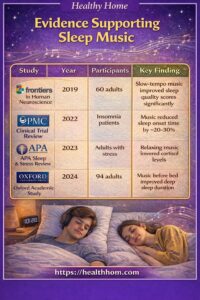
Evidence Supporting Sleep Music
| Study | Year | Participants | Key Finding |
|---|---|---|---|
| Frontiers in Human Neuroscience | 2019 | 60 adults | Slow-tempo music improved sleep quality scores significantly |
| PMC Clinical Trial Review | 2022 | Insomnia patients | Music reduced sleep onset time by ~20–30% |
| APA Sleep & Stress Review | 2023 | Adults with stress | Relaxing music lowered cortisol levels |
| Oxford Academic Study | 2024 | 94 adults | Music before bed improved deep sleep duration |
1. What is Sound Therapy?
Sound therapy : It involves sound, vibration, music to sustain physical, emotional and mental health. In contrast with background noise, which may prove to be soothing. It utilizes consciously selected notes that help to guide the brain into a relaxed state.
Sound healing has always been echoed throughout many cultures:
- The singing bowls of Tibet have been in use rendering centuries of meditation.
- Drumming is practiced by the indigenous community to get into the trance, restorative states.
- It is natural to other parents to have the babies fall asleep under the influence of the songs and the humming.
Sound therapy scattered across the present day can comprise many things: binaural beats or white noise machines or guided meditational music or even a full sound bath. Each kind has a slight variation but they all are geared towards quieting the brain and putting the human body to a profound sleep.
2. The Science of Sound & Sleep:
We must examine the reaction of the brain to sound to know why sound therapy is successful.
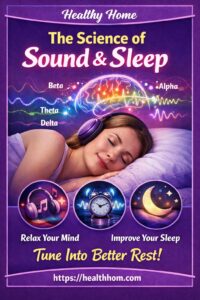
Some brainwave frequencies that the brain works are:
- Beta waves (13–30 Hz): Alert, active thinking.
- Alpha waves (8 to 12 Hz): Calmed meditative procedures.
- Theta waves (4–7 Hz): Light sleep and deep relaxation.
- Delta waves (0.5–3 Hz): Deep, restorative sleep.
Your brain can be coached or trained, so when you listen to some kinds of music or tones, it is possible to be sent off into these deeper states. The binaural beats are used as an example, set slightly different frequency in the ear and the mind of course records the difference as a beat. When that beats, the same frequency as a theta or delta, it can naturally put your mind into sleepy mode.
- According to the results of a 2019 study in Frontiers in Human Neuroscience, listening to slow-tempo music standing by bedtime contributed to a significant increase in the quality of sleep.
- Other researchers indicate sound therapy has the capacity to reduce cortisol (the stress hormone) and is associated with improved melatonin regulation (the sleep hormone).
In a word, the right tunes can tune your brain to sleep.
3. Types of Sleep-inducing Sounds:
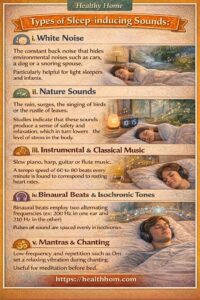
i. White Noise
- The constant back noise that hides environmental noises such as cars, a dog or a snorting spouse.
- Particularly helpful for light sleepers and infants.
ii. Nature Sounds
- The rain, surges, the singing of birds or the rustle of leaves.
- Studies indicate that these sounds produce a sense of safety and relaxation, which in turn lowers the level of stress in the body.
iii. Instrumental & Classical Music
- Slow piano, harp, guitar or flute music.
- A tempo speed of 60 to 80 beats every minute is found to correspond to resting heart rates.
iv. Binaural Beats & Isochronic Tones
- Binaural beats employ two alternating frequencies (ex: 200 Hz in one ear and 210 Hz in the other) to produce the perception of a rhythm.
- Pulses of sound are spaced evenly in isochronies. Both works well to induce brainwaves into the sleeps.
v. Mantras & Chanting
- Low-frequency and repetition such as Om set a relaxing vibration during chanting.
- Useful for meditation before bed.
Learn more about : Outdoor Wellness: How Nature Enhances Physical and Mental Health
4. Benefits of Sound Therapy for Sleep
- Alleviates stress and anxiety: Chills out the nervous system, beating down the heart rate and blood pressure.
- Enhances sleep routines: Indicates the brain to dive into deep and restful delta waves.
- Enhances performance the next day: With increased sleep there comes enhanced focus, memory and energy.
- Harmless and easy: As compared to sleeping pills, sound therapy is not addictive and is safe to both the young and the old.
- Helps in mental health: Most of them claim to have less depression and experience higher emotional levels when subjected to regular sound-based relaxation.
Learn how better sleep can also improve lifespan naturally with science-backed habits : Improve Lifespan Naturally with Science-Backed Healthy Habits
5. How to Use Sound Therapy at Home
You do not have to have a lot of costly equipment in order to start. Following may be the solution :
- Now compose a bedtime playlist: Select relaxing 20–40-min music. Spotify, Apple Music and YouTube have created playlists of sleep music.
- Best timing: Sounds should be played 30 to 60 minutes before sleep to put your brain in the rest mode.
- Headphones vs. speakers : are popular to use with white noise and nature sounds, whereas the headphones are to be employed with binaural beats.
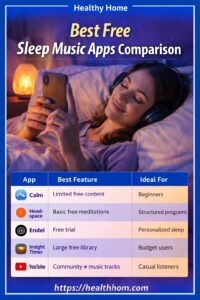
- Use apps: Calm, Headspace and Endel have soundscapes which are relaxation-oriented and sleep-oriented.
- Combine with rituals: Use sound therapy with aromatherapy, light stretching exercise or journaling to consider a total wind-down sequence.
6. Sound Therapy Tools & Devices:
- White noise Machines: Small machines that play original background noise.
- Sleep earbuds : are special, low profile earbuds that offer comfort when sleeping.
- Sound Pillows: In-built speakers enable you to listen without the use of headphones.
- Singing Bowls and Tuning Forks: This is good in the meditation before sleep.
- Mobile Apps: Affordable, accessible and customizable for every user.
Best Free Sleep Music Apps Comparison
| App | Free Version | Best Feature | Ideal For |
|---|---|---|---|
| Calm | Limited free content | Guided sleep stories | Beginners |
| Headspace | Basic free meditations | Structured programs | Stress relief |
| Endel | Free trial | AI-generated soundscapes | Personalized sleep |
| Insight Timer | Large free library | Community + music tracks | Budget users |
| YouTube | Fully free | Variety of sounds | Casual listeners |
7. Sound Therapy for Kids & Teens:
Kids and teenagers may have child-specific sleep issues: resistance to bedtime or pre-school/exam stress. Sound therapy may become a mild treatment.
- Sweet songs and tunes: Make younger patient children comfortable and secure.
- In nature noises: Good to people that cannot sleep.
- In adolescents: Music is shown to help reduce anxiety even lower study attention.
Tips on parenting: Do not use screens at bedtime. Play audio-only music on a speaker or smart device in the room and at a low level.
8. Precautions and what to remember:
- Not a replacement for medical care: If insomnia persists, consult a doctor.
- Volume issues: Play music that is not over 60 decibels to conserve hearing.
- Consistency is fundamental: When it comes to much like meditation, the payoffs accumulate with daily practice.
- Personal preference: People might be bothered by some audible noises- experiment until you find what sounds good.
Brainwave & Sleep Stage Data Table
| Brainwave | Frequency | Associated State |
|---|---|---|
| Beta | 13–30 Hz | Alert, active thinking |
| Alpha | 8–12 Hz | Relaxed wakefulness |
| Theta | 4–7 Hz | Light sleep |
| Delta | 0.5–3 Hz | Deep restorative sleep |
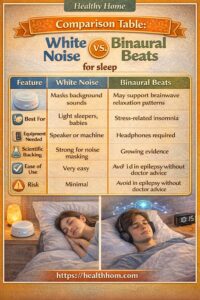
Comparison Table: White Noise vs Binaural Beats for sleep
| Feature | White Noise | Binaural Beats |
|---|---|---|
| How It Works | Masks background sounds | May support brainwave relaxation patterns |
| Best For | Light sleepers, babies | Stress-related insomnia |
| Equipment Needed | Speaker or machine | Headphones required |
| Scientific Backing | Strong for noise masking | Growing evidence |
| Ease of Use | Very easy | Moderate |
| Risk | Minimal | Avoid in epilepsy without doctor advice |
Healthy Sleep Routine Checklist
- Have regular sleep pattern.
- NO Screens 60 min before bed.
- Keep bedroom dark and cool
- Use low-volume sleep music (<60 dB)
- Do not take any caffeine 6 hours before sleep.
- Deep breathing or stretching.
- Sound therapy should be used regularly.
5 Min Bedtime Sound Bedtime Sound Routine.
Quick Night Routine
- Minute 1 Darkness and no notifications.
- Minute 2: Play relaxing instrumental music.
- Minute 3: Slow 4-6 breathing.
- Minute 4: Body scan relaxation
- Minute 5: Let music playing come to pass as you fall asleep.
Total time: 5 minutes.
Stability is more important than time.
Did You Know?
- Slow-tempo music is more likely to get in sync with a human heart rate.
- The music of 60-80 BPM is equal to the resting heart rate.
- There is a psychological effect of safety response caused by nature sounds.
- Stress hormones can be reduced even by 10 minutes of relaxing music.
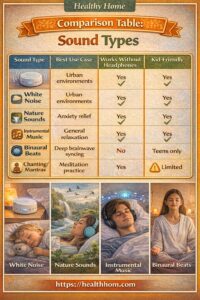
Comparison Table: Sound Types
| Sound Type | Best Use Case | Works Without Headphones | Kid-Friendly |
|---|---|---|---|
| White Noise | Urban environments | Yes | Yes |
| Nature Sounds | Anxiety relief | Yes | Yes |
| Instrumental Music | General relaxation | Yes | Yes |
| Binaural Beats | Deep brainwave syncing | No | Teens only |
| Chanting/Mantras | Meditation practice | Yes | Limited |
Who Should Avoid Sound Therapy?
- People have sensitive hearing impairments.
- Individuals who have epilepsy (must seek the physician before using binaural beats)
- Extreme chronic insomnia (need medical examination) patients.
Case Study: Working Professional with Sleep Stress
Ravi is a 35-year-old IT professional who experienced problems with exposure to the screens at night and stresses at work. He started playing 30 minutes of slow instrumental sleep music a night using a speaker.
After 3 weeks:
- The Sleep onset decreased to 20 minutes, instead of 45 minutes.
- Less night awakening reported.
- Fatigue in the morning was also reduced.
This shows how sound therapy with decreased screen time can facilitate the quality of sleep.
When to See a Doctor?
- If sleep problems last more than 2–3 weeks,i
- Involve loud snoring
- Breathing pauses or severe daytime fatigue
- Consult a healthcare professional to rule out sleep apnea or medical insomnia.
Quick recommendation
- Best for Light Sleepers – White Noise
- Best for Stress & Anxiety – Slow Instrumental Musi
- Best for Deep Relaxation – Binaural Beats
- Best for Kids – Nature Sounds
Concluding Points:
Sound therapy and sleep music are not only the current trends within the bedtime but they are really effective techniques supported with science and history. Whether it is masking noise to relax or it is beats that can get your brainwaves in sync with the beat, sound can help to improve your nervous system and get you into a deep rest.
This night, rather than scrolling through your phone, close your eyes and listen to a 10 minutes relaxing song. Take note of how your breath becomes slow, your mind rapt and sleep yoga-stepping comes.
“Music with a slow tempo can help regulate the autonomic nervous system and reduce stress-related arousal before sleep.”
— Sleep & Behavioral Research Findings, American Psychological Association Review
Try a 10-minute sleep music session tonight and observe how quickly your breathing slows.
Related Health Articles from Healthy Home :
- Social Media Addiction in 2026: Symptoms, Health Effects & 10 Proven Ways to Reduce Screen Time
- Nurturing Mental Well-Being in Adolescents for a Healthier Future
- Pre-Pregnancy Planning Guide for Women: Nutrition, Health & Lifestyle Tips
- Vitamin D Deficiency in Pregnancy & Breastfeeding: Risks and Key Precautions
Trusted References and Research Sources:
- Can white noise really help you sleep better? — Harvard Health
- Sleep Quality Improvements Through Music Interventions – Oxford Academic Study (2024)
- Therapeutic Effects of Music on Sleep: Evidence from Clinical Trials (PMC)
- Music-Based Interventions for Insomnia and Sleep Disorders – ScienceDirect Review (2024
- Music Therapy as a Promising Intervention for Better Sleep – ResearchGate Review
- Music Interventions to Improve Sleep in Adults with Mental Health Disorders – Systematic Review (Cambridge University Press)
- Relaxation Music and Sleep Patterns – Clinical Findings (PMC)
- How Music Influences Mood, Stress, and Sleep – APA (American Psychological Association)
- Music Therapy Approaches for Improving Night-time Relaxation – Evidence From PMC
FAQ:
For more detail, please visit to my website as mentioned below:


About the Author – “Bibhu Ranjan Mund”, Master in Public Health (MPH) from IIHMR University, Jaipur (Rajasthan- IHMR-U/12/2021 -23/0015) has experience of 18 years in Public Health activities like maternal health, child health, adolescent health, nutrition and community wellness programs. Through “Healthy Home”, he shares evidence-based health and wellness guidance designed to support families in making informed lifestyle decisions. This content is for educational purposes only and does not replace professional medical advice. Connect LinkedIn – https://www.linkedin.com/in/bibhu-ranjan-mund-b72171358/