Last Updated on June 24, 2026 by Bibhu Ranjan Mund, MPH
Discover how to know your cholesterol level, BMI, BMR. See normal ranges, formulas and tips to support weight and heart health.
Reviewed by Bibhu Ranjan Mund, MPH (Public Health Expert) with experience in maternal, infant, child, and adolescent health programs. Content is based on evidence-informed guidelines aligned with organizations such as the World Health Organization, UNICEF, Centers for Disease Control and Prevention, and National Institutes of Health.
Medical Disclaimer: This content is for informational and educational purposes only and is not intended as medical advice, diagnosis, or treatment. Always seek the advice of a qualified healthcare professional regarding any medical condition or concerns.
Have you ever though why some people feel healthy but later develop heart disease or weight-related problems?
As per the study report of World Health Organization (WHO, 2024), it shows that more than 60% of many lifestyle related diseases like heart disease, obesity, diabetes etc. may be associated with health indicators like Cholesterol levels, BMI and metabolism.
The important thing is your body may give few symptoms sufficient days prior to originally it appears, but many are un-noticed or not tracked.
Many of us unknowingly develop unhealthy lifestyle habits viz. we eat during our busy time, skipping of exercise during tiredness and only think these if and only if something happen to our health.
But, do you predict & prevent, is it possible? Yes it’s possible just by knowing the below mentioned simple numbers.
- BMI (Body Mass Index) – informs if your weight is healthy
- BMR (Basal Metabolic Rate) – shows how your body burns calories
- Cholesterol Levels – reveal your heart health risk
You may think that these are your body’s internal health dashboard.
As per the research conducted by the National Institutes of Health (NIH, 2023), it clearly shows that people who actually monitor these indicators periodically, are more likely to prevent chronic diseases early and maintain a long-term fitness.
In this article, you will not only find the meaning of these numbers, but also know about how they are interlinked, impact your health and how you can control naturally.
As prevention isn’t a complicated topic, it just begins with a clear awareness.
Understanding the importance of preventive healthcare and early detection can help you to avoid major lifestyle diseases.
The Day I Realized These Numbers Matter:
During my community health camps, I have sometimes met many people who felt themselves as healthy.
Once, one middle age person said me that, he never checked his cholesterol level as he has no any symptoms. But after his routine health screening, his cholesterol level has risen up in-spite of his good feeling.
The issue was identified early in the health camp so that his lifestyle changes could be possibel with medical guidance.
By such types of field experiences, I could be able to know that the many health problems develop silently without any symptoms. Also the BMI, BMR and Cholesterol levels sometimes provide us few warning signs before the actual symptoms appear.
Quick Summary :
- BMI is used to determine weight.
- BMR estimates calorie needs at rest
- Cholesterol is a measure of heart related blood lipid profiles
- Excessive LDL and triglycerides can be a risk factor to cardiovascular.
- Exercise increases the HDL (good cholesterol).
- Fiber diets are favourable to lipid balance.
- Get your lipid profile checked annually
- Prophylactic care promotes long term health.
Know your Body Mass Index
Why Most People Ignore These Health Indicators?
In my experience, I have seen that most of the people are monitoring their bank balance regularly but ignore the health indicators.
Weight gain may happen gradually and cholesterol level can rise without any proper symptoms. Also metabolism may slow without any attention.
As these changes happens slowly, most people don’t give importance till a health concern develops. So, you should understand these numbers so as to get proper healthcare before any complication appears.
What is BMI?
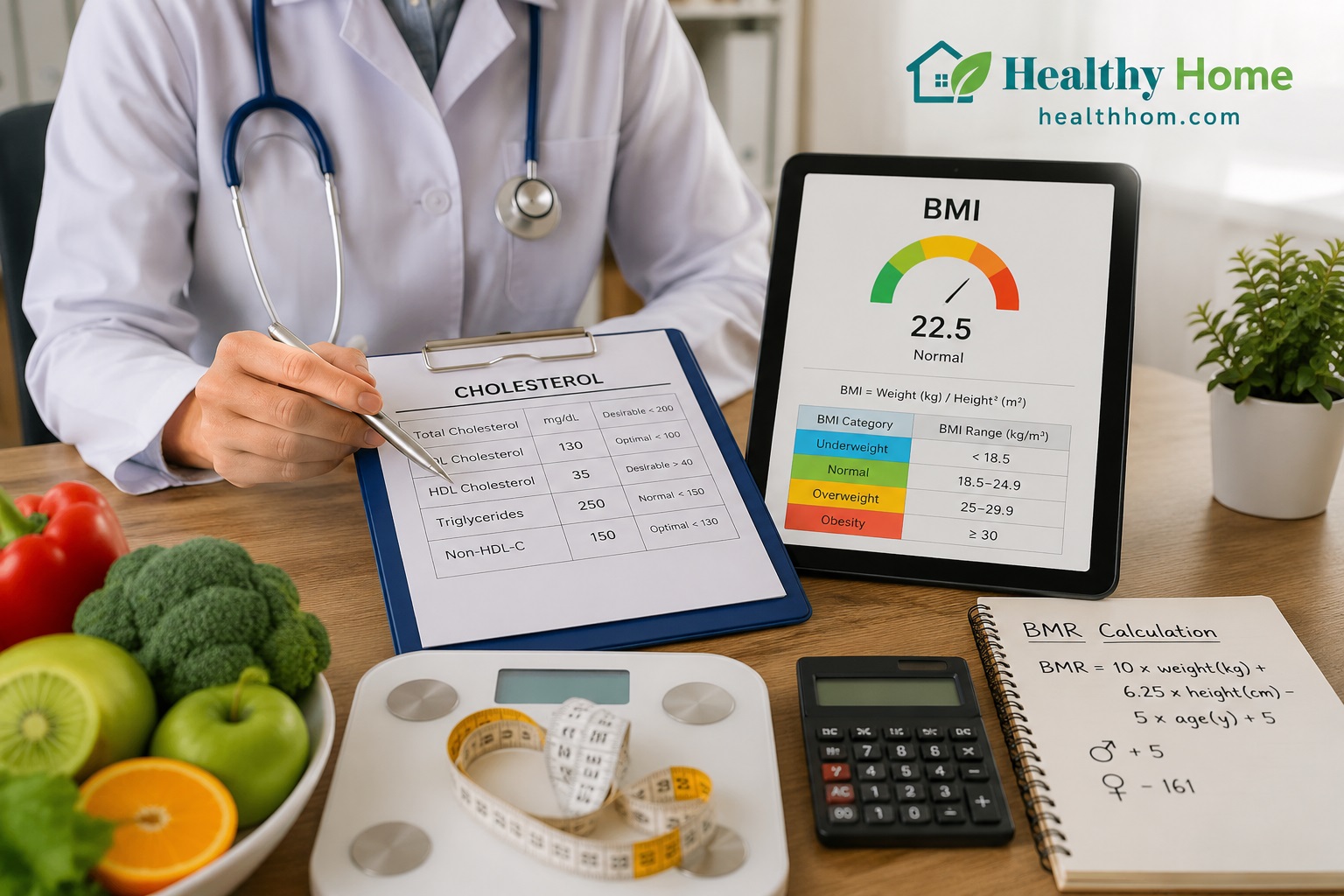
The Body Mass Index (BMI) is an easy ratio of weight and height that approximates the percentage of body fat. Although it does not determine fat directly, it is a fast way of telling whether you are within your normal weight range or not.
The healthy BMI lowers the chances of heart disease, diabetes, blood pressure and arthritis. Overweight enhances the deposition of fat around the body organs which may cause metabolic imbalance
| Asian BMI Category | BMI |
|---|---|
| Normal | 18.5–22.9 |
| Overweight | 23–24.9 |
| Obese | ≥25 |

BMI Formula:
BMI = Weight (kg) / [Height (m)]²
For example: Assuming that you are 70kg and 1.70 meters tall:
BMI = 70 / (1.7 × 1.7) = 24.2
BMI Classification (as per WHO)
Obese = above 30 kg/m2
Underweight = less than 18.5kg/m2
Normal weight = 18.5 kg/m2 to less than 25 kg/m2
Overweight = 25 kg/m2 to 30 kg/m2
WHO classifications are used globally, while lower Asian BMI cut-offs are sometimes used because Asian populations may develop metabolic risks at lower BMI levels.

Waist Circumference Risk
- Men: >90 cm (Asian)
- Women: >80 cm (Asian)
Why BMI Matters
Limitations of BMI
It does not differentiate fat and muscle. An example is the case of the athletes or individuals with high muscle mass that may be registered as having high BMI but with low body fat. Thus, it should be taken as a guideline but not a health verdict.
Maintaining a healthy BMI is crucial to prevent long-term health risks—explore proven obesity prevention strategies and healthy lifestyle habits.
How to maintain a healthy BMI
- Consume healthy diets that are high in vegetables, whole grains and proteins low in calories.
- Keep moving: thirty minutes of vigorous exercise every day.
- Do not consume sweetened beverages and processed foods.
- Weigh yourself monthly at home or smart health apps
To maintain a healthy BMI, following a structured nutrition plan is essential—read our complete guide on balanced daily meal planning for families to build sustainable eating habits.

You can use BMI Calculator that can be found to check your number immediately.
What I Commonly Observe in Indian Households
In many Indian households, weight gain is not the single factor for unhealthy meal pattern. It usually develops through small daily irregular habits like frequent sugary tea, packaged snacks, limited physical activity, more screen time etc.
Such habit may not harm individually, but it can influence the BMI and Cholesterol level in later life. If one will perform daily healthy routines, he can have a meaningful health benefits in long run.
A Common Misunderstanding About BMI
During my awareness sessions in Odisha, rural people assume that a normal looking body means a healthy weight.
But, in reality BMI may inform the hidden risks that may not appear. Also, the physically active person with higher muscle mass may have increase BMI even he is healthy.
So, BMI should be taken as a screening tool not as a complete health assessment.
What is BMR
Basal Metabolic Rate (BMR) is the number of calories your body requires to sustain basic functions in rest (e.g. breathing, blood flow, cell functions, etc).
That is, although you may be lying in bed throughout the day, your body is still able to burn calories to keep you alive.
Knowing your BMR helps you:
- Formulate proper weight management in relation to lose, maintain or gain weight.
- One should not eat excessively or under eat, but rather balance your calorie consumption to your body needs.
- BMR, in brief is the energy base of your body, the basis on which it is possible to construct a healthy lifestyle, which is sustainable.

Know your daily calories requirements.
- Efficiently set weight management objectives.
- Do not eat either too little or too much.
- In case you eat more calories than your BMR + daily activity burns, you will gain weight.
- When you consume fewer calories, you may lose weight
BMR (Mifflin-St Jeor Equation) Calculation.
For Men:
BMR=10×Weight(kg)+6.25×Height(cm)−5×Age+5
For Women:
BMR=10×Weight(kg)+6.25×Height(cm)−5×Age−161
Example:
A thirty-five-year-old woman, 160 cm in height and 60 kg in weight:
BMR = (10 × 60) + (6.25 × 160) – (5 × 35) – 161 = 600 + 1000 – 175 – 161 = 1264 calories/day
It is as though her body requires approximately 1264 calories per day to carry out the vital processes.
Adjusting on the Level of Activity.
| Activity Level | Multiplier | Description |
| Sedentary | ×1.2 | Minimal or no physical activity |
| Light Active | ×1.375 | Light exercise 1-3 days/week |
| Moderately Active | ×1.55 | Moderate exercise 3-5 days/week |
| Very Active | ×1.725 | Intense exercise 6-7 days/week |
So, if she’s moderately active: 1264 x 1.55 =1960 calories a day (maintenance calories)
BMR and weight goals How to use BMI.
- To lose weight: May Consume 300-500 calories lower than your maintenance calorie.
- To build up muscle: May Consume 300-500 kcal over and above maintenance.
Individual calorie needs vary. Consult a qualified healthcare professional for personalized guidance
How to improve BMR naturally
- Develop lean muscle by consistent training.
- Consume foods with protein (they increase metabolism).
- Stay hydrated and sleep well.
- The weak diets that lacking metabolism should be avoided.
Quality sleep plays a major role in metabolism—follow this 7-day sleep improvement plan to naturally boost your BMR.

You will make your precise calorie requirements by using the BMR Calculator
Staying hydrated supports metabolism and calorie burning—check out our daily hydration routine guide based on climate and activity level.
Why Two People Can Eat the Same Food and Gain Different Weight?
One question every time I hear from many people is “Why does my friend eat more than I do but never gain weight?”
The answer may be due to difference in age, muscle mass, physical activity, metabolism and genetics. So, BMR helps us to explain why the calorie requirement varies from person to person.
What is Cholesterol?
Cholesterol is a greasy, fatty substance which is essential to construct cells and create hormones. But excessive consumption of the un-healthy type may increase the risk of heart disease.
There are two lipoproteins which is responsible for cholesterol in your blood:
| Type | Description | Health Impact |
| LDL (Low-density lipoprotein) | deposits fat in the arteries | High level leads to blockage |
| HDL (High-Density lipoprotein) | Good cholesterol – cleanses the heart arteries of LDL | cholesterol Keeps the heart healthy |
| Triglycerides | Fat in the blood used as energy | high level exposes one to heart disease |
Ideal cholesterol levels
It refers to cholesterol level (number of mg/dl) found in the blood-stream:
| Component | Healthy Range |
| Total Cholesterol | < 200 |
| LDL (Bad) | <100 |
| HDL (Good) | 40 (men), > 50 (women) |
| Triglycerides | < 150 |
What These Numbers Mean in Real Life?
Many Indian people, focus on cholesterol values which is inside or outside the normal range. But from a public health perspective, trend to be monitored not a single reading.
If the cholesterol level is gradually in increasing trend years after years, you actually need a lifestyle change. So, monitoring the changes of levels may lead to prevent from future cardiovascular risk.
Why Cholesterol Matters
- Excess LDL or triglycerides may deposit plaques in the arteries. The result of this may lead to heart attacks, strokes and poor circulation.
- Watching your cholesterol levels monitors any problem early and may take a suitable action either by diet, exercise or medication.

Influencing Factors of Cholesterol.
- Fatty diet rich in trans fats/ sat fats.
- Smoking and alcohol
- Sedentary lifestyle
- Genetics and age
- Stress and poor sleep

When should I get tested?
| Age Group | Suggested Screening |
|---|---|
| 20–39 years | Every 4–6 years |
| 40+ years | More frequently based on risk |
Screening frequency may vary depending on personal and family risk factors.
How to keep Cholesterol Healthy
- Increased intake of fiber (flaxseeds, fruits, beans, oats).
- Flaxseeds: They also contain the soluble fiber and omega-3 fatty acids which lower LDL cholesterol.
- Functional foods: Good sources of soluble fiber are fruits, berries, pears, citrus fruit and others.
- Oats: It contains beta-glucan, which is a form of soluble fiber that demonstrates the ability to lower the LDL levels significantly.
- Have 25-30 grams of fiber daily with a healthy portion of it consisting of soluble fiber.
- Eating foods rich in fiber, such as flaxseeds, fruits, beans and oats, is an easy, natural and efficient method to keep your cholesterol level in check and preserve your heart at the same time.
- How Fiber Helps:
- The soluble fiber is associated with LDL (bad cholesterol) in the digestive system and it aids in minimizing the cholesterol in the body.
- This minimizes the absorption of cholesterol in the blood.
- Additive of good fats: olive oil, nuts and avocados.
- Olive Oil: It is a good source of fatty acids and antioxidants which are one of the mono-unsaturated type. Cooking or using in salad dressings helps to enhance cholesterol levels naturally.
- Nuts: Walnuts, almonds, pistachios, and cashews are good sources of healthy fats, fiber and plant sterols are heart healthy.
- How to Add Them in Your Diet:
- Light cooking with olive oil is preferred rather than utter or ghee.
- A snacks of a few nuts is nice or may be used on salads and breakfast bowels.
- Why Good Fats Matter:
- They supports in reducing the bad LDL cholesterol along-with formation of plaque in arteries.
- They increase HDL cholesterol that aids in minimizing the unwanted cholesterol in the blood-stream.
- Restrict red meat, fried and processed snacks.
- The reason why restriction is significant:
- Red Meat: Saturated fats are high sources of LDL (bad cholesterol) and contribute to the deposition of the plaque in blood vessels. Regular intake is a risk factor to heart-related disease and obesity.
- Fried Foods: When food is cooked in used or hydrogenated oils, it forms trans fats which have a great contribution to LDL and reduction in HDL (good cholesterol). There is also the development of inflammation in the arteries by these fats.
- Healthy Alternatives:
- Select low-calorie sources of proteins such as fish, beans, and poultry.
- Baked, grilled, or steamed foods can be eaten instead of fried one.
- The reason why restriction is significant:
- Be active- 30 minutes of exercise improves the HDL.
- Boosts HDL (Good Cholesterol): Exercise makes the body to generate extra HDL cholesterol. The increasing HDL levels can reduce the surplus LDL (bad cholesterol) in the blood.
- Workouts assist in burning the unwanted fats and lowering the risk of bad cholesterol and increasing the general lipid profile.
- The activities that can be followed:
- Brisk walking or jogging Cycling or swimming
- Increasing the heart rate by at least 30 minutes
- Have your cholesterol level checked at least once in a year.
- BMI and Cholesterol can be used together in order to assess your overall cardiovascular risk.
Reducing processed foods and hidden sugars plays a key role in heart health, learn more about the benefits of reducing salt and sugar intake for better cholesterol control.
What a Heart-Healthy Indian Plate Can Look Like
- One portion of dal or beans
- One serving of seasonal vegetables
- Brown rice or millet-based roti
- Curd
- Fresh fruit

Including anti-inflammatory foods in your diet can help to reduce bad cholesterol, discover the best foods to fight inflammation naturally.
Cholesterol Problems Sometimes Have No Early Symptoms
The most challenging aspects of high cholesterol is that the people may not feel any abnormal. Like fever and pain increased cholesterol level may not show any immediate symptoms.
So, regular health check-up is highly essential even if you are feeling healthy and fit. Early detection & lifestyle improvements can help to prevent from major complications.
A Family Example of How These Numbers Are Connected
During a community health awareness program in Kalahandi (Odisha), a couple shared their issues on weight gain consistently.
After discussion, they inform that they are in a habit of taking sugary drinks, limited physical activity due to busy schedule.
Subsequently, they were habituated in daily evening walks, taken vegetables in every meals, reduced the processed fast foods. Again during interaction after a few months, I could notice that they have improved a lot in weight management.
As the people are different from each other in all respect, but this example shows that just a simple lifestyle change can also influence the health indicators.
The relationship between BMI, BMR & Cholesterol
Knowing each figure is best idea, however the real value lies how they work together. The combination of these denotes how your body stores energy, burns it and how it reacts to diet as follows:
| Name | Description | Health Focus |
| BMI | weight (fat vs height) | Balanced diet and exercise |
| BMR | Calorie requirements and metabolism | Scientifically manage weight |
| Cholesterol level | Heart and blood health | Maximize fats in diet |
When your BMI is high, then chances may be your cholesterol would have been affected as well, particularly LDL and triglycerides. When your BMR is low (slow metabolism) then you are fine.
Gut health plays a hidden role in metabolism and weight balance, learn how a 7-day gut health reset plan can support overall wellness.
Comparison Table : BMI vs BMR vs Cholesterol
| Indicator | Measures | Why It Matters | How To Check |
|---|---|---|---|
| BMI | Weight relative to height | Weight classification | Formula or calculator |
| BMR | Calories burned at rest | Metabolism & energy needs | Equation-based calculator |
| Cholesterol | Blood lipid levels | Heart health risk | Blood test (lipid profile) |

Regular monitoring of BMI, cholesterol, and BMR is a part of preventive care, discover how annual health checkups help prevent lifestyle diseases early.
Simple Habits That Can Improve All Three Numbers
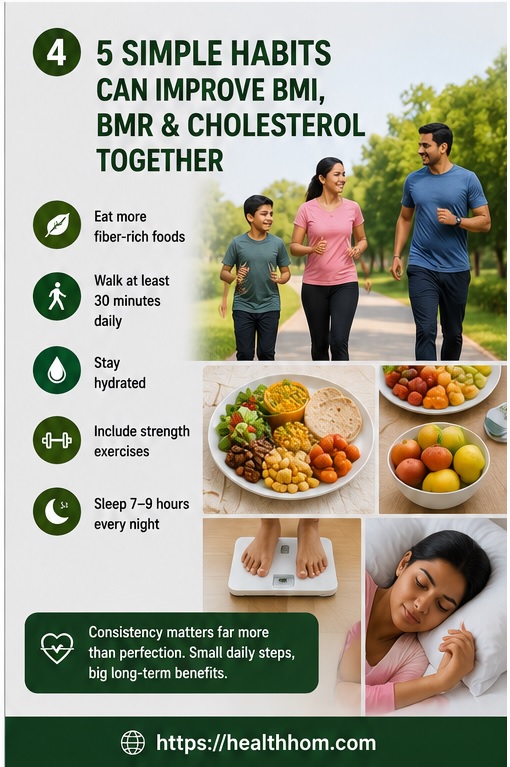
- Walk at least 30 minutes daily.
- Increase fiber-rich foods.
- Reduce sugary drinks.
- Sleep 7–9 hours.
- Include strength exercises twice weekly.
- Drink adequate water.
- Schedule annual health screenings.
Key Takeaways:
- Monitoring is important : awareness of your BMI, BMR, and cholesterol level will allow you to know the current health state of your body and exclude the presence of potential risks.
- All of them have a story behind them: BMI reflects your body weight balance, BMR displays your calorie requirements, and cholesterol amount indicates that you are healthy at heart.
- See the doctor, regularly check your weight and undergo professional consultation to make sure that you are not overweight or underweight, your metabolism is normal, your cholesterol is also normal.
- Prevention – when you are informed about your numbers, then you can make wise decisions in preventing such lifestyle diseases as diabetes, hypertension, and heart disease.
Expert Insight (By Bibhu Ranjan Mund, MPH)
During my so many years of working under public health programs throughout the Odisha state, I have observed that in many cases the lifestyle diseases are not appearing quickly. Warning signs like increasing body weight, rising cholesterol level, reduced physical activity and irregular eating habits matters a lot gradually.
The success people not doing any extra ordinary activity, they just monitor their health indicators and make required small corrections before any symptoms appear.
Prevention may not seem dramatic, but it is often the most effective healthcare strategy available.
- As per my work experience in the public health sector, it is observed that, the majority of lifestyle illnesses start silently, due to lacking proper observation of simple health indicators.
- Those who constantly monitor the BMI and the cholesterol are more likely to adopt healthy habits at an earlier age.
- Even minor life modifications such as walking daily and diets rich in fiber can make a big difference in improving the level of cholesterol in 2-3 months.
- It is always better and cheaper to prevent than to treat a chronic disease such as heart disease and diabetes.
Health Screening Timeline
| Age | Screening |
|---|---|
| 20+ | BMI yearly |
| 20+ | Cholesterol every 4–6 years |
| 40+ | Annual health screening |
| Diabetes | More frequent lipid monitoring |
Silent Indicators You Should Never Ignore
- Increasing waist size
- Persistent fatigue
- Weight gain
- Physical inactivity
- Family history of heart disease
- High blood pressure
Concluding Points
As a public health professional, I have seen that prevention can be done through proper awareness. Today’s good feeling is not said to be a good health, but it’s your body is silently warning something.
BMI, BMR and cholesterol levels are more than numbers, they are important health indicators. A little high in BMI today, a slow metabolism or just rising in cholesterol levels. These may feel a small thing, but subsequently they may lead to different serious conditions like heart disease, diabetes and hypertension.
As per the studies from the Centers for Disease Control and Prevention (CDC, 2023), it shows that a very simple day-to-day lifestyle changes like daily walking, balanced die, and regular monitoring may reduce the risk of cardiovascular up to 80%.Which means that you should focus on your future health .
Start a small habit to:
- Check your health indicators in regular intervals
- Make mindful food choices from locally available natural sources and seasonal products to be focused
- Stay active always i.e. only 30 minutes in a day matters a lot
- Focus on better sleep and stress management
In short, real health is not about costly diet or quick remedies, it’s only about consistent every single day.
Reference to my previous articles which may be read:
- Prevention of Lifestyle Diseases by Annual Checkups – protect yourself – Lovely Health Tips-2025
- 8 best ways to Improve Lifespan & Healthspan – Lovely Health Tips-2025
- 7 day plan to sleep like a baby – Lovely Health Tips-2025
- Pre pregnancy planning for female : first step to be mother – Lovely Health Tips-2025
- Precious Infancy to Toddler: A Baby’s First Two Years
References from other trusted sources which may be referred:
- Are You at a Healthy Weight?
- Obesity
- How useful is the body mass index (BMI)? – Harvard Health
- WHO Guidelines
- Healthy Weight • The Nutrition Source
- Heart-Healthy Living – Aim for a Healthy Weight | NHLBI, NIH
- Dietary treatment to lower cholesterol and triglyceride and reduce cardiovascular risk – PubMed
- Cholesterol Levels: By age, LDL, HDL, and More
- My Cholesterol Guide: Taken Action. Live Healthy!
- Body mass index (BMI)
Common Myths About BMI, BMR and Cholesterol
| Myth | Reality |
|---|---|
| Thin people never have high cholesterol | Cholesterol can be elevated at any body size |
| BMI tells everything about health | BMI is only one screening tool |
| Slow metabolism is always genetic | Lifestyle factors also influence metabolism |
| Cholesterol problems always cause symptoms | Most people have no early symptoms |
| Exercise alone can fix cholesterol | Diet and lifestyle work together |
FAQs:
Q1. What is Body Mass Index (BMI)?
BMI (Body Mass Index) is a measure that compares your weight and height to determine, if you’re underweight, healthy, overweight, or obese.
Q2. Is BMI accurate for all ages?
Yes, BMI is accurate for adults. Children and teens which needs age‑adjusted percentile charts.
Q3. Does BMI measure body fat?
No. BMI only estimates weight category, not actual fat percentage.
Q4. Can athletes use BMI?
BMI may be misleading for muscular individuals because muscle weighs more than fat.
Q5. What is Basal Metabolic Rate (BMR)?
BMR (Basal Metabolic Rate) is the number of calories your body needs to function at rest.
Q6. Why is BMR important?
It helps to calculate daily calorie needs for weight loss, muscle gain, or maintenance.
Q7. Is BMR different for men and women?
Yes. Men usually have a higher BMR due to higher muscle mass.
Q8. Normal level of Cholesterol ?
The normal range of total cholesterol level is lower than 200 mg/dl. LDL which is bad cholesterol should be less than 100mg/dl. HDL (good cholesterol):> more than 40 mg/dL in men and 50mg/dl in women. Triglycerides: less than 150mg/dl.
10 Early Warning Signs of Type 2 Diabetes: Symptoms, Risk Factors and PreventionHealthy Living Guide for Families : Nutrition, Sleep and Daily Wellness Habits10 Early Warning Signs of Type 2 Diabetes: Symptoms, Risk Factors and PreventionHealthy Living Guide for Families : Nutrition, Sleep and Daily Wellness Habits10 Early Warning Signs of Type 2 Diabetes: Symptoms, Risk Factors and PreventionHealthy Living Guide for Families : Nutrition, Sleep and Daily Wellness Habits


About the Author – “Bibhu Ranjan Mund”, Master in Public Health (MPH) from IIHMR University, Jaipur (Rajasthan) has more than 18 years of experience in Public Health activities in maternal health, child health, adolescent health, nutrition and community wellness programs under National Health Mission, Health & Family Welfare Department, Odisha. He is the founder of “Healthy Home” and translates the evidence based public health information into a practical source so that families may able to apply in everyday life. All the information are for educational purposes only and not replaces the professional medical advice. ORCID Researcher ID – 0009-0003-0158-4992. Connect LinkedIn – https://www.linkedin.com/in/bibhu-ranjan-mund-b72171358/