
Last Updated on March 22, 2026 by Bibhu Ranjan Mund, MPH
Teach mindful eating for kids with 7 fun, science-backed ways. Improve focus, digestion and healthy food habits from early childhood.
Reviewed by Bibhu Ranjan Mund, MPH (Public Health Expert) with experience in maternal, infant, child, and adolescent health programs. Content is based on evidence-informed guidelines aligned with organizations such as the World Health Organization, UNICEF, Centers for Disease Control and Prevention, and National Institutes of Health.
Last reviewed on: 22 March 2026.
Medical Disclaimer: This content is for informational and educational purposes only and is not intended as medical advice, diagnosis, or treatment. Always seek the advice of a qualified healthcare professional regarding any medical condition or concerns.
Affiliate Disclosure: This article contains affiliate links. If you purchase through these links, we may earn a small commission at no extra cost to you.
Introduction:
In the modern fast-paced society, children tend to watch television when eating or in a hurry. Mindful eating is a way of teaching kids to not hurry and identify when they are hungry and create a positive association with food.
The following are 7 easy and enjoyable methods to make mindful eating at home.
Quick Summary :
- Mindful eating creates awareness of the children on hunger and fullness signs.
- It decreases gluttony and mindless eating (such as screen-time meals).
- Stimulates higher digestion and absorptions.
- Helps reduce the picky eating habits. Helps to control emotions and decrease stress levels.
- Develops a healthy life long association with food.
- It can be practiced in the form of simple everyday habit such as slow chewing or gratitude exercises.
What is Mindful Eating?
Mindful eating is to help the children for full attention to their food, how it looks, smells, tastes and feels, while recognizing hunger without interruptions like screens.
Mindful eating implies full-focused eating. It will imply chewing more, tasting more, and paying attention to the body’s signals of hunger and fullness. It helps to make children interested in food instead of eating fast or labeling foods either as good or bad.
In one example, as you bite into a strawberry, you feel its color, smell its smell, touch its texture, chew slowly enough to receive the flavor. It is a question of living in the moment and not of eating in a routine manner.
This is contrary to distracted eating where children nibble in front of televisions, eat too quickly or stuffs their stomach until they are unusually full. Kids can then enjoy a healthy relationship with food, without feeling guilty, pressured or stressed with mindful eating.
Why Kids Need Mindful Eating?
Children are exposed to numerous fast-food advertisements, sweetened foods and they have hectic schedules, which do not allow time to enjoy relaxed and balanced meal times. The effects can be countered by means of mindful eating:
- Decreases over-eating and picky eating: Kids who become aware of their hunger markers eat until they feel full, not full and more likely to experience novel foods.
- Promotes self-control: rather than parents dictating the amount of foods to consume, children are able to know how to listen to their bodies.
- Fosters healthy lifelong habits: Mindful eating by kids will help them less likely to engage in emotional eating as they get older.
- Practices good mental health: Sitting at the table to eat mindfully reduces stress, sight and builds connections with loved ones.
- Boosts digestion and nutrition: Slow eating allows the body time to digest food, absorb nutrients and prevent stomach ills.
Aware they eat begins at an early age, as occurs as trying brushing of the teeth or tying shoes.
Research-Based Statistics
- Such studies indicate that children who have their meals with the family 3-5 times a week have improved quality of diet and reduced risk of poor eating habits.
- The research on mindful eating intervention suggests that self-regulation and emotional eating can be improved.
- Slow eating has been linked to the decrease in calorie consumption and the enhancement of awareness of satisfaction.
- Screen-free meals have been associated with better family time and eating healthier food.
7 Fun ideas of how to teach mindful eating to children:
1. Screen Free Meals:
Be tech free during eating. Disconnect the television, leave off tablets and lock out phones. This will aid in making kids concentrate on their food and talking to the family members. Parents can use a special basket where all the devices are placed at dinner when it becomes fun.
Tip: Start with one screen free meal each day, like breakfast or dinner.
2. Slow Down with Chewing Games:
Kids often eat quickly. An amusing method of getting them to slow is a teeth tester. You may ask to child that how many swallow of the chews are you going to make? Allow them plenty of time to count, to experience the different feel of food and to tell what they are tasting.
The reasons why it does: Chewing always stimulates the digestive system and teaches children to feel full.
3. Food Exploration Plates:
Rather than placing hefty dishes of fresh foods on kids dishes, place small serving exploring plates. Take small pieces of veggies, fruits or grain and ask them to explain: What color is? Is it crunchy or soft? Sweet or sour?
Why it is better: It makes it pressure free and turns food into an adventure. Children are more interested in attempting when they feel that it is discovery, not something they have to.
Learn more in our Food Supplementation Guide for Essential Nutrients : Ensuring Essential Nutrients for Better Health
4. Mindful Snacking:
Snacks are necessarily carried along with us and conscious snelling will allow children not to lose their concentration. Make them sit at the table, take small bites put on a plate and snacks.
Example: An apple snack. Tell them to pay attention to the fir or crisp sound produced by bite, the sweet flavor, the fresh juice.
Why it works: It allows to create awareness even during small meals and prevent mindless overfeeding.
Deep learning on Healthy Cooking Tips for Pregnant Women – Safe, Nutritious & Balanced Meals
5. Gratitude Ritual Before Meals:
Take 30 seconds, encourage children to express gratitude for farmers, nature and everyone involved in bringing food to the table. Spread the message to the kids to be grateful to the farmers or the sunshine or the rain or anyone who made the food reach to them.
Why it works: Gratitude can convert meals into times of sharing and connecting and valuing.
6. Cooking Together:
Children doing the cooking are more conscious of food. It incorporates the vegetable cleaning, prepping of sauces, slicing fruit and other minor food preparation jobs as well. It will increase their interest as they are involved in prepared food.
Why it works: Cooking involves all of the senses and learns the respect to food.
Learn more from our Iron Deficiency Anemia in Children (6–24 Months) – Prevention & Safe Supplementation
7. Mindful Food Journals (for Older Kids & Teens):
Older children may develop further awareness through writing a food journal. Rather than including the number of calories, describe feeling better: I felt energy after my oatmeal or That huge burger was giving me sleepiness.
Why it works: It brings up self consciousness and associates the foods with mood and energy in kids.
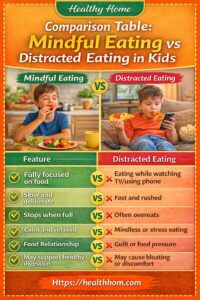
Comparison Table: Mindful Eating vs Distracted Eating in Kids
| Feature | Mindful Eating | Distracted Eating |
|---|---|---|
| Attention Level | Fully focused on food | Eating while watching TV/using phone |
| Eating Speed | Slow and deliberate | Fast and rushed |
| Hunger Awareness | Stops when full | Often overeats |
| Emotional Impact | Calm and relaxed | Mindless or stress eating |
| Food Relationship | Positive and balanced | Guilt or food pressure |
| Digestion | May support healthy digestion | May cause bloating or discomfort |
Parents’ Role in Modeling Mindful Eating:
Children are able to tell by the actions of parents more than they say. Make your kids eat mindfully: it shows the below mentioned:
- Savor slowly what you are experiencing in food.
- Never say newspapers, such as I do not want to eat and this food is bad. Talk instead of how good it tastes and make you feel.
- Share meals as a family and everyone serves himself/herself and represents when he/she is full or still hungry.
- Stay calm at the table. No rushing, no stressful moments.
Children would imitate prudent habits by parents.
Case Example: Aarav, 8 Years Old
Aarav would watch cartoons and have dinner. He also ate fast and requested his snacks in-between meals. His parents introduced:
- Screen-free dinners
- A “chew 15 times” game
- Thirty second of grace before meals.
After 4 weeks:
- When Aarav felt full, he started to become aware of this.
- He was more open to trying vegetables.
- Conversations with family meals were enhanced.
- The tendency to snack at night decreased.
This case illustrates how little careful eating habits can eventually change the eating consciousness and habits of children.
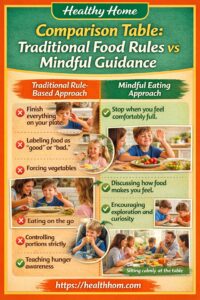
Comparison Table: Traditional Food Rules vs Mindful Guidance
| Traditional Rule-Based Approach | Mindful Eating Approach |
|---|---|
| “Finish everything on your plate.” | “Stop when you feel comfortably full.” |
| Labeling food as “good” or “bad.” | Discussing how food makes you feel. |
| Forcing vegetables | Encouraging exploration and curiosity |
| Eating on the go | Sitting calmly at the table |
| Controlling portions strictly | Teaching hunger awareness |
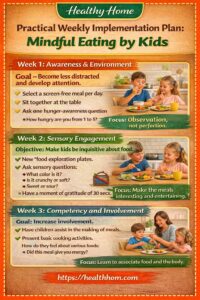
Practical Weekly Implementation Plan
This plan assists the families in slowly educating the children about mindful eating.
1. Week 1: Awareness & Environment
Goal – Become less distracted and develop attention.
- Select a screen-free meal per day.
- Sit together at the table
- Ask one hunger-awareness question
- How hungry are you from 1 to 5?
- Encourage slow and thorough chewing
Focus: Observation, not perfection.
2. Week 2: Sensory Engagement
Objective: Make kids be inquisitive about food.
- New “food exploration plates.
- Ask sensory questions:
- What color is it?
- Is it crunchy or soft?
- Sweet or sour?
- Have a moment of gratitude of 30 seconds.
Focus: Make the meals interesting and entertaining.
3. Week 3: Competency and Involvement.
Goal: Increase involvement.
- Have children assist in the making of meals.
- Present basic cooking activities.
- How do they feel about various foods:
- Did this meal give you energy?
Focus: Learn to associate food and the body.
4. Week 4: Reflection and Strengthening the Habit.
Goal: Build independence.
- Ask children not to eat until they are full enough.
- Pick up a basic food and mood journal (in older children)
- Family reflection: once in a week:
- What was different this week?
- What was enjoyable?
Focus : Consciousness and constancy.
Simple Weekly Tracker
| Practice | Mon | Tue | Wed | Thu | Fri | Sat | Sun |
|---|---|---|---|---|---|---|---|
| Screen-Free Meal | ✓ | ✓ | ✓ | ✓ | ✓ | ||
| Slow Chewing | ✓ | ✓ | ✓ | ✓ | |||
| Gratitude Pause | ✓ | ✓ | ✓ |
Benefits Summary Table
| Benefit | How It Helps Kids |
|---|---|
| Better digestion | Slower eating supports gut comfort |
| Reduced overeating | Awareness of fullness signals |
| Improved focus | Less distraction during meals |
| Emotional balance | Reduces stress-related eating |
| Family bonding | Shared conversations at table |
Common Pitfalls to Avoid:
Parents also have the ability of coming up with negative thoughts about food without intending to do so. These are some of the pitfalls to be avoided:
- Since children are made to clear the entire food on their plate, this educates them to believe the food they fed on is more important than the fullness they get.
- Excess control of the decisions may lead to defiance in the future.
- Having food on the move, like in the motor car or when standing, deprives food of its relaxation and reflection.
Instead, it is preferable to gentle guidance, patience and optimistic environment.
Concluding points:
Being mindful to eat is not a dietary program, rather it is life skill training. Parents provide their children with a tool, which will assist both mind and body because of teaching them to slow down, listen and value food. Research suggests mindful eating may support healthier long-term eating behaviors, confidence in their choice of food and family relationships.
Start small: one mindful meal, one gratitude ritual, or one chewing game at a time. Small habits create meaningful changes over time, over weeks and months. At this, one to keep in mind is the aim of not achieving perfection but actually being aware.
When we change the aspect of our attention to mealtime by focusing on being there, we are feeding the future not only parent and child but also solely our own children.
Did You Know?
Children who regularly eat meals with their families tend to have better diet quality and stronger emotional well-being.
Related Health Articles from Healthy Home :
- Healthy Lunch Box Ideas for Kids – Easy & Nutritious Recipes
- Choline-Rich Foods List – Brain & Child Development Guide
- What is a Balanced Daily Meal Plan? Complete Beginner Guide
- From Infancy to Toddlerhood – Key Milestones & Healthy Development Tips
- Supplementary Feeding for Infants – When, What & How to Start Safely
Trusted References and Research Sources:
- How to practice mindful eating | Harvard T.H. Chan School of Public Health
- Mindful Eating Behaviors and Their Impact on Emotional & Physical Health – Comprehensive Review (PMC)
- Mindful Eating – Evidence-Based Guide from Harvard School of Public Health
- Mindful Eating Intervention for Healthy Food Habits in Children – Pilot Study (ResearchGate)
- Mindful Eating Guide – How to Eat With Awareness and Reduce Overeating (Healthline)
- Mindfulness-Based Eating Strategies for Nutrition Health – ScienceDirect Review
- Mindful Eating and Its Relationship to Stress, Diet Quality & Behavioral Health – Clinical Findings (PMC)
- Development of a School-Based Mindful Eating Program for Children and Parents – ResearchGate Evidence
- Eating_Intervention_Program_among_Third_Through_Fifth_Grade_Elementary_School_Children_and_Their_Parents
- Harvard Nutrition Source – Trusted Resource on Healthy Eating & Lifestyle Science
FAQs:
For more detail, please visit to my website as mentioned below:


About the Author – “Bibhu Ranjan Mund”, Master in Public Health (MPH) from IIHMR University, Jaipur (Rajasthan- IHMR-U/12/2021 -23/0015) has experience of 18 years in Public Health activities like maternal health, child health, adolescent health, nutrition and community wellness programs. Through “Healthy Home”, he shares evidence-based health and wellness guidance designed to support families in making informed lifestyle decisions. This content is for educational purposes only and does not replace professional medical advice. Connect LinkedIn – https://www.linkedin.com/in/bibhu-ranjan-mund-b72171358/