
Last Updated on March 22, 2026 by Bibhu Ranjan Mund, MPH
Understand important Early Childhood Development of children between 2-30 months. Recognize the signs of delay and encourage the development of your child with easy and tips of experts.
Reviewed by Bibhu Ranjan Mund, MPH (Public Health Expert) with experience in maternal, infant, child, and adolescent health programs. Content is based on evidence-informed guidelines aligned with organizations such as the World Health Organization, UNICEF, Centers for Disease Control and Prevention, and National Institutes of Health.
Last reviewed on: 22 March 2026.
Medical Disclaimer: This content is for informational and educational purposes only and is not intended as medical advice, diagnosis, or treatment. Always seek the advice of a qualified healthcare professional regarding any medical condition or concerns.
Affiliate Disclosure: This article contains affiliate links. If you purchase through these links, we may earn a small commission at no extra cost to you.
Introduction:
The initial 3 years of life of the child puts forward all the speedy exciting developments. Every month learns new skills of smiling, rolling, walking and talking. Knowing these milestones allows parents to determine a normal development and know the signs of early delays.
This article provides each of the key milestones within the 2 months to 30 months in a straightforward and simple to follow format complying to the international child-development standards.
Global Early Childhood Development Statistics
- Around 250 million children in low- and middle-income countries are at risk of not reaching developmental potential (Source: WHO & UNICEF, 2023)
- Nearly 80% of brain development occurs before age 3 (Source: Harvard Center on the Developing Child, 2022)
- Early stimulation can improve cognitive outcomes by up to 20–25 (Source: Lancet Early Childhood Series, 2017)
Quick Summary:
- First smile → 2–3 months
- Sitting → 6–9 months
- Walking → 12–18 months
- Talking → 18–24 months
A. Early Childhood Development : (2-30 months old)
(If you notice consistent delays in these areas, consider discussing them with a qualified pediatric professional):
- By three months, the child keeps his or her hands open and relaxed most of the time, elevates his or her head briefly when lying face down, and movements both arms and both legs freely and evenly when awake or agitated.
- If you speak, the child will react, become alarmed by loud sounds or notice new noises by either smiling or getting quiet.
- At this stage, a child observes the one who takes care of him/her and tries to speak in other sounds other than crying.
- Sucks and swallows properly while feeding, meaning there is no choking.
- From this point, your baby smiles happily at you because they sense your happiness.

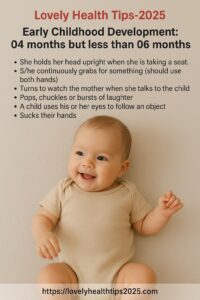
B. 04 – 06 months
- She holds her head upright when she is taking a seat.
- She or he continuously grabs for something (should use both hands).
- Turns to watch the mother when she talks to the child.
- Pops, chuckles or bursts of laughter.
- A child uses his or her eyes to follow an object.
- Sucks their hands.
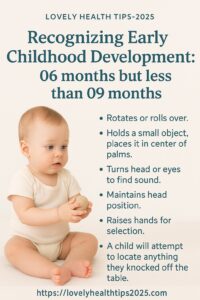
C. 06-09 months
- Either way, the child rotates or rolls over.
- Holding a small object, the child uses both hands and places it right in the center of their palms.
- When you whisper behind them, the child will turn his or her head or eyes to find the source of the voice. Responding consonants viz. p, b, m etc.
- When a baby is in front of the television or playing with toys, that baby maintains his head in the same position.
- The child raises their hands for the parents to select them.
- A child will attempt to locate anything they knocked off the table.
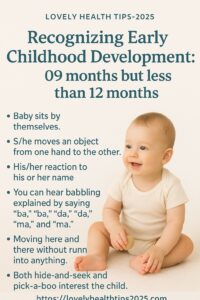
D. 09 – 12 months
1. Baby sits by themselves.
2. She or he moves an object from one hand to the other.
3. His or her reaction to his or her name
4. You can hear babbling explained by saying “ba,” “ba,” “da,” “da,” “ma,” and “ma.”
5. Moving here and there without running into anything.
6. Both hide-and-seek and pick-a-boo interest the child.
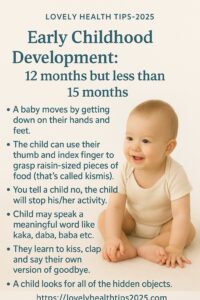
E. 12 – 15 months
- A baby moves by getting down on their hands and feet.
- The child can use their thumb and index finger to grasp raisin-sized pieces of food (that’s called kismis).
- You tell a child no, the child will stop his or her activity.
- Child may speak a meaningful word like kaka, daba, baba etc.
- They learn to kiss, clap and say their own version of goodbye.
- The offspring produce cries due to being carried by new people.
- A child looks for all of the hidden objects.
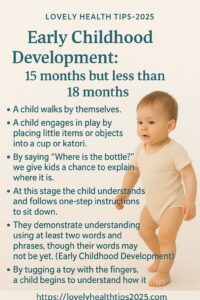
F. 1 5 – 18 months
- A child walks by themselves.
- A child engages in play by placing little items or objects into a cup or katori.
- By saying “Where is the bottle?” we give kids a chance to explain where it is.
- At this stage the child understands and follows one-step instructions to sit down.
- They demonstrate understanding using at least two words and phrases, though their words may not be yet. (Early Childhood Development)
- By tugging a toy with the fingers, a child begins to understand how it works.
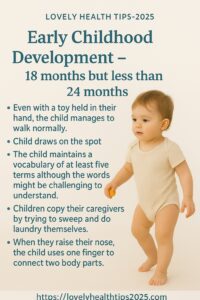
G. 18 – 24 months
- Even with a toy held in their hand, the child manages to walk normally.
- Child draws on the spot
- The child maintains a vocabulary of at least five terms although the words might be challenging to understand.
- Children copy their caregivers by trying to sweep and do laundry themselves.
- When they raise their nose, the child uses one finger to connect two body parts.
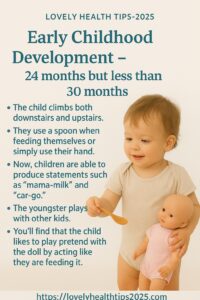
H. 24 – 30 months
- The child climbs both downstairs and upstairs.
- They use a spoon when feeding themselves or simply use their hand.
- Now, children are able to produce statements such as “mama-milk” and “car-go.”
- The youngster plays with other kids.
- You’ll find that the child likes to play pretend with the doll by acting like they are feeding it.
When should parents consult any Medical Professional?
- Is not responding to sounds
- Appears to be too hard or too soft.
- Does not smile by 3 months
- Cannot sit by 9 months
- Silent 15-18 months.
- Gives up doing things that he or she did
Early intervention is a result of the identification of any problem and able to solve this.
Developmental Milestones by Domain (2–30 Months)
| Age Range | Gross Motor | Fine Motor | Language | Social & Emotional | Cognitive |
|---|---|---|---|---|---|
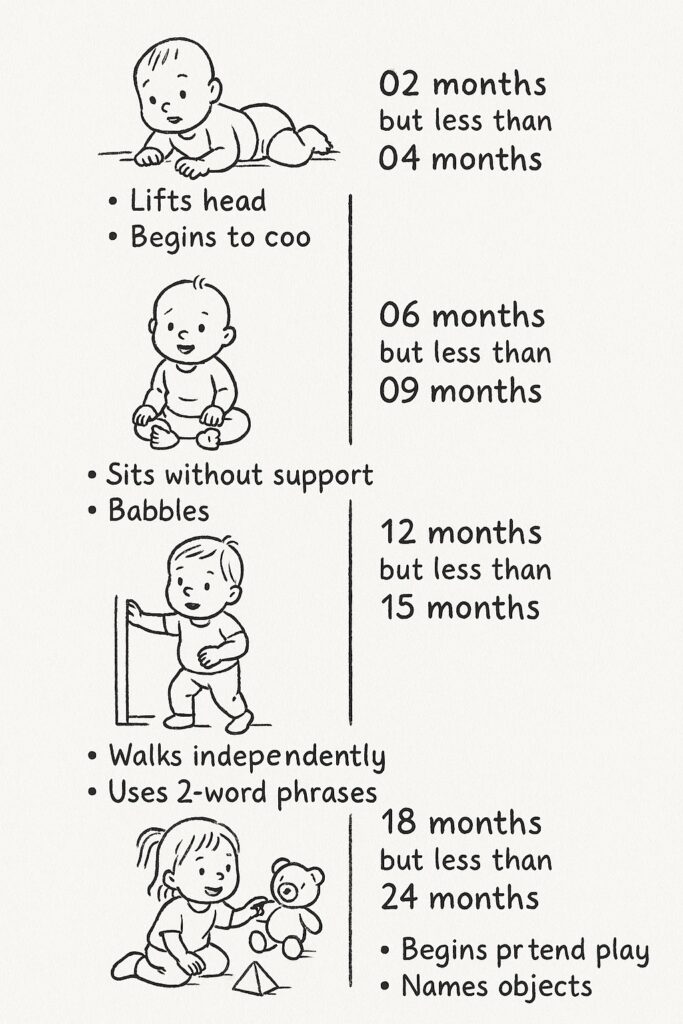
| 2–3 Months | Lifts head briefly | Hands open | Coos | Smiles socially | Recognizes caregiver |
| 4–6 Months | Rolls over | Reaches objects | Laughs | Responds to voice | Tracks objects |
| 6–9 Months | Sits with support | Transfers objects | Babbling (ba/da) | Stranger anxiety | Looks for dropped objects |
| 9–12 Months | Sits alone | Pincer grasp begins | Responds to name | Plays peek-a-boo | Object permanence |
| 12–15 Months | Crawls/stands | Picks small items | 1–2 words | Imitates actions | Follows simple commands |
| 15–18 Months | Walks independently | Stacks objects | 5–10 words | Shows affection | Understands instructions |
| 18–24 Months | Runs, climbs | Scribbles | 2-word phrases | Parallel play | Identifies body parts |
| 24–30 Months | Walks stairs | Uses spoon | Simple sentences | Pretend play | Simple problem solving |
5 Domains of Early Childhood Development
- Gross Motor (sitting, walking)
- Fine Motor (grasping, scribbling)
- Language (babbling, words)
- Social-Emotional (smiling, bonding)
- Cognitive (problem solving, memory)
Milestone Red Flags vs Normal Variation
| Age | Normal Variation | Possible Concern |
|---|---|---|
| 6 months | Slight delay in rolling | No movement at all |
| 12 months | Limited words | No babbling |
| 18 months | Few words | No single words |
| 24 months | Short phrases | No 2-word phrases |
Source: CDC Developmental Milestones, 2023
Warning Signs by Age
| Age | Concerning Sign |
|---|---|
| 3 Months | No social smile |
| 6 Months | Cannot roll |
| 9 Months | Cannot sit |
| 12 Months | No babbling |
| 18 Months | No single words |
| 24 Months | No 2-word phrases |
| Any Age | Loss of previously acquired skills |
Growth vs Development Comparison Table
| Growth | Development |
|---|---|
| Physical increase in size | Skill acquisition |
| Measured in height/weight | Measured in milestones |
| Quantitative | Qualitative |
Nutrition Impact
| Nutrient | Function | Food Sources |
|---|---|---|
| Iron | Supports brain oxygenation | Spinach, lentils |
| DHA | Brain structure | Fish, walnuts |
| Iodine | Thyroid + brain | Iodized salt |
| Protein | Growth | Eggs, pulses |
Source: WHO Infant Nutrition Guidelines, 2023
FAQs:
Related Health Articles from Healthy Home:
- Danger Signs of Baby for Developmental Delay at 3 Months – Parenting Tips
Learn to identify early developmental delay signs in infants and support your baby’s growth with practical parenting advice. - First Day of Birth – Essential Newborn Care Guide
Explore what happens on your baby’s first day of life, including crucial newborn care tips, bonding, and feeding guidance. - Why Is a Human Child So Unique – What Makes Us Truly Human?
Understand the fascinating aspects that make human children unique, from emotional intelligence to brain development and social learning.
Trusted References and Research Sources:
- WHO Report on Improving Early Childhood Development (PDF) – A comprehensive WHO report highlighting key global strategies to enhance early childhood growth and developmental outcomes.
- WHO – Nurturing Care Framework for Early Childhood Development – Learn about WHO’s global framework promoting nurturing care from birth to age 8 for optimal child development.
- Harvard Center on the Developing Child – Science of Early Childhood Development (PDF) – Explore scientific insights into how early experiences shape brain architecture and lifelong learning capacity.
- UNICEF – Early Childhood Development Programs and Policies – UNICEF’s global approach to nurturing care, learning, and protection in the first years of life.
- Harvard Graduate School of Education – Nurturing Relationships in Early Childhood – Understand how caregiver relationships shape emotional and cognitive development in early years.
- UNESCO Report – Early Childhood Care and Education (ECCE) – Insights into global policy initiatives for early learning and care systems.
- UNICEF Programme Guidance for Early Childhood Development (PDF) – Practical guide for implementing UNICEF’s early childhood initiatives globally.
For more detail, please visit to my website as mentioned below:


About the Author – “Mr. Bibhu Ranjan Mund”, Master in Public Health (MPH) from IIHMR University, Jaipur (Rajasthan- IHMR-U/12/2021 -23/0015) has experience of 18 years in Public Health activities like maternal health, child health, adolescent health, nutrition and community wellness programs. Through “Healthy Home”, he shares evidence-based health and wellness guidance designed to support families in making informed lifestyle decisions. This content is for educational purposes only and does not replace professional medical advice. Connect LinkedIn – https://www.linkedin.com/in/bibhu-ranjan-mund-b72171358/
Reviewed by Public Health Expert (MPH)