Last Updated on March 28, 2026 by Bibhu Ranjan Mund, MPH
Reviewed by Bibhu Ranjan Mund, MPH (Public Health Expert) with experience in maternal, infant, child, and adolescent health programs. Content is based on evidence-informed guidelines aligned with organizations such as the World Health Organization, UNICEF, Centers for Disease Control and Prevention, and National Institutes of Health.
Last reviewed on: 22 March 2026.
Medical Disclaimer: This content is for informational and educational purposes only and is not intended as medical advice, diagnosis, or treatment. Always seek the advice of a qualified healthcare professional regarding any medical condition or concerns.
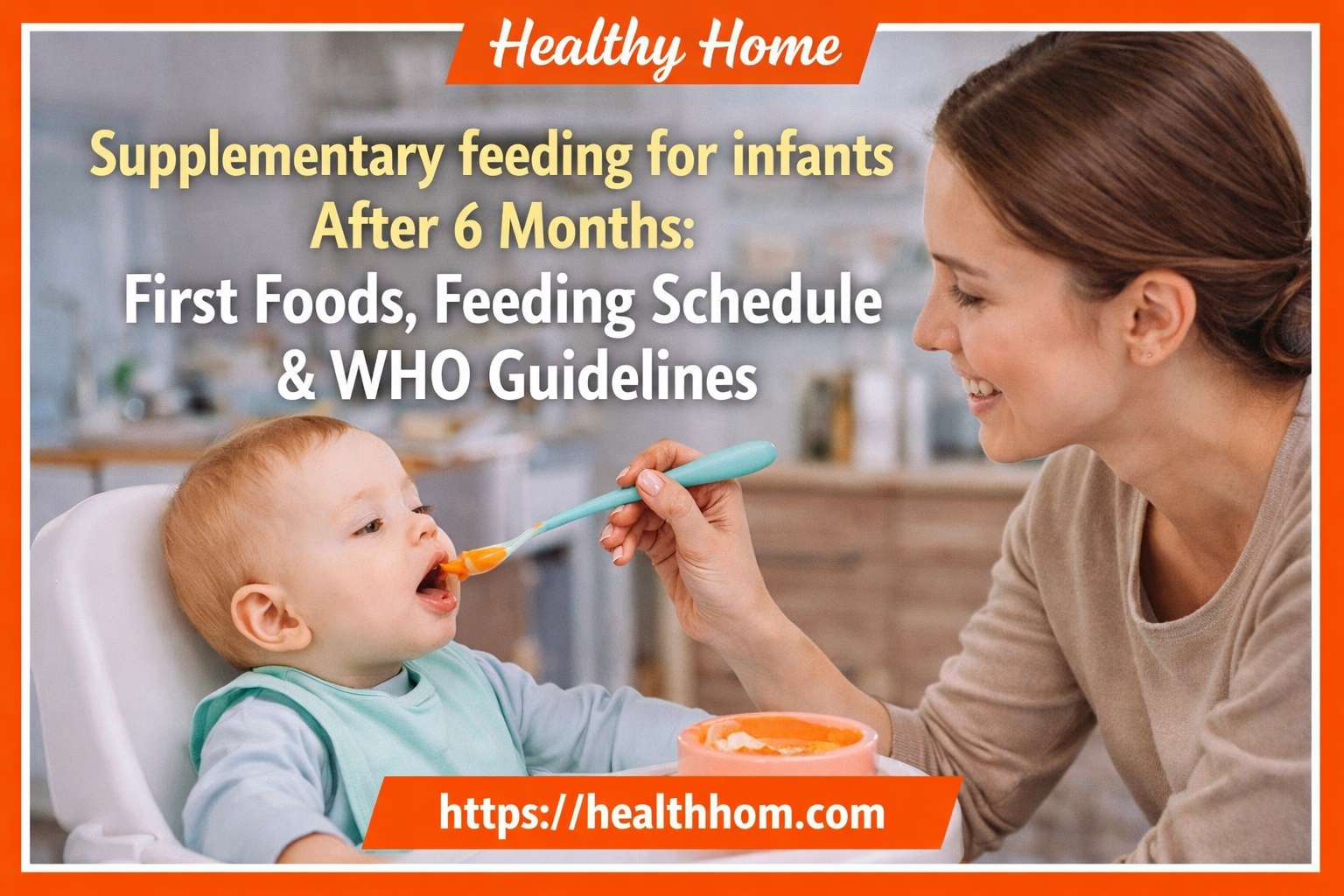
Supplementary feeding for infants : During a baby’s growth, they require food in addition to breast milk; therefore, introducing complementary foods at this stage is essential. Starting after 6 months, a baby requires semi-solid foods alongside breastfeeding to support healthy growth, brain development, and immune function.
The breast milk has all the necessary nutrients that an infant needs within the first six months of his or her life. As babies however develop though, their nutritional needs become more and more. After approximately half a year of age, breast milk is no longer adequate to support the increasing energy, iron and other nutrient requirements.
This is where complementary foods also referred to as complementary feeding comes in. It entails the introduction of safe, nutritious solid and semi-solid foods while continuing breastfeeding, which may help support optimal growth, brain development and immunity, brain development and immunity.
Proper nutrition in early life is critical for growth—learn more in our detailed guide on early childhood development and milestones.
Nutritional Needs After 6 Months
| Nutrient | Why It Becomes Important After 6 Months | Common Complementary Food Sources |
|---|---|---|
| Iron | Supports oxygen transport and normal development | Lentils, fortified cereals, mashed beans |
| Zinc | Supports growth and immune function | Meat, legumes, whole grains |
| Energy | Babies become more active and need more calories | Rice porridge, mashed potatoes |
| Protein | Helps tissue growth | Eggs, lentils, yogurt |
| Vitamin A | Supports vision and immune health | Carrots, pumpkin, sweet potato |
What Is Supplementary Feeding for Infants?
Supplementary feeding can be described as a slow introduction of solids or semi-solids beyond six months of age but at the same time breastfeeding up to two years or more as suggested by the World Health Organization (WHO).
The foods are supplementary to breast milk and can be used to fill any nutritional deficiencies at a very critical stage of infant development.
Comparison Table: Breastfeeding vs Complementary Feeding
| Feature | Exclusive Breastfeeding (0–6 Months) | Complementary Feeding (After 6 Months) |
|---|---|---|
| Main nutrition source | Breast milk only | Breast milk + solid/semi-solid foods |
| Nutritional sufficiency | Meets most nutrient needs | Additional nutrients required |
| Feeding frequency | On demand | Structured meals + breastfeeding |
| Food texture | Liquid | Semi-solid → solid gradually |
| Development role | Supports immunity and bonding | Supports chewing and eating skills |
Source: WHO Infant and Young Child Feeding Framework 2023
The Importance of Complementary foods After 6 months
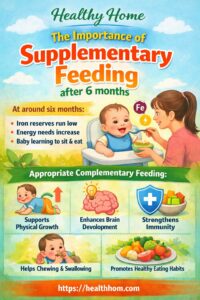
At around six months:
- Iron reserves since birth start to run out.
- Energy needs increase
- Babies learn how to sit with assistance and ingest food.
Appropriate complementary feeding:
- Supports physical growth
- Enhances brain development
- Strengthens immunity
- Helps acquire chewing and swallowing.
- Promotes healthy eating habit at an early age.
Global Statistics Table: Complementary Feeding
| Indicator | Global Estimate | Source |
|---|---|---|
| Infants receiving complementary foods at 6–8 months | ~72% worldwide | UNICEF Infant Feeding Report |
| Children meeting minimum dietary diversity | ~29% | UNICEF Global Nutrition Report |
| Children meeting minimum acceptable diet | ~18% | WHO Infant Feeding Indicators |
| Exclusive breastfeeding under 6 months | ~48% globally | WHO Global Health Observatory |
Sources:
WHO Global Health Observatory 2023 and UNICEF Infant and Young Child Feeding Report 2021
A balanced diet during infancy helps prevent malnutrition later—read our child nutrition and development guide.
WHO-Recommended Feeding Schedule by Age
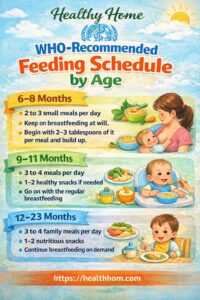
6–8 Months
- 2 to 3 small meals per day
- Keep on breast feeding at will.
- Begin with 2 -3 tablespoons of it per meal and build up.
Iron deficiency can affect growth and brain development—explore our iron deficiency anemia complete guide
9–11 Months
- 3 to 4 meals per day
- 1–2 healthy snacks if needed
- Go on with the regular breastfeeding
12–23 Months
- 3 to 4 family meals per day
- 1–2 nutritious snacks
- Continue breastfeeding on demand
Feeding Frequency Table by Age
| Age of Child | Meals per Day | Snacks | Breastfeeding |
|---|---|---|---|
| 6–8 months | 2–3 meals | Optional | Continue on demand |
| 9–11 months | 3–4 meals | 1–2 snacks | Continue breastfeeding |
| 12–23 months | 3–4 family meals | 1–2 snacks | Continue breastfeeding |
Source: WHO Complementary Feeding Guidelines 2023
Structured feeding supports growth—also read our infancy to toddler development guide for stage-wise care.
Food Texture and Consistency as a Function of Age
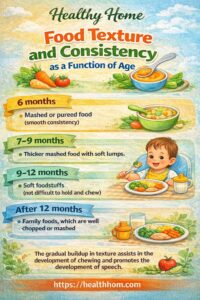
- 6 months: Mashed or pureed food (smooth consistency)
- 7-9 months thicker mashed food with soft lumps.
- 9-12 months: soft foodstuffs (not difficult to hold and chew)
- After 12 months: Family foods, which are well chopped or mashed.
The gradual buildup in texture assists in the development of chewing and promotes the development of speech.
Age vs Food Texture
| Age | Recommended Texture | Example Foods |
|---|---|---|
| 6 months | Smooth puree | Mashed pumpkin, rice porridge |
| 7–8 months | Thick mashed food | Mashed vegetables, lentils |
| 9–11 months | Soft finger foods | Soft fruits, cooked vegetables |
| 12+ months | Chopped family foods | Rice, vegetables, eggs |
Source: UNICEF Complementary Feeding Guidance 2020
Best Foods to Start With
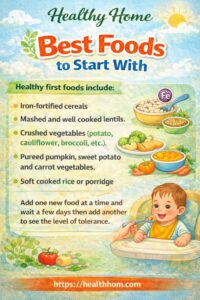
Healthy first foods include::
- Iron-fortified cereals
- Mashed and well cooked lentils.
- Crushed vegetables (potato, cauliflower, broccoli, etc.)
- Pureed pumpkin, sweet potato and carrot vegetables.
- Soft cooked rice or porridge
Add one new food at a time and wait a few days then add another to see the level of tolerance.
Choosing the right foods is essential—see our right food supplementation for babies after 6 months guide
Best First Foods for Babies
| Food | Key Nutrient | Texture |
|---|---|---|
| Rice porridge | Energy | Smooth |
| Lentil puree | Protein | Mashed |
| Sweet potato | Vitamin A | Soft mashed |
| Banana | Potassium | Mashed |
| Cooked egg yolk | Protein | Soft mashed |
Source: National Health Mission Maa Programme 2019
Hygiene and Food Safety Regulations
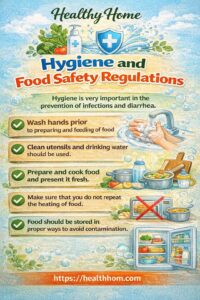
- Wash hands prior to preparing and feeding of food.
- Clean utensils and drinking water should be used.
- Prepare and cook food and present it fresh.
- Make sure that you do not repeat the heating of food.
- Food should be stored in proper ways to avoid contamination.
Hygiene is very important in the prevention of infections and diarrhea.
Food Safety Checklist
| Food Safety Practice | Why It Matters |
|---|---|
| Wash hands before feeding | Reduces contamination |
| Use clean utensils | Prevents infections |
| Cook food thoroughly | Improves digestibility |
| Serve freshly prepared food | Maintains food safety |
| Store food properly | Prevents bacterial growth |
Source: WHO Food Safety Guidelines 2022
Safe and Pleasant Feeding
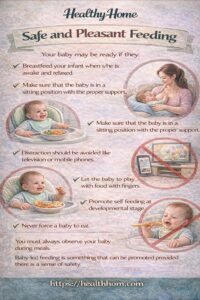
- Breastfeed your infant when s/he is awake and relaxed.
- Make sure that the baby is in a sitting position with the proper support.
- Distraction should be avoided like television or mobile phones.
- Let the baby to play with food with fingers.
- Promote self feeding at developmental stage.
- Never force a baby to eat
- You must always observe your baby during meals.
Baby-led feeding is something that can be promoted provided there is a sense of safety.
Foods to Avoid for Infants
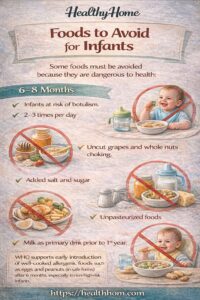
Some foods must be avoided because they are dangerous to health:
- Honey: Infants at risk of botulism.
- Uncut grapes and whole nuts: choking.
- Added salt and sugar
- Highly spicy or fried foods
- Unpasteurized foods
- Milk as primary drink prior to 1 st year.
Eggs to be given to infants should be cooked properly.
WHO supports early introduction of well-cooked allergenic foods such as eggs and peanuts (in safe forms) after 6 months, especially in non-high-risk infants.
Comparison Table: Safe vs Unsafe Foods
| Safe Foods | Foods to Avoid | Reason |
|---|---|---|
| Mashed vegetables | Honey | Risk for infants |
| Soft fruits | Whole nuts | Choking hazard |
| Cooked eggs | Raw eggs | Food safety concern |
| Plain porridge | Sugary foods | Not recommended for infants |
Source: WHO Complementary Feeding Recommendations 2023
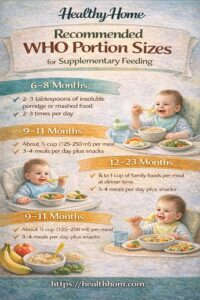
Recommended WHO Portion Sizes
6–8 Months
- 2-3 tablespoons of insoluble porridge or mashed food.
- 2–3 times per day
9–11 Months
- About ½ cup (125–250 ml) per meal
- 3–4 meals per day plus snacks
12–23 Months
- ¾ to 1 cup of family foods per meal at dinner-time.
- 3–4 meals per day plus snacks
Portion Size Table
| Age | Portion Size | Feeding Frequency |
|---|---|---|
| 6–8 months | 2–3 tablespoons per meal | 2–3 times/day |
| 9–11 months | ½ cup per meal | 3–4 meals/day |
| 12–23 months | ¾–1 cup per meal | 3–4 meals/day |
Source: WHO Infant Feeding Guide 2023
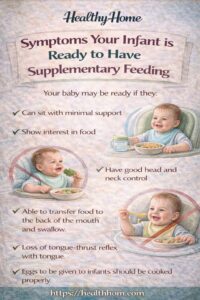
Symptoms Your Infant Is Ready for Complementary Foods
Your baby may be ready if they:
- Can sit with minimal support
- Show interest in food
- Have good head and neck control
- Able to transfer food to the back of the mouth and swallow.
- Loss of tongue-thrust reflex with tongue.
Development Signs Table
| Development Sign | What It Indicates |
|---|---|
| Can sit with support | Improved posture control |
| Shows interest in food | Readiness to explore eating |
| Good head control | Safe swallowing ability |
| Reduced tongue-thrust reflex | Ability to accept solids |
Source: UNICEF Infant Feeding Recommendations 2020
FAQs :
Related Health Articles from Healthy Home:
- Basic Infant Care: Discover How to Take Care of Your Baby
https://healthhom.com/basic-infant-care-discover-how-to-take-care-of-your-baby/ - Pre-Pregnancy Planning for Women: A Complete Health Guide
https://healthhom.com/pre-pregnancy-planning-for-women/ - Precious Infancy to Toddlerhood: Growth, Care & Development
https://healthhom.com/precious-infancy-to-toddler/ - Early Childhood Development: Stages, Milestones & Care Tips
https://healthhom.com/early-childhood-development/ - Child Vaccination: Importance, Schedule & Benefits
https://healthhom.com/child-vaccination-schedule-india/
Trusted References and Research Sources:
- WHO – Complementary Feeding Guidelines Source:
https://www.who.int/publications/i/item/9789240081864 - NCBI Bookshelf – Infant and Young Child Feeding Source:
https://www.ncbi.nlm.nih.gov/books/NBK148957/ - National Health Mission (NHM) – Maa Programme Trainer’s Guide Source:
https://nhm.gov.in/New_Updates_2018/NHM_Components/RMNCHA/CH/Schemes/Maa/TRAINERS’_GUIDE_FINAL_Web.pdf - UNICEF – Complementary Feeding Guidance 2020 Source:
https://www.unicef.org/media/93981/file/Complementary-Feeding-Guidance-2020.pdf - Oxford Academic (Nutrition Reviews) – Complementary Feeding Research Source:
https://academic.oup.com/nutritionreviews/article/79/8/825/6158336 - The Lancet Global Health – Infant Nutrition Study Source:
https://www.thelancet.com/journals/langlo/article/PIIS2214-109X(17)30074-8/fulltext - NCBI Bookshelf – Complementary Feeding and Nutrition Source:
https://www.ncbi.nlm.nih.gov/books/NBK596415/
For more detail, please visit to my website as mentioned below:


About the Author – “Bibhu Ranjan Mund”, Master in Public Health (MPH) from IIHMR University, Jaipur (Rajasthan- IHMR-U/12/2021 -23/0015) has experience of 18 years in Public Health activities like maternal health, child health, adolescent health, nutrition and community wellness programs. Through “Healthy Home”, he shares evidence-based health and wellness guidance designed to support families in making informed lifestyle decisions. This content is for educational purposes only and does not replace professional medical advice. Connect LinkedIn – https://www.linkedin.com/in/bibhu-ranjan-mund-b72171358/