Last Updated on March 22, 2026 by Bibhu Ranjan Mund, MPH
Learn how teenage mindfulness and ADHD helps to improve focus, emotional control & school performance. Science-backed strategies for parents & teachers.
Reviewed by Bibhu Ranjan Mund, MPH (Public Health Expert) with experience in maternal, infant, child, and adolescent health programs. Content is based on evidence-informed guidelines aligned with organizations such as the World Health Organization, UNICEF, Centers for Disease Control and Prevention, and National Institutes of Health.
Last reviewed on: 22 March 2026.
Medical Disclaimer: This content is for informational and educational purposes only and is not intended as medical advice, diagnosis, or treatment. Always seek the advice of a qualified healthcare professional regarding any medical condition or concerns.
Affiliate Disclosure: This article contains affiliate links. If you purchase through these links, we may earn a small commission at no extra cost to you.
Introduction for Teenage Mindfulness and ADHD:
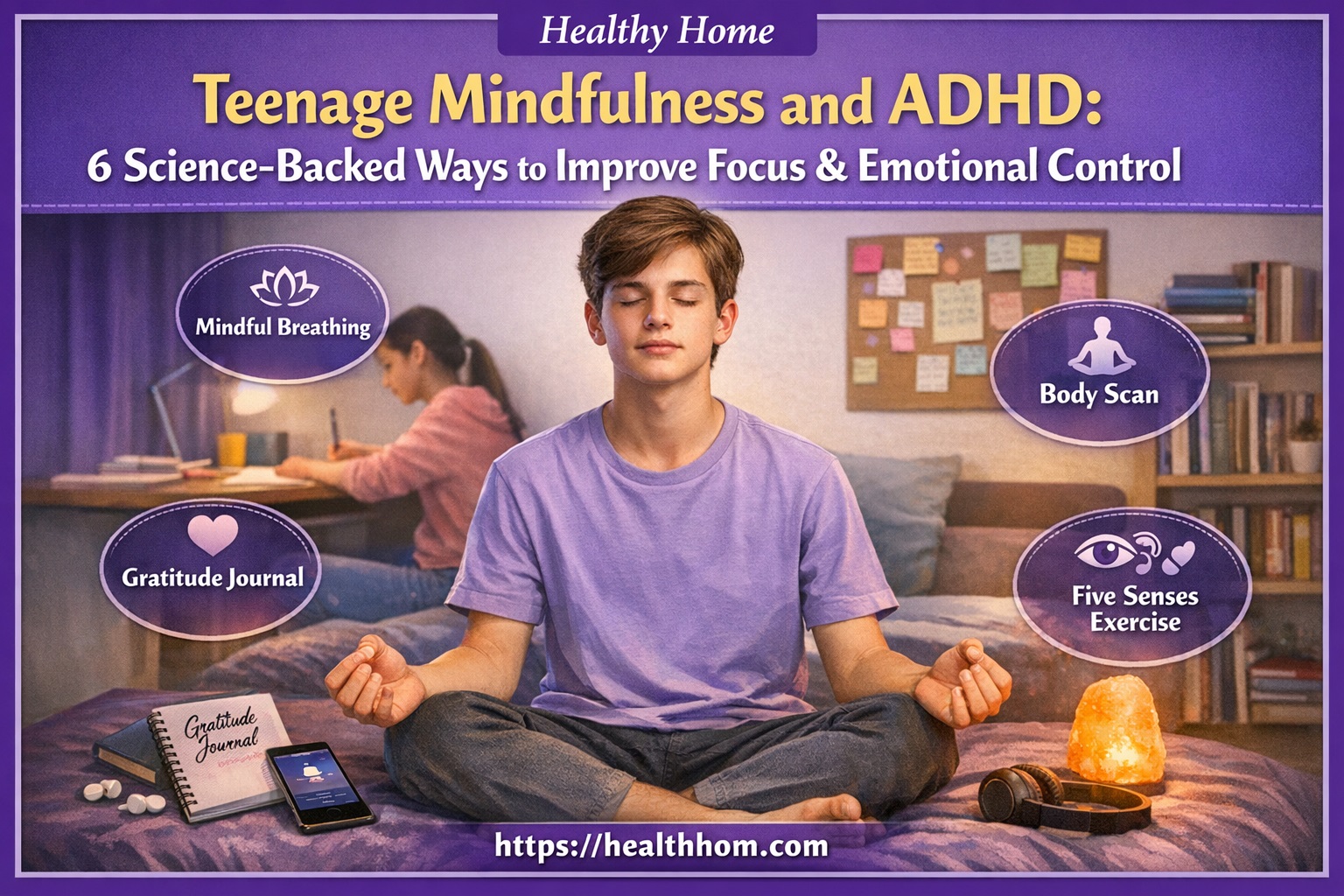
As the world is rapidly developing, adolescents have to endure numerous problems that influence their mental health. These problems may be even more pressing to the teenagers living with Attention Deficit Hyperactivity Disorder (ADHD). It influences attention, self control as well as time management. Mindfulness is becoming a very strong, viable method that can take teens with ADHD to new levels of focus, emotional control and self-discovery.
How Does Mindfulness Help Teenagers with ADHD? Mindfulness helps teenagers with ADHD to improve focus, emotional regulation, impulse control and stress management through consistent present-moment awareness practices.
Quick Summary :
- ADHD affects attention, impulse control and emotional regulation in adolescents.
- Mindfulness assists in enhancing concentration and minimizing emotional responsiveness.
- Attention control can be enhanced by brief daily sessions (5-10 minutes).
- Some of the techniques include body scan, gratitude journal, mindful breathing and sensory grounding.
- Continuous practice can be supported by schools and parents.
- Mindfulness is not a substitute technique, but it is a supportive mechanism.
- The self-awareness, confidence and resilience are developed during long-term practice.
Key Statistics:
- ADHD occurs in about 5-7 percent of children and adolescents in the whole world.
- Boys are more often diagnosed as compared to girls whereas girls are underdiagnosed.
- Research indicates that mindfulness-based interventions can produce moderate effects of attention and emotional regulation on adolescents with ADHD.
- According to research reviews, mindfulness has the potential to decrease the level of impulsivity and stress in cases of continuous practice over 6 to 8 weeks.
- Improved emotional regulation is one of the strongest observed benefits.
What does ADHD mean?
ADHD is the neuro-developmental disorder with childhood onset and common persistence through childhood to adolescence and adulthood. They might find it hard to remain committed, sit at the same location or complete tasks, they also might not be able to control their emotions. It is not the matter of laziness or un-motivated attitude, it is the brain problem that influences the executive functioning abilities.
The symptoms may be:
- Inattention (careless or unable to complete tasks or work)
- Reckless (thoughtless) behavior — With or without a sense of freedom or license to do as they please (being free to do anything)
- Hyperactivity (surplus energy or inability to sit down and keep still)
These symptoms may disrupt the school performance and association and self-esteem.
What is the Mindfulness?
Mindfulness refers to an ability of focusing on the present moment being non judgmental. It is considered as a fully conscious way of being in touch with your thoughts, feelings, body sensations and the world around you thoroughly and calmly and acceptingly.
It teaches the brain to take its time, pay attention and act wisely instead of being reactive. It is not the process of coming to be in a perfectly calm and centered state of mind in a night but learning to observe and accept whatever one is going through at a particular moment.
Why the ADHD Mindfulness Works?
Mindfulness focuses on the main zones of difficulties of teenagers with ADHD:
- Better Attention: Mindfulness exercise enhances the power of the brain to pay attention and ignore distractions.
- Emotional Regulation: Teens will learn to be aware of their emotions and be able to identify their feelings which will enable a teen respond less emotionally to frustration, anxiety or anger.
- Impulse Control: Mindfulness works like a time out that helps to take actions better.
- Less Stress: The practice of mindful breathing as well as the concept of getting grounded means that there is a reduced stress factor that may cause or exacerbate the ADHD symptoms.
- Self-Acceptance: Being mindful leads to the feeling of self-compassion, which eliminates growling.
Learn more on : 5 Minute Mindfulness Exercise for Kids & Teens (Easy & Effective)
ADHD Techniques of Mindfulness Among Teens:
The following are some of the easy and productive mindfulness exercises:
1. Mindful Breathing:
The teenagers are able to lie down or sit and easily concentrate on their breathing, the ebbing of the air in and out through the nose or the stomach. And when thoughts appear (thought they will) considerately bring the mind back to the breath.
It is recommended to begin with 1–3 minutes and slowly work your way to ten minutes.
2. Body Scan:
- You can lie, sit or stand in a way that is most comfortable.
- Pay attention to each and every part of your body, the head to the toes.
- Take note of any tightness or pains, push or do not force any part of your body.
- Scan about several times a day.
Read our guide on : Mindful Eating for Kids : 7 fun & Science-Backed ways
3. Mindful Movement:
- Activities like walking, stretching or yoga should be selected.
- Perform them slowly and with a proper considerations to the respective feelings of your body.
- Repeat often.
Explore :12 Science-Backed Benefits of Morning Walk on Empty Stomach (2026 Guide)
4. Five senses practice:
To help the teen become attentive, tell him/her to stop and observe:
- Five things which they can behold
- Four things that they can touch
- Three things that can be heard
- Two things which they can smell
- One thing which they can taste
This impulsive game makes them live in the present.
5. Gratitude Journaling:
Journaling about one to three things they are grateful about day after day diverts their minds to think positively and not about stress. It enhances contemplation and introspection as well.
6. Usage of Apps and Tool:
Examples of mediations apps with mindfulness include: Headspace, Calm, Smiling Mind and Insight Timer, which were designed specifically to work with teens and individuals with ADHD.
Traditional ADHD Management vs Mindfulness Support
| Aspect | Medication | CBT | Mindfulness |
|---|---|---|---|
| Targets Brain Chemistry | Yes | Indirectly | Indirectly |
| Improves Behavior | Yes | Yes | Yes |
| Side Effects | Possible | Minimal | None (generally safe) |
| Builds Self-Awareness | Limited | Moderate | Strong |
| Long-Term Skill Building | Moderate | Strong | Strong |

These are the points to consider to include mindfulness into your daily plans:
- Start with small period of time. Take some 2–3 minutes.
- Decide on a specific time in a day. Associate it with what a teen is already doing such as waking up or going to sleep.
- Make use of visual reminder. They can be assisted by sticky notes, phone apps or calendar entries.
- It is up to the teenager to choose the mindfulness methods that he or she feels good about.
- Be patient. New habits are not made in one day. Celebrate on the way the incremental success.
Mindfulness can be taught to teens by their parents and other people in charge of them.
These are some of the uses:
- Do it yourself and inform your teen about it.
- Prepare a relaxed environment in which your adolescent would train.
- Stress that the positive outcomes are possible with mindfulness due to the ability to decrease stress, concentrate attention and control emotions.
- Praise and give positive comments and not only results.
Giving attention and awareness to schools:
Mindfulness has become part of the regular lessons in quite a number of schools. Mind UP, Inner Explorer and Mindful Schools are just some of the programs that provide clear step-by-step strategies that allow students to manage stress, become focused and be good at handling their emotions.
In the situations where teachers and school counselors are dealing with students with ADHD they can:
- Provide mindfulness breaks through out the day
- Recommend body and mind activities, such as walking or stretching
- Design sensory-friendly rooms.
- Choose a couple of quiet areas or rooms which are less sensory-friendly. The areas can be used when one is over-stimulated.
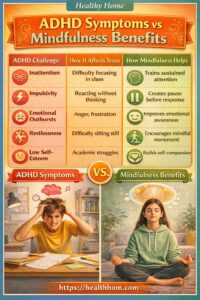
ADHD Symptoms vs Mindfulness Benefits
| ADHD Challenge | How It Affects Teens | How Mindfulness Helps |
|---|---|---|
| Inattention | Difficulty focusing in class | Trains sustained attention |
| Impulsivity | Reacting without thinking | Creates pause before response |
| Emotional Outbursts | Anger, frustration | Improves emotional awareness |
| Restlessness | Difficulty sitting still | Encourages mindful movement |
| Low Self-Esteem | Academic struggles | Builds self-compassion |
Obstacles You can Encounter (and How to Deal with Them)
Becoming mindful may be a challenging experience at the initial stages once you have ADHD. These are four typical challenges and the ways of overcoming them:
- Restlessness — Do any kind of mindfulness you can: move your arms, stretch or walk.
- Boredom — Sessions should not be long and need to be interesting. Watch mindfulness video or apps.
- Forgetfulness — Apply reminders and visual reminders (notes, alarms on the phone, sticky notes).
- Resistance — Normalize their emotions and concentrate on increment. It is alright not to do so well.
It is not about getting it right but making it better.
Eventually, teenagers with the ADHD condition can be assisted by mindfulness:
- Increase the grades and school performance.
- Enhance friendship relationships and family ties.
- Reduces the level of anxiety and depression.
- Become powerful and self confident.
Mindfulness is not a magic cure but rather an additional aid that allows adolescents to learn more about themselves and their brains and treat them in a more appropriate manner.
Data Table: Benefits After Consistent Practice (6–8 Weeks)
| Area of Improvement | Expected Change | Time Frame |
|---|---|---|
| Focus Duration | Increased by small gradual increments | 2–4 weeks |
| Emotional Control | Fewer reactive episodes | 4–6 weeks |
| Stress Levels | Noticeable reduction | 3–6 weeks |
| Sleep Quality | Improved relaxation | 2–4 weeks |
| Academic Engagement | Better task completion | 6–8 weeks |

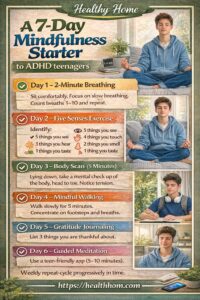
7-Day Mindfulness Starter to ADHD teenagers
1. Day 1 – 2-Minute Breathing
Sit comfortably. Focus on slow breathing. Count breaths 1–10 and repeat.
2. Day 2 – Five Senses Exercise
Identify:
- 5 things you see
- 4 things you touch
- 3 things you hear
- 2 things you smell
- 1 thing you taste
3. Day 3 – Body Scan (5 Minutes)
Lying down, take a mental check up of the body, head to toe. Notice tension.
4. Day 4 – Mindful Walking
Walk slowly for 5 minutes. Concentrate on footsteps and breaths.
5. Day 5 – Gratitude Journaling
List 3 things you are thankful about.
6. Day 6 – Guided Meditation
Use a teen-friendly app (5–10 minutes).
7. Day 7- Reflection and Progress Check.
Ask:
- Did I feel calmer this week?
- Was I more focused?
- What worked best?
Weekly repeat-cycle progressively in time.
Indications that Mindfulness Is Working
- Less disruption in the classrooms.
- Better performance of homework.
- Better emotional reactions
- Increased patience Improved sleep patterns
Tips for Parents & Teachers
- Make sessions brief (2-5 minutes at the start in the beginning)
- Do not make the participation mandatory.
- Model mindfulness yourself
- Prepare distraction free conditions.
- Promote improvement, not excellence.
When to Seek Professional Help
Mindfulness is to be added to professional care. Seek medical guidance if:
- Severe academic decline
- Aggressive behavior
- Symptoms of anxiety or depression.
- Sleep disturbances persist
- Side effects to medication ensue.
Role of mindfulness in ADHD teenagers :
Mindfulness assists teenagers with ADHD by enhancing concentration, impulsiveness, emotional regulation, stress and self-awareness by engaging in regular practices of present-mindfulness.
It is not that mindfulness is a cure to ADHD because it is a safe and evidence-based approach that would enable the teenager to learn to control their attention, manage their emotions, and have confidence in themselves when practiced regularly.
Concluding Points:
Adolescents having ADHD usually become anxious. The other way is to be mindful: this enables them to know themselves better, remain calm and in control. Mindfulness calls upon them to act in response to action instead of reaction, to accept the status quo before proceeding further and to refrain in criticizing themselves.
It gives them a chance to listen, not only to other people but also to themselves, to the inner voices.
Reference from my previously posted articles, which may be referred:
- Healthy Lifestyle in Adolescents: Its Promotion
Strategies for promoting active, balanced lifestyles in adolescents to reduce future risk of chronic diseases. - Cyber Security in Daily Life of Adolescents
Essential online safety tips and digital habits for teens to protect themselves and their mental health. - Non-Communicable Diseases: Prevention Essentials
Overview of major non-communicable diseases (NCDs) and how lifestyle and awareness can reduce their burden. - Iron Deficiency Causes & Anaemia
Explains what causes iron-deficiency anaemia, how it affects health, and what can be done to reverse it. - Hydration Routine for Better Health
A practical routine to ensure proper hydration, improve digestion, energy levels, and overall wellness.
Scientific Evidence Supporting Mindfulness for ADHD
- Harvard Health – ADHD A to Z
Comprehensive guide on attention-deficit/hyperactivity disorder: causes, symptoms, treatments and lifestyle approaches. - PMC – Mindfulness & Meditation in ADHD
Systematic review of mindfulness, meditation and related interventions for ADHD management. - PMC – Yoga and ADHD: A Research Review
Research article exploring yoga as a supplementary therapy for ADHD symptoms in children and adults. - WebMD – ADHD, Mindfulness, Meditation & Yoga
Accessible overview of how mindfulness, meditation and yoga can support ADHD symptoms and wellbeing. - Mayo Clinic – Cognitive Behavioral Therapy (CBT)
Overview of CBT: what it is, how it works, and what it’s used for across mental health conditions. - Wikipedia – Cognitive Behavioral Therapy
Background, history, mechanisms and evidence surrounding CBT as a psychological intervention. - Cleveland Clinic – CBT: Treatment Overview
Patient-friendly guide detailing CBT techniques, applications, and what to expect in therapy. - PMC – CBT Efficacy Meta-Analysis
Meta-analysis of the effectiveness of CBT across psychological disorders, including ADHD and anxiety.
FAQs:
For more detail, please visit to my website as mentioned below:


About the Author – “Bibhu Ranjan Mund”, Master in Public Health (MPH) from IIHMR University, Jaipur (Rajasthan- IHMR-U/12/2021 -23/0015) has experience of 18 years in Public Health activities like maternal health, child health, adolescent health, nutrition and community wellness programs. Through “Healthy Home”, he shares evidence-based health and wellness guidance designed to support families in making informed lifestyle decisions. This content is for educational purposes only and does not replace professional medical advice. Connect LinkedIn – https://www.linkedin.com/in/bibhu-ranjan-mund-b72171358/