Last Updated on June 13, 2026 by Bibhu Ranjan Mund, MPH
Healthy lifestyle in adolescent explained with importance, benefits & practical tips. Learn simple habits to improve teen health and prevent future diseases.
Reviewed by Bibhu Ranjan Mund, MPH (Public Health Expert) with experience in maternal, infant, child, and adolescent health programs. Content is based on evidence-informed guidelines aligned with organizations such as the World Health Organization, UNICEF, Centers for Disease Control and Prevention, and National Institutes of Health.
Medical Disclaimer: This content is for informational and educational purposes only and is not intended as medical advice, diagnosis, or treatment. Always seek the advice of a qualified healthcare professional regarding any medical condition or concerns.
Introcution:
As per the research published by World Health Organization in 2022, it shows that about 80% of adolescents globally don’t meet the recommended physical activity levels causing the increased risk of obesity, stress and other lifestyle diseases in early life.
Teenage years the actual period which decide the future health and the most vital for an adolescent girl to be a safe mother. Today’s daily sedentary lifestyle habits are affecting the teenagers long-term health including mental well-being.
Particularly, after the Covid-19 pandemic, the screen time has been increased to an optimum level for education of every adolescents that may be linked with rising the mental stress levels. In this article, you will find-out the real picture of Healthy Lifestyle in Adolescent, its long-term benefits and practical tips for improvement.
A healthy lifestyle is closely linked with emotional stability, learn more about mental well-being in adolescents and how to manage stress effectively.
The habits developed at this stage are likely to be carried into adulthood and hence this is a crucial stage to engage in healthy practices.
Poor dietary habits, sedentary lifestyles, too much screen time and stress may put people at risk of obesity, micronutrient deficiency, mental health problems and non-communicable diseases (NCDs) in the future. Poor lifestyle habits significantly increase the risk of non-communicable diseases in adolescents, including obesity, diabetes, and heart conditions.
What is a healthy lifestyle in adolescents?
A healthy lifestyle in adolescents includes balanced nutrition, regular physical activity, adequate sleep, stress management and avoiding harmful habits like tobacco or excessive screen time.
A Situation I Sometimes Notice During Adolescent Health Programs:
During my School Health Awareness sessions under adolescent health programs in Odisha, I sometimes meet with many teenagers whose thinking is that the health programs are related to the adults and older people only.
One day, a boy told me that “Sir, I am now very young and strong, why I will give importance for exercise and health eating?”
After a few minute, he narrated his daily life schedule and informed that he is spending free time by seeing the Mobiles and not involving any sports or outdoor play.
This is a common issue now. So many adolescents are not in a habit of any physical fitness, mental health and suspecting any lifestyle disease risk in future.
Global Statistics on Adolescent Lifestyle and Health
| Indicator | Global Estimate | Source |
|---|---|---|
| Adolescents worldwide (10–19 years) | ~1.2 billion | UNICEF Adolescent Well-Being Report 2023 |
| Adolescents not meeting physical activity recommendations | ~80% globally | WHO Global Health Estimates 2022 |
| Adolescents experiencing overweight or obesity | Increasing globally | WHO Global Health Estimates 2022 |
| Adolescents with insufficient physical activity | Around 4 out of 5 adolescents | WHO Global Health Estimates 2022 |
What These Numbers Actually Mean?
The statistics shows only for a growing opportunity to prevent the lifestyle diseases.
Many lifestyle related health risks are preventable from adolescent age. Daily small step like physical activity, proper balanced nutrition, sleep quality, stress management may be beneficial for a better health outcome.
Public health experts focus the preventive actions from the adolescent period because the healthy habits started now continues to adulthood.
What I Have Observed During Adolescent Health Programs?
I have worked in both the rural & urban communities and found a major change over the last decade.
Previously, many adolescents were spending free time with playing outdoor games, cycling or performing any household activities.
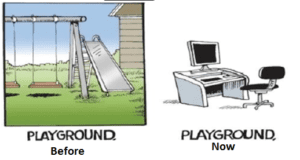
But, today the situation changed from outdoor to indoor entertainment in leisure time.
We know that the latest technology has given a lot of benefits, but the excessive sedentary behavior may be one of the most common lifestyle challenges among the teenagers in India and also worldwide.
Why Teenage Habits May Last a Lifetime?
Most of the Indian parents actually worry about the study environment, examination marks, college admissions and also future career of their teens.
But, to meet the above expectations, they sometimes forgot the investment for future which is daily lifestyle habits.
All are interlinked like the food the teens eat, quality sleep, outdoor time, screen habits may influence the health in long-term.
In most of the cases, the healthy lifestyle developed during the adolescent period reflects into the adulthoods.
What Is a Healthy Lifestyle among Adolescents?
A healthy lifestyle among the adolescents involves a mixture of:
- Healthy and well-balanced diets.
- Regular physical activity
- Adequate sleep
- Emotional stability and coping with stress.
- Avoidance of detrimental behaviors, i.e. tobacco, alcohol, substance use.
A structured diet is essential, explore a practical balanced daily meal plan for adolescents to ensure proper nutrition.
These factors collaborate in favor of the general growth and lowering the health risks in adolescence and adulthood.
Key Components of a Healthy Lifestyle
| Lifestyle Component | Example Behaviors |
|---|---|
| Balanced nutrition | Eating diverse and nutrient-rich foods |
| Physical activity | Sports, walking, cycling |
| Adequate sleep | Maintaining regular sleep schedules |
| Stress management | Relaxation, mindfulness, hobbies |
| Avoiding harmful substances | Avoiding tobacco, alcohol, drugs |
Source: WHO Adolescent Health Framework 2022
A Common Reality in Indian Homes:
In many Indian households, both the parents may be working professional and adolescents spend long periods for classes, coaching, homework and online activities.
Here, the academic performance is much more importance rather than physical activity.
So, that the outdoor play, family meal time, quality sleep routine are gradually decreasing from the daily life schedule.
As the education is an important for every teen, health should not be neglected until adulthood.
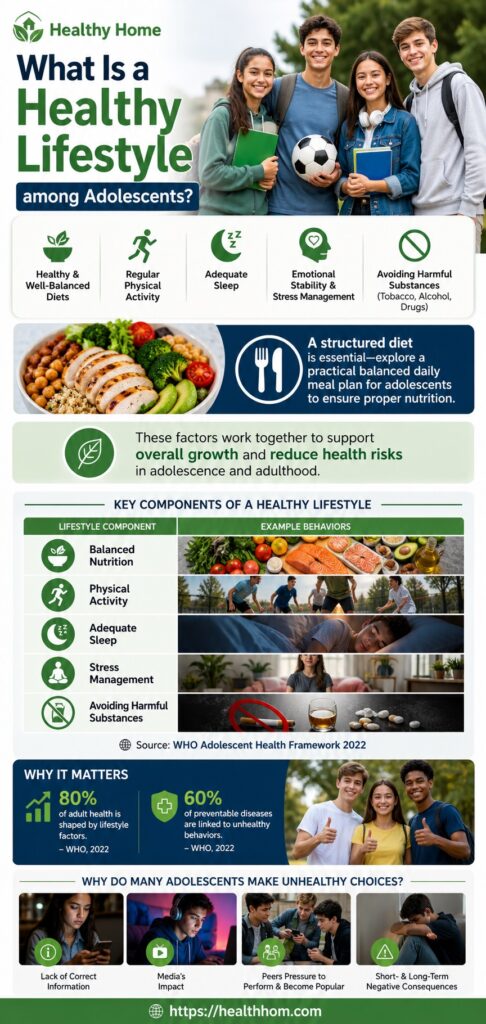
Many adolescents make unhealthy choices due to limited awareness, social influence & environmental factors:
- Lack of correct information
- Media’s impact
- Peers Pressure to perform become popular
- However, they leave you with short and long-term negative consequences.
Healthy Lifestyle vs Unhealthy Lifestyle
| Aspect | Healthy Lifestyle | Unhealthy Lifestyle |
|---|---|---|
| Diet | Balanced meals with fruits, vegetables and whole grains | Frequent fast foods and sugary drinks |
| Physical activity | Regular daily movement or exercise | Sedentary behavior |
| Sleep | Regular sleep schedule | Irregular or insufficient sleep |
| Screen use | Limited recreational screen time | Excessive digital media use |
Source: WHO Healthy Living Guidelines 2021
What Is So Important about a Healthy Lifestyle in Adolescence?
Adolescence is a sensitive stage of development when the body and the brain develop rapidly. Lifestyle habits made at this age may affect the physical development, academic results, emotional stability and health adversely in the long term.
The healthy lifestyle at the adolescent stage:
- Helps the bones and muscles to develop well.
- Enhances intellectual functions and performance.
- Improves self esteem and confidence.
- Lessens the chances of obesity, diabetes and heart disease in the future.
- Enhances good mental health and resistance to stress.
Source: UNICEF Adolescent Well-Being Strategy 2022
Goals of a Healthy Lifestyle:
The primary objectives of having a healthy lifestyle in adulthood are:
- Promoting physical exercise.
- Establishing healthy dietary habits.
- Lessening stress and enhancing psychological well-being.
- Making knowledgeable lifestyle choices.
- Avoidance of the long-run lifestyle-related illnesses.
Unhealthy choices which occur because of:
- Inadequate accurate health information.
- Peer pressure
- Media influence
- Spending too much time and being inactive.
Being aware of such factors will enable adolescents to make better health-related decisions.
Goals of a Healthy Lifestyle
| Goal | Description |
|---|---|
| Encourage active lifestyle | Promote regular movement and sports |
| Promote balanced nutrition | Encourage healthy food choices |
| Support mental well-being | Reduce stress and emotional challenges |
| Prevent future health risks | Encourage healthy lifelong habits |
Source: WHO Health Promotion Guidelines 2021
Avoiding harmful habits is crucial, learn effective substance abuse prevention strategies in adolescents.
A Parent’s Concern:
During a parent awareness session at community, one mother shared her experience that his son is always remining inside his room and only go outside during school hours.
After study hour, he was involved in playing mobile games, active in social media and also late-night screen use.
He was a good performer in academic career, but subsequently complained about headache, tiredness and lack of concentration.
Gradually after counselling, he started his outdoor play, reduced the screen time so that his energy level improved.
The lifestyle habits also plays a key role in addition to physical activity alone.

A Typical School-Day Challenge:
Think about a teenager who leaves from home early in the morning for school hours, after that attend the coaching class in the evening time and then return to home with tiredness.
For him, the fast food is convenient choice due to shortage of time.
Outdoor play is negligible due to academic pressure and it replaces the mobile phones.
Sleep time is delayed till midnight for homework from both school & coaching classes.
All the above habits appear normal for an individual person, but gradually it may affect the health.
So, importance must be given to leave the sedentary lifestyle and choose the small healthy daily improvements.
Nutrition Guidelines for Adolescents
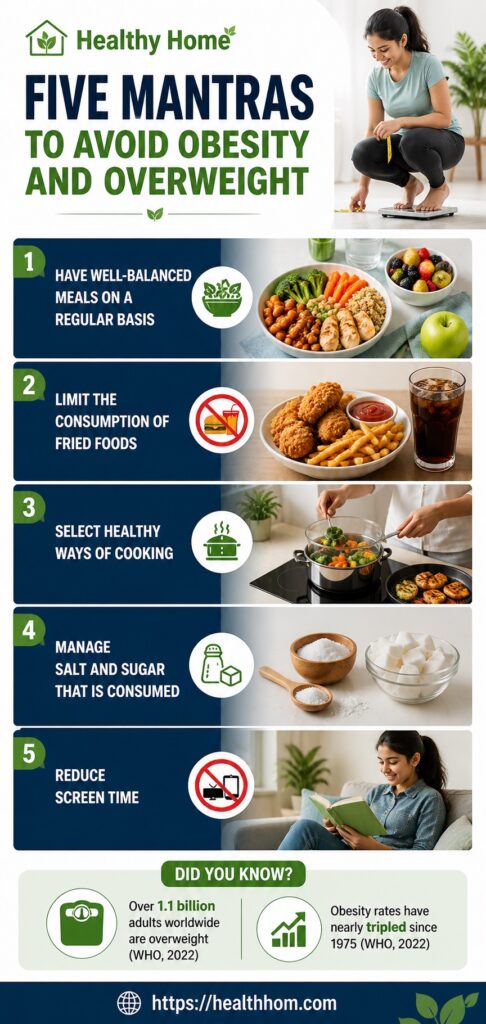
A. Five Mantras to avoid obesity and overweight:
1. Well-balanced meals on a regular basis.
Avoid skipping meals. Intake of pulses, vegetables, fruits, entire grains, and sufficient protein in the daily meals. Restrict High-Fat, High-Sugar and High-Salt Foods.
2. Limit the consumption of fried foods
Reduce the taking of fast food, candy, chocolates, chips, pastries and sugar sweetened drinks.
3. Select Healthy ways of cooking.
Use steaming, boiling, roasting or grilling over deep frying. Do not use used cooking oil and trans fats.
4. Manage Salt and Sugar that is consumed.
Reduce the amount of salt taken per day to not more than 5 grams (approximately one teaspoon). Minimized the amount of added sugar in sweets, juices, and soft drinks.
5. Reduce Screen Time
Restrict the time spent in front of the screen (TV, mobile, video games) to a minimum of two hours per day. Watch screens should not be eaten in front of screens.
Managing screen time is critical, explore safe internet use for adolescents and online safety practices.
Healthy Eating vs Unhealthy Eating Habits
| Healthy Eating Habits | Less Healthy Eating Habits |
|---|---|
| Regular balanced meals | Skipping meals |
| Fruits and vegetables | High intake of processed foods |
| Whole grains | Excess refined carbohydrates |
| Drinking water | Sugary beverages |
Source: WHO Healthy Diet Fact Sheet 2023
Choosing the right foods plays a key role, discover the best healthy foods for adolescents to support growth and immunity.
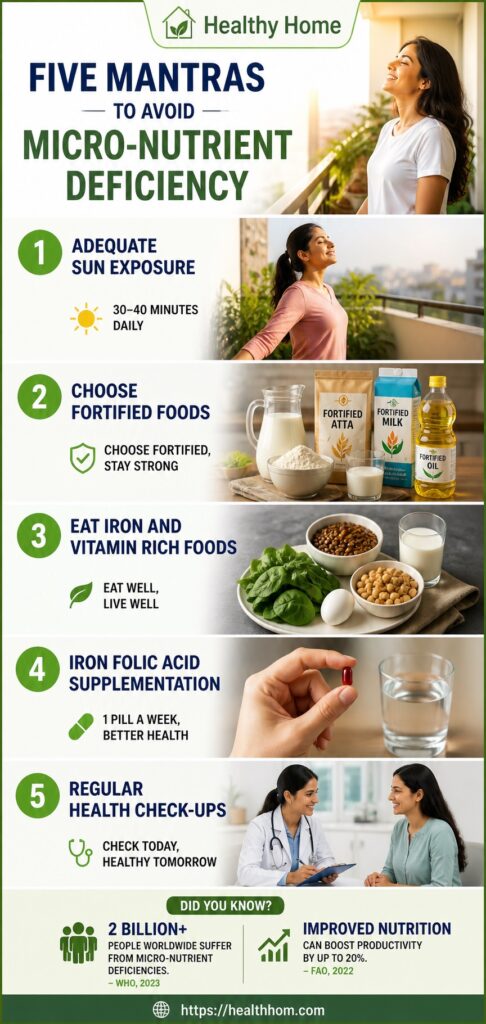
B. Five Mantras to Avoid Micro-nutrient Deficiency:
1. Adequate Sun Exposure
Spend 30-40 minutes in the sun in a balcony, terrace or a courtyard in order to supplement vitamin D levels.
2. Choose Fortified Foods
Consume fortified staple food e.g. fortified flour, fortified milk, or fortified oils.
3. Eat Iron and vitamin Rich Foods.
Foods containing iron, folate, and vitamin B12 should be included namely, green leafy vegetables, legumes, eggs, and dairy products.
4. Iron Folic Acid Supplementation.
Take iron-folic acid pills once in a week as recommended by the health authorities.
5. Regular Health Check-Ups
Regular health checks allow the deficiencies to be identified and addressed at a young age.
Examples of Nutrient-Rich Foods for Adolescents
| Nutrient | Example Food Sources |
|---|---|
| Iron | Legumes, green leafy vegetables |
| Calcium | Milk, yogurt, fortified foods |
| Vitamin A | Carrots, spinach, pumpkin |
| Protein | Eggs, pulses, nuts |
Source: UNICEF Nutrition Guidelines 2022
Micronutrient deficiencies are common during adolescence, find-out anaemia in adolescents and its long-term health risks.
Healthy Habits That Fit Indian Families:
A healthy lifestyle does not always require any costly gym time or any special diets.
Some practical examples:
- Walking to nearby shops instead of using vehicles.
- Playing badminton, cricket or football with friends.
- Eating homemade meals many times in a week
- Drinking water instead of sugary beverages.
- Taking family walks for few minutes just after dinner time
- Participating in household activities like gardening.
Such types of simple habits may be more sustainable than complicated fitness plans.
What a Healthy Day Might Look Like for a Teenager?
| Time | Healthy Habit |
|---|---|
| Morning | Wake up at a regular time and eat breakfast |
| School Hours | Carry water and avoid sugary drinks |
| Afternoon | Balanced lunch with vegetables and protein |
| Evening | Outdoor play, sports, cycling or walking |
| Night | Family dinner and reduced screen time |
| Before Sleep | Avoid mobile use and get adequate sleep |
Promoting a healthy lifestyle:
All healthy habits can be developed at the adolescence stage rather than when one is in adulthood. Some of the ways of promoting a healthy lifestyle include:
- Promoting physical exercise in everyday life.
- Avoiding substance misuse, tobacco and alcohol.
- Training on how to distinguish healthy and unhealthy food.
- Getting parental, teacher, and adult assistance.
- Making the home and school friendly.
Role modeling and positive reinforcement has a significant role to play in maintaining healthy behaviors.
These benefits also support long-term emotional stability, understand more about emotional health in adolescents.
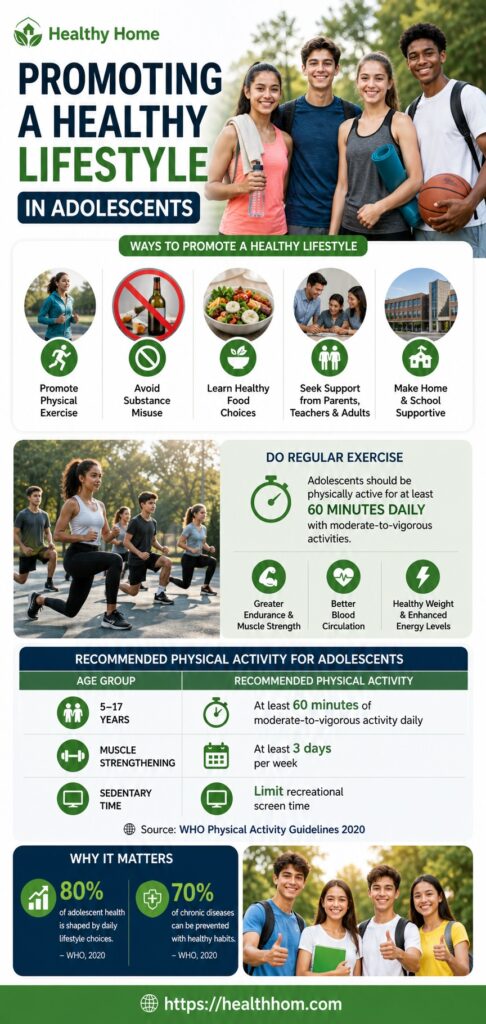
Doing regular exercise:
Adolescents are supposed to get involved in physical activities of at least 60 minutes in a day with moderate to vigorous activities.
- Greater endurance and strength of muscles.
- Better blood circulation
- Healthy weight maintenance
- Enhanced energy levels
Recommended Physical Activity for Adolescents
| Age Group | Recommended Physical Activity |
|---|---|
| 5–17 years | At least 60 minutes of moderate-to-vigorous activity daily |
| Muscle strengthening | At least 3 days per week |
| Sedentary time | Limit recreational screen time |
Source: WHO Physical Activity Guidelines 2020
Family support plays a major role, understand the role of parents in adolescent health and lifestyle development.
The activities may involve walking, jogging, sports, cycling, dancing or routine exercises.
- For at-least five days in a week, doing 30 minutes of physical activity
- Improvement of our muscle potential and continuation of blood flow
- Exercising more frequently results in obtaining multiple health advantages.
Benefits of Regular Physical Activity
| Area | Possible Benefit |
|---|---|
| Physical health | Supports muscle strength and endurance |
| Mental well-being | Helps reduce stress |
| Energy levels | Supports daily activity |
| Social interaction | Encourages teamwork in sports |
Source: WHO Physical Activity and Youth Report 2022
Regular movement supports overall growth, learn about the importance of physical activity in child and adolescent development.
Significance and Advantages of Yoga among the Adolescents.
Yoga is a healing methodology that integrates physical poses(asanas), breathing techniques and meditation.

Advantages to health by doing Yoga:
- Enhances posture, flexibility as well as balance.
- Improves the breathing capacity.
- Lessens fatigue and anxiety and stress.
- Enhances the emotional regulation.
- Ensures mindfulness-self-discipline.
Yoga may be used in combination with standard physical exercises and lead to physical and psychological well-being.
Source: Ministry of AYUSH Yoga Guidelines 2021
Yoga and mindfulness go hand in hand, explore effective mindfulness techniques for adolescents to improve focus and emotional control.

Minimizing Sedentary behavior :
Sedentary behaviour (sitting too long and being on screens too long) may cause adverse health outcomes.
Healthy practices include:
- Reducing the time spent on screen leisure to less than two hours a day.
- Minimizing sitting at home and school.
- Using the active mode of transportation.
- Promoting outdoor activities and physical exercise.
It is important to avoid tobacco and other harmful substances, in particular, at the adolescence stage.
Examples of Sedentary Behaviors vs Active Behaviors
| Sedentary Behavior | Active Alternative |
|---|---|
| Long hours on mobile devices | Outdoor games |
| Watching TV for long periods | Cycling or walking |
| Sitting during leisure time | Participating in sports |
| Online gaming for extended time | Dancing or exercise |
Source: WHO Active Lifestyle Campaign 2022
Excessive screen time can lead to unhealthy habits, understand the effects of social media addiction in adolescents.
Physical, Mental and Social Benefits.
Physical benefits
- Helps in developing healthy bones and muscles.
- Makes him stronger and more fit.
- Helps to maintain a normal body weight.
Source: UNICEF Adolescent Development Report 2023
Mental benefits
- Enhances self-confidence and self esteem.
- Helps treat stress, anxiety and mood variation.
- Increases concentration and decision-making.
Managing stress is essential for mental health, learn practical stress management techniques for adolescents.

Social benefits
- Promotes team work and collaboration.
- Assist teenagers to cope with failure and success.
- Develop communication and interpersonal abilities.
Sports, yoga, dance, martial arts, and outdoor games are activities that encourage the holistic growth.
For a broader understanding, explore our complete adolescent health and wellness guide.
My Final Reflection After Years of Working With Adolescents:
I have worked many years for adolescent health programs and observe that most of the family thinks the healthy living requires a major lifestyle changes.
But in reality, the most successful teenagers in both academic and health concerns who actually follow simple daily healthy habits consistently.
Adequate sleep, some physical activity, family support, regular meals, not skipping breakfast and reduced screen time may have a greater impact than a single day’s effort.
Common Lifestyle Mistakes Teenagers Sometimes Make:
Many unhealthy habits develop gradually and may seem harmless at first like:
- Skipping breakfast regularly
- Staying awake late on mobile phones
- Replacing outdoor games with screen entertainment
- Drinking sugary beverages daily
- Spending most of the day sitting
- Ignoring stress and emotional health
- Following social media health trends without proper information
Early identifying all the above habits may help the teenagers to make healthier choices.
How Parents Can Encourage Healthy Habits Without Constant Pressure?
Many parents worry about their teenagers who do not listen the advice.
In my experience during adolescent health programs, teenagers are more likely to follow healthy habits when they see adults practicing them.
Some practical approaches:
- Eating meals together whenever possible
- Taking evening walks as a family
- Limiting screen use for all family members
- Encouraging sports without focusing only on competition
- Praising effort rather than criticizing mistakes
Key message:
As per the evidence from World Health Organization and UNICEF (2023), they show that early lifestyle choices may influence the future risks of obesity, diabetes and mental health issues.
But, any major changes don’t need any complicated tasks.
Simple everyday step like eating balanced diet, consistent physical activity, adequate sleep, proper stress management etc. may abe able to create a strong foundation for the future healthy life.
Just start with only one positive habit today in teenage years and continue it for the entire future.
Becoming more aware, asking a friend to assist, and making well-informed decisions will enable adolescents to control their health.
The following educational video explains healthy lifestyle habits for adolescents in a simple and engaging manner. https://www.youtube.com/embed/lZ3nOqPshyM?si=2Fg8JivkizUaz-6h
7-Day Healthy Lifestyle Challenge for Teenagers:
| Day | Challenge |
|---|---|
| Monday | Walk for 20 minutes |
| Tuesday | Eat one extra fruit |
| Wednesday | Sleep before 10:30 PM |
| Thursday | Avoid sugary drinks |
| Friday | Play an outdoor game |
| Saturday | Spend one hour screen-free |
| Sunday | Take a family walk |
This simple daily step may help to build a healthier routines.
FAQs:
Q1. What lifestyle does the teenager have to lead for a good health?
Ans. The foundation of adolescent wellness includes proper diet combined with daily exercise & adequate sleep along with stress control measures and non-use of dangerous behaviors such as substance abuse.
Q2. During adolescence what factors make a healthy lifestyle essential?
Ans. A healthy lifestyle promotes adolescent’s physical growth along-with mental well-being. which improves their academic performance and lower the possibility of developing future diseases including obesity, diabetes and depression.
Q3. Which food items form the essential nutrition for teenage?
Ans.
* Fruits and vegetables
* Whole grains Lean proteins consist of eggs,
* Legumes and fish among others.
* Low fat
* Limiting the sugar, salt & processed food
Q4. How much physical exercise should teenagers do per day?
Ans. Keeping active every day needs adolescents to perform 60 min of exercising moderately hard or harder alongside muscle-strengthening exercises.
Q5. What challenges prevent teenagers from maintaining a healthy lifestyle?
Ans.
* Lacking awareness with education
* Peer pressure
* Reckless use of your time
* Access to unhealthy food
* Taking in a lot of media on digital screens
Q6. How can parents guide their teen for healthy choices?
* Show your good behavior every day high-lighting healthy life.
* Invite your family to eat together and ask for exercise or play together.
* Ensure that kids are taught about both nutrition and how to care for themselves together.
* Helping and encouraging teenagers to build good relationships.
Q7. Can online tools help the teens to start healthy behavior?
Ans. Yes, but it needs more practice oriented physical method.
Related Health Articles from Healthy Home :
- What is a balanced daily meal plan?
- Natural Remedy for Acne Natural home remedies to manage and reduce acne effectively.
- Safety & Security of Adolescents from Violence and Injuries
Guidance for protecting adolescents from violence, injuries, and risky environments. - Non-Communicable Diseases – Prevention & Key Facts
Overview of major NCDs and strategies to prevent lifestyle-related health conditions. - Substance Abuse in Adolescents – Best Prevention Strategies
Evidence-based ways to prevent substance misuse among teenagers.
Trusted References and Research Sources:
- Adolescent Health and Well-Being – UNICEF
Global overview of adolescent health challenges and well-being strategies. - Adolescents’ Health: Risks & Solutions – WHO Fact Sheet
Key health risks facing adolescents and evidence-based solutions. - Peer-Reviewed Study on Adolescent Nutrition & Health (PubMed 30393010)
Detailed research exploring adolescent diet, nutrition and long-term health outcomes. - Open Access Article: Adolescent Health Transitions (PMC10778914)
Comprehensive review of adolescence as a critical life phase for health tracking. - Healthy Diet – WHO Fact Sheet
Guidelines and recommendations for a healthy diet across all life stages. - Keeping Well in Adolescence & Youth (10-24 Years) – WHO
Resources and advice for maintaining health during adolescence and young adulthood. - Research Article: Adolescents’ Healthy Lifestyle Behaviors (PMC11562273)
Study examining healthy lifestyle patterns among adolescent populations. - Adolescents’ Healthy Lifestyle – ResearchGate Publication
Academic paper discussing lifestyle choices and wellbeing in adolescents. - Scientific Article: Adolescent Diet & Health Outcomes (ScienceDirect S002175571830768X)
Advanced research into adolescent dietary patterns and health impacts. - CNNS Thematic Report: Adolescents’ Diets & Nutrition – UNICEF India
Detailed thematic report on adolescent nutrition in India. - Adolescent Health – WHO Health Topics
Comprehensive WHO overview page on adolescent health issues. - Peer-Reviewed Study: Dietary Patterns & Long-Term Health Outcomes (PMC9432147)
Research article on how dietary patterns influence long-term health outcomes.


About the Author – “Bibhu Ranjan Mund”, Master in Public Health (MPH) from IIHMR University, Jaipur (Rajasthan) has more than 18 years of experience in Public Health activities in maternal health, child health, adolescent health, nutrition and community wellness programs under National Health Mission, Health & Family Welfare Department, Odisha. He is the founder of “Healthy Home” and translates the evidence based public health information into a practical source so that families may able to apply in everyday life. All the information are for educational purposes only and not replaces the professional medical advice. ORCID Researcher ID – 0009-0003-0158-4992. Connect LinkedIn – https://www.linkedin.com/in/bibhu-ranjan-mund-b72171358/