Last Updated on June 13, 2026 by Bibhu Ranjan Mund, MPH
Dengue cases are rising fast. Learn dengue disease symptoms, causes, treatment & prevention tips backed by WHO data. Protect yourself before it’s too late.
Reviewed by Bibhu Ranjan Mund, MPH (Public Health Expert) with experience in maternal, infant, child, and adolescent health programs. Content is based on evidence-informed guidelines aligned with organizations such as the World Health Organization, UNICEF, Centers for Disease Control and Prevention, and National Institutes of Health.
Medical Disclaimer: This content is for informational and educational purposes only and is not intended as medical advice, diagnosis, or treatment. Always seek the advice of a qualified healthcare professional regarding any medical condition or concerns.
What is Dengue ?
Dengue is a mosquito-borne viral infection causing high fever, pain, and potential complications if untreated.
Maintaining strong immunity through healthy lifestyle practices can help to reduce the risk of infections like dengue.
Introduction to Dengue Disease Symptoms:
Now a days, Dengue is not just a seasonal illness as it is rapidly growing threat globally. As per the research of World Health Organization (2023), about 390 millions of dengue infections are occurring every year and almost half of the population are at risk in the world.
Dengue isn’t just a dangerous fever, but it can lead to severe without warning. During rainy season, even if a single mosquito bite may lead to high fever, body pain, low platelet count and also life-threatening complications if not medically checked-up.
But, the important things is that, the may severe cases can be prevented with early detection and just few simple precautions.
In this article, you will find-out the:
- Early symptoms most people ignore
- When dengue becomes dangerous
- What actually helps in recovery
- Proven prevention strategies to protect your family
Quick Summary:
Dengue refers to a viral infection spread by mosquitoes and mostly seasonal in tropical and sub tropical areas, particularly during the rainy season. To minimize the complications and avoid outbreaks, early diagnosis, medical attention, hydration and mosquito control are of utmost importance.
Proper nutrition plays a key role in recovery, learn how a balanced diet for immunity supports overall health.
Global Dengue Burden
| Indicator | Global Estimate | Source |
|---|---|---|
| Annual dengue infections worldwide | About 390 million infections each year | WHO |
| Estimated symptomatic cases | Around 96 million | WHO |
| Countries with dengue transmission | More than 100 countries | WHO |
| Population at risk globally | Nearly half of the world’s population | WHO |
What is Dengue Disease:
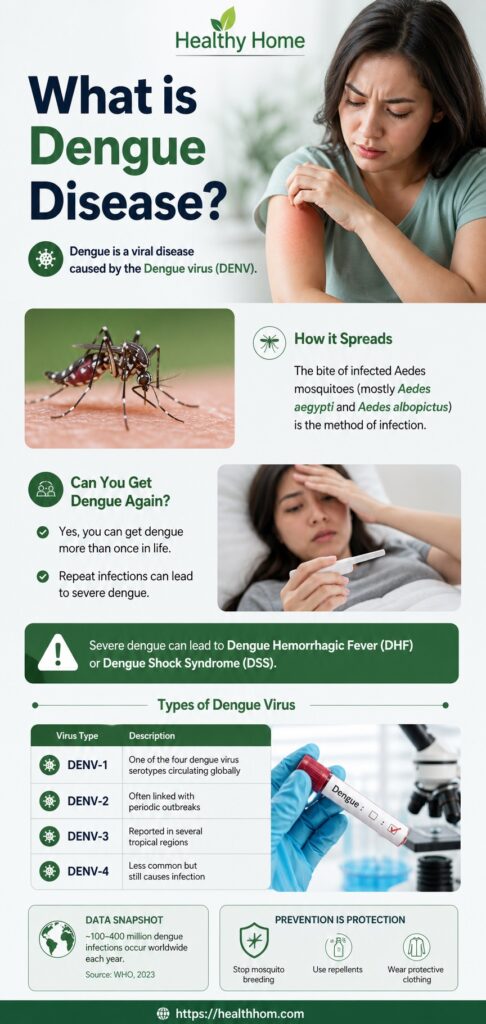
Dengue is a viral disease that is caused by the Dengue virus (DENV), with four types: DENV-1, DENV-2, DENV-3 and DENV-4. The bite of the infected Aedes mosquitoes (mostly Aedes aegypti and Aedes albopictus) is the method of infection.
One may get infected with dengue more than once in life. Repeat infections can lead to the predisposition of serious dengue, which includes Dengue Hemorrhagic Fever (DHF) or Dengue Shock Syndrome (DSS).
Types of Dengue Virus
| Virus Type | Description |
|---|---|
| DENV-1 | One of the four dengue virus serotypes circulating globally |
| DENV-2 | Often linked with periodic outbreaks |
| DENV-3 | Reported in several tropical regions |
| DENV-4 | Less common but still causes infection |
Source: WHO Dengue Guidelines 2023
Preventive health awareness is essential, explore overall disease prevention strategies for long-term health.
How Does the Dengue Disease Spread?
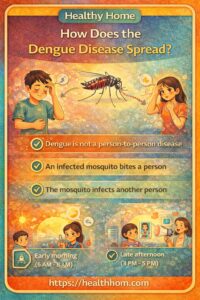
Dengue infection does not move between individuals by direct contact. Infected patients transmit the disease when female Aedes mosquitoes which have consumed their blood feed on human hosts. Aedes female mosquitoes choose their prey during the first half of the day and the last part of the afternoon for their blood feeding.
- Dengue is not a person to person disease.
- When a person is bitten by a dengue-carrying mosquito, the mosquito gets infected.
- The mosquito having the virus infects another person on biting them.
- The infectious agent of dengue does not transfer directly from one person to another person during its transmission.
- Female Aedes mosquitoes typically bite
- Early morning (6 AM – 8 AM)
- Late afternoon (3 PM – 5 PM)
Understanding transmission helps reduce risk, learn more about common infection prevention methods for parasitic and vector-borne diseases.
Comparison of Common Mosquito-Borne Diseases
| Feature | Dengue | Malaria | Chikungunya |
|---|---|---|---|
| Causative agent | Virus | Parasite | Virus |
| Vector mosquito | Aedes | Anopheles | Aedes |
| Biting time | Daytime | Night | Daytime |
| Typical climate | Tropical & subtropical | Tropical | Tropical |
WHO Vector-Borne Disease Overview 2023
How dengue cases increase?
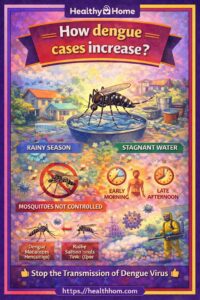
- Quick breeding of the mosquitoes in rainy seasons.
- stangnat water at residential areas and towns.
- Absence of control of mosquitoes.
- Greater exposure at the high mosquito biting times.
The prevention and control of mosquitoes serve as the most potent methods for stopping the transmission of dengue virus.
Poor sanitation increases disease risk, understand the importance of hygiene and sanitation in preventing infections.
Source: CDC Dengue Transmission Overview 2023
Symptoms of Dengue Disease
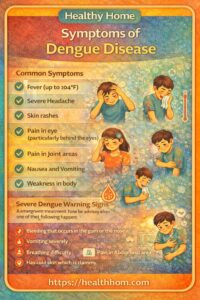
Common Symptoms
The common symptoms generally occur 4-10 days following infection and they can include:
- Fever (up to 104°F)
- Severe Headache
- Skin rashes
- Pain in eye (particularly behind the eyes)
- Pain in Joint areas
- You may experience nausea and start vomiting.
- Weakness in body
- Significant cases having a low platelet count
Blood-related complications can worsen outcomes, read more aboutlow platelet and blood health issues such as anaemia.
Typical Dengue Symptom Timeline
| Stage | Approximate Time | Possible Symptoms |
|---|---|---|
| Incubation | 4–10 days after bite | No symptoms |
| Early phase | Day 1–3 | Fever, headache, body pain |
| Critical phase | Day 4–6 | Warning signs may appear |
| Recovery phase | Day 7–10 | Gradual improvement |
Source: WHO Dengue Clinical Management Guide 2022
Severe Dengue Warning Signs :
Emergency treatment should be advised when one of the following happen:
- Bleeding that occurs in the gum or the nose
- Vomiting severely
- Breathing difficulty
- Pain in Abdominal area
- Has cold skin which is clammy
Severe illness can affect emotional health, learn about stress and health management strategies during illness.
Warning Signs That Require Medical Attention
| Warning Sign | Reason to Seek Care |
|---|---|
| Persistent vomiting | Possible dehydration |
| Severe abdominal pain | Possible complication |
| Bleeding gums or nose | Needs medical evaluation |
| Difficulty breathing | Possible severe dengue |
Source: WHO Dengue Guidelines 2023
How is dengue diagnosed?
Confirmation of diagnosis is done using laboratory tests including:
- NS1 Antigen Testing : Blood analysis is used to support the presence of dengue infection in the body as it detects the presence of the virus in blood.
- IgM/IgG Antibody-Tests
- The platelet levels are determined by doing a Complete Blood Count (CBC).
If the disease is found early on, treatment is easier and you are less likely to experience further complications.
Common Diagnostic Tests for Dengue
| Test | Purpose | Stage of Illness |
|---|---|---|
| NS1 Antigen test | Detects dengue virus protein | Early infection |
| IgM antibody test | Indicates recent infection | Later phase |
| IgG antibody test | Shows past exposure | Recovery phase |
| CBC (Platelet count) | Monitors blood parameters | Throughout illness |
Source: WHO Laboratory Diagnosis Guidelines 2022
Regular checkups are essential, understand the importance of health monitoring and early diagnosis.
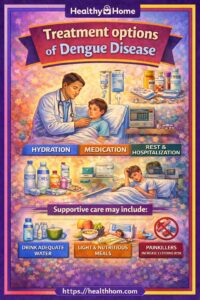
Treatment options
Dengue does not have a definite treatment against viruses. Medical treatment is aimed at the control of symptoms and complications prevention:
- ORS or IV fluids to keep hydration
- Taking of drugs as per prescription of Doctor
- Drinking enough water so you don’t get dehydrated
- Take rest as per advice of doctor
- Hospitalization as per suggestion of doctor
Caution: do not self-medicate particularly without medical consultation and taking of painkillers.
Avoid painkillers such as aspirin or ibuprofen unless prescribed by a healthcare provider, as they may increase the risk of bleeding in dengue patients.
Staying hydrated is critical, follow a proper hydration routine for recovery and overall health.
Home-based methods and support
Important Note: Home-based measures cannot cure dengue but may help support hydration and comfort when used under medical guidance.
Supportive care may include:
- Consumption of adequate water (water, ORS, coconut water).
- Light, nutritious meals
- Adequate rest
- Adhering to medical prescription.
Always consult a healthcare provider before any traditional remedies.
Eating light and nutritious foods is essential, discover nutritious foods for recovery such as millets and balanced meals.
Supportive Care Measures (Educational)
| Supportive Measure | Purpose |
|---|---|
| Adequate hydration | Helps maintain fluid balance |
| Rest | Supports recovery |
| Medical monitoring | Tracks disease progression |
| Nutritious meals | Maintains energy levels |
Source: WHO Dengue Management Handbook 2023
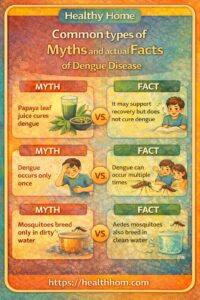
Common types of Myths and actual Facts
| Myth | Fact |
|---|---|
| Papaya leaf juice cures dengue | It may support recovery but does not cure dengue |
| Dengue occurs only once | Dengue can occur multiple times |
| Mosquitoes breed only in dirty water | Aedes mosquitoes also breed in clean water |
| Dengue spreads directly between people | Dengue spreads through mosquito bites |
Misinformation can delay treatment, learn about health awareness and how misinformation spreads.
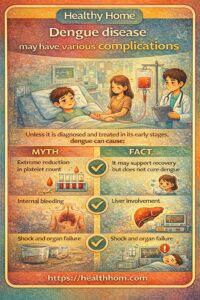
Dengue may have various complications.
Unless it is diagnosed and treated in its early stages, dengue can cause:
- Extreme reduction in platelet count.
- Internal bleeding
- Liver involvement
- Shock and organ failure
Severe infections can lead to long-term health complications if not managed properly.
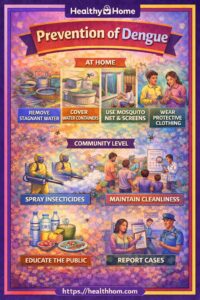
Prevention of Dengue at Home
Eradicate breeding areas of the mosquitoes by:
- Removal of stagnant water in: Water tanks, Coolers, Flowerpots, Old tires etc.
- Covering water containers.
- Covering the windows with used mosquito nets and window screens.
- Fashionably wearing long-sleeved clothing.
- Wearing the exempted mosquito repellents or vaporizers.
Source: WHO Dengue Prevention Guide 2023
Adopting preventive health habits can significantly reduce the risk of infectious diseases.
Prevention at the Community level
- Frequent fogging and spraying insecticides.
- Cleanliness motivates the community.
- Health education campaigns (IEC) and (SBCC).
- Awareness of schools and colleges.
- Media participation toward community education.
- Monitoring and reporting cases of dengue to the local authorities.
- Greater caution in the rainy seasons.
Public participation is key, learn more about community health awareness and disease prevention programs.
For more expert-backed advice, explore our complete health and wellness guide.
Best Foods During Dengue Recovery:
- Coconut water
- Papaya (myth clarified)
- Protein-rich foods
Conclusion :
Dengue can be prevented but if and only if it is identified early.
The most important point is the awareness and identifying the symptoms on time, staying hydrated and avoiding self medication may reduce the major complications.
Actually, Dengue cases are rising due to lack of daily prevention habits, without eliminating stagnant water, lacking community awareness etc. Just a simple step today like cleaning of surroundings, using mosquito protection can be able to prevent a serious health issue from dengue.
Always be alert and protection is the best method to win the disease.
FAQs:
Q1. What is dengue disease?
Dengue is an infectious virus that is spread by the Aedes mosquitoes and carried by the dengue virus.
Q2. How is dengue transmitted?
By means of an infected Aedes mosquito bite, which is mostly bite during the day.
Q3. Is it possible that a patient can get recover from dengue?
Yes. Through early diagnosis and appropriate medication, majority of the individuals will heal fully.
Q4. Is there a vaccine for dengue?
There are also vaccines that can be found in certain countries and are only prescribed as a medical measure for particular groups.
Q5. Is there an effect of foods in increasing platelet count during dengue?
None of the food can elevate the platelets fast. Taking of nutritional support must be advised by a doctor.
Q6. Is dengue dangerous?
Cases of severe dengue may be fatal unless timely action is taken.
Related Health Articles from Healthy Home
- How to Minimize the Risk of Worm Infestation: Causes, Symptoms & Prevention
https://healthhom.com/how-to-minimize-the-risk-of-worm-infestation/ - Impact of Anaemia in Adolescents: Long-Term Health Risks of Malnutrition
https://healthhom.com/impact-of-anaemia-in-adolescents-long-term-risks-of-malnutrition/ - Find out what millet is and why it’s considered a human nutritional gift
https://healthhom.com/what-is-millet-its-gift-to-human/ - Food Supplementation for Growth & Nutrition – Learn how nutritional supplementation supports maternal and child health through Food Supplementation and Its Importance
- How to Know Your Cholesterol Level, BMI & BMR
Complete guide to understanding cholesterol levels, calculating BMI/BMR, and improving heart health.
Trusted References and Research Sources:10 Early Warning Signs of Type 2 Diabetes: Symptoms, Risk Factors and PreventionHealthy Living Guide for Families : Nutrition, Sleep and Daily Wellness HabitsHow to know your Cholesterol level, BMI & BMR? A Simple Health Guide5 Benefits of Reducing Salt and Sugar : Health Effects and Practical Tips
- Dengue guidelines, for diagnosis, treatment, prevention and control (who.int)
- Dengue (who.int)
- Dengue as a growing global health concern – PMC (nih.gov)
- Dengue – The Lancet
- Dengue and severe dengue (who.int)
- Dengue guidelines, for diagnosis, treatment, prevention and control (who.int)


About the Author – “Bibhu Ranjan Mund”, Master in Public Health (MPH) from IIHMR University, Jaipur (Rajasthan) has more than 18 years of experience in Public Health activities in maternal health, child health, adolescent health, nutrition and community wellness programs under National Health Mission, Health & Family Welfare Department, Odisha. He is the founder of “Healthy Home” and translates the evidence based public health information into a practical source so that families may able to apply in everyday life. All the information are for educational purposes only and not replaces the professional medical advice. ORCID Researcher ID – 0009-0003-0158-4992. Connect LinkedIn – https://www.linkedin.com/in/bibhu-ranjan-mund-b72171358/