Last Updated on March 22, 2026 by Bibhu Ranjan Mund, MPH
Reviewed by Bibhu Ranjan Mund, MPH (Public Health Expert) with experience in maternal, infant, child, and adolescent health programs. Content is based on evidence-informed guidelines aligned with organizations such as the World Health Organization, UNICEF, Centers for Disease Control and Prevention, and National Institutes of Health.
Last reviewed on: 22 March 2026.
Medical Disclaimer: This content is for informational and educational purposes only and is not intended as medical advice, diagnosis, or treatment. Always seek the advice of a qualified healthcare professional regarding any medical condition or concerns.
Affiliate Disclosure: This article contains affiliate links. If you purchase through these links, we may earn a small commission at no extra cost to you.
Early Childhood development in India: Every child requires early childhood age to develop their cognitive abilities and social bonds as well as their physical attributes.
Introduction
The period of early childhood is the most crucial stage of human development. The brain of a child grows very fast during the period of birth to six years, which forms the basis of physical wellbeing, learning capacity, emotional stability and social interactions. In India, the early childhood development (ECD) can be enhanced with the help of family care, Anganwadi services, ICDS programs and national projects including POSHAN Abhiyaan.
Knowledge about developmental milestones will enable parents to know when a child is developing normally and when he or she might require professional assistance.
Early Childhood Development Statistics (India)
Early childhood development is a significant public health concern as per global and national reports. The statistics below show the magnitude of ECD programs and requirement.
| Indicator | India Estimate | Source/Program |
|---|---|---|
| Children under 6 years in India | ~158 million | Census / Government estimates |
| Brain development by age 5 | ~90% of adult brain size | WHO |
| Children with risk of developmental delay globally | ~250 million | WHO / UNICEF |
| Anganwadi centres in India | ~1.3 million | ICDS |
| Children receiving supplementary nutrition | ~100 million+ | POSHAN Abhiyaan |
Quick Summary: Early Childhood Development in India (0–6 Years)
- The most crucial stage in child development is the early childhood (06 years). At this age, there is a rapid development of the brain, which establishes the foundation to a lifetime of health, academic capabilities, emotional state and interpersonal capabilities.
- Family care, Anganwadi services, ICDS and POSHAN Abhiyaan are the programs that help in the development of early childhood in India. Keeping track of developmental milestones achieved i.e. movement, speech, vision, hearing and socialization will assist parents and caregivers in understanding whether a child is developing as per expectations.
- Healthy development pillars are good nutrition, responsive care giving, play-based learning and early stimulation. When a child exhibits delayed milestones, they can be effectively approached at an early age with the help of a skilled medical specialist to assist them in dealing with their problems in time and achieving improved results.
What Is Early Childhood development (ECD)?
Early childhood development can be defined as the process of physical, cognitive, emotional, social and language development of children through birth up to approximately eight years of age. WHO and UNICEF state that the early years have a considerable impact on lifelong health and educational performance as well as productivity.
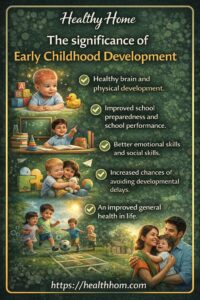
The significance of Early Childhood Development
Strong ECD ensures:
- Healthy brain and physical development.
- Improved school preparedness and school performance.
- Better emotional skills and social skills.
- Increased chances of avoiding developmental delays.
- An improved general health in life.
Major Government Programs Supporting ECD in India
| Program | Year Launched | Focus Area | Key Services |
|---|---|---|---|
| ICDS (Integrated Child Development Services) | 1975 | Child health & nutrition | Anganwadi services, supplementary nutrition |
| POSHAN Abhiyaan | 2018 | Malnutrition reduction | Growth monitoring, nutrition awareness |
| National Education Policy – Early Childhood Care & Education | 2020 | Early learning | Preschool education integration |
| Mission Saksham Anganwadi | 2021 | Strengthening Anganwadi services | Nutrition, health monitoring |
Source: Ministry of Women & Child Development, Government of India, 2023
Age-wise Development Areas
| Age Group | Main Development Focus |
|---|---|
| 0–12 months | Sensory development, bonding |
| 1–2 years | Motor skills and first words |
| 2–3 years | Language and social play |
| 3–5 years | Learning, curiosity and imagination |
Source: UNICEF Early Learning Report, 2019
Early childhood developmental Milestones
Key Development Domains in Early Childhood
| Development Domain | What It Includes | Examples |
|---|---|---|
| Physical Development | Growth of body and motor abilities | Crawling, walking |
| Cognitive Development | Thinking and learning skills | Memory, problem solving |
| Language Development | Communication abilities | Words, sentences |
| Social Development | Interaction with others | Playing with peers |
| Emotional Development | Managing feelings | Attachment, empathy |
Source: UNICEF Early Childhood Development Framework, 2019
Milestones are skills that majority of children attain at a specific age. Small variations are normal.
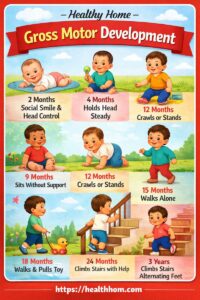
Gross Motor Development
| Age | Expected Milestones |
|---|---|
| 2 months | Social smile, some head control |
| 4 months | Holds head steadily |
| 9 months | Sits without support |
| 12 months | Crawls or stands with support |
| 15 months | Walks independently |
| 18 months | Walks well, pulls toys while walking |
| 24 months | Climbs up and down stairs with help |
| 3 years | Climbs stairs alternating feet |
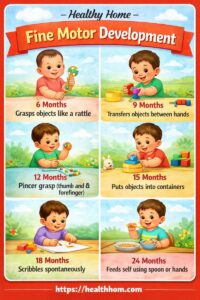
Fine Motor Development
| Age | Expected Milestones |
| 6 months | Grasps objects like a rattle |
| 9 months | Transfers objects between hands |
| 12 months | Pincer grasp (thumb and forefinger) |
| 15 months | Puts objects into containers |
| 18 months | Scribbles spontaneously |
| 24 months | Feeds self using spoon or hands |
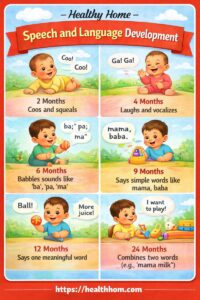
Speech and Language Development
| Age | Expected Milestones |
| 2 months | Coos and squeals |
| 4 months | Laughs and vocalizes |
| 6 months | Babbles sounds like “ba”, “pa”, “ma” |
| 9 months | Says simple words like mama, baba |
| 12 months | Says one meaningful word |
| 18 months | Uses 5–10 words |
| 24 months | Combines two words (e.g., “mama milk”) |
| 3 years | Speaks simple sentences |
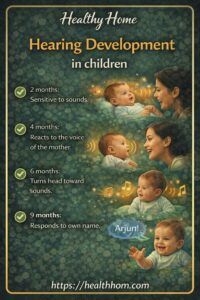
Hearing Development
- 2 months: Sensitive to sounds
- 4 months: Reacts to the voice of the mother.
- 6 months: Turns head toward sounds.
- 9 months: Responds to own name
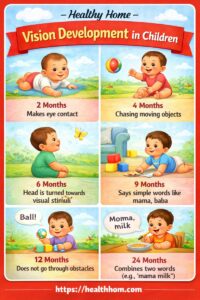
Vision Development
- 2 months: Makes eye contact
- 4 months: Chasing moving objects.
- 6 months: Head is turned towards visual stimuli.
- 9 months: Does not go through obstacles.
- 15 months: Putting of small objects into a container.
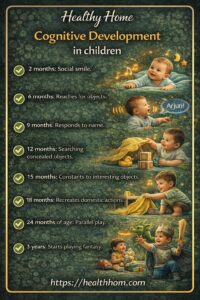
Cognitive Development
- 2 months: Social smile
- 6 months: Reaches for objects
- 9 months: Responds to name
- 12 months: Searching concealed objects.
- 15 months: Constants to interesting objects.
- 18 months: Recreates domestic actions.
- 24 months of age: Parallel play.
- 3 years: Starts playing fantasy.
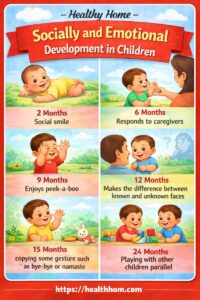
Socially and Emotional Development
- 2 months: Social smile
- 6 months: Responds to caregivers.
- 9 months: Enjoys peek-a-boo
- 12 months: Makes the difference between known and unknown faces.
- 15 months: copying some gesture such as bye-bye or namaste.
- 24 months: Playing with other children parallel
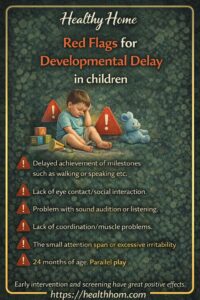
Red Flags for Developmental Delay
They are the general warning signs. Some are mentioned below:
- Delayed achievement of milestones such as walking or speaking etc.
- Lack of eye contact/social interaction.
- Problem with sound audition or listening.
- Lack of coordination/muscle problems.
- The small attention span or excessive irritability.
Early intervention and screening have great positive effects.
Global Statistics on Developmental Risk
| Indicator | Global Estimate |
|---|---|
| Children under 5 at risk of poor development | ~250 million |
| Main contributing factors | Poverty, malnutrition, limited stimulation |
| Regions with highest risk | South Asia & Sub-Saharan Africa |
Source: WHO & UNICEF Early Childhood Development Report, 2017
Parental involvement in the development of children in early childhood
The role of parents in ECD is the most significant as they:
- Social protection and attentiveness.
- Making nutritious food balance.
- Promoting play based learning.
- Discussing, reading and singing to children.
- Providing a safe and stimulating homely atmosphere.
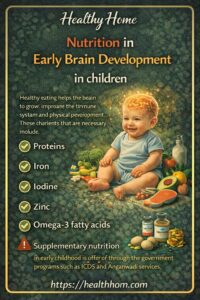
Nutrition in Early Brain Development
Healthy eating helps the brain to grow, improves the immune system and physical development. Those nutrients that are necessary include:
- Proteins
- Iron
- Iodine
- Zinc
- Omega-3 fatty acids
Supplementary nutrition in early childhood is offered through the government programs such as ICDS and Anganwadi services.
Key Nutrients Supporting Early Brain Development
| Nutrient | Role in Child Development | Common Food Sources |
|---|---|---|
| Protein | Growth and tissue development | Eggs, pulses, milk |
| Iron | Supports oxygen transport | Green leafy vegetables, legumes |
| Iodine | Supports thyroid and brain development | Iodized salt, dairy |
| Zinc | Supports immune function | Nuts, seeds, legumes |
| Omega-3 fatty acids | Brain structure support | Fish, walnuts, flaxseed |
Source: FAO & WHO Nutrition Guidelines, 2020
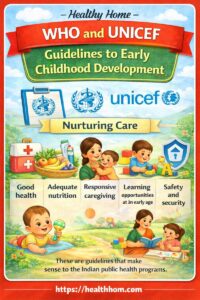
WHO and UNICEF Guidelines to Early Childhood Development
WHO puts special focus on nurturing care by:
- Good health
- Adequate nutrition
- Responsive caregiving
- Learning opportunities at an early age.
- Safety and security
These are guidelines that make sense to the Indian public health programs.
WHO Nurturing Care Framework
| Component | Description |
|---|---|
| Good Health | Access to maternal and child healthcare |
| Adequate Nutrition | Balanced diet and breastfeeding |
| Responsive Caregiving | Caregiver interaction and emotional bonding |
| Opportunities for Early Learning | Play, stimulation and preschool learning |
| Safety & Security | Protection from violence and neglect |
Source: WHO Nurturing Care Framework, 2018
Healthy Development Guide
| Key Pillar of Healthy Development | Example |
|---|---|
| Nutrition | Balanced diet |
| Play | Interactive games |
| Responsive caregiving | Talking, reading |
| Safe environment | Injury prevention |
Source: WHO ECD Guideline, 2018
FAQs:
Related Health Articles from Healthy Home
- Early Childhood Development – Learn about key stages, milestones, and factors influencing a child’s growth in this guide on Early Childhood Development
- Global Developmental Delay – Understand causes, symptoms, diagnosis, and early intervention strategies for Global Developmental Delay in Children
- What Makes Humans Unique – Explore the biological, cognitive, and emotional traits that define humanity in Why a Human Child Is So Unique and What Makes Us Human
- Infancy to Toddler Development – A comprehensive overview of physical, emotional, and cognitive changes from birth to toddlerhood in Precious Infancy to Toddler Stage
- Food Supplementation for Growth & Nutrition – Learn how nutritional supplementation supports maternal and child health through Food Supplementation and Its Importance
Trusted References and Research Sources:
- Improving early childhood development: WHO guideline, WHO ECD guideline
- Early childhood development | UNICEF India
- Early childhood education | UNICEF India
- Motor development milestones (who.int)
- Early Childhood Development in the UNICEF Strategic Plan 2018-2021.pdf
For more detail, please visit to my website as mentioned below:


About the Author – “Bibhu Ranjan Mund”, Master in Public Health (MPH) from IIHMR University, Jaipur (Rajasthan- IHMR-U/12/2021 -23/0015) has experience of 18 years in Public Health activities like maternal health, child health, adolescent health, nutrition and community wellness programs. Through “Healthy Home”, he shares evidence-based health and wellness guidance designed to support families in making informed lifestyle decisions. This content is for educational purposes only and does not replace professional medical advice. Connect LinkedIn – https://www.linkedin.com/in/bibhu-ranjan-mund-b72171358/