Last Updated on June 13, 2026 by Bibhu Ranjan Mund, MPH
1 in 3 children suffer from tooth decay (WHO 2022). Learn early signs, causes and common dental dental problems in children which affect growth, nutrition & learning. Prevention tips for parents.
Reviewed by Bibhu Ranjan Mund, MPH (Public Health Expert) with experience in maternal, infant, child, and adolescent health programs. Content is based on evidence-informed guidelines aligned with organizations such as the World Health Organization, UNICEF, Centers for Disease Control and Prevention, and National Institutes of Health.
Medical Disclaimer: This content is for informational and educational purposes only and is not intended as medical advice, diagnosis, or treatment. Always seek the advice of a qualified healthcare professional regarding any medical condition or concerns.
Introduction:
As per the data of World Health Organization (2022), more than 514 millions of children globally suffer from un-treated tooth decay, so that it leads to a most common chronic disease in childhood.
Even a small cavity may affect a child’s nutrition, growth, sleep, learning ability and self-confidence. Still, so many parents miss to treat at early symptoms which lead to pain, infection or costly treatment lateron.
Due to the modern lifestyle having frequent sugary items, irregular oral care, dental problems in children are increasing a lot.
In this article, you will find-out help you to:
- The early signs parents often ignore
- How tooth decay actually begins
- Its hidden impact on health, nutrition, and school performance
- Simple, practical steps to protect your child’s smile for life
Because healthy teeth are not just about smiles, they are the foundation of a child’s overall well-being.
Oral health is closely linked with overall growth and development, learn more in our guide on Early Childhood Development in India (0–6 Years).
Global Burden of Childhood Dental Diseases
| Indicator | Global Estimate |
|---|---|
| Children affected by untreated dental caries in primary teeth | ~514 million |
| Most common chronic disease among children | Dental caries |
| Children affected by caries in permanent teeth | ~2 billion people globally |
| Main contributing factors | High sugar intake, poor oral hygiene |
Source: World Health Organization Global Oral Health Status Report, 2022
Objective of Dental Problems in children:
This article aims to assist the parents and the caregivers:
- Early detection of early childhood caries, dental caries, gingivitis and other oral diseases.
- Learn the development of the tooth decay.
- Get to know about the appropriate preventive methods.
- Detect, at an early stage, problems with the dentures.
- Preserve the health, nutritional, and well-being of a child.
Global Oral Health Risk Factors in Children
| Risk Factor | Description |
|---|---|
| High sugar diet | Frequent sugary foods and drinks |
| Poor brushing habits | Inadequate plaque removal |
| Limited fluoride exposure | Reduced enamel protection |
| Irregular dental visits | Late detection of problems |
Source: WHO Global Oral Health Strategy, 2022
Dental Problems in Children.
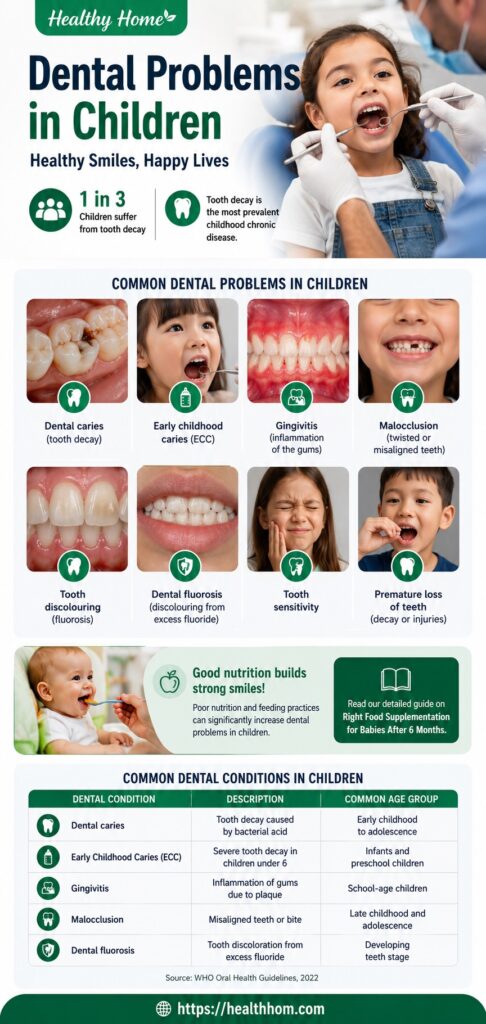
The children can have various oral health issues that include:
- Dental caries (tooth decay)
- Early childhood caries (ECC)
- Gingivitis (inflammation of the gums)
- Malocclusion (twisted or misaligned teeth)
- Tooth discolouring (fluorosis)
- Dental fluorosis (tooth discolouring caused by an overload of fluoride)
- Tooth sensitivity
- Premature loss of teeth because of decay or injuries.
The most prevalent childhood chronic disease is tooth decay.
Poor nutrition and feeding practices can significantly increase dental problems, read our detailed guide on Right Food Supplementation for Babies After 6 Months.
Common Dental Conditions in Children
| Dental Condition | Description | Common Age Group |
|---|---|---|
| Dental caries | Tooth decay caused by bacterial acid | Early childhood to adolescence |
| Early Childhood Caries (ECC) | Severe tooth decay in children under 6 | Infants and preschool children |
| Gingivitis | Inflammation of gums due to plaque | School-age children |
| Malocclusion | Misaligned teeth or bite | Late childhood and adolescence |
| Dental fluorosis | Tooth discoloration from excess fluoride | Developing teeth stage |
Source: WHO Oral Health Guidelines, 2022
How Tooth Decay Starts
The process of tooth decay is well known:
- Streptococcus mutans are the bacteria that are present in the mouth.
- These bacteria develop on carbohydrates and sugars.
- There is generation of acids as a by-product.
- Acid leads to demineralization of enamel in teeth.
- This causes destruction of teeth and cavities with time.
The problem may arise within 20-40 minutes following each sugary intake, and frequency (but not quantity) of sugar consumption is more detrimental than quantity.
Diet plays a major role in disease development, understand how food impacts overall health in How Food Affects Mental Health & Well-being.
Stages of Tooth Decay Development
| Stage | What Happens in Teeth |
|---|---|
| Initial stage | Plaque forms on tooth surface |
| Acid attack | Bacteria break down sugars producing acids |
| Demineralization | Enamel minerals begin to dissolve |
| Cavity formation | Visible hole or damage occurs |
| Advanced decay | Infection may reach deeper tooth layers |
Source: National Institute of Dental and Craniofacial Research (NIDCR), 2021
What Is Early Childhood Caries (ECC)?
Tooth decay in children below the age of six years is severe and is a progressive disease known as Early Childhood Caries. It is defined as:
- A lesion (cavities or non-cavities) one or more decayed.
- Missing teeth due to decay
- Filled tooth surfaces in any primary (baby) tooth.
ECC may deteriorate rapidly in case it is not observed early.
Early childhood conditions often affect multiple developmental domains, explore this in Precious Infancy to Toddler Stage Development Guide.
Early Warning Signs
Risk Indicators
- Primary/mother with untreated dental caries.
- Home practice of poor oral health.
Symptoms in Children
- Aversion to hot, cold or sweet food.
- Food trapped between teeth.
- Toothache or pain
Visual Signs
- Early demineralization in the form of white spots on the teeth.
- Brown or black spots
- Red, swollen, or bleeding gums
- Visible plaque or calculus
Frequent inspection of the house may assist in identifying issues.
Severe Dental Decay
As the process of decay increases, children can have:
- Persistent pain
- Dental abscess or infection
- Problem with difficulty in chewing or talking.
- Early loss of primary teeth
High stages of dental decay are usually a complicated and expensive procedure and may be done under sedation or in the case of general anesthesia.
Early Warning Signs Parents Can Observe
| Type of Sign | What Parents May Notice |
|---|---|
| Visual signs | White, brown, or black spots on teeth |
| Behavioral signs | Child avoids cold or sweet foods |
| Gum signs | Redness or bleeding gums |
| Functional signs | Difficulty chewing or speaking |
Source: American Academy of Pediatric Dentistry, 2022
Effects of Dental Diseases on Child Health and Quality of life
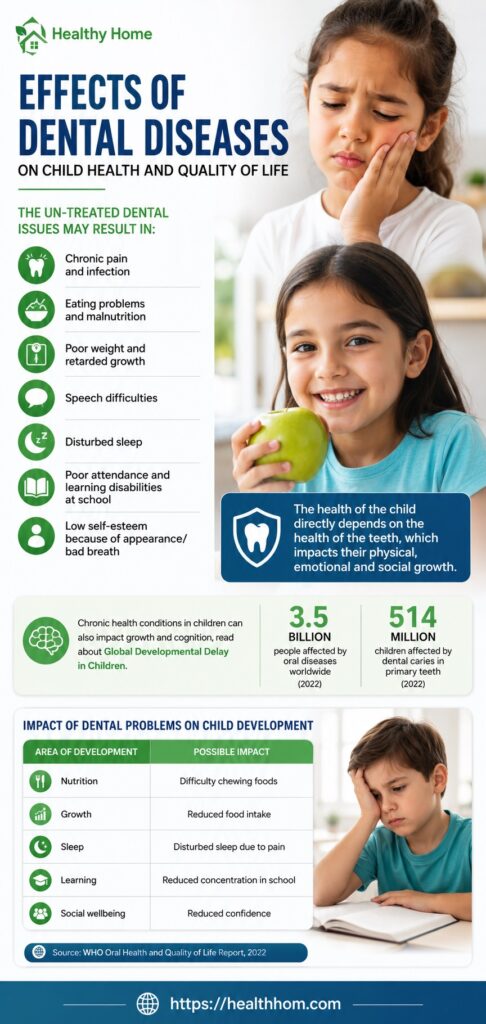
The un-treated dental issues may result in:
- Chronic pain and infection
- Eating problems and malnutrition.
- Poor weight and retarded growth.
- Speech difficulties
- Disturbed sleep
- Poor attendance and learning disabilities at school.
- Self-esteem
- Low self-esteem because of appearance/bad breath.
The health of the child directly depends on the health of the teeth, which impacts their physical, emotional and social growth.
Chronic health conditions in children can also impact growth and cognition, read about Global Developmental Delay in Children.
Impact of Dental Problems on Child Development
| Area of Development | Possible Impact |
|---|---|
| Nutrition | Difficulty chewing foods |
| Growth | Reduced food intake |
| Sleep | Disturbed sleep due to pain |
| Learning | Reduced concentration in school |
| Social wellbeing | Reduced confidence |
Source: WHO Oral Health and Quality of Life Report, 2022
Early Childhood Caries: Infectious or not?
Yes. Tooth decaying bacteria may be passed on as a caregiver to a child mostly via saliva.
How Transmission Happens
- Sharing spoons or utensils
- Using the mouth to clean the pacifiers.
- Sharing food or drinks
Reducing Risk
- Good oral hygiene should be observed by the caregivers.
- Sharing of saliva should be avoided.
- Keep toothbrushes separate
Oral Health and Infant Feeding Habits
Eating habits are significant in dental health issues prevention.
Recommended Practices:
- The breastfeeding is promoted.
- Always make sure that a child is not taken to bed with a bottle holding milk or juice.
- Present cup drinking towards the first birthday.
- Regular bottle feeding is replaced by using a spoon and katori.
Proper infant feeding is critical not only for dental health but also immunity, see our guide on Vaccination Schedule for a Disease-Free Childhood.
Infant Feeding Practices and Oral Health
| Feeding Practice | Oral Health Consideration |
|---|---|
| Breastfeeding | Encouraged as part of healthy development |
| Bottle feeding during sleep | May increase exposure of teeth to sugars |
| Transition to cup | Recommended around 12 months |
| Frequent sugary liquids | May increase risk of tooth decay |
Source: WHO Infant Feeding Guidelines, 2021
Diet and Sugar Consumption: Parents Information
The type of food that children eat does not only influence their dental health; the timing of eating also has an impact on dental health.
When eaten in large amounts, high-risk foods are associated with increased risk factors
- Jalebi and other sweets
- Chocolates
- Chips and Kurkure
- Sugary drinks and juices
Practical Tips
- Limit between‑meal snacks
- Drinking water after sweets helps reduce acid exposure
- Have a day dedicated to treats (sweet bank concept)
- Look at moderation, but not total restriction.
Excess sugar intake can also contribute to nutritional disorders like anemia, learn more in Iron Deficiency Anemia: Causes & Treatment.
Foods That Support Good Oral Health
| Food Category | Examples |
|---|---|
| Calcium-rich foods | Milk, yogurt, cheese |
| Fibrous fruits | Apple, pear, guava |
| Vegetables | Carrot, cucumber |
| Protein foods | Eggs, pulses, fish |
Source: FAO Nutrition and Oral Health Education Materials, 2019
Preventing Saliva Exchange
In order to minimize the transmission of bacteria:
- Sharing of toothbrushes and utensils is not permitted.
- Pacifier or in spoons should not be licked and then given to a child.
- Do not allow children to put fingers of the caregivers in their mouths.
Comparison Table: Healthy vs Risky Dietary Habits for Teeth
| Tooth-Friendly Habits | Habits That Increase Tooth Decay Risk |
|---|---|
| Drinking water after meals | Frequent sugary snacks |
| Eating fresh fruits | Sugary drinks |
| Balanced meals | Sticky sweets and candies |
| Limited snack frequency | Continuous grazing on sweets |
Source: American Dental Association Dietary Guidance, 2021
Awareness on Oral Hygiene in Children
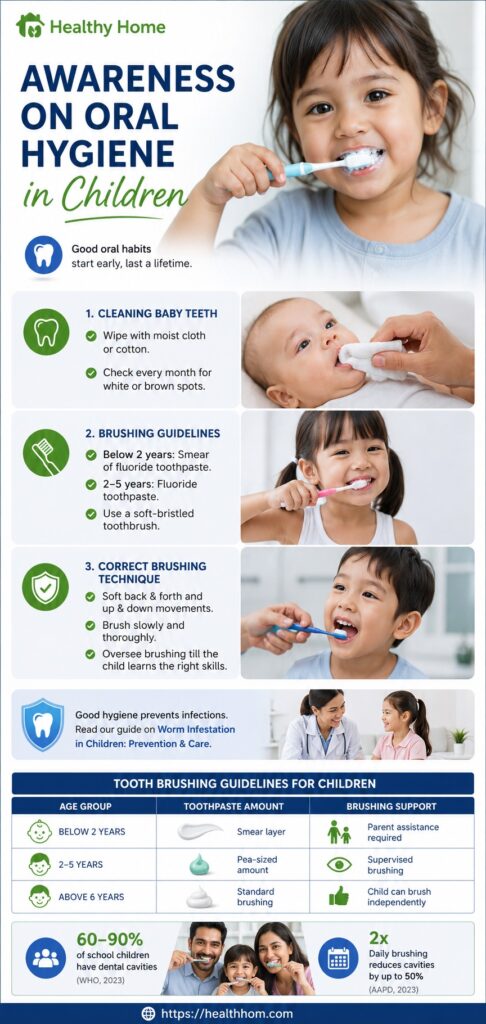
Cleaning Baby Teeth
- Wipe down the first tooth using moist cloth or cotton.
- Parents are supposed to lift the lip of the child every month to examine whether it has white or brown spots.
Brushing Guidelines
- Below 2 years of age; smear or swipe of toothpaste fluoride.
- 2-5 years of age: Fluoride toothpaste.
- Use a soft-bristled toothbrush.
Correct Brushing Technique
- Soft back and forward and down up movements.
- Brush slowly and thoroughly
- Oversee brushing till the child learns the right skills.
Hygiene practices are equally important in preventing infections, read our guide on Worm Infestation in Children: Prevention & Care.
Tooth Brushing Guidelines for Children
| Age Group | Toothpaste Amount | Brushing Support |
|---|---|---|
| Below 2 years | Smear layer | Parent assistance required |
| 2–5 years | Pea-sized amount | Supervised brushing |
| Above 6 years | Standard brushing | Child can brush independently |
Source: American Academy of Pediatric Dentistry Guidelines, 2023
Recommended First Dental Visit Timeline
| Age of Child | Recommended Oral Health Action |
|---|---|
| First tooth eruption | Begin cleaning with soft cloth |
| By age 1 | First dental visit |
| 2–5 years | Supervised brushing |
| School age | Regular dental check-ups |
Source: American Academy of Pediatric Dentistry, 2022
Takeaways:
As per the research published by World Health Organizations (2022), it shows that early prevention of dental problems is more effective and affordable than treatment, still most of the cases are overlooked.
The important thing is that, it can be prevented by simple daily habits like brushing techniques, diet, regular dental visits etc. So that the children can be be protected from pain, infections and long-term complications.
A child’s smile is more than just its appearance, as it reflects their health, confidence, and future well-being.
Who ever you may be, a parent or caregiver, your small step to guide the children in limiting sugar, encouraging proper brushing and identifying the early signs can make a difference.
Because, if you protect your child from tooth decay, you are supporting them for their growth, learning, confidence and quality of life. The important points as follows:
- The baby teeth are very significant just like the permanent teeth.
- Decay itself may develop to severe infection and chronic complications.
- Tooth decay needs the presence of the teeth, germs and carbohydrates.
- Dental issues in early childhood can be prevented.
- Timeline the initial visit to a dentist by a child by the time they are one year old or when the first tooth erupts.
FAQs :
Q1. What are the common dental problems in children?
Malocclusion, tooth erosion, dental injuries, tooth decay and gingivitis are prevalent.
Q2. What impact does a defective tooth have on the health of the child?
It may bring pain, infection, malnutrition, sleeping disorders and problems with learning.
Q3. Does dental issue influence self-esteem and academic achievement?
Yes. Oral diseases can cause embarrassment, speech, as well as low self-esteem.
Q4. At what age would one recommend a child to visit the dentist?
When the first tooth is erupted at the age of one or by the age of one.
Q5. What is the cause of tooth decay amongst children?
Unhealthy food habits including frequent sugary foods, neglect of brushing and insufficient fluoride and irregular visits to the dentist.
Q6. What can the parents do to prevent dental problems?
Brush two times a day, restrict sugar, dental check-ups and healthy diet.
Q7. What is the correlation between dental and nutrition?
Dental pain may decrease the chewing habits which causes inadequate intake of nutrients.
Q8. Does childhood dental problem influence adulthood?
Yes. Childhood oral issues worsen adult dental issues.
Related Health Articles from Healthy Home
- Early Childhood Development – Learn about key stages, milestones, and factors influencing a child’s growth in this guide on Early Childhood Development
- Global Developmental Delay – Understand causes, symptoms, diagnosis, and early intervention strategies for Global Developmental Delay in Children
- What Makes Humans Unique – Explore the biological, cognitive, and emotional traits that define humanity in Why a Human Child Is So Unique and What Makes Us Human
- Infancy to Toddler Development – A comprehensive overview of physical, emotional, and cognitive changes from birth to toddlerhood in Precious Infancy to Toddler Stage
- Food Supplementation for Growth & Nutrition – Learn how nutritional supplementation supports maternal and child health through Food Supplementation and Its Importance
Trusted References and Research Sources:Child Health and Development Guide: Growth Milestones, Immunity and Daily CareChild Health and Development Guide: Growth Milestones, Immunity and Daily CareChild Health and Development Guide: Growth Milestones, Immunity and Daily Care
- Ending childhood dental caries: WHO implementation manual
- Impact of oral health conditions on oral health-related quality of life in children with special healthcare needs: A systematic review – PubMed (nih.gov)
- Oral Health-Related Quality of Life in Children and Adolescents with a Traumatic Injury of Permanent Teeth and the Impact on Their Families: A Systematic Review – PMC (nih.gov)
- Oral health (who.int)
- The effect of early childhood caries on the quality of life of children and their parents – PubMed (nih.gov)
- Does poor oral health impact on young children’s development? A rapid review – PMC (nih.gov)


About the Author – “Bibhu Ranjan Mund”, Master in Public Health (MPH) from IIHMR University, Jaipur (Rajasthan) has more than 18 years of experience in Public Health activities in maternal health, child health, adolescent health, nutrition and community wellness programs under National Health Mission, Health & Family Welfare Department, Odisha. He is the founder of “Healthy Home” and translates the evidence based public health information into a practical source so that families may able to apply in everyday life. All the information are for educational purposes only and not replaces the professional medical advice. ORCID Researcher ID – 0009-0003-0158-4992. Connect LinkedIn – https://www.linkedin.com/in/bibhu-ranjan-mund-b72171358/