Last Updated on June 13, 2026 by Bibhu Ranjan Mund, MPH
Learn the steps of adolescent safety from violence and injuries. Discover warning signs, prevention strategies, and legal rights for teen safety.
Reviewed by Bibhu Ranjan Mund, MPH (Public Health Expert) with experience in maternal, infant, child, and adolescent health programs. Content is based on evidence-informed guidelines aligned with organizations such as the World Health Organization, UNICEF, Centers for Disease Control and Prevention, and National Institutes of Health.
Medical Disclaimer: This content is for informational and educational purposes only and is not intended as medical advice, diagnosis, or treatment. Always seek the advice of a qualified healthcare professional regarding any medical condition or concerns.
Introduction to Adolescent Safety from Violence and Injuries:
According to the data of UNICEF (2023), about 1 billion children globally facing some form of violence each year. Also the data of World Health Organization (2022) shows that, road injuries is one of the major causes of death among adolescnets.
These statistics are actually reflecting the real risk which can affect any teenagers without any warnings.
The teen-age is a critical phase for growth, vulnerability and independence. Subsequently, when the teen enters into the world, they may be face bullying, abuse, accidental injuries, unsafe environments from both the offline and online sources.
So, the important thing is to recognize the risk and protect them in due time.
This article will provide the early warning signs of adolescent safety from violence and injuries, real life risks, different prevention strategies, legal protections etc. and help the parents, caregivers & adolescents for taking steps before arising any problems.
Quick Safety Takeaways
- Violence can be physical, emotional, or online
- Early warning signs are often behavioral
- Safe environments reduce long-term risks
- Legal protection exists, use it
Global Situation of Violence Against Adolescents
| Indicator | Global Estimate | Source |
|---|---|---|
| Adolescents aged 10–19 worldwide | About 1.3 billion | UNICEF Global Child Protection Report 2023 |
| Adolescents experiencing violence annually | Nearly 1 billion children worldwide | UNICEF Global Child Protection Report 2023 |
| Leading cause of death among adolescents | Road traffic injuries | WHO Youth Violence Report 2022 |
| Adolescents affected by bullying globally | Around 1 in 3 students | UNESCO School Violence Study 2019 |
Comparison : Violence vs Injury
| Aspect | Violence | Injury |
|---|---|---|
| Definition | Intentional harm by another person | Physical harm caused by accidents or unsafe situations |
| Examples | Bullying, abuse, assault | Road accidents, falls, burns |
| Prevention approach | Social protection, education | Safety measures and supervision |
| Impact | Emotional, psychological and physical effects | Mainly physical consequences |
Source: WHO Injury Prevention Framework 2022
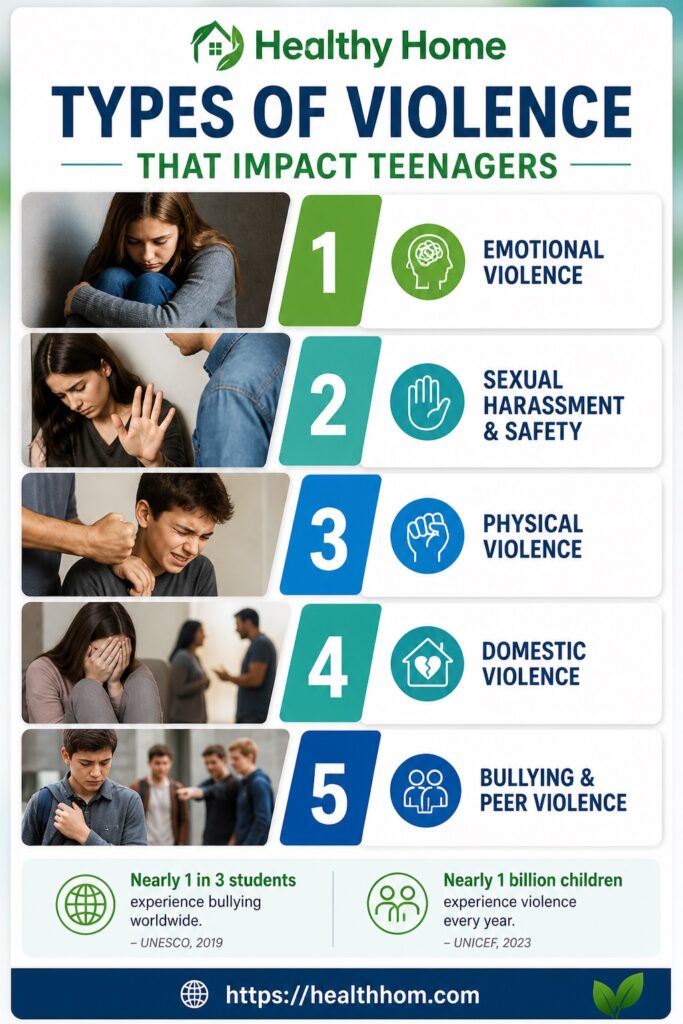
Types of Violence That Impact Teenagers
The following sections discuss sensitive topics in an educational and preventive context. Reader discretion is advised.
Many cases of cyberbullying are linked to excessive digital exposure, learn more about social media addiction in adolescents and its impact on teen safety.
1. Emotional Violence
Emotional violence refers to intentional behaviors, which have psychological negative impacts. This can be bullying, verbal abuse, humiliation, name-calling, intimidation, and constant criticism, which cause emotional trauma in the long-term.
2. Sexual Harassment and Safety
Rape and sexual assault are destructive types of violence. These are unwanted sex comments, improper touch, exploitation on internet and child sex abuse of both boys and girls. These are not acceptable no matter how the victim and the offender are related to each other.
3. Physical Violence
Physical violence is the deliberate action that provokes physical injury. They may include hitting, pushing, corporal punishment, fights between siblings or physical punishment at home or in school.
4. Domestic Violence
Domestic violence is an act of aggressiveness or abuse at home. It can be physical, emotional, or sexual abuse and a prolonged impact on the psychological and physical well-being of adolescents.
5. Bullying and Peer Violence
Bullying is emotional or physical violence, in which one uses power in a harmful way to others. It can be done in schools, in the online, or in the community and can result in fear, isolation and low self-esteem.
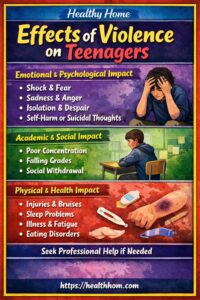
Teenagers at Greater risk of Abuse
Some circumstances make people susceptible such as:
- Family strife or marital dissonance.
- Family financial pressure or chronic diseases.
- Parental lack of supervision.
- Victims of domestic violence.
- Orphans, institutionalized children and street connected children.
- Physically or mentally challenged adolescents.
Every child and teenager needs well-meaning adults who will take care of them, protect and support them emotionally.
Adolescents at Higher Risk of Violence
| Risk Factor | Explanation |
|---|---|
| Lack of parental supervision | Increases vulnerability |
| Poverty or financial stress | May increase family conflict |
| Exposure to domestic violence | Higher likelihood of victimization |
| Disability or chronic illness | May increase dependence |
| Living on streets or institutions | Reduced protective environment |
Source: WHO Violence Prevention Report 2022
Effects of Violence on Teenagers
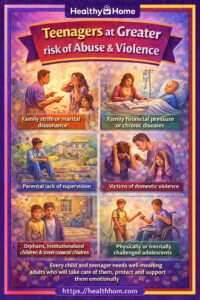
Violence and injuries may have a great impact on the well-being of adolescents.
Emotional and Psychological Effect.
- Shock, fear, confusion
- Sadness, guilt, shame, anger
- Fear, desolation or emotional isolation.
- In extreme situations, self-harm or suicide.
Exposure to violence can severely impact mental well-being in adolescents, leading to anxiety, depression, and emotional distress.
In case a teenager develops self-harming tendencies or expresses strong emotional pain, it is necessary to provide a professional help as soon as possible.
Practicing mindfulness techniques for adolescents can help to manage stress, improve emotional control, and support recovery from trauma.
Academic and Social Impact
- Difficulty concentrating
- Reduction in academic achievements.
- Withdrawal or aggression of social behavior.
Physical and Health Impact
- Mutilations like bruises, burns or bite marks.
- Repeat infections or pain which has no explanation.
- Eating and sleeping disorders.
- Impoverished hygiene or retarded maturation.
Poor health conditions such as anaemia in adolescents can increase vulnerability and reduce physical resilience in stressful environments.
Effects of Violence on Teenagers
Leading Causes of Adolescent Injuries Worldwide
| Cause | Description | Source |
|---|---|---|
| Road traffic accidents | Injuries during transportation | WHO |
| Interpersonal violence | Physical fights or assaults | WHO |
| Falls | Accidents during play or work | WHO |
| Drowning | Water-related accidents | UNICEF |
Unsafe environments and poor hygiene can also increase the risk of worm infestation, affecting adolescent health and well-being.
Warning sings and Indications of Abuse.
Behavioral Signs
- The abrupt shifts in the mood or behavior.
- Too much fear or too much aggression.
- Overly pleasing behavior
- Substance misuse
Psychological Signs
- Favoritism, depression, emotional numbness.
- Nightmares, insomnia, loss of appetite.
Physical Signs
- Unexplained injuries
- Frequent illness or fatigue
Early detection has the benefit of early intervention and support.
Popular Place where Violence may occurs
- Schools and classrooms
- On the way to school
- Homes and communities
- Plays and unattended places.
- Online media and cyberspace.
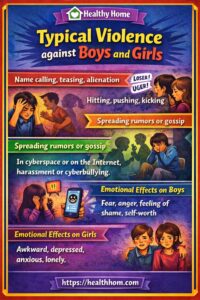
Typical Violence against boys and girls.
- Name calling, teasing, alienation.
- Hitting, pushing, kicking
- Spreading rumors or gossip
- In cyberspace or on the Internet, harassment or cyberbullying.
Addressing gender equality issues in adolescents is essential to reduce discrimination, harassment, and gender-based violence.
Emotional Effects on Boys
- Terror, anger, feeling of shame, self-worth.
Emotional Effects on Girls
- Awkward, depressed, anxious, lonely.
How Violence Spreads
Violence can be carried outside schools to the surrounding publics and even the internet. The patterns in relation to time, location, and behavior can help the communities to create effective ways of preventing crime and establish safer areas.
Basic Rights of Adolescents
- All teenagers are entitled to security, self esteem and respect.
- The physical, emotional, and sexual abuse are all the violations of basic rights.
- Teenagers can have a right to say No and get assistance.
- The No, Go, Tell strategy ensures that children arm themselves to defend themselves.
In Search of Support and Spend the Night.
- Talk to an adult, teacher, parent or a counselor one can trust.
- Do not accuse yourself of abuse and violence.
- Report bullying, harassment or unsafe behavior
- There are laws in place that guard children and adolescents.
Indian Violence, Injury and Legal Support
Legal protection in India has been created and it includes:
- POCSO Act (Protection of children against sexual offences).
- Childline 1098- 24/7 helpline to needy children.
- Online Abuse or Threats Cyber Crime Helpline 1930.
Legal Protection for Adolescents in India
| Law / Service | Purpose |
|---|---|
| POCSO Act 2012 | Protects children from sexual offences |
| Juvenile Justice Act 2015 | Protects rights of children in need of care |
| Childline 1098 | 24-hour emergency support for children |
| Cyber Crime Helpline 1930 | Reporting online fraud or cyber threats |
Source: Government of India Child Protection Framework 2023
Risky Behaviors and Responsible Decision-Making
Adolescents are to take into consideration:
- Is the situation safe?
- Will this be detrimental to myself or other people?
- Which are the long and short-term outcomes?
Well-informed choices are useful in keeping up health, safety and trust.
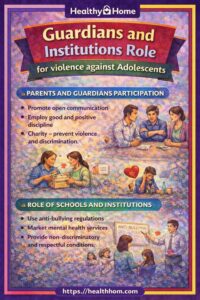
Guardians and Institutions Role
Parents and Guardians Participation
- Promote open communication
- Employ good and positive discipline.
- Charity – prevent violence and discrimination.
Role of Schools and Institutions.
- Use anti-bullying regulations.
- Market mental health services.
- Provide healthy, non-discriminatory and respectful conditions.
Source: WHO Violence Prevention Strategy 2022
Adopting a healthy lifestyle in adolescents can strengthen physical resilience, emotional stability, and overall safety awareness
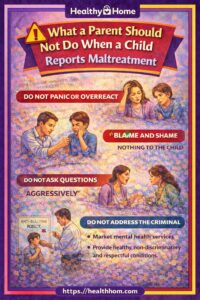
What a Parent Should Not Do When a Child Reports Maltreatment.
- Do not panic or overreact
- Blame and shame nothing to the child.
- Do not ask questions aggressively.
- Do not address the criminal in the presence of the child.
Encouraging healthy food choices for families supports physical strength and emotional resilience in adolescents
According to UNICEF, nearly one billion children globally experience some form of violence each year, highlighting the importance of protecting adolescents during this critical stage of development.
A safe and supportive environment during adolescence also contributes to the prevention of non-communicable diseases later in life.
Concluding Points:
Adolescent safety is not only to avoid the danger, but to create an enabling environment where the young generation may feel secure, supported and blessed.
As per the report of World Health Organization (2022), it shows that early awareness and timely intervention may reduce the long-term impact of violence and injuries. The main point is that the prevention needn’t always require complicated solutions.
So, start with the simple steps like:
- Listen without judgment
- Recognize warning signs early
- Encourage open communication
- Seek help when needed
Because one time of awareness can change many thing for the positive construction of teen. Protecting adolescents today means to shape them for a better healthier & safer adult.
The responsibility doesn’t belong to parents alone, but it should be all of our society.
FAQs:
Q1. What are the significant safety issues that adolescents face nowadays?
Online threats, road accidents, peer pressure, abuse and bullying pose a threat to adolescents. Safety is important in promoting both physical and emotional health in the long run.
Q2. What is the kind of violence that the adolescents are often exposed to?
Physical violence, emotional abuse, sexual harassment, bullying, cyberbullying and being exposed to domestic violence.
Q3. What are universal causes of injuries in adolescents?
The accidents on the road, falls, sportive injuries, incidents that involve substances, and interpersonal violence.
Q4. What can parents do to help the adolescents to be safe?
With transparency, defining scope, oversight of activities in a respectful and considerate manner, and providing emotional support.
Q5. What is the role of schools in the safety of adolescents?
Anti-bullying policies, mental health, digital safety promotion, and inclusive environments should be implemented in schools.
Q6. What can the teenagers do to safeguard themselves against violence?
Through risky situations recognition, positive peer group selection, abuse disclosure, and adult assistance.
Q7. What are the red flags of abuse?
Change in behavior, unaccounted injuries, withdrawal, school failure, nervousness or depression.
The following educational video explains adolescent safety and injury prevention in simple language suitable for parents, teachers and adolescents.
https://www.youtube.com/embed/7W-MQWHHSo0?si=0qZkVZOsGmqZHYQm
Related Health Articles from Healthy Home
- Social Media Addiction in Adolescents: Causes, Effects & Prevention
https://healthhom.com/social-media-addiction/ - Mindfulness Techniques for ADHD Management in Children and Adolescents
https://healthhom.com/mindfulness-and-adhd/ - How to Minimize the Risk of Worm Infestation: Causes, Symptoms & Prevention
https://healthhom.com/how-to-minimize-the-risk-of-worm-infestation/ - Impact of Anaemia in Adolescents: Long-Term Health Risks of Malnutrition
https://healthhom.com/impact-of-anaemia-in-adolescents-long-term-risks-of-malnutrition/ - Healthy Food Choices for Families: Balanced Diet Tips for All Ages
https://healthhom.com/healthy-food/
Trusted References and Research Sources:
- Staying safe in adolescence and youth (who.int)
- Youth violence (who.int)
- Adolescent safety and protection | UNICEF India
- DSpace (who.int)
- Adolescent safety and protection | UNICEF
- Violence against adolescents: prevention must cross the divide between children and women – PMC (nih.gov)


About the Author – “Bibhu Ranjan Mund”, Master in Public Health (MPH) from IIHMR University, Jaipur (Rajasthan) has more than 18 years of experience in Public Health activities in maternal health, child health, adolescent health, nutrition and community wellness programs under National Health Mission, Health & Family Welfare Department, Odisha. He is the founder of “Healthy Home” and translates the evidence based public health information into a practical source so that families may able to apply in everyday life. All the information are for educational purposes only and not replaces the professional medical advice. ORCID Researcher ID – 0009-0003-0158-4992. Connect LinkedIn – https://www.linkedin.com/in/bibhu-ranjan-mund-b72171358/